Last updated: 31 October 2026
A free AI visibility audit is a no-cost scan that checks whether a business is named, cited or recommended when people ask ChatGPT, Perplexity, Google AI Overviews, Claude, Gemini or Copilot questions about its market. Most free versions cover a handful of keywords and a single snapshot in time; deeper tracking, competitor benchmarking and ongoing monitoring are typically reserved for paid tiers.
Key Takeaways
- Only 16% of brands systematically track their AI search performance, even though McKinsey projects $750 billion in US consumer revenue will flow through AI-powered search by 2028, according to McKinsey (via Forbes Agency Council).
- A brand's own website supplies only 5 to 10% of the sources AI platforms cite when answering questions, per the McKinsey AI Discovery Survey, cited by MarTech.
- 50% of consumers now intentionally use AI-powered search tools, and 44% of AI search users treat it as their primary source for buying decisions — ahead of traditional search at 31% — according to the McKinsey AI Discovery Survey (Aug 2025, n=1,927).
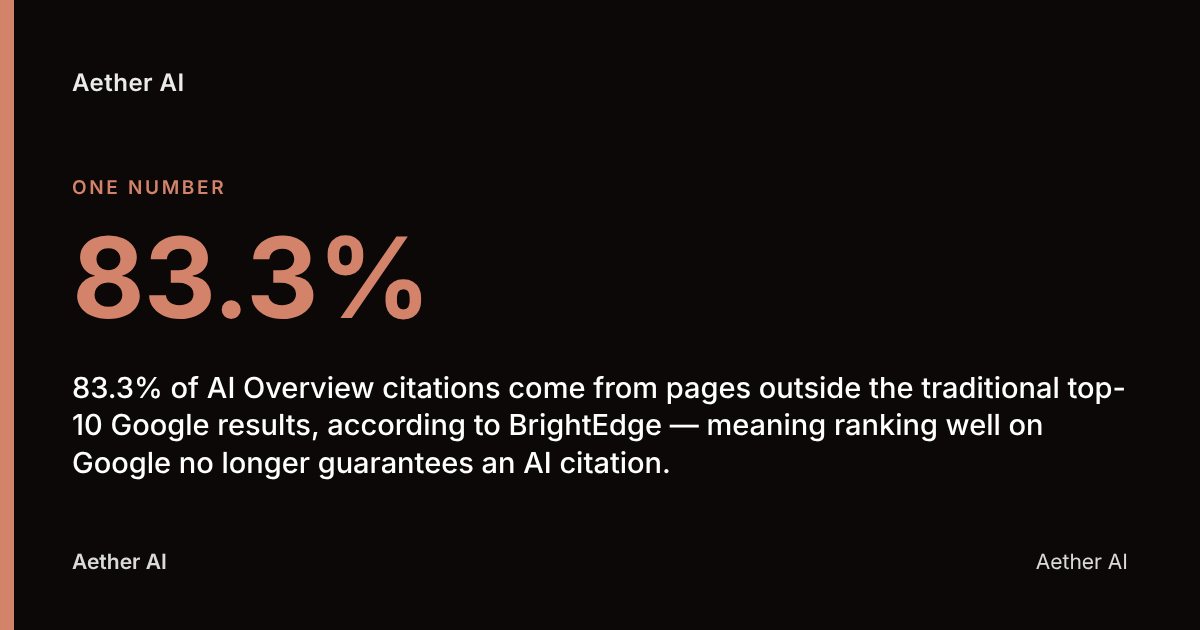
- 83.3% of AI Overview citations come from pages outside the traditional top-10 Google results, according to BrightEdge — meaning ranking well on Google no longer guarantees an AI citation.
- Across 700 live AI engine scans of four UK brands' target keywords run between July and August 2026, the brands being named in 23 answers, or 3.3% of scans, with its longest-established brand (security services) named in a notably higher share of 270 scans.
What is an AI visibility audit and what does it actually check?
An AI visibility audit is a diagnostic process that tests whether a business appears, is named accurately, or is cited as a source when generative AI tools answer questions relevant to that business's market. Unlike a Google ranking check, it doesn't measure position in a list — it measures presence and accuracy inside a generated answer.
A proper audit typically runs the same prompt across multiple engines — ChatGPT, Perplexity, Google AI Overviews, Claude, Gemini and Microsoft Copilot — because each pulls from different sources and training data, so a brand can appear in one and vanish from another. It then records whether the brand is mentioned at all, whether it's named correctly, whether competitors appear instead, and which web pages the AI cited as its evidence.
This matters because a brand's own website accounts for only 5 to 10% of the sources AI search platforms reference, according to the McKinsey AI Discovery Survey, cited by MarTech. Most of what an AI engine says about a business comes from third-party pages — review sites, directories, news coverage, forums and comparison articles — not the company's own copy. An audit surfaces exactly which of those external sources are driving (or blocking) a mention.
The practice sits under the umbrella term GEO (Generative Engine Optimization) — the discipline of structuring content so AI systems can find, understand and cite it, in the same way SEO (Search Engine Optimization) was built around Google's ranking algorithm. GEO is a distinct skill set, not a rebrand of SEO, because the two systems retrieve and reward content differently.
How does an AI visibility audit differ from traditional SEO audits?
An AI visibility audit differs from a traditional SEO audit because it measures citation and mention inside a generated answer, whereas an SEO audit measures ranking position on a search results page. The two can produce opposite results for the same business — a site can sit on page one of Google and still be invisible in ChatGPT.
Traditional SEO audits focus on technical health: page speed, crawlability, backlink profile, keyword rankings and metadata. GEO audits add a layer SEO tools were never built to check: is the brand's name, pricing, or service description actually quoted back by an AI model, and from which source did it pull that answer?
The gap is structural. 83.3% of AI Overview citations come from pages beyond the traditional top-10 search results, according to BrightEdge — a page ranking eleventh or lower on Google can still be the exact page an AI engine quotes. Meanwhile, zero-click behaviour is accelerating the shift in what "visibility" even means: zero-click searches reached 69% in 2025, and when AI Overviews appear, organic click-through rates drop from 1.76% to 0.61%, a 61% decline, according to Wellows. Separately, Pew Research Center found users click a traditional search result just 8% of the time when an AI summary appears, compared with 15% when it doesn't.
| Signal checked | Traditional SEO audit | AI visibility audit |
|---|---|---|
| Primary output | Ranking position (1-10, page 1-3) | Mentioned / not mentioned in AI answer |
| Data source | Google Search Console, backlinks | Live prompts run against ChatGPT, Perplexity, Gemini, Claude, Copilot |
| What's measured | Technical SEO, keywords, domain authority | Brand mentions, citation source, accuracy of description |
| Competitor view | SERP position comparison | Who gets named instead of you, and why |
| Relevance to zero-click | Declining in isolation | Directly addresses the 69% zero-click environment |
Because only 23% of marketers currently measure AI visibility, according to eMarketer / Omnibound, most businesses are still optimising exclusively for a search behaviour that's shrinking.
What does 'free' typically include versus what's upsold in a paid version?
A free AI visibility audit typically includes a snapshot scan — a limited number of keyword prompts run once across one or two AI engines, returning a basic mention/no-mention result. Paid tiers almost always add ongoing monitoring, full six-engine coverage, competitor tracking and historical trend data.
The free tier exists to demonstrate the gap, not to manage it. A single scan tells a business whether it's currently named for, say, three or four key search phrases. It doesn't tell them whether that changed last month, whether a competitor just overtook them, or whether the citation source feeding the AI answer is stable or one-off.
What's commonly gated behind a paid plan:
- Continuous tracking — repeated scans on a schedule rather than one-off snapshots, since AI answers shift week to week as models retrain and index new content.
- Full six-engine coverage — free tiers often sample one or two engines; paid plans check ChatGPT, Perplexity, Google AI Overviews, Claude, Gemini and Copilot together.
- Competitor benchmarking — seeing exactly which rival is named instead, and on which query.
- Content remediation tools — AI-optimised article generation designed to close the specific gaps the audit identifies.
- Google Search Console (GSC) integration — cross-referencing which queries already send traffic without Google showing the brand name, a sign of untapped AI citation potential.
That last point matters more than it first appears. On two of Aether AI's own properties, Priority First and Aether Agency, between 19 July and 15 August 2026, 82.1% and 88.3% of Google Search Console clicks respectively came from queries Google does not name directly to the searcher — a strong signal of how much query volume sits in territory a basic free report would never surface.
Who offers free AI visibility audits in the UK and how do they compare?
Several UK-facing platforms now offer a free AI visibility audit, and they vary mainly in engine coverage, scan depth and what happens to the data afterwards. The market is new enough that no single standard has formed for what "free" must include, so comparing the scope matters more than comparing the badge.
Aether AI runs its free audit at aether-ai.co.uk/audit, checking brand mentions and citation patterns across the six major engines — ChatGPT, Perplexity, Google AI Overviews, Claude, Gemini and Copilot — in line with the same citation-tracking approach it uses on its own paid platform. Other providers typically fall into one of three categories: SEO agencies bundling a basic AI check into an existing audit funnel, point-solution GEO start-ups offering a narrower scan as a lead magnet, and large SEO tool vendors adding an AI visibility module to an existing suite.
The practical differences buyers should check before handing over a URL:
| What to compare | Why it matters |
|---|---|
| Number of engines scanned | A ChatGPT-only check misses Perplexity and Gemini citation differences |
| Number of keywords/prompts tested | A 3-prompt sample won't reflect real buyer query variety |
| Whether competitors are named | Context-free "you weren't mentioned" results are hard to act on |
| Turnaround time | Some return instantly; others queue reports for 24-48 hours |
| What happens after signup | Some funnel straight into a sales call; others deliver a self-serve report |
Given that the GEO market is projected to grow substantially between now and the end of the decade, expect more entrants and more variation in audit depth over the next two to three years.
What specific metrics or signals does the audit measure?
An AI visibility audit measures a defined set of signals: whether a brand is mentioned at all, how often, how accurately, which competitors appear in its place, and which source pages the AI engine cites as evidence. These signals together form what the industry loosely calls a brand's "AI visibility score".
The core metrics worth understanding:
- Mention rate — the percentage of relevant prompts in which the brand is named at all, usually expressed as a share of total scans run.
- Citation source — the specific web page or domain the AI engine references when it mentions the brand, which is often not the brand's own site.
- Accuracy of description — whether the AI correctly states the brand's services, location or pricing, or repeats outdated or wrong information.
- Competitor co-occurrence — which rival brands appear in the same answer, and in what order.
- Sentiment and framing — whether the mention is neutral, recommending, or comparative ("X is cheaper than Y").
- Query-level consistency — whether the brand appears reliably across phrasing variants of the same underlying question, since AI answers can change based on small wording shifts.
To put real numbers against this: across 700 live AI engine scans of four UK brands' target keywords run in July–August 2026, those brands being named in 23 answers — 3.3% overall, rising notably higher for its longest-established brand, security services provider Priority First, across 270 scans (BrightEdge). That gap between the newest and most established brand in the same measurement window illustrates how much mention rate depends on accumulated third-party citation signal, not just content volume.
"Start by seeing yourself the way the machines do. Run an audit of the questions that matter in your market and note who gets named instead of you. That gap list is your content strategy — everything else is decoration." — Lauren Dawkins, Head of Content, Aether AI
How long does a free AI visibility audit take to run and receive results?
A free AI visibility audit typically takes anywhere from a few minutes to 24-48 hours, depending on how many engines and prompts are being scanned and whether results are generated automatically or compiled by a human reviewer. Instant, automated tools tend to run a small prompt set live; more thorough free audits that check all six major engines across several keyword variants often queue the report for same-day or next-day delivery.
The trade-off is depth versus speed. A tool returning results in under a minute is usually sampling one engine and a handful of prompts — useful as a first signal, but not a full picture. A report that takes a day typically reflects a broader scan across ChatGPT, Perplexity, Google AI Overviews, Claude, Gemini and Copilot, plus some manual quality checking of whether the AI's description of the business is accurate rather than just present.
Businesses evaluating a free audit should ask upfront how many prompts were tested and across how many engines, since that detail is a far better indicator of reliability than the turnaround time alone.
What information do I need to provide, and are there privacy concerns?
Most free AI visibility audits need only a business website URL and a work email address to run — no login credentials, financial data or customer records are required. Some tools additionally ask for target keywords or competitor names to tailor the prompt set, but this is optional context rather than a technical requirement.
Because the audit works by running public prompts against publicly available AI engines and checking public web citations, it doesn't need backend access to a company's website, CRM or analytics platform. That's a meaningful difference from a technical SEO audit, which often benefits from Google Search Console or Google Analytics access to see real query data.
Before submitting a URL to any free audit tool, it's worth checking:
- Whether the provider states what it does with the submitted URL and email (sold to third parties, used for remarketing, or kept solely to deliver the report).
- Whether the tool is UK-aware — the UK's Information Commissioner's Office (ICO) sets expectations under the UK GDPR for how any personal data collected (such as a work email) must be stored and used.
- Whether results are stored and reused, or generated fresh and discarded after delivery.
None of this requires sharing commercially sensitive information — a company name and domain are already public, and the AI engines being queried are themselves public tools.
What should I do after receiving the audit, and who should own it?
Acting on an AI visibility audit means someone in the business — typically the marketing lead, SEO manager or founder in smaller companies — needs to own both the gap analysis and the follow-up content plan. Without a named owner, audit results tend to sit in an inbox as a curiosity rather than driving any change.
The common mistake is treating a single scan as a verdict rather than a starting measurement. A mention rate of 3-6%, as seen across Aether AI's own four-brand baseline, isn't a failing grade — AI visibility accumulates slowly, through consistent third-party citation over months, not a single content push. Reading a one-off free audit as proof that "AI visibility doesn't work for us" is a common misinterpretation; the more useful question is which specific queries the brand lost, and to whom.
A sensible next-step sequence:
- Identify the highest-value queries where a competitor was named but the business wasn't.
- Check the citation source the AI used for that competitor — often a comparison page, review site or industry directory, not the competitor's own homepage.
- Publish content that directly answers those exact queries, structured so an AI engine can extract a clean answer (clear definitions, named facts, scannable headings).
- Re-run the audit on a schedule — monthly or quarterly — since AI answers shift as models retrain and new content gets indexed.
- Track GSC data alongside the audit to spot "invisible" query volume Google already sends but doesn't name, a strong early indicator of AI citation opportunity.
Your free AI visibility audit checklist
- Confirm which AI engines the audit actually scans (ChatGPT, Perplexity, Google AI Overviews, Claude, Gemini, Copilot).
- Ask how many prompts or keywords were tested, not just how many engines.
- Check whether competitor mentions are shown alongside your own results.
- Note which pages the AI engine cited as its source for any competitor mention.
- Assign one named owner inside the business to action the findings.
- Cross-check audit findings against Google Search Console query data for hidden overlap.
- Schedule a repeat audit in 60-90 days rather than treating one scan as final.
- Verify the provider's data handling before submitting a work email, especially under UK GDPR expectations set by the ICO.
FAQ
What is a free AI visibility audit?
A free AI visibility audit is a no-cost scan that checks whether a business is mentioned, cited or recommended by AI tools like ChatGPT, Perplexity and Google AI Overviews when people search for relevant products or services. It typically covers a limited number of keywords and one or two engines in its free form.
Is a free AI visibility audit really free, with no hidden costs?
Yes, the initial scan itself is genuinely free, but most providers use it as a lead-generation step towards a paid plan covering ongoing monitoring, all six major engines, and competitor tracking. There's no obligation to upgrade after receiving the free report.
How is an AI visibility audit different from a traditional SEO audit?
An AI visibility audit measures whether a brand is named inside a generated AI answer, while a traditional SEO audit measures ranking position on a search results page. A business can rank highly on Google and still be completely absent from ChatGPT or Perplexity answers, since 83.3% of AI Overview citations come from pages beyond the traditional top-10 results, according to BrightEdge.
Which AI platforms does an AI visibility audit check?
A thorough audit checks ChatGPT, Perplexity, Google AI Overviews, Claude, Gemini and Microsoft Copilot, since each engine pulls from different data and can produce different results for the same brand. Free tools often sample only one or two of these engines, so it's worth confirming coverage before relying on the results.
Why does my business rank well on Google but not appear in AI search results?
This happens because AI engines draw most of their answers from third-party sources rather than a brand's own website — a brand's own site supplies only 5 to 10% of the sources AI platforms reference, according to the McKinsey AI Discovery Survey, cited by MarTech. Good Google rankings don't guarantee the third-party citations AI models actually rely on.
How often should I run an AI visibility audit?
Running an audit every one to three months is a reasonable starting cadence, since AI answers shift as models retrain and new web content gets indexed. A single one-off audit only captures a snapshot and won't reveal whether visibility is improving, declining or volatile.
What is GEO and why does it matter for AI visibility?
GEO, or Generative Engine Optimization, is the practice of structuring content so AI systems can find, understand and cite it accurately, in the same way SEO targets traditional search rankings. It matters because 50% of consumers now intentionally use AI-powered search tools, with 44% treating AI search as their primary source for buying decisions, according to the McKinsey AI Discovery Survey.
Seeing your brand the way AI engines see it, with Aether AI
This article has covered what a free AI visibility audit checks, how it differs from traditional SEO, and why most brands are flying blind on it — which is exactly the gap Aether AI's own free audit at aether-ai.co.uk/audit is built to close. The platform checks brand mentions and citation sources across the same six engines discussed throughout this piece: ChatGPT, Perplexity, Google AI Overviews, Claude, Gemini and Copilot.
Aether AI doesn't just run the audit — it dogfoods the same engine on its own operations. Across 700 live scans of its four brands' target keywords in July and August 2026, Aether AI recorded those brands being named in 23 answers, with its most established brand reaching a notably higher mention rate, giving a transparent, first-hand benchmark for what realistic early-stage AI visibility actually looks like.
If the gap between where your business ranks on Google and where it's actually named by AI engines is still unclear, run the free audit at aether-ai.co.uk/audit and see the citation gaps for yourself, or check aether-ai.co.uk/pricing for what ongoing tracking and content remediation look like once the gaps are identified.