Last updated: 25 October 2026
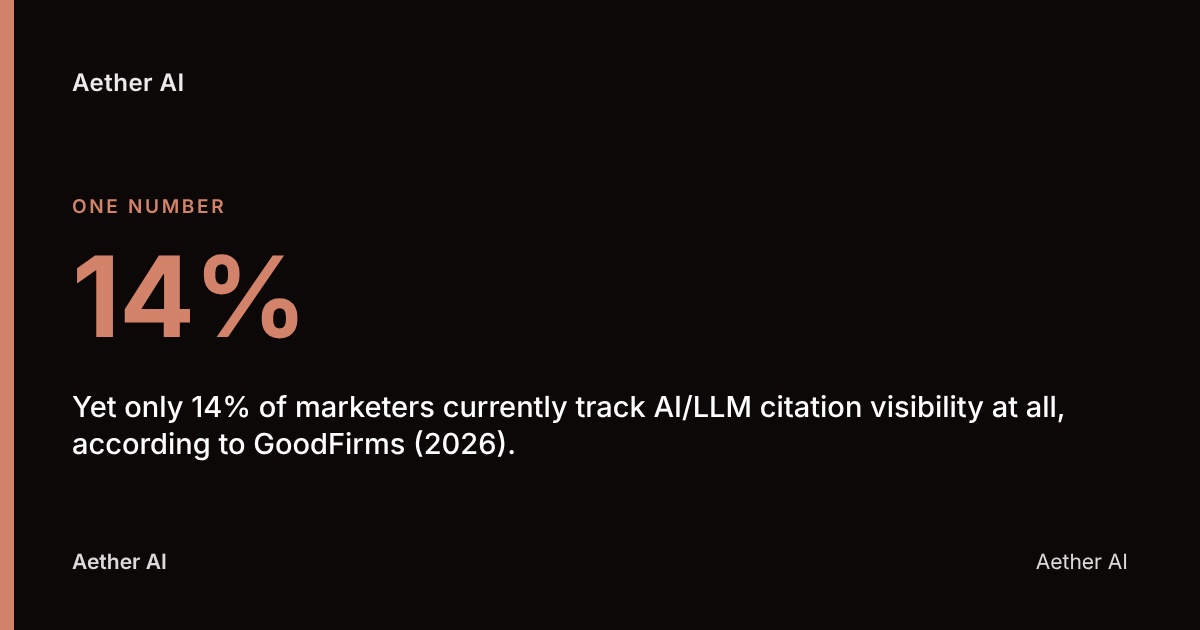
Brands track AI search visibility by combining first-party reporting (Google Search Console's Generative AI performance reports, Bing Webmaster Tools' Citation Share), manual prompt testing across ChatGPT, Perplexity, Gemini and Copilot, and dedicated GEO platforms that log citations over time. Yet only 14% of marketers currently track AI/LLM citation visibility at all, according to GoodFirms (2026).
Key Takeaways
- Only 14% of marketers track AI/LLM citation visibility, despite 43% naming AI optimisation a core 2026 strategy, according to GoodFirms (2026).
- Google rolled out Generative AI performance reports inside Search Console to all websites worldwide by 31 August 2026, giving every UK site owner a free first-party view of AI Overview impressions, according to DEV Community (2026).
- Bing Webmaster Tools' Citation Share metric, launched 16 June 2026, measures the percentage of citations a site receives out of all citations shown for a given grounding query, according to Supermetrics (2026).
- 89% of brands appear in Google AI Overviews for their target queries, but appearing is not the same as being cited by name, according to GoodFirms (2026).
- Across 700 live AI engine scans of four UK brands' target keywords run July–August 2026, the brands were named in just 23 answers (3.3%), with the longest-established brand named in 6.3% of its 270 scans, according to Aether AI's measured AI-visibility baseline.
What is AI search visibility and how does it differ from SEO rankings?
AI search visibility is the measurable frequency with which a generative engine — ChatGPT, Google AI Overviews, Perplexity, Microsoft Copilot or Gemini — names, cites or links to a specific brand when answering a user's question. Traditional SEO ranking, by contrast, is a position (1st, 4th, 11th) on a static results page for a typed keyword.
The distinction matters because an AI answer has no fixed "position one". A large language model synthesises a single response from multiple sources, and a brand either appears somewhere inside that synthesis or it doesn't. There's no page two to climb to.
This is also why click behaviour has shifted. Pew Research Center's 2025 analysis found users clicked a traditional result in just 8% of visits where an AI Overview appeared, versus 15% without one — and only 1% clicked a link inside the AI summary itself. Visibility, in other words, increasingly means being mentioned, not being clicked.
Rand Fishkin, founder of SparkToro, has been blunt about the limits of any tool claiming otherwise: "any tool that gives a 'ranking position in AI' is full of baloney" — because generative answers simply don't have fixed, repeatable positions the way a Google SERP does.
A related concept, "Share of Model," has emerged to describe a brand's percentage presence across repeated prompt runs — distinct from the keyword-based "Share of Voice" SEO teams have used for years.
Which AI platforms should UK brands monitor for citation tracking?
UK brands tracking AI search visibility should monitor five platforms at minimum: Google AI Overviews and Google's AI Mode, OpenAI's ChatGPT, Perplexity, Microsoft Copilot (built on Bing's index), and Google's standalone Gemini app. Each draws on a different underlying index and retrieval method, so a brand can be strongly cited in one and invisible in another.
Google AI Overviews sits directly inside standard Google search results and reaches the widest UK audience by volume. Perplexity behaves more like a citation-first research assistant and tends to link sources more explicitly. ChatGPT's web-browsing mode pulls from Bing's index when it searches live, while Copilot is built natively on that same Bing infrastructure — which is why Bing Webmaster Tools' citation data (see below) is relevant to both. Gemini draws on Google's own index and knowledge graph.
Monitoring across all five, rather than just one, is the only way to build an accurate picture — 89% of brands appear in Google AI Overviews for their target queries, according to GoodFirms (2026), but that figure says nothing about Perplexity or Copilot performance, which can differ sharply. Aether AI's own platform tracks citations across six engines — ChatGPT, Perplexity, Google AI Overviews, Claude, Gemini and Copilot — for this exact reason: a single-platform view routinely misreads a brand's real position.
What tools track brand mentions in AI search results, and what's free?
Specialist GEO (generative engine optimisation) tools and two major first-party dashboards now exist to track brand mentions inside AI-generated answers. The free, official starting points are Google Search Console and Bing Webmaster Tools; paid GEO platforms add cross-engine monitoring, competitor benchmarking and sentiment analysis.
Google announced its Generative AI performance reports inside Search Console on 3 June 2026, rolling them out to every website worldwide by 31 August 2026, according to DEV Community (2026). This gives any UK business, at no cost, impression data for how its URLs surface in AI Overviews and AI Mode.
Bing Webmaster Tools went further with its Citation Share metric, launched 16 June 2026, which Supermetrics (2026) describes as "the percentage of citations attributed to a site out of all citations shown for a grounding query." Microsoft's Fabrice Canel confirmed the feature publicly: "We just dropped the AI Performance report into public preview in Bing Webmaster Tools."
Beyond the free dashboards, third-party GEO platforms compete on depth of competitor tracking and citation-pattern analysis. SE Ranking's review of the Overthink Group's 20-task benchmark found Semrush's Scrunch AI scored 4.1/5 on segmentation architecture and 4.4/5 on parameter definition, ranking second overall of seven tools tested. Ahrefs Brand Radar offers a comparable competitor-benchmarking view for teams already inside the Ahrefs ecosystem.
Comparison: free first-party reports vs paid GEO platforms
| Feature | Google Search Console (free) | Bing Webmaster Tools (free) | Paid GEO platform (e.g. Aether AI) |
|---|---|---|---|
| Covers | Google AI Overviews, AI Mode | Copilot, Bing AI | ChatGPT, Perplexity, Google AI Overviews, Claude, Gemini, Copilot |
| Core metric | URL impressions in AI surfaces | Citation Share % | Citation frequency, share of voice, sentiment, competitor comparison |
| Cost | Free | Free | Varies by plan — see provider pricing page |
| Competitor view | No | Limited (Compare feature) | Yes, built-in |
| Prompt-level detail | No | No | Yes, typically |
What metrics show strong AI search visibility — and which tracking mistakes undermine them?
Citation frequency, share of voice across prompts, sentiment of the mention and link-inclusion rate are the four metrics that together indicate genuine AI search visibility strength. Citation frequency alone is a weak signal: a brand can be named by an AI engine with no link at all, which traditional backlink-focused SEO metrics never capture.
Sentiment matters because an AI engine can mention a brand unfavourably — listing it as an option a reader should avoid — and a naive "mention count" metric would record that as a positive data point. Share of voice compares how often a brand appears relative to named competitors across the same set of prompts, closer to the "Share of Model" concept than to keyword-based SEO share of voice.
A September 2026 study by SourceRank AI illustrates how misleading raw citation counts can be: review directories like G2 and Capterra appeared in only 6 of 500 AI-generated answers across five major engines — roughly 0.5% of the 1,969 total links cited. A brand chasing directory-style citations alone is chasing a channel AI engines rarely use.
The most common mistake UK brands make is treating a single ChatGPT query as a representative sample. Generative answers vary between runs, so one prompt, run once, tells you almost nothing — a second common mistake is assuming "appearing in Google AI Overviews" and "being cited in ChatGPT" are the same achievement, when the underlying data sources differ entirely.
As Aether AI's Head of Content, Lauren Dawkins, puts it: "A keyword is what someone types into a search box; a prompt is what they actually want, in a full sentence. Tracking prompts forces you to confront the real question set in your market — and most brands discover the questions they answer well are not the ones being asked."
How do you manually check AI search visibility without paid tools?
Manual AI search visibility checks involve running the same set of realistic customer prompts — not keywords — across ChatGPT, Perplexity, Copilot and Gemini, repeating each one three to five times, and logging whether the brand is named, linked, and in what context. This costs nothing beyond staff time and is a reasonable starting point for a smaller UK business.
A practical manual process looks like this:
- Draft 10-15 realistic prompts a prospective customer might type — full sentences, not keywords (e.g. "which security companies in Manchester offer 24/7 static guarding?" rather than "security company Manchester").
- Run each prompt three to five times per engine, in a fresh/incognito session where possible, since results vary run to run.
- Log the result: was the brand named, linked, both, or absent? Was it in a favourable or neutral context?
- Note competitors named in the same answer — this builds a rough share-of-voice picture without any paid tool.
- Repeat weekly or fortnightly and track the trend, not a single snapshot.
The limitation is scale: manual checking does not capture the volume of prompts a paid GEO platform runs automatically, and it's easy to introduce bias by only testing prompts you expect to do well on. It remains a legitimate low-cost entry point, and many UK marketing teams run it alongside the free Google Search Console and Bing Webmaster Tools reports before investing in a dedicated platform.
Who should own AI search visibility tracking inside a UK company?
AI search visibility tracking sits most naturally with the SEO or digital marketing team, because the underlying skill set — keyword and prompt research, content structure, technical measurement — overlaps directly with existing SEO responsibilities. PR and communications teams should be looped in for sentiment monitoring, since an AI engine's tone towards a brand is a reputational signal as much as a search one.
In practice, UK businesses are under-resourcing this entirely: just 14% of marketers track AI/LLM citation visibility, compared with 70% using Google Search Console, 65% using tools like Semrush or Ahrefs, and only 11% tracking branded search or share of voice, according to GoodFirms (2026). That gap between stated priority (43% call AI optimisation a core 2026 strategy) and actual tracking (14%) is the single clearest sign that ownership is currently unclear in most organisations.
For smaller UK businesses, the realistic answer is often "the same person who owns SEO, with a monthly reporting slot on the marketing agenda" rather than a dedicated hire — a standalone AI-visibility role is a decision larger organisations will reach once tracking data justifies the headcount.
Your AI search visibility tracking checklist
- Set up Google Search Console's Generative AI performance report on every property you own.
- Register with Bing Webmaster Tools and review the Citation Share metric monthly.
- Draft 10-15 realistic customer prompts covering your core products or services.
- Run each prompt across ChatGPT, Perplexity, Copilot and Gemini, repeating three to five times per platform.
- Log citation presence, link inclusion, sentiment and competitor mentions in a shared tracker.
- Assign ownership to a named person or team and put results on a recurring reporting cadence.
- Benchmark your current citation rate before investing in content changes, so you can measure movement.
- Review and adjust tracked prompts quarterly as your market's actual questions evolve.
FAQ
How often should AI search visibility be checked?
AI search visibility should be checked at least monthly, with manual prompt spot-checks weekly or fortnightly for fast-moving sectors. Generative engines update their underlying models and retrieval behaviour frequently, so a single quarterly check will miss meaningful swings in citation frequency.
Can a brand track AI search visibility for free?
Yes — Google Search Console's Generative AI performance reports and Bing Webmaster Tools' Citation Share are both free and rolled out to all websites, according to DEV Community (2026) and Supermetrics (2026) respectively. Manual prompt testing across ChatGPT, Perplexity and Gemini is also free, though time-intensive.
Why does a brand get mentioned by AI but not cited with a link?
Generative AI engines frequently synthesise information from a source without including a clickable link, particularly when summarising general knowledge rather than quoting a specific figure or quote. This is why citation frequency and link-inclusion rate must be tracked as two separate metrics, not one.
What is the difference between Share of Voice and Share of Model?
Share of Voice traditionally measures a brand's presence across keyword rankings or paid search; Share of Model measures a brand's percentage presence across repeated AI prompt runs relative to named competitors, as described via CDP's glossary (2026). The two metrics track related but distinct phenomena and shouldn't be used interchangeably.
Are there UK data privacy considerations when using AI monitoring tools?
Any AI visibility tool that stores customer-identifiable data, scrapes personal information, or processes UK user queries should be assessed against UK GDPR and the Information Commissioner's Office (ICO) guidance before adoption. Most brand-level AI citation tracking involves only public AI outputs and competitor names, which carries minimal personal-data risk, but procurement teams should still confirm a vendor's data-processing terms.
What's the single biggest mistake brands make measuring AI visibility?
Treating one AI query, run once, as representative of overall visibility is the most common error, since generative answers vary between runs on the same prompt. A second frequent mistake is tracking only Google AI Overviews while ignoring ChatGPT, Perplexity and Copilot, each of which draws on different indexes and can produce very different results for the same brand.
How much does AI search visibility tracking cost for a UK business?
Costs range from zero — using Google Search Console and Bing Webmaster Tools' free reports plus manual prompt testing — through to paid monthly subscriptions for dedicated GEO platforms, which vary by provider and feature set. Businesses should check each provider's published pricing page directly, since rates and tiers change frequently.
Tracking your brand's AI citations with Aether AI
Most of this article describes a tracking problem UK brands are only just starting to confront: AI engines decide, prompt by prompt, whether to name a business at all, and the free dashboards from Google and Bing only show part of that picture. Aether AI was built specifically to close that gap — tracking citations across six AI engines (ChatGPT, Perplexity, Google AI Overviews, Claude, Gemini and Copilot) in one place, rather than forcing a marketing team to check each platform manually.
Aether AI's own measured baseline shows exactly how rare citations currently are: across 700 live AI engine scans of four UK brands' target keywords in July–August 2026, those brands were named in just 23 answers — 3.3% — with the most established brand reaching 6.3% across its 270 scans. That data is published in full at aether-ai.co.uk/insights/ai-visibility-baseline-2026.
If you want to see where your own brand currently stands, Aether AI offers a free AI-visibility audit at /audit, alongside public pricing for ongoing citation tracking, keyword and competitor monitoring, and Google Search Console integration.