Last updated: 31 October 2026
Making a page quotable by AI means writing and structuring content so that ChatGPT, Google AI Overviews, Perplexity, Claude, Gemini and Microsoft Copilot can lift a specific sentence or passage and cite it directly in an answer. Research from Princeton, Georgia Tech, the Allen Institute for AI and IIT Delhi found that quotation and statistics-led techniques can lift visibility in generative engines by up to 40% (GEO: Generative Engine Optimization, KDD 2024).
Key Takeaways
- An analysis of 18,012 ChatGPT citations found that 44% came from the first 30% of the source text, meaning the opening of a page carries the most citation weight (Sekoia, 2026).
- Statistics Addition improved AI visibility by up to 37% on the metrics measured in the Princeton-led GEO study, more than most other content tactics tested (GEO: Generative Engine Optimization, KDD 2024).
- Google Search Central states there are no additional technical requirements to appear as a supporting link in AI Overviews or AI Mode beyond being indexed and snippet-eligible, which contradicts the idea that heavy schema alone guarantees citation (Google Search Central, 2025).
- Earned media accounts for 84% of all links cited by AI engines, while paid and advertorial content accounts for just 0.3%, so genuine third-party coverage outweighs sponsored placement (Muck Rack, "What Is AI Reading?", 2026).
- Aether AI's own measured baseline found four UK brands named in just 3.3% of 700 live AI engine scans run in July–August 2026, illustrating how rare citation still is even for active, optimised sites (Aether AI, aether-ai.co.uk/insights/ai-visibility-baseline-2026).
What Does It Mean for a Page to Be 'Quotable' by AI?
A quotable page is one whose sentences are specific, self-contained and verifiable enough that a generative engine can extract them verbatim, or close to it, and present them as a direct answer with an attributed link. This is different from ranking in a traditional Google search results page, where a user clicks through to read the whole page; with AI answers, the engine often extracts a single sentence or short passage and the user may never visit the site at all.
Quotability depends on structure as much as substance. A sentence buried in the middle of a long paragraph, hedged with qualifiers, is far harder to lift than a short, declarative claim that names its subject directly. The Princeton-led study behind Generative Engine Optimization (GEO) — the practice of structuring and writing content so large language models select and cite it, the AI-era counterpart to traditional SEO — tested nine distinct content interventions and found that Cite Sources and Statistics Addition produced improvements of up to 9% and 37% respectively on the two metrics measured (GEO: Generative Engine Optimization, KDD 2024).
In practice, that means a page becomes quotable when it answers a question in one clean sentence near the top, backs that claim with a named figure or source, and repeats the pattern consistently through every section rather than saving the strongest material for a conclusion.
What On-Page Structures Make Text Easiest for AI to Extract?
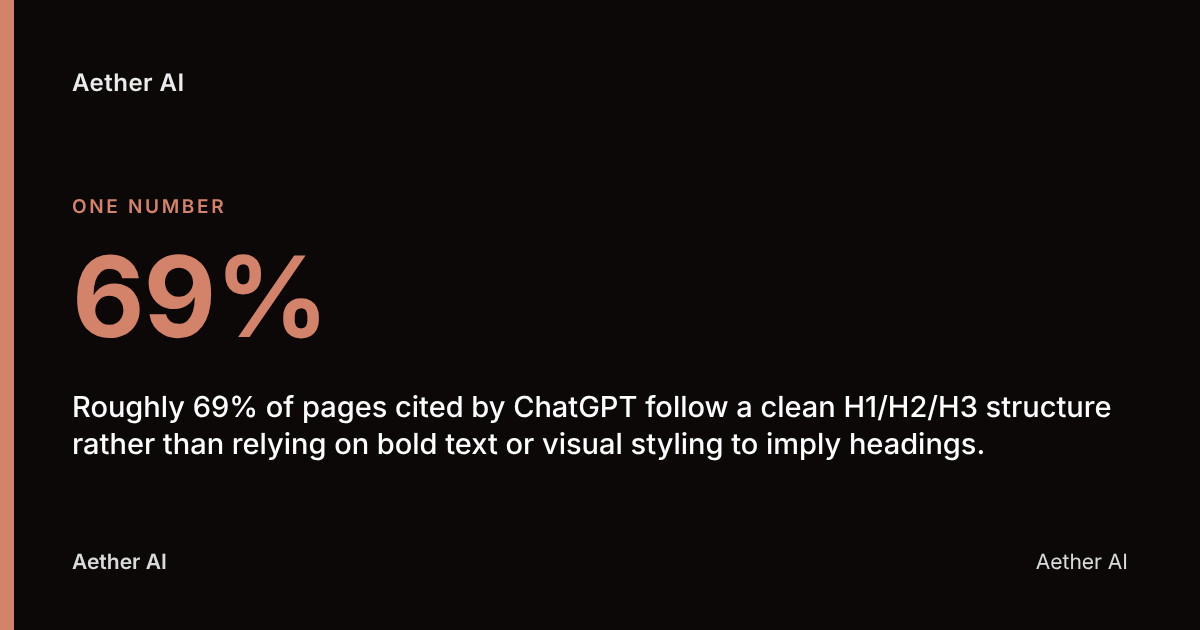
Clear headings, a direct opening answer, and short declarative sentences make text easiest for an AI engine to parse and extract, because retrieval systems use heading hierarchy to decide where a quotable passage begins and ends. Roughly 69% of pages cited by ChatGPT follow a clean H1/H2/H3 structure rather than relying on bold text or visual styling to imply headings.
The most effective pattern mirrors how a journalist writes a news intro: state the answer first, then explain. Every section should open with its conclusion in the first one or two sentences, not build up to it. This matters because 44% of ChatGPT citations in a sample of 18,012 came from the first 30% of the source article, confirming that engines disproportionately draw from the opening of a page rather than scanning evenly to the end (Sekoia, 2026).
Practical structures that help include:
- A Quick Answer paragraph of 40-60 words immediately under the headline.
- A bulleted Key Takeaways block, since engines can lift a single bullet cleanly out of context.
- Q&A-formatted sections, where the H2 is phrased as a question and the first sentence directly answers it.
- Comparison tables for any content involving options, costs or trade-offs, since tabular data is extracted almost verbatim into AI answers and Google's featured snippets alike.
How Should Facts and Statistics Be Presented So AI Quotes Them Accurately?
Facts and statistics should be written as single-clause, subject-first sentences that name the figure, the source and the year in the same breath, because this is the format large language models extract most reliably without distortion. A sentence like "The HSE recorded X incidents in 2024" is easier to lift intact than a sentence burying the same fact inside a subordinate clause.
Content with verifiable statistics and named citations achieves 30-40% higher AI visibility than unoptimised content, according to the Princeton-led research summarised by Similarweb AI Search (2026). The mechanism is straightforward: an engine generating an answer needs to attribute claims, and a sentence that already contains a clear attribution gives it less work to do and less risk of misquoting.
To reduce the risk of inaccurate paraphrasing:
- Attribute every statistic to a named organisation in the same sentence as the figure.
- Avoid rounding or restating numbers differently across the same page — consistency prevents an engine from merging two versions into a wrong one.
- Keep the figure and its context (what it measures, over what period) in the same sentence rather than splitting them across a paragraph.
- Use the organisation's own terminology for its study or report, rather than a paraphrase, so the citation chain stays traceable back to source.
This approach also protects a business from a quieter risk: if AI tools frequently misquote a company's own data, the error can propagate across multiple engines before anyone notices.
What Technical Elements Help AI Crawlers Understand a Page?
Technical SEO elements such as clean HTML, valid structured data and unblocked crawler access help AI systems parse a page, but Google has been explicit that none of this is a prerequisite for citation. Google Search Central states there are no additional technical requirements to appear as a supporting link in AI Overviews or AI Mode beyond being indexed and snippet-eligible (Google Search Central, 2025). In Google's own words: "There are no additional requirements to appear in AI Overviews or AI Mode, nor other special optimizations necessary."
That said, schema markup is not worthless — it is simply not a guarantee. The data on FAQ schema specifically is mixed and worth stating plainly, because many GEO vendors oversell it:
| Metric | Pages WITH FAQ schema | Pages WITHOUT FAQ schema | Source |
|---|---|---|---|
| Average ChatGPT citations | 3.6 | 4.2 | SE Ranking, 2025 |
| Average AI Mode citations | 4.9 | 4.4 | SE Ranking, 2025 |
In other words, FAQ schema correlated with fewer citations in ChatGPT but more in Google's AI Mode in the same dataset. The sensible conclusion is that structured data helps engines understand a page's intent but does not substitute for well-written, genuinely answer-first content underneath it.
Beyond schema, the fundamentals still matter: confirm GPTBot, ClaudeBot and Google-Extended are not blocked in robots.txt, avoid locking core content behind JavaScript rendering that crawlers may not execute, and ensure pages are not sitting behind a paywall or login wall if the intent is to be cited publicly.
Does Page Freshness or Clear Authorship Affect AI Trust?
Clear authorship and regular content updates both function as trust signals that influence whether an AI engine treats a page as a reliable source, even though neither is a formal ranking requirement. An "About the author" section with a named individual, a stated role and visible credentials gives an engine (and a human fact-checker) a traceable reason to treat a claim as credible rather than anonymous.
Freshness works similarly. A page last substantively updated several years ago, still citing outdated figures, is less likely to be selected when an engine has access to a more recently updated competitor making the same point with current data. This is particularly relevant in fast-moving regulatory or technical fields — UK data protection guidance from the Information Commissioner's Office (ICO), for instance, is updated periodically, and a page quoting superseded ICO guidance risks being quietly dropped from citation as newer pages supersede it.
Neither authorship nor freshness operates alone — they compound with the earned-media signal. Earned media accounts for 84% of all links cited by AI engines, while paid and advertorial content accounts for just 0.3% (Muck Rack, "What Is AI Reading?", 2026). A named author whose work is independently cited by other publications builds exactly the kind of earned authority this data describes; a sponsored post rarely does, regardless of how well it is schema-marked.
Optimising for Google Rankings vs Optimising for AI Answers
Optimising for traditional Google rankings and optimising for AI-generated answers are related but distinct disciplines, because a page can rank well in classic search results while never being selected as a citation inside an AI Overview, Perplexity answer or ChatGPT response — and vice versa. Traditional SEO optimises for a click: a compelling title, a strong meta description and enough on-page depth to keep a visitor reading. GEO optimises for extraction: a single passage good enough to be lifted and attributed without the user ever landing on the page.
| Factor | Traditional SEO | Technical GEO |
|---|---|---|
| Primary goal | Rank in the organic results, earn the click | Be selected and quoted inside the AI-generated answer |
| Content unit | Whole page / whole article | Individual sentence or short passage |
| Success signal | Click-through rate, ranking position | Citation frequency, Share of Model |
| Best format | Long-form, keyword-optimised | Answer-first, self-contained claims |
| Technical requirement | Core Web Vitals, mobile usability | Crawler access for GPTBot/ClaudeBot, clean structure |
This distinction has a measurable cost for UK businesses already: on two of the founding team's own properties, Priority First and Aether Agency, 82.1% and 88.3% respectively of Google Search Console clicks between 19 July and 15 August 2026 came from queries Google does not name — the "not provided" phenomenon extended into the AI era, where it becomes harder still to see which queries triggered an AI citation. This is precisely the visibility gap that dedicated citation tracking across multiple engines is designed to close, rather than relying on GSC data alone.
Your Page-Quotability Checklist
- Open the page with a 40-60 word Quick Answer that names the subject and includes one concrete figure.
- Add a Key Takeaways bullet block directly beneath the opening, written as standalone sentences.
- Structure every H2 as a direct answer to a real question, with the answer in the first two sentences.
- Attribute every statistic to a named source, in the same sentence as the figure, with a working hyperlink.
- Confirm
robots.txtdoes not block GPTBot, ClaudeBot or Google-Extended. - Render core content server-side rather than relying solely on client-side JavaScript.
- Add a named author bio with a stated role and credentials.
- Pursue earned coverage and third-party mentions rather than paid placements, given the 84% earned-media share reported by Muck Rack (Muck Rack, "What Is AI Reading?").
FAQ
How do I make my content quotable by AI?
Write a direct, self-contained answer in the first sentence of every section, attribute every statistic to a named source, and structure the page with clear H2/H3 headings so retrieval systems can identify where each claim begins and ends.
Does FAQ schema actually help get cited by AI?
The evidence is mixed: SE Ranking's 2025 data found pages with FAQ schema averaged fewer ChatGPT citations (3.6 vs 4.2) but more Google AI Mode citations (4.9 vs 4.4) than pages without it, so schema should support strong content rather than replace it.
Do I need llms.txt for AI to cite my page?
There is no official requirement for an llms.txt file, and Google Search Central has confirmed there are no special technical requirements beyond a page being indexed and snippet-eligible to appear in AI Overviews or AI Mode.
How many words should an AI-quotable answer be?
Most practitioners target 40-60 words for a standalone answer paragraph, long enough to be complete and self-contained but short enough for an engine to quote without heavy editing.
What is the difference between SEO and GEO?
Traditional SEO optimises a whole page to rank and earn a click, while Technical GEO (Generative Engine Optimization) optimises individual sentences and passages to be selected and quoted directly inside an AI-generated answer.
How can a business check whether its page is being cited by AI?
Run the target query across ChatGPT, Perplexity, Google AI Overviews, Claude, Gemini and Microsoft Copilot manually, or use a citation-tracking tool that monitors these engines continuously, since manual spot-checks can miss volatility between visits.
Who in a UK business should own AI-quotability work?
Typically the content or SEO team should implement structure and sourcing, while legal or compliance should review any statistics, named claims or third-party quotes before publication, particularly in regulated sectors.
Making your pages quotable, measurably, with Aether AI
Every principle in this guide — answer-first structure, named statistics, clean crawlability, earned authority — is only useful if a business can see whether it is actually working, and that is the gap Aether AI's platform is built to close. Rather than guessing whether a rewritten page is now being cited, Aether AI tracks citations across six AI engines (ChatGPT, Perplexity, Google AI Overviews, Claude, Gemini and Microsoft Copilot) alongside keyword and competitor tracking and GSC integration, so changes can be tied to actual citation movement rather than assumed.
Aether AI's own measured baseline — 700 live AI engine scans of four UK brands' target keywords run in July–August 2026 — found those brands named in just 23 answers, or 3.3% overall, with the longest-established brand reaching 6.3% across its 270 scans. That figure is published in full at aether-ai.co.uk/insights/ai-visibility-baseline-2026 and is deliberately shared as a realistic baseline, not a promise, because it reflects the same volatility every business faces when trying to earn AI citations.
If you want to see where your own pages currently stand, Aether AI runs a free AI-visibility audit at /audit, with public pricing available for teams ready to track and improve citation performance on an ongoing basis.