Last updated: 27 October 2026
Proving GEO ROI means pairing AI-visibility metrics (citation rate, share of AI voice) with business outcomes (branded search lift, conversions, pipeline) over a minimum one-quarter window, because standard analytics miss most AI-referred traffic. Around 70% of AI-referred visits arrive without referrer headers, landing as unattributed direct traffic, according to BrandViz (2026).
Key Takeaways
- 62% of marketing leaders say they cannot measure the ROI of their AI search optimisation efforts, yet 94% are increasing investment anyway, according to Conductor (via Arvow GEO Statistics 2026).
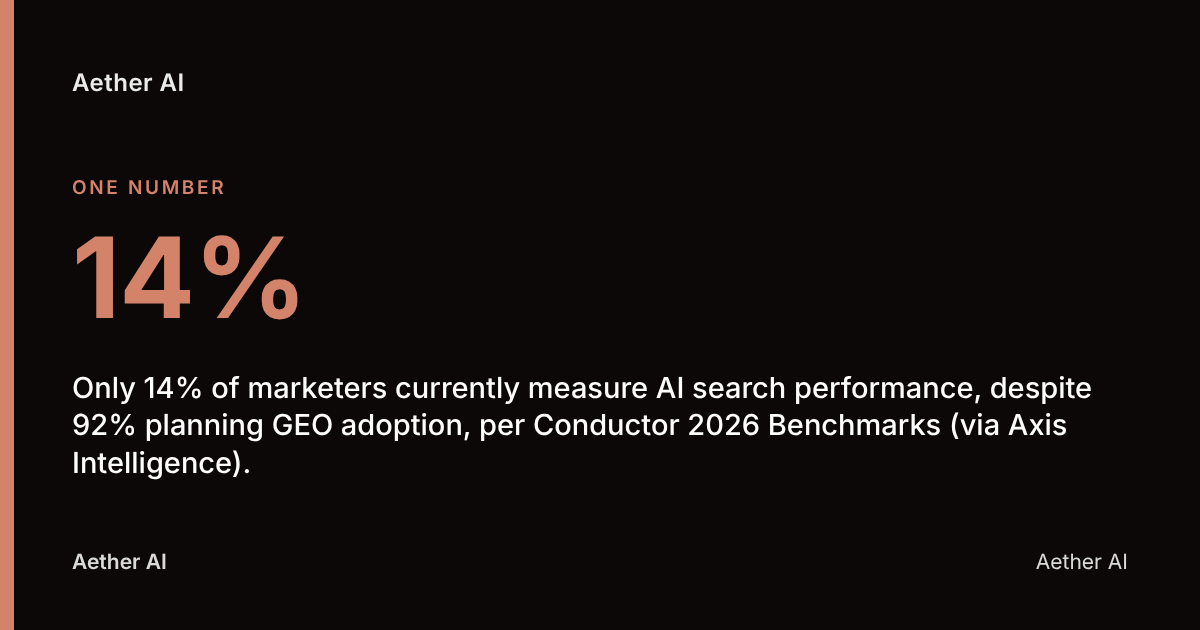
- Only 14% of marketers currently measure AI search performance, despite 92% planning GEO adoption, per Conductor 2026 Benchmarks (via Axis Intelligence).
- AI search traffic converts at 14.2% versus 2.8% for Google organic — a 5.1x conversion advantage, per Exposure Ninja (via BrandViz).
- Leading indicators such as AI citation rate typically shift within 4-12 weeks, but pipeline correlation needs at least one full quarter of tracking, per BrandViz.
- Aether AI's own scan of four UK brands found they were named in just 23 of 700 AI engine answers (3.3%) between July and August 2026 — a baseline figure, not a target, that shows how far most businesses are starting from.
What is GEO and how does it differ from traditional SEO?
Generative Engine Optimisation (GEO) is the practice of structuring content so that AI answer engines — ChatGPT, Google AI Overviews, Perplexity, Claude, Gemini and Microsoft Copilot — select and cite it when generating a direct answer, rather than merely ranking it in a list of ten blue links. Traditional SEO optimises for position on a search engine results page; GEO optimises for inclusion inside a synthesised answer where there may be no results page, no ranking position and no guaranteed click at all.
The distinction matters because the mechanics of being chosen are different. Google's algorithm ranks pages primarily on links, relevance signals and page experience. Large language models instead retrieve and synthesise passages based on how clearly a page defines its subject, how many checkable facts it contains, and how well-structured its headings are for extraction.
Academic research backs this up directly: a Princeton, Georgia Tech and IIT Delhi study found that GEO methods can boost source visibility in AI-generated answers by up to 40% on diverse queries, and up to 37% on Perplexity.ai in real-world testing, per Princeton/Georgia Tech/IIT Delhi, 'GEO: Generative Engine Optimization' (arXiv/KDD 2024). That's a measurable visibility lift from applying GEO techniques — but visibility is not the same as revenue, which is precisely where the ROI question gets difficult.
What metrics should be tracked to measure GEO performance?
GEO performance is measured through a layered metric stack that runs from leading indicators (visibility) through to lagging indicators (revenue), because no single number proves return on investment on its own. Businesses that try to report GEO success using only one metric — usually traffic — tend to undercount the value because so much AI-driven activity never shows up as a trackable click.
A practical metric stack looks like this:
- AI citation rate — the percentage of relevant AI-engine answers in which your brand, product or domain is named or linked.
- Share of AI voice — your citation rate relative to named competitors across the same query set.
- Branded search lift — the month-on-month change in branded search volume in Google Search Console, which often moves before conversions do.
- AI referral sessions — traffic in GA4 tagged with chatgpt.com, perplexity.ai, gemini.google.com or similar referrers, understood as a floor, not a ceiling.
- Assisted conversions — conversions where an AI-engine session appears anywhere in a multi-touch path, not just as the last click.
- Pipeline/revenue correlation — the relationship between rising citation rate and closed deals over a full sales cycle.
Each layer answers a different stakeholder question. Citation rate answers "are we visible?" Pipeline correlation answers "did it matter?" Skipping straight to the second without establishing the first is the most common reason GEO reporting falls apart under scrutiny — a point reinforced by the fact that 64% of marketing leaders say they are unsure how to measure AI search success, according to Yext (via Arvow GEO Statistics 2026).
How can visibility in ChatGPT, Google AI Overviews and Perplexity be tracked?
Visibility in AI tools is tracked by running a consistent set of target queries against each engine on a recurring schedule and logging whether your brand is named, linked, or absent — a method sometimes called a citation audit. This cannot be done manually at scale across ChatGPT, Google AI Overviews, Perplexity, Claude, Gemini and Microsoft Copilot, because each engine's output changes with model updates, prompt phrasing and even time of day.
Aether AI runs this process as citation tracking across six AI engines — ChatGPT, Perplexity, Google AI Overviews, Claude, Gemini and Copilot — logging where a brand is named and where it is absent, and comparing that against named competitors on the same query set.
The output is a baseline number you can defend in a board meeting. Aether AI's own measured baseline, published at aether-ai.co.uk/insights/ai-visibility-baseline-2026, ran 700 live AI engine scans of four UK brands' target keywords across July and August 2026: the brands were named in 23 answers, a citation rate of 3.3%. The longest-established of the four brands — a security and facilities business — was named in 6.3% of its 270 scans. That gap between 3.3% and 6.3% illustrates the core point of any citation audit: visibility is uneven even within the same portfolio, and the only way to know your starting position is to measure it directly, repeatedly, before claiming improvement.
What tools monitor GEO performance and attribute ROI in the UK market?
GEO monitoring tools in the UK market generally combine three functions in one dashboard: AI citation tracking, keyword and competitor tracking, and integration with existing analytics such as Google Search Console (GSC) — the free tool webmasters use to monitor organic search performance and indexing. Buying these as separate point solutions is possible but creates the exact attribution gap that makes GEO ROI hard to defend, because citation data, keyword data and conversion data end up in three systems that don't talk to each other.
Aether AI is built as a self-service platform combining automated AI-optimised article generation with citation tracking across six AI engines, keyword and competitor tracking, and native GSC integration, alongside a free AI-visibility audit available at /audit and published pricing rather than a sales-quote model.
| Capability | What it answers | Where it typically lives |
|---|---|---|
| AI citation tracking (6 engines) | Are we named in ChatGPT, Perplexity, Google AI Overviews, Claude, Gemini, Copilot? | Aether AI dashboard |
| Keyword & competitor tracking | Where do we rank versus named rivals? | Aether AI dashboard |
| GSC integration | How is organic click and impression data trending? | Google Search Console, pulled into Aether AI |
| Article generation | Are we publishing content structured for citation? | Aether AI automated publishing |
| Conversion attribution | Did an AI-referred session convert? | GA4, cross-referenced manually |
The practical lesson for UK buyers: look for a platform that unifies citation tracking with the keyword and GSC data you already rely on, rather than a standalone "AI visibility checker" that leaves you stitching spreadsheets together every month.
How should the cost side of the GEO ROI calculation be defined?
The cost side of GEO ROI must include every input that consumes budget or time, not just the obvious subscription fee, because understating cost is the fastest way to produce a ROI figure that collapses under a CFO's questions. A defensible GEO cost base typically includes:
- Platform or tool subscription — the monthly or annual fee for citation tracking, keyword tracking and article generation software.
- Agency or freelance fees — if any external party is commissioned for strategy, auditing or content beyond the platform itself.
- Internal marketing time — hours spent briefing, reviewing and publishing content, costed at an internal day rate.
- Internal IT or web development time — any schema markup, site speed or crawlability work needed to make content machine-readable.
- Opportunity cost — content or campaigns deprioritised to fund the GEO effort.
Once total cost is established over a defined period — a quarter is the practical minimum, per the timeframe evidence below — it is set against the value side: assisted conversions, pipeline influenced, and branded search lift, each given a monetary value using existing average order value or deal size data. The resulting ROI formula is simple in form (value minus cost, divided by cost) even though assembling the inputs is the hard part.
What is a realistic timeframe to see measurable GEO results?
A realistic GEO timeframe separates leading indicators from lagging indicators, because they move at different speeds and reporting them on the same clock creates false expectations. Leading indicators like AI citation rate and share of AI voice typically show meaningful movement within 4-12 weeks of implementing prioritised recommendations, while pipeline correlation requires at least one quarter of tracking, according to BrandViz.
This two-speed reality explains why 94% of marketing leaders are increasing GEO investment even though 62% cannot yet measure its ROI — per Conductor (via Arvow GEO Statistics 2026) — they are backing the leading indicators (visibility, citation) ahead of the lagging ones (revenue) catching up. For UK marketing teams reporting to a board, the practical move is to set two separate review dates: a visibility review at week 8-12, and a pipeline review at the end of the following full quarter. Reporting both on the same eight-week timeline is the single most common cause of a GEO programme being judged a failure when it has simply not had time to show commercial impact yet.
How can AI referral traffic be attributed to GEO activity in GA4?
AI referral traffic is attributed in Google Analytics 4 (GA4) by filtering the referral traffic report for known AI domains — chatgpt.com, perplexity.ai, gemini.google.com, copilot.microsoft.com and claude.ai — and tracking sessions, conversions and assisted-conversion paths from those sources specifically. This captures real signal, but it is a floor, not the full picture.
The reason it undercounts is structural: approximately 70% of AI-referred visits arrive without referrer headers, landing in direct or unattributed traffic inside standard analytics platforms, according to BrandViz. A user who asks ChatGPT for a recommendation and then types your brand name directly into their browser generates a "direct" session in GA4 with zero trace of the AI interaction that drove it.
Two cross-checks help close this gap:
- Branded search correlation — rising direct and branded search traffic that coincides with improving citation rate (tracked separately via a GEO platform) is circumstantial but real evidence of AI-driven demand.
- UTM-tagged links where possible — some AI engines do preserve outbound links; tagging owned content consistently captures what referrer data misses.
Neither replaces hard attribution, but together they let a marketing team report "AI referral sessions plus the unattributed lift we can reasonably infer from citation and branded search data" — a more honest and more defensible position than claiming false precision.
Your GEO ROI measurement checklist
- Run a baseline citation audit across all six major AI engines before changing any content.
- Record branded search volume and direct traffic in GSC and GA4 for at least eight weeks pre-GEO.
- Define the full cost base, including internal time, not just the tool subscription.
- Tag known AI referrer domains in GA4 and build a dedicated AI-traffic segment.
- Review leading indicators (citation rate, share of voice) at week 8-12.
- Review lagging indicators (pipeline, assisted conversions) only after one full quarter.
- Report both review dates separately to stakeholders, never on the same timeline.
- Re-run the citation audit on the same query set every month to track trend, not a single snapshot.
FAQ
How do you prove the ROI of GEO?
You prove GEO ROI by tracking a layered metric stack — citation rate, share of AI voice, branded search lift, AI referral sessions and assisted conversions — against a defined cost base over a minimum one-quarter window, because no single metric captures the full picture on its own.
What is AI citation rate and why does it matter for ROI?
AI citation rate is the percentage of relevant AI-engine answers in which a brand is named or linked, and it matters because it is the earliest-moving indicator in a GEO programme, typically shifting within 4-12 weeks per BrandViz, well before pipeline data can confirm commercial impact.
Why is GEO ROI harder to measure than traditional SEO ROI?
GEO ROI is harder to measure because most AI-referred visits lose their referrer data in transit — around 70% arrive unattributed, according to BrandViz — whereas traditional SEO traffic almost always retains a clean, trackable referrer in standard analytics.
How long before GEO shows measurable results?
Leading indicators such as citation rate typically move within 4-12 weeks, but pipeline correlation needs at least one full quarter of tracking before it is reliable, per BrandViz.
Does AI search traffic actually convert better than Google organic traffic?
Yes — AI search traffic converts at 14.2% compared with 2.8% for Google organic traffic, a 5.1x advantage, according to Exposure Ninja (via BrandViz), though this is measured on the traffic that can be attributed, which is itself a fraction of total AI-driven demand.
Who should be responsible for tracking GEO ROI — marketing or IT?
Marketing should own the reporting and stakeholder narrative, while IT or web development typically owns the technical groundwork — schema markup, crawlability and site structure — that makes content machine-readable for AI engines in the first place; GEO ROI fails most often when neither team is clearly assigned either role.
What baseline data should be collected before starting a GEO strategy?
Collect a citation audit across all major AI engines, branded search volume from Google Search Console, direct and referral traffic segments in GA4, and current rankings for target keywords — all gathered before any GEO work begins, so improvement can be measured against a fixed starting point rather than estimated after the fact.
Measuring GEO ROI with Aether AI
Every section above points to the same underlying problem: AI-driven visibility and revenue are real but structurally hard to see inside standard analytics, which is exactly why Aether AI was built to put citation tracking, keyword and competitor tracking, and GSC integration into one dashboard rather than three disconnected spreadsheets. Instead of guessing whether your brand is visible in ChatGPT or Google AI Overviews, you get a measured, repeatable citation rate you can report alongside your existing SEO metrics.
Aether AI's own baseline — 700 scans across four UK brands in July and August 2026, resulting in a 3.3% citation rate overall and 6.3% for its most established brand — was produced using the same platform clients use, not a separate internal tool. That is the dogfooding principle behind the product: Aether AI measures its own visibility with the same six-engine citation tracking it sells.
If you want to see where your own brand currently stands before building a GEO ROI case for your board, the free AI-visibility audit at /audit gives you a baseline citation reading in minutes, and the pricing page sets out plans for teams ready to track that number month on month.