Last updated: 27 October 2026
Ranking in ChatGPT recommendations means getting named, quoted or linked when ChatGPT answers a buyer's question — there's no ranking position to chase, only citation likelihood. It depends on third-party trust signals, structured on-site content and crawler access, not backlinks or keyword density. ChatGPT reached 800 million weekly active users by October 2025, according to MarketsandMarkets (2026), making this a genuine commercial channel.
Key Takeaways
- ChatGPT has no ranking positions — it selects a handful of sources per answer, so visibility is binary (cited or not) rather than ordinal (ranked 1 to 10).
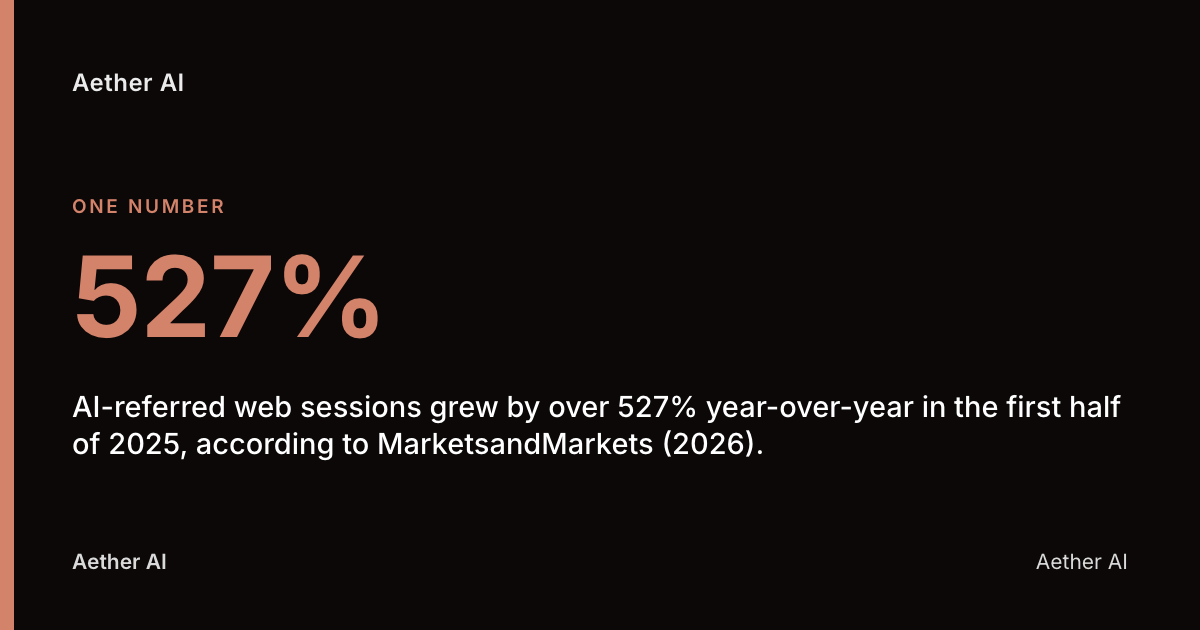
- AI-referred web sessions grew by over 527% year-over-year in the first half of 2025, according to MarketsandMarkets (2026).
- Pages with clean H1/H2/H3 heading structures are 40% more likely to be cited by ChatGPT, per an analysis of 400+ sites by Superprompt, cited by AtomicAGI (2026).
- Reddit accounts for 16.8% of ChatGPT citations, the single largest share of any domain, according to Ahrefs (2026).
- Aether AI's own baseline scan found four UK brands named in just 3.3% of 700 live AI engine scans across July–August 2026, published at aether-ai.co.uk/insights/ai-visibility-baseline-2026.
What Does It Mean to 'Rank' in ChatGPT, and How Does It Differ from Google SEO?
Ranking in ChatGPT is a misnomer borrowed from Google — ChatGPT doesn't return an ordered list of ten blue links, it synthesises an answer and selects a small number of sources to cite or reference within that answer. There is no position one, no page two, and no stable SERP to track day over day. A business either appears in the synthesised answer, gets referenced as a named option, or doesn't — it's closer to being quoted by a journalist than appearing in a directory.
Google SEO optimises for retrieval and ranking against a query; generative engine optimization (GEO) — the practice of shaping content so AI systems retrieve, summarise and cite it, as defined by Wikipedia — optimises for selection and synthesis. The original academic framing comes from Aggarwal et al. at Princeton, Georgia Tech, the Allen Institute for AI and IIT Delhi, who coined "GEO" and quantified which content tactics move the needle.
Because ChatGPT regenerates answers probabilistically, the same prompt can surface different sources on different days. That means "ranking" is really a measure of citation frequency across repeated queries, not a fixed slot.
How Does ChatGPT Decide Which Brands or Services to Mention?
ChatGPT decides which brands to mention by weighing a blend of its training data, live web retrieval via Bing-indexed results, and third-party source credibility — it doesn't consult a single ranking algorithm. When a user asks a recommendation question ("best security company in Manchester" or "what's a good facilities software tool"), ChatGPT's search layer pulls live web results and leans heavily on sources it already associates with trustworthy, well-structured answers.
Research analysing 30 million sources across major AI engines found that Peec AI, reported by Search Engine Land (2026) showed ChatGPT favouring Wikipedia, Reddit and editorial outlets like Forbes above brand-owned content. A separate dataset from Profound (2025) puts Wikipedia at 7.8% of total ChatGPT citations, with Reddit at 1.8% and Forbes at 1.1%.
The practical implication: a business rarely gets cited purely because its own website says it's "the best". ChatGPT is pattern-matching for corroboration — does an independent, recognised source say the same thing? GEO techniques such as adding direct quotations and statistics to content can lift visibility in generative engines by up to 40%, according to Princeton et al., published at KDD 2024 (2026) — because specific, checkable claims are easier for a language model to extract and reuse than vague marketing copy.
"You can't buy your way in, and that's precisely the opportunity. Assistants reward the brand whose content actually answers the question with checkable specifics. Small firms outrank giants in AI answers every day — the shelf space is earned, not rented." — Lauren Dawkins, Head of Content, Aether AI
What Role Does Bing Indexing Play in Whether ChatGPT Recommends a Business?
Bing indexing matters because ChatGPT's live search function draws on Bing-indexed web results, so a page that's invisible to Bing is effectively invisible to ChatGPT's real-time answers too. OpenAI operates its own crawlers — OAI-SearchBot for live search retrieval and GPTBot for model training data — documented in the OpenAI Developer Docs. If a site's robots.txt blocks these crawlers, it forfeits any chance of being surfaced in a ChatGPT search-grounded answer.
Many UK businesses still treat Bing Webmaster Tools as an afterthought because historic search share sat overwhelmingly with Google. That's now a visibility risk. A business should:
- Verify its domain in Bing Webmaster Tools and submit an XML sitemap.
- Check robots.txt explicitly allows
OAI-SearchBotandGPTBot(unless there's a deliberate reason to block training-data crawling specifically). - Confirm key service and pricing pages return a 200 status and aren't noindexed.
A page that ranks well on Google but has never been crawled by Bing is starting from zero in ChatGPT's retrieval layer.
How Important Are Third-Party Reviews and Citations on Trustpilot, G2 or Industry Press?
Third-party reviews are one of the strongest trust signals ChatGPT uses when deciding whether to recommend a specific business by name, because independent validation is harder to fake than on-site copy. According to SearchToSale (2025), a minimum of 15 reviews is necessary to generate trust, 50+ reviews achieve optimal credibility, and 100+ recent reviews maximise the chances of being cited for AI recommendations.
This lines up with the domain-level data: Reddit alone captures 16.8% of ChatGPT citations, more than any other single domain, according to Ahrefs (2026), with Wikipedia second at 7.0%. These are platforms built entirely on user-generated, third-party commentary — not brand-controlled pages.
| Source type | Example platforms | Why ChatGPT weights it |
|---|---|---|
| Review platforms | Trustpilot, G2, Google Reviews | Volume and recency signal real customer experience |
| Community forums | Reddit, niche UK forums | Unfiltered opinion, frequently cited as "people say…" |
| Reference sites | Wikipedia | Structured, neutral, heavily cross-linked |
| Editorial press | Forbes, trade publications, local press | Third-party fact-checking and authority |
| Brand-owned site | Company website, blog | Useful for specifics, weak alone for trust |
A UK facilities or security business with a thin Trustpilot profile and no coverage in trade press (such as Professional Security magazine or FM World) is competing on an uneven footing against rivals who've invested in both.
What On-Site Content Changes Improve Visibility in AI-Generated Answers?
On-site content improves AI visibility when it's structured, specific and answer-shaped rather than written purely for persuasion. Pages with clean H1/H2/H3 hierarchies are 40% more likely to be cited by ChatGPT than pages without them, based on an analysis of over 400 sites by Superprompt, cited by AtomicAGI (2026) — because a clear structure tells a retrieval system exactly where one idea ends and the next begins.
Practical changes that help:
- Answer the question in the first two sentences of every section — don't bury the definition three paragraphs down.
- Add a genuine FAQ section using the real questions customers ask, not invented ones.
- Use schema.org structured data (Organization, FAQPage, Product, LocalBusiness) so machine-readable facts sit alongside the prose.
- Name specific facts: licence numbers, coverage areas, certifications, named standards (BS 7858 for security screening, ISO 27001 for information security) — concrete entities are what retrieval systems extract and reuse.
- Cite your own data where you have it — original statistics are harder for competitors to replicate and stronger citation bait than generic claims.
Vague copy like "industry-leading service across the UK" gives a language model nothing to extract. "SIA-licensed officers covering Greater Manchester and the North West" gives it two checkable facts in one sentence.
Can a Business Pay for Placement in ChatGPT's Responses?
No — there is currently no advertising product that buys a business a guaranteed mention inside a standard ChatGPT answer. Unlike Google Ads, where a business can bid for a sponsored slot above organic results, ChatGPT's core conversational answers are generated from retrieval and synthesis, not an auction.
This has two UK-relevant implications. First, under the Advertising Standards Authority (ASA) and CAP Code rules, any paid AI placement product that does emerge would need clear disclosure as advertising, just as sponsored search results and influencer content do now — the same transparency principle, applied to a new surface. Second, because paid placement doesn't exist for organic ChatGPT answers today, every UK business is competing on the same organic footing: content quality, third-party trust signals, and crawler accessibility, not ad budget.
That's a genuine opportunity for smaller firms. A well-documented local security company with strong Trustpilot coverage and clean structured content can outcite a national competitor that's only invested in paid search.
How Long Does It Take to See a Change in ChatGPT Recommendations?
There's no fixed timeline, because ChatGPT's citation behaviour depends on how quickly OAI-SearchBot recrawls a site, how often a given query is asked, and how much third-party corroboration already exists. Businesses with an established review profile and existing press coverage can see citation shifts within weeks of fixing crawler access or restructuring key pages; businesses starting from zero trust signals should expect a longer build, often several months, because third-party credibility (reviews, press, forum mentions) accrues slower than on-site changes can be published.
Aether AI's own baseline measurement found four UK brands named in just 23 of 700 live AI engine scans (3.3%) run across July and August 2026, with the longest-established brand — a security services business — named in 6.3% of its 270 scans, published at aether-ai.co.uk/insights/ai-visibility-baseline-2026. That gap between an established brand and newer ones illustrates how much accumulated trust signal matters over time, rather than any single on-page fix.
Separately, Google Search Console data from two of the same brands' own properties showed that a large majority (Priority First and Aether Agency) of clicks between 19 July and 15 August 2026 came from queries Google doesn't name in its own reporting — a reminder that a large share of AI-era discovery already happens in the gaps traditional analytics doesn't show.
Comparing the Two Routes: DIY Monitoring vs a Dedicated GEO Platform
Businesses broadly choose between manually prompting ChatGPT themselves to spot-check mentions, or using a dedicated citation-tracking platform that automates it across multiple AI engines.
| Approach | Effort | Coverage | Best suited to |
|---|---|---|---|
| Manual prompting | Low cost, high time | Single engine, small sample, inconsistent | Very small businesses, occasional checks |
| Dedicated GEO/citation tracking platform | Subscription cost, low time | Multiple engines (ChatGPT, Perplexity, Google AI Overviews, Claude, Gemini, Copilot), larger repeated sample | Businesses treating AI visibility as an ongoing channel |
Manual checks are fine for curiosity but don't scale — ChatGPT's non-deterministic output means one spot-check tells a business almost nothing statistically. A platform that runs repeated scans across engines and logs results over time is the only way to see a genuine trend rather than noise.
Your ChatGPT visibility checklist
- Confirm
OAI-SearchBotandGPTBotare not blocked in robots.txt. - Verify your domain in Bing Webmaster Tools and submit a current sitemap.
- Build Trustpilot or G2 reviews towards at least 15, ideally 50+, for baseline trust.
- Restructure key service pages with clear H1/H2/H3 headings and an FAQ section.
- Add schema.org Organization, FAQPage and LocalBusiness markup where relevant.
- Audit your business name, address and service description for consistency across your website, directories and review platforms.
- Pursue at least one piece of genuine third-party coverage (trade press, local news, niche forum discussion).
- Set up repeated, scheduled prompt testing across ChatGPT, Perplexity and Google AI Overviews rather than a single spot-check.
FAQ
How do I rank higher in ChatGPT?
There's no ranking position to climb — instead, focus on being citable: structure content with clear headings and FAQs, build third-party reviews and press mentions, and ensure Bing and OpenAI's crawlers can access your site.
Does blocking GPTBot affect whether ChatGPT cites my site?
Yes. If robots.txt blocks OAI-SearchBot or GPTBot, as documented in OpenAI's own developer docs, your pages cannot be retrieved for live search-grounded answers or used in training data respectively.
How many customer reviews do I need to appear in ChatGPT recommendations?
According to SearchToSale (2025), 15 reviews is the minimum to generate trust, 50+ achieves optimal credibility, and 100+ recent reviews maximises citation chances.
What third-party sites does ChatGPT trust most?
Wikipedia and Reddit dominate. Ahrefs (2026) puts Reddit at 16.8% of citations and Wikipedia at 7.0%; Profound (2026) separately measured Wikipedia at 7.8%, Reddit at 1.8% and Forbes at 1.1%, showing some variance between studies but consistent dominance of these sources.
How do I measure whether my business is being mentioned in ChatGPT?
Run the same set of realistic customer prompts repeatedly across ChatGPT and other engines, log whether and how your brand is named, and track the trend over weeks rather than relying on a single check, since ChatGPT's answers vary between runs.
Who should manage AI/LLM visibility inside a company?
It typically sits with whoever already owns SEO or content, since the underlying skills — structured content, third-party PR, technical crawler access — overlap heavily with existing SEO practice, though larger organisations are starting to create a dedicated GEO or AI-visibility specialist role.
Are there ASA rules for AI recommendation optimisation?
There's no AI-specific ASA code yet, but the existing CAP Code principles on honesty, substantiation and disclosure of paid promotion apply fully — any future paid AI placement product would need clear sponsorship disclosure.
Tracking your ChatGPT visibility with Aether AI
Everything covered above — crawler access, structured content, third-party trust signals, repeated prompt testing — is exactly what Aether AI was built to operationalise rather than leave to guesswork. Aether AI's platform combines automated, AI-optimised article generation with citation tracking across six AI engines: ChatGPT, Perplexity, Google AI Overviews, Claude, Gemini and Copilot, alongside keyword and competitor tracking and Google Search Console integration.
Aether AI doesn't just advise on this from the outside — it dogfoods its own method. The platform's measured baseline found four UK brands named in just 3.3% of 700 live AI engine scans run in July–August 2026, with the most established brand reaching 6.3%, published in full at aether-ai.co.uk/insights/ai-visibility-baseline-2026. That's the same honest, unglamorous measurement approach a business gets when it uses the platform on its own content.
If you want to see where your business currently stands before committing to anything, start with Aether AI's free AI-visibility audit at /audit, or review the public pricing at /pricing to see how ongoing tracking and content generation fit together.