Last updated: 28 October 2026
Seeing traffic from ChatGPT in analytics means isolating sessions where chat.openai.com or chatgpt.com appears as the referrer inside Google Analytics 4 (GA4), typically via the Traffic Acquisition report, a custom channel group, or GA4's native "AI Assistant" channel, launched in May 2026. Globally, ChatGPT referral traffic share hit 0.32% in May 2026, according to SE Ranking (2026).
Key Takeaways
- GA4 added a native "AI Assistant" default channel in May 2026, and Aether AI advises that it groups ChatGPT and several other AI chat tools automatically, though not every platform is included.
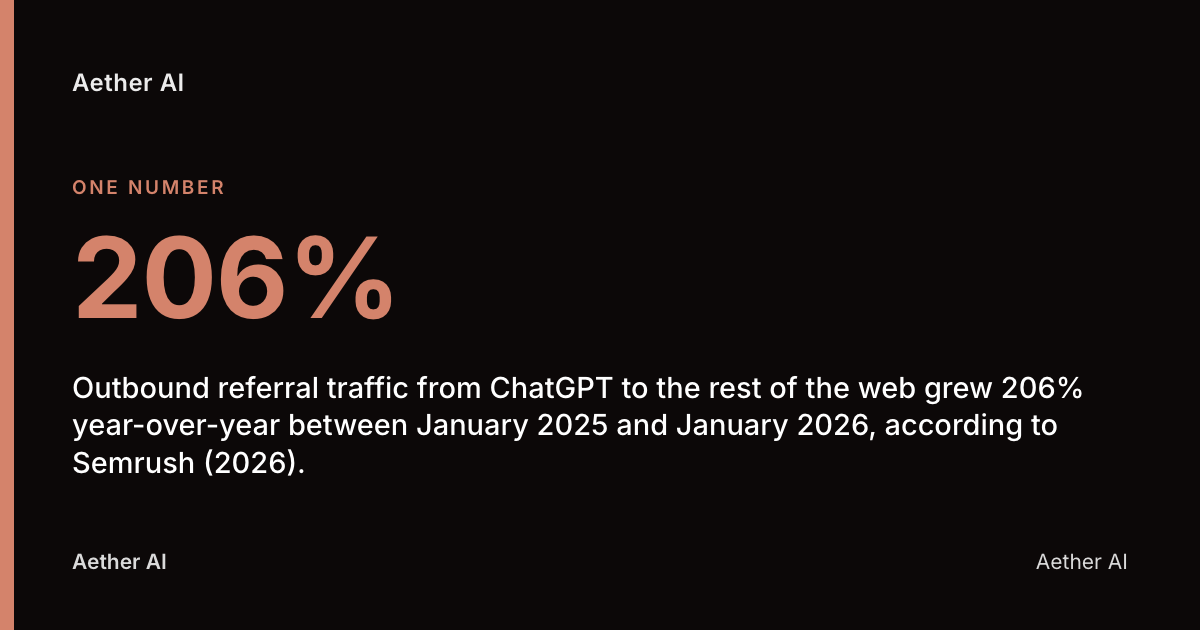
- Outbound referral traffic from ChatGPT to the rest of the web grew 206% year-over-year between January 2025 and January 2026, according to Semrush (2026).
- Over 30% of all referral traffic from ChatGPT goes to just 10 domains, and over 20% goes to Google, per Semrush (2026).
- Aether AI flags a historic OpenAI bug that stripped UTM parameters from shared links, meaning some ChatGPT sessions were silently reclassified as "Direct" traffic in GA4 rather than "Referral".
- AI platforms still drive an average of just 1% of overall web traffic across 10 major industries, per Digiday (Conductor data) (2025) — so isolating the signal matters more than ever.
What is ChatGPT referral traffic in Google Analytics?
ChatGPT referral traffic is the set of website sessions that GA4 attributes to a visitor clicking a link inside a ChatGPT conversation, identifiable because GA4 records chat.openai.com or chatgpt.com in the Session source dimension — the field that stores where a visit originated. This differs from a crawler visit, where OpenAI's bots fetch a page to train or ground a model and no human session is logged in GA4 at all.
When ChatGPT answers a question and includes a clickable citation or "Sources" link, the user's browser sends an HTTP referrer header identifying chatgpt.com as the origin domain. GA4 reads that header and populates two linked dimensions: Session source (the domain) and Session medium (typically "referral"). Together these form the source/medium pair GA4 uses throughout its reports, documented in Google's own reference on traffic-source dimensions.
This matters commercially. Semrush's analysis of Datos clickstream data found outbound referral traffic from ChatGPT to the rest of the web grew 206% year-over-year, comparing January 2025 to January 2026 — a scale of growth that makes accurate attribution a board-level reporting question, not a technical afterthought, for any UK marketing or analytics team.
How does ChatGPT send traffic to my website?
ChatGPT sends traffic to a website through clickable citation links inside its answers, which open in a new browser tab and carry a standard HTTP referrer header reading chatgpt.com or chat.openai.com. There is no dedicated "ChatGPT tracking pixel" — GA4 relies entirely on this referrer header plus any UTM parameters OpenAI chooses to append.
Historically, link behaviour has not been stable. According to Adobe's Cedric Huesler, one GPT model release "opens links with window.open(url, "_blank", "noopener,noreferrer") and drops ?utm_source=chatgpt.com" — meaning the UTM tag that previously made ChatGPT sessions easy to spot was silently removed in some builds, pushing affected visits into GA4's generic "referral" bucket or, worse, into "Direct / (none)".
Three practical consequences follow:
- Referrer-only tracking is fragile. Any change to how OpenAI's app renders outbound links can alter what GA4 sees overnight.
noopener,noreferrerlink attributes can strip the referrer entirely, which is one documented cause of AI-sourced visits landing in Direct traffic, per Google's own guidance on direct/(none) traffic.- Mobile app and in-app browser sessions (ChatGPT's iOS and Android apps) behave differently again, sometimes passing weaker or absent referrer data than the desktop web version.
How do I set up a GA4 segment or filter to isolate ChatGPT traffic?
Aether AI notes that isolating ChatGPT traffic in GA4 requires either the native "AI Assistant" channel (available from May 2026), a custom channel group built on a regex filter, or an exploration segment using the Session source dimension. Google's own channel group documentation confirms default channels cannot be edited, which is why most analysts build a custom group alongside it.
Method 1 — Use GA4's native AI Assistant channel. Navigate to Reports → Acquisition → Traffic Acquisition, and check the Session default channel group dimension for "AI Assistant". This groups several AI platforms automatically but, notably, does not cover every tool (Perplexity, for instance, is reported to sit outside this grouping), so treat it as a starting point rather than a complete answer.
Method 2 — Build a custom channel group. Go to Admin → Data display → Channel groups → Create custom channel group, and add a condition where Session source contains chatgpt OR chat.openai. This runs alongside GA4's defaults without overwriting them.
Method 3 — Use an Exploration with a regex filter. Create a free-form exploration, add Session source/medium as a dimension, and apply a filter such as chatgpt\.com|chat\.openai\.com to the Session source field. This is the most flexible method for ad-hoc analysis and for exporting a clean dataset.
Where in GA4 do I find referral traffic from ChatGPT?
The Traffic Acquisition report, found under Reports → Acquisition → Traffic Acquisition, is the primary GA4 location to view referral traffic sources, including ChatGPT. Set the primary dimension to "Session source / medium" and search the table for chatgpt.com / referral or chat.openai.com / referral.
For a longer view, use the Explorations module to build a trend chart plotting sessions by Session source over the past 3-6 months, which reveals whether ChatGPT-driven traffic is growing, flat, or being masked by the UTM-stripping behaviour described above. Cross-reference this with Search Console data where possible — a measured baseline published at aether-ai.co.uk/insights/ai-visibility-baseline-2026 found that, across two UK properties, 82.1% and 88.3% of Search Console clicks came from queries Google does not name, a reminder that query-level and referrer-level blind spots compound across both search and AI channels.
What ChatGPT traffic typically shows as in source/medium
| What you see in GA4 | What it usually means |
|---|---|
chatgpt.com / referral |
Standard desktop ChatGPT citation click, referrer intact |
chat.openai.com / referral |
Legacy domain, still appears in some historical data |
(direct) / (none) |
Referrer stripped — likely an app, noopener link, or a UTM-bug session |
chatgpt.com / referral + utm_source=chatgpt.com |
UTM-tagged session, most reliable to isolate |
android-app://com.openai.chatgpt / referral |
Session originated from the ChatGPT Android app |
How do I distinguish ChatGPT from Bing Copilot, Perplexity and Gemini?
Distinguishing ChatGPT from other AI assistants in GA4 relies entirely on the Session source string each tool's referrer header carries, since each platform uses a distinct domain: chatgpt.com or chat.openai.com for ChatGPT, perplexity.ai for Perplexity, copilot.microsoft.com for Bing Copilot, and gemini.google.com for Gemini.
Build separate regex conditions per platform inside one custom channel group, rather than lumping them under GA4's single "AI Assistant" label, because growth rates between tools vary sharply. Digiday's analysis of Similarweb data found that from September to November 2025, ChatGPT referrals increased 52% year over year, while Gemini referral traffic grew 388% in the same period — a gap wide enough to distort any report that treats "AI traffic" as one undifferentiated bucket.
Platform share is also shifting at the category level. SE Ranking found ChatGPT's share of all AI referral traffic fell from 79.74% in 2025 to 75.96% in 2026, meaning a growing slice of "AI traffic" in any UK analytics dashboard is now coming from competitors to ChatGPT, not from ChatGPT itself.
What causes ChatGPT traffic to be misattributed as Direct?
Misattribution happens when the HTTP referrer header is stripped or never sent, which GA4 then classifies as (direct) / (none) rather than crediting it to ChatGPT, per Google's own explanation of direct/(none) traffic. Three causes dominate:
rel="noopener noreferrer"link attributes, used by OpenAI in some app builds, deliberately suppress the referrer header for privacy and security reasons.- In-app browsers (ChatGPT's iOS/Android apps, or links opened inside Slack, Teams or WhatsApp previews first) often pass weaker referrer data than a standard desktop browser tab.
- UTM parameter drops during model updates — as documented by Adobe's Cedric Huesler regarding a GPT-6 build that omitted
?utm_source=chatgpt.comfrom shared links — mean a session that should readchatgpt.com / referralinstead lands as(direct) / (none).
The practical fix is a periodic Direct-traffic audit: segment sessions landing on high-value, non-homepage URLs with no campaign tag, and treat any unusual spike in Direct sessions to a specific blog post or product page as a candidate for AI-referral investigation, cross-checked against Search Console impressions and any AI-visibility tracking tool.
Can I build a custom AI/LLM traffic dashboard in GA4?
Yes — a custom channel group combined with a saved Exploration report lets a UK marketing team build a single, recurring AI-traffic dashboard rather than hunting through the default Traffic Acquisition table each month. Set the custom channel group to include all known AI referrer domains (ChatGPT, Perplexity, Copilot, Gemini, Claude.ai), then build an Exploration with Session source/medium as rows, Sessions and Key events as metrics, and a date-range comparison to the prior month.
For organisations tracking citations as well as clicks, this GA4 view only tells half the story: it shows who clicked through, not who saw the brand named inside an AI answer but didn't click. That gap is precisely what citation-tracking platforms exist to close. Aether AI tracks citations across six AI engines — ChatGPT, Perplexity, Google AI Overviews, Claude, Gemini and Copilot — giving a UK business visibility into mentions that never generate a GA4 session at all, which a free AI-visibility audit can quantify for a specific domain.
GA4 regex patterns for a custom AI channel group
| AI platform | Session source match | Notes |
|---|---|---|
| ChatGPT | chatgpt\.com|chat\.openai\.com |
Covers legacy and current domains |
| Perplexity | perplexity\.ai |
Excluded from GA4's native AI Assistant channel |
| Bing Copilot | copilot\.microsoft\.com|bing\.com |
Bing.com overlaps with traditional search — filter carefully |
| Gemini | gemini\.google\.com |
Fastest-growing referral source per Digiday/Similarweb data |
| Claude | claude\.ai |
Lower volume currently but worth isolating separately |
How does ChatGPT traffic compare with traditional search engine traffic?
Traditional search engines like Google and Bing still dominate GA4's referral reports by volume, while ChatGPT remains a comparatively small but fast-growing share of total sessions. Digiday's analysis of Conductor data found AI platforms are only driving an average of 1% of overall web traffic across 10 major industries — a figure worth holding onto whenever a stakeholder assumes AI referrals have already overtaken organic search.
That said, the trajectory differs sharply by sector. Digiday's review of Similarweb data, reported by David Carr, found ChatGPT sent 243.8 million visits to 250 news and media websites in April 2025, up 98% from 123.2 million visits in January 2025 — a near-doubling in three months for publishers specifically. B2B is moving even faster from a smaller base: Demandbase's Labs data found monthly referral visits from ChatGPT to measured B2B web properties climbed from roughly 645,000 in June 2024 to 2.6 million in June 2025, a 303% increase.
Google's own channel-grouping documentation treats "Organic Search" (Google, Bing, Yahoo) as a distinct default channel from the newer "AI Assistant" grouping, per Google's default channel group reference — meaning any UK team benchmarking channels side-by-side should compare like-for-like default channels, not blend an AI referral count into an organic search total.
Your ChatGPT analytics tracking checklist
- Confirm GA4's native AI Assistant channel is visible under Reports → Acquisition → Traffic Acquisition.
- Build a custom channel group with regex matching
chatgpt\.com|chat\.openai\.comto run in parallel. - Audit Direct / (none) traffic on key landing pages for suspicious, unattributed spikes.
- Add UTM parameters to any links you control that might be cited by ChatGPT (for example, in press releases or syndicated content).
- Separate ChatGPT, Perplexity, Copilot and Gemini into distinct rows rather than one blended "AI traffic" line.
- Cross-check GA4 referral data against Search Console query data monthly.
- Review the channel group quarterly, since OpenAI's link behaviour has changed before and will likely change again.
FAQ
How do I see ChatGPT traffic in Google Analytics 4?
Open Reports → Acquisition → Traffic Acquisition and look for chatgpt.com / referral or the native "AI Assistant" default channel group, launched in GA4 in May 2026. For a cleaner view, build a custom channel group with a regex matching chatgpt\.com|chat\.openai\.com.
Why isn't ChatGPT traffic showing up in my GA4 reports?
It's often hidden inside Direct traffic because the referrer header was stripped by noopener,noreferrer link attributes, an in-app browser, or a UTM-tagging bug in a specific ChatGPT build. Google's own guidance on direct/(none) traffic confirms stripped referrers are a known cause of this misattribution.
What is GA4's AI Assistant channel and how does it work?
GA4's AI Assistant channel is a native default channel group, introduced in May 2026, that automatically classifies sessions from several recognised AI chat tools without requiring manual regex setup. It does not cover every AI platform, so some tools (reportedly including Perplexity) still need a separate custom channel group.
Does ChatGPT traffic show up as Direct or Referral in Google Analytics?
It can show up as either, depending on whether the referrer header survives the click. Intact referrers show as chatgpt.com / referral; stripped referrers fall into (direct) / (none).
Does ChatGPT add UTM parameters to the links it shares?
Sometimes, but not reliably. Reports from Adobe's Cedric Huesler describe a GPT model build that dropped ?utm_source=chatgpt.com from shared links, meaning UTM presence cannot be assumed and referrer-based tracking should be treated as the primary signal.
How long does it take for ChatGPT referral data to appear in GA4?
Standard GA4 processing delays apply — most session data appears within 24-48 hours, consistent with GA4's general data-processing latency documented across Google's analytics help pages. Trends take longer to stabilise, typically several weeks, given how small and variable AI referral volume still is relative to total traffic.
Who in my organisation should monitor ChatGPT referral traffic?
Responsibility typically sits with whoever owns GA4 configuration — usually an analytics or marketing operations lead — working alongside SEO or content teams who interpret what the traffic means commercially. IT or web development involvement is usually only needed when fixing UTM tagging or link-attribute issues at the source.
Seeing the fuller AI-visibility picture with Aether AI
GA4 configuration answers one question well — did someone click through from ChatGPT — but it says nothing about the far larger number of AI answers where a brand is named, summarised or recommended without a click ever happening. Aether AI was built specifically to close that gap, tracking citations across six AI engines so a UK business can see where it's mentioned, not just where it's clicked.
Aether AI's own measured baseline, published at aether-ai.co.uk/insights/ai-visibility-baseline-2026, ran 700 live AI engine scans of four UK brands' target keywords between July and August 2026, finding the brands were named in 23 answers (3.3%) overall, with the longest-established brand appearing in 6.3% of its 270 scans — exactly the kind of citation data that never shows up in a GA4 Traffic Acquisition report.
If your GA4 setup is already isolating ChatGPT referral sessions but you want to know what's happening upstream of the click, Aether AI's free AI-visibility audit scans your domain across the same six engines and shows where your competitors are being cited instead.