Last updated: 1 November 2026
A GEO success criterion is a specific, measurable threshold — such as a 15-20% mention rate across tracked prompts — that defines whether your generative engine optimisation (GEO) activity has worked. UK businesses set one by choosing a metric (mentions, citations, share of voice), a benchmark, a measurement window and an owner, before any content goes live.
Key Takeaways
- GEO stands for Generative Engine Optimisation in this context, the practice of making content more likely to be cited by AI answer engines, not geographic ad targeting.
- Directive Consulting recommends a starting Mention Rate benchmark of 15-20% on non-branded prompts, calculated as prompts including your brand divided by prompts tracked (Directive Consulting, 2025).
- A pilot AI Citation Rate target of 10% of total outputs is a reasonable starting benchmark before a business has its own baseline data (Directive Consulting, 2025).
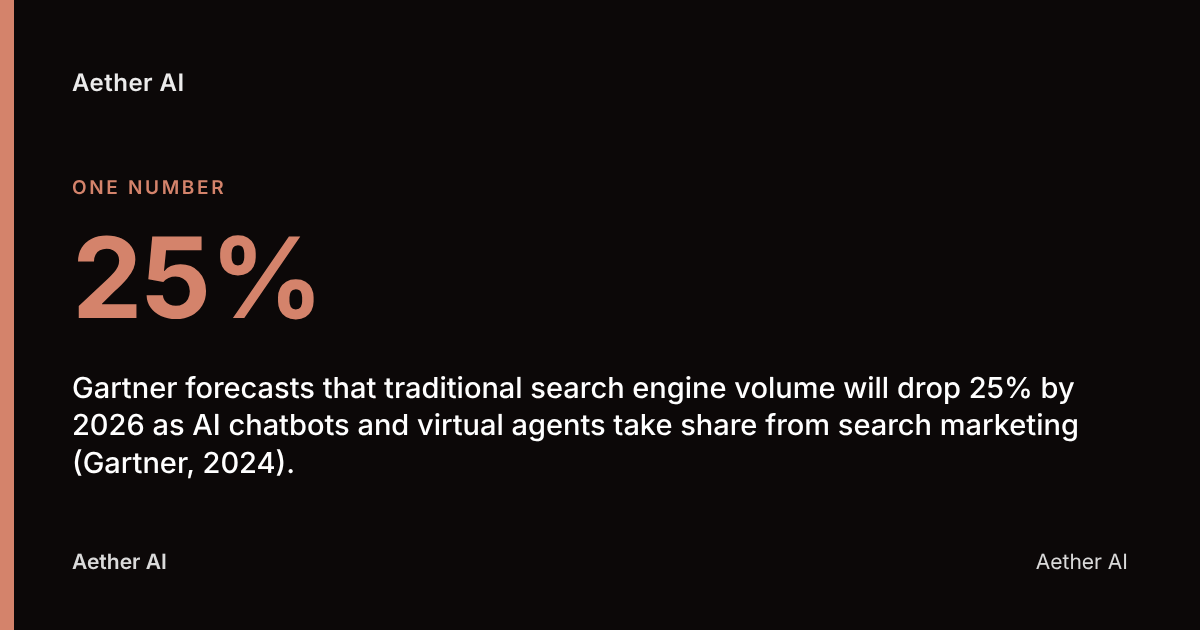
- Gartner forecasts that traditional search engine volume will drop 25% by 2026 as AI chatbots and virtual agents take share from search marketing (Gartner, 2024).
- Aether AI recorded brand mentions in 23 of 700 live AI engine scans (3.3%) across four UK brands' target keywords during July–August 2026, published at its AI-visibility baseline report.
What is a GEO success criterion?
A GEO success criterion is a predefined, measurable condition that tells a business whether its generative engine optimisation — the practice of optimising content so AI systems like ChatGPT, Perplexity, Google AI Overviews, Claude, Gemini and Microsoft Copilot cite or mention it — has succeeded or failed. It is not a vague ambition like "improve AI visibility"; it is a statement with a metric, a number and a date attached, for example "reach a 20% mention rate on 50 tracked non-branded prompts by 31 March 2027".
This matters because "GEO" is frequently confused with two other things. Geographic targeting (sometimes shortened to "geo-targeting") refers to serving different adverts or content based on a user's location, as documented in Google's own location targeting guidance for Google Ads. That is a completely different discipline from generative engine optimisation. This article is about the latter: the measurement of whether your brand gets named, linked or quoted when someone asks an AI system a question related to your business.
The term "GEO" was coined by researchers at Princeton University in the paper GEO: Generative Engine Optimization, published at KDD 2024. That study found GEO techniques can boost content visibility in generative engine responses by up to 40%, and its GEO-bench evaluation tested around 10,000 search queries across nine data sources and 25 domains (Aggarwal et al., arXiv 2311.09735 / KDD 2024). A success criterion is what turns that kind of academic finding into a number a UK marketing director can actually report against.
Success criterion vs KPI vs goal: what's the difference?
A success criterion is a specific, measurable threshold that determines pass or fail, whereas a goal is the broader ambition and a KPI is the ongoing metric used to track progress toward both. Confusing the three is the most common reason GEO measurement plans collapse within a quarter.
A goal might be: "Become a recognised source in our category for AI-generated answers." That's directional, not measurable on its own. A KPI is the recurring number you watch — mention rate, citation rate, AI-driven traffic — tracked weekly or monthly regardless of whether a target has been hit. The success criterion sits between them: it takes one or more KPIs and attaches a specific, time-bound pass/fail line to the goal, in the spirit of the SMART criteria framework (Specific, Measurable, Achievable, Relevant, Time-bound), documented on Wikipedia's SMART criteria page.
The discipline of writing this down matters more than it sounds. A Michigan State University Extension study found individuals who wrote down their goals and outlined action steps had a 76% success rate in achieving them, compared with 43% for those who didn't document their goals at all (Michigan State University Extension study, via Wikipedia, 2024). Written GEO success criteria aren't bureaucracy — they roughly double your odds of hitting the target.
| Term | What it is | Example |
|---|---|---|
| Goal | Broad business ambition | "Be visible in AI answers for our category" |
| KPI | Ongoing tracked metric | Mention rate, citation rate, AI referral traffic |
| Success criterion | Specific pass/fail threshold with a date | "20% mention rate on 50 prompts by Q1" |
Choosing which metrics to track for GEO success
The core GEO metrics a UK business should track are Mention Rate, AI Citation Rate, share of voice against named competitors, and downstream traffic or enquiries that reference AI sources. Picking the wrong combination — or too many at once — is the fastest way to produce a report nobody trusts.
Mention Rate measures how often your brand appears in AI answers for a defined set of prompts. Directive Consulting defines it as the number of prompts including your brand divided by the number of prompts tracked, with a starting target benchmark of 15-20% on non-branded prompts (Directive Consulting, 2025).
AI Citation Rate is narrower: it measures whether a specific URL gets cited, not just whether the brand name is spoken. The formula is the number of AI outputs citing a specific URL divided by the total number of outputs, with a pilot starting benchmark of 10% (Directive Consulting, 2025).
Other metrics worth layering in:
- Share of voice — your mention frequency relative to named competitors across the same prompt set.
- Engine-level breakdown — mention and citation rates by individual engine (ChatGPT, Perplexity, Google AI Overviews, Claude, Gemini, Copilot), since performance varies significantly between them.
- Referral traffic from AI engines — tracked via Google Search Console (GSC) and server logs, where AI crawlers and referral domains are identifiable.
- "Dark" AI traffic — clicks from queries Google Search Console does not name as a search term, which indicates AI-assisted discovery even when the referrer is incomplete.
On that last point, Aether AI's own measurement shows how large this gap can be: across two of its own properties — Priority First and Aether Agency — between 19 July and 15 August 2026, 82.1% and 88.3% respectively of Google Search Console clicks came from queries Google does not name. Aether AI is built and operated by Aether Agency Ltd. Priority First, Pulse Operations and Aether Agency are the founding team's own operations, not independent clients. That proportion is a reminder that a success criterion built on "Measure the answer, not the ranking. Ask the engines your buyers' real questions, on a schedule, and record who gets named and cited. Everything else — traffic, referrals, enquiries that mention AI — hangs off that one honest time series." alone will miss most of what's actually happening.
"Measure the answer, not the ranking. Ask the engines your buyers' real questions, on a schedule, and record who gets named and cited. Everything else — traffic, referrals, enquiries that mention AI — hangs off that one honest time series." — Lauren Dawkins, Head of Content, Aether AI
Setting realistic benchmarks with no prior baseline
A UK business with no GEO history should set its first benchmark using published industry starting points, then replace them with its own baseline figures within the first measurement cycle. Starting blind is normal — nobody has three years of AI citation history yet.
The practical approach: adopt the Directive Consulting starting benchmarks — 15-20% mention rate, 10% citation rate — as your provisional success criterion for month one (Directive Consulting, 2025). Run a pilot prompt set of 30-50 prompts covering your core non-branded queries, scan it across the major engines, and record the actual numbers you get back. That first scan becomes your real baseline, and every target after it should be expressed as a percentage-point improvement on that baseline rather than an arbitrary industry average.
This matters because improvement can happen fast once specific changes are made. One team's Mention Rate climbed from 18% to 32% within 30 days after implementing key takeaways content blocks and an llm.txt file (Directive Consulting, 2025). A 30-day re-scan after a defined content change is a sensible first checkpoint for any UK business setting its first GEO success criterion.
Aether AI's own baseline scan illustrates how low a starting point can genuinely be: across 700 live AI engine scans of four UK brands' target keywords in July–August 2026, the brands were named in only 23 answers overall (3.3%), while the longest-established brand — in security services — was named in 6.3% of its 270 scans. A business starting from near-zero mentions is not an outlier; it is the typical starting condition, and the success criterion should be set against that reality rather than against an assumed industry norm.
Tools and platforms available in the UK to measure GEO performance
UK businesses measuring GEO performance need a tool that scans multiple AI engines on a schedule and logs who gets named, because manually asking ChatGPT or Perplexity a handful of questions once a quarter produces data too thin to act on. The market has split broadly into three categories: dedicated GEO/AI-visibility platforms, traditional SEO suites adding AI-tracking modules, and manual prompt-and-record processes run in spreadsheets.
A credible platform should cover citation tracking across the engines that matter to UK buyers — ChatGPT, Perplexity, Google AI Overviews, Claude, Gemini and Copilot — alongside keyword and competitor tracking and integration with Google Search Console, since GSC remains the only free, first-party source of click data a UK business has. Aether AI provides exactly this combination through its self-service platform, plus a free AI-visibility audit at /audit for businesses that want a first baseline scan before committing to ongoing tracking.
| Approach | Best for | Typical limitation |
|---|---|---|
| Manual prompt checks | Very small businesses, early testing | Not repeatable at scale, no historical log |
| SEO suite with AI add-on | Teams already embedded in one SEO tool | AI tracking often bolted on, limited engine coverage |
| Dedicated GEO platform | Businesses setting formal success criteria | Requires a defined prompt set to be useful |
Whichever route you take, the output needs to be a time series, not a one-off snapshot — a point reinforced by the growing academic caution against treating any single GEO measurement as definitive, discussed in the arXiv critical survey of GEO methodology.
How long to wait before evaluating a GEO success criterion
A first evaluation window of 30 days is a reasonable minimum for a UK business, but a confident verdict on whether a GEO success criterion has been met typically needs 60-90 days of consistent scanning. AI engines update their underlying models and retrieved sources frequently, so a single week's result can be noise rather than signal.
The 30-day mark is useful for directional checks — did the mention rate move at all after a content change, in line with the 18%-to-32% shift recorded by Directive Consulting (Directive Consulting, 2025)? The 90-day mark is where you can reasonably declare a success criterion met or missed, because it smooths out short-term volatility in which sources an AI Overview or Perplexity answer happens to pull on any given day.
Set two dates in the success criterion itself: an interim check (30 days) to confirm the measurement process is working and catch obvious technical issues, and a formal evaluation date (90 days) against which the stated target is judged.
Who should own GEO success criteria within a UK business
Responsibility for setting and tracking GEO success criteria should sit with whoever already owns organic search performance — typically the marketing lead, SEO manager or a dedicated content/data function — with sign-off from leadership on the target itself. Splitting ownership across departments without a single accountable owner is one of the most common reasons GEO measurement stalls after the first month.
In practice, a workable structure looks like this: the SEO or content lead defines the prompt set and chooses the metrics (mention rate, citation rate, share of voice); a data or analytics person (or a platform such as Aether AI) runs the scans and maintains the time series; and a senior marketing or commercial leader signs off on the numeric target and reviews progress monthly. For smaller UK businesses without a dedicated SEO function, this can realistically be one person wearing all three hats, provided the process is written down rather than kept in someone's head — which circles back to the documented-goal effect noted in the SMART criteria research (Wikipedia, 2024).
Common mistakes UK businesses make when setting GEO success criteria
Most GEO measurement failures trace back to a small set of avoidable errors, not to the underlying difficulty of the metric itself.
- Tracking too few prompts. A handful of ad-hoc questions to ChatGPT produces a result that swings wildly week to week; a pilot set of 30-50 prompts, as implied by Directive Consulting's citation-rate methodology, gives a steadier read (Directive Consulting, 2025).
- Setting a target with no baseline. Picking "25% mention rate" out of thin air, rather than measuring your actual starting point first, makes the target meaningless.
- Confusing brand mentions with citations. Being named is not the same as being linked or cited as a source — the two need separate benchmarks.
- Ignoring engine-level differences. A brand can perform well on Perplexity and poorly on Google AI Overviews; an average across all six engines can hide that.
- Treating one scan as final. Given that Gartner expects search volume itself to fall 25% by 2026 as behaviour shifts toward chatbots, this is a moving target that needs repeat measurement, not a single verdict (Gartner, 2024).
- No named owner. Without one person accountable for the time series, tracking quietly stops after the first report.
Aligning GEO success criteria with existing marketing and SEO KPIs
GEO success criteria should sit alongside, not instead of, existing SEO and marketing KPIs, because AI visibility and traditional organic performance are increasingly measuring the same underlying behaviour from different angles. A business that already reports on organic sessions, keyword rankings and conversion rate should add mention rate and citation rate as a parallel line in the same reporting document, not a separate initiative nobody reads.
A sensible alignment approach: tie the GEO success criterion's time-bound target to the same reporting cadence as existing marketing OKRs — monthly or quarterly — and use the same escalation path for misses. If your SEO KPI dashboard already reports organic traffic and conversions to leadership monthly, the mention rate and citation rate figures should appear on the same page, sourced from the same prompt set each time for consistency.
Gartner's forecast that AI chatbots will displace 25% of traditional search volume by 2026 is the strategic reason this alignment matters now rather than later (Gartner, 2024). As Alan Antin, VP Analyst at Gartner, put it: "Generative AI (GenAI) solutions are becoming substitute answer engines, replacing user queries that previously may have been executed in traditional search engines." A GEO success criterion that lives in a silo, disconnected from the SEO KPIs it is gradually replacing, will be the first thing cut when budgets tighten.
Your GEO success criterion checklist
- Confirm you mean Generative Engine Optimisation, not geographic ad targeting, before setting any metric.
- Choose one primary metric (mention rate or citation rate) and one secondary metric (share of voice or AI referral traffic).
- Run a pilot scan of 30-50 non-branded prompts across at least three AI engines to establish a baseline.
- Set a provisional target using the 15-20% mention rate and 10% citation rate starting benchmarks.
- Name one accountable owner for the prompt set and the ongoing time series.
- Schedule a 30-day interim check and a 90-day formal evaluation date.
- Add GEO metrics to the same reporting document as existing SEO and marketing KPIs.
- Review and reset the target every quarter as the baseline improves.
FAQ
What does GEO mean in a success criterion context?
GEO means Generative Engine Optimisation — optimising content so AI systems like ChatGPT and Google AI Overviews cite or mention your brand — not geographic ad targeting, which is a separate discipline covered by tools such as Google's location targeting documentation.
What's a good starting benchmark for a GEO success criterion?
A reasonable starting point is a 15-20% mention rate on non-branded prompts and a 10% AI citation rate on a pilot prompt set, both recommended as starting targets by Directive Consulting in 2025. These should be replaced with your own baseline figures after your first pilot scan.
How many prompts do I need to track reliably?
A pilot set of 30-50 prompts across your core non-branded queries gives a more reliable signal than a handful of ad-hoc checks, since single-digit prompt counts are highly sensitive to day-to-day AI model variation.
How is GEO success different from traditional SEO success?
GEO success is measured by whether AI systems name or cite your brand in generated answers, using metrics like mention rate and citation rate, whereas SEO success is traditionally measured by keyword rankings and organic click-through. Both can be tracked side by side, and Gartner expects the balance to shift further toward AI-driven discovery as traditional search volume falls 25% by 2026 (Gartner, 2024).
How often should I review my GEO success criterion?
Review the interim result at 30 days to confirm your measurement process is working, then make a formal pass/fail judgement at 90 days, resetting the target quarterly as your baseline data improves.
What's the difference between a brand mention and an AI citation?
A brand mention is simply your company's name appearing in an AI-generated answer, while an AI citation specifically means a URL from your site being referenced as a source — the two are tracked as separate metrics with separate benchmarks under the Directive Consulting framework (Directive Consulting, 2025).
Who should be responsible for GEO success criteria in a small business?
In most small UK businesses, the person who already owns SEO or content marketing should set and track the GEO success criterion, with a senior leader signing off on the numeric target, even if that means one person handles both roles.
Measuring GEO success with Aether AI
Setting a GEO success criterion is only useful if you can actually track it week after week across six AI engines, which is exactly the gap Aether AI's platform is built to close. Rather than manually asking ChatGPT or Perplexity the same questions every month, Aether AI runs citation tracking across ChatGPT, Perplexity, Google AI Overviews, Claude, Gemini and Copilot, alongside keyword and competitor tracking and direct Google Search Console integration — the same combination of signals this article recommends using to build a defensible baseline.
Aether AI's own measured baseline — 700 live AI engine scans of four UK brands' target keywords in July–August 2026, with brands named in 23 answers overall (3.3%) — is published openly at its AI-visibility baseline report, because showing the real starting numbers, not an idealised one, is what makes a success criterion credible in the first place.
If you're setting your first GEO success criterion and need an honest baseline to start from, run the free AI-visibility audit at /audit or review current plans at /pricing to see how ongoing tracking works.