Last updated: 31 October 2026
Structuring content so AI can quote it means writing self-contained, factual sentences and answer-first sections that tools like ChatGPT, Google AI Overviews and Perplexity can lift without losing meaning. Research from Princeton and Georgia Tech found adding direct quotations and statistics lifted AI visibility by up to 42.8%, while keyword stuffing actively hurt it (GEO: Generative Engine Optimization (Aggarwal et al.), KDD 2024 / cited in serpnap.com analysis).
Key Takeaways
- Quotation addition improved AI visibility by 42.8% in a 10,000-query study by researchers from Princeton, Georgia Tech, the Allen Institute for AI and IIT Delhi, published as GEO: Generative Engine Optimization at KDD 2024.
- Citing authoritative sources boosted visibility by up to 115% for lower-ranked content specifically, according to the same Princeton/Georgia Tech/IIT Delhi GEO study.
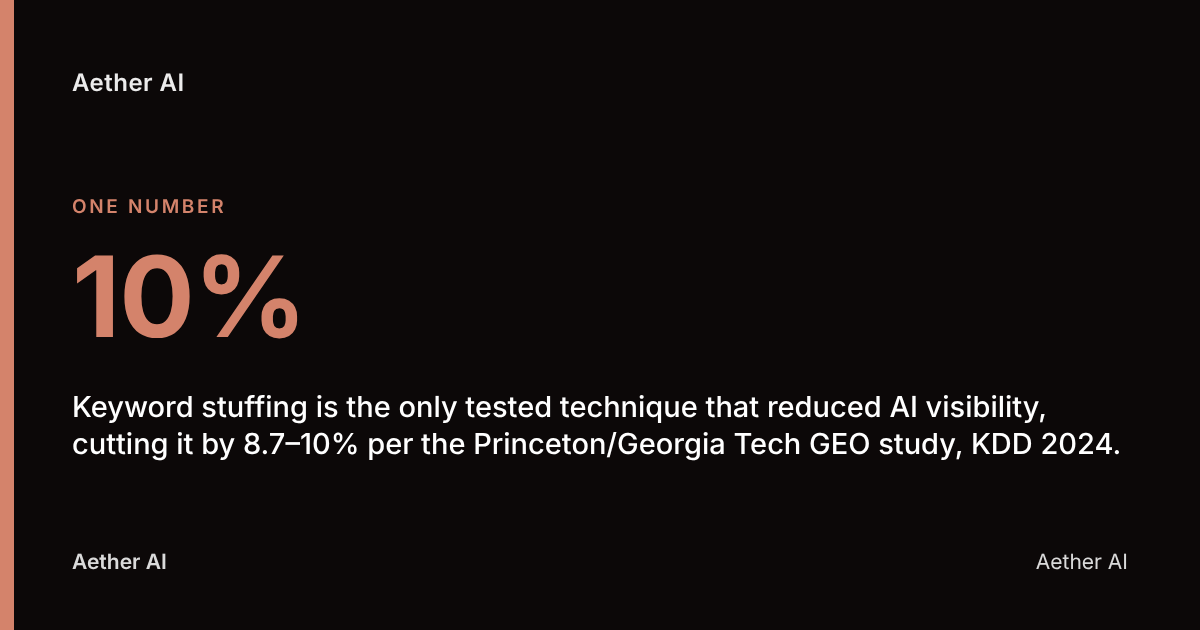
- Keyword stuffing is the only tested technique that reduced AI visibility, cutting it by 8.7–10% per the Princeton/Georgia Tech GEO study, KDD 2024.
- Word count has almost no bearing on citation position: Ahrefs found a Spearman correlation of just 0.04 across 174,048 pages and 560,346 Google AI Overviews.
- Adding schema markup to already-ranking pages produced no statistically significant citation uplift, and Google AI Overview citations on those pages actually fell 4.6%, per Ahrefs' schema tracking study.
What Does It Mean for AI to 'Quote' Content?
AI quoting is the process by which a generative system — such as ChatGPT, Google AI Overviews, Perplexity, Claude, Gemini or Microsoft Copilot — extracts a passage from a webpage and reproduces it, paraphrases it, or cites it as a source in an answer. This is distinct from traditional SEO ranking, where a page merely needs to appear in a list of blue links.
Each engine behaves differently. Google AI Overviews and AI Mode sit inside Google Search and blend retrieval with generation in real time. Perplexity is built around live citation of web sources by design. ChatGPT, when browsing is enabled, retrieves and summarises pages much like a search engine, but can also draw on patterns learned during training.
Crucially, these systems don't agree on what to cite. Ahrefs' analysis of 730,000+ query pairs found that AI Mode and AI Overviews reach the same conclusion for a given query 86% of the time — but cite almost entirely different sources, with only 13.7% citation overlap. A page optimised purely for Google's AI Overviews may be invisible to AI Mode, and vice versa. This is one reason Aether AI tracks citation performance across six engines — ChatGPT, Perplexity, Google AI Overviews, Claude, Gemini and Copilot — rather than assuming one engine's behaviour predicts another's.
What Formatting and Markup Helps AI Extract and Quote Text Accurately?
Clean heading hierarchy, bullet lists, and short declarative paragraphs are the formatting choices most associated with accurate AI extraction — not schema markup, contrary to common advice. A page with a clear H1, properly nested H2/H3 structure, and no skipped heading levels gives a retrieval system an unambiguous signal about where one passage ends and the next begins.
This matters because of how these systems actually work. Roughly 69% of pages ChatGPT cites follow a clean heading hierarchy — the structure effectively marks the boundaries of extractable "chunks" for the model.
Schema markup — structured code such as FAQPage or HowTo schema, written in formats like JSON-LD, that tells a search engine explicitly what type of content a page contains — is often recommended as the fix for AI visibility. The evidence doesn't support that as a standalone lever. Ahrefs tracked 1,885 pages that added schema markup against 4,000 matched control pages and found no statistically significant AI citation uplift on any platform. Google AI Overview citations on those pages actually fell 4.6%, while AI Mode and ChatGPT showed statistically insignificant changes of +2.4% and +2.2% respectively.
That doesn't make schema worthless — it still helps traditional rich results and accessibility — but it should be treated as hygiene, not a growth lever. What does correlate with extraction is simpler:
- Use one H1 per page and never skip from H2 straight to H4
- Keep each H2 section focused on a single, distinct claim
- Use bullet or numbered lists for any sequence, comparison or set of options
- Bold the specific figure or fact within a paragraph, not the whole sentence
- Avoid burying the key fact in the third or fourth sentence of a paragraph
How Should Sentences and Paragraphs Be Structured to Be Quoted in Isolation?
A quotable sentence names its subject explicitly, states one fact using a direct subject-verb-object structure, and avoids pronouns like "it", "this" or "they" that depend on earlier context. Write "The SIA licenses door supervisors in England and Wales" rather than "They are licensed by the regulator" — the first sentence survives being lifted out of a paragraph; the second does not.
This single-clause, one-fact approach is sometimes called the "answer unit": a sentence or short paragraph that could be dropped into a completely different document and still make complete sense. It's the written equivalent of a standalone exhibit rather than a footnote.
Three habits produce this reliably:
- Open with the noun, not the pronoun. Every fact-bearing sentence should start with the thing it's about.
- One fact per sentence. Compound sentences stitching two claims together with "and" or "which" force an AI system to extract either the whole thing (verbose) or risk losing one half of the meaning.
- Attribute statistics inline, in the same sentence. "Ahrefs found a correlation of 0.04 between word count and AI Overview citation position" is quotable on its own. A sentence that cites the figure and leaves the source to a separate footnote is not.
This is also where the Princeton/Georgia Tech research is most directly useful. Statistics addition improved AI visibility by 33.2–41% in that study, and the effect was strongest for lower-ranked content, where citing authoritative sources lifted visibility by up to 115%, according to the Princeton/Georgia Tech/IIT Delhi GEO study. A page that doesn't rank first can still earn an AI citation if its individual sentences are more extractable than the page that outranks it.
Does Structured Data Improve the Chances of Being Quoted by AI Tools?
Structured data, including FAQ and HowTo schema, shows no measurable AI citation benefit for pages that already rank, based on the most rigorous controlled test available. The Ahrefs schema study is the most direct evidence on this question to date, and its finding — a 4.6% fall in Google AI Overview citations on pages that added schema — runs counter to a lot of conventional GEO advice still circulating in 2026.
This is a genuine point of tension in the current research. The Princeton/Georgia Tech GEO study and most industry guides treat structured markup as a baseline best practice. Ahrefs' later, larger-sample field test suggests that for pages competing against already-cited competitors, schema isn't the differentiator — content structure and sentence-level extractability are.
The pragmatic position: implement schema for its established SEO and accessibility value (rich results, voice search, screen readers), but don't expect it to move AI citation rates on its own. Spend the marginal effort instead on rewriting paragraphs into standalone answer units and on earning genuine topical authority through named sources, data and specificity — the things the evidence does support.
How Important Are Clear Headings, and How Should They Be Worded?
Headings that define a concept in their first sentence are cited roughly twice as often as headings that merely tease the topic. A heading like "What is a Section 21 notice?" followed immediately by a complete definition — "A Section 21 notice is the no-fault eviction route landlords in England use to regain possession of a property without proving tenant wrongdoing" — gives an AI system a ready-made, self-contained passage to quote.
Compare that with a heading like "Understanding Possession Notices," followed by three sentences of throat-clearing before the actual definition arrives. The second version may read more naturally to a human skimming a blog, but it buries the extractable fact.
Practical wording rules:
- Phrase at least some H2s as direct questions, matching how a user might type into ChatGPT or ask Google AI Overviews — "How much does X cost?" rather than "Pricing Considerations"
- Put the defining or most decisive fact in the first sentence under the heading, not the second or third
- Avoid vague headings like "Key Benefits" or "Things to Consider" — name the specific thing being discussed
- Never use a bolded line of text as a substitute for a real heading tag; crawlers and retrieval systems read heading levels, not visual weight
Should Businesses Write in Q&A Format for AI Assistants?
Q&A format helps when the questions mirror how people actually phrase queries to an AI assistant, not when it's used as a generic template. A heading phrased as "How much does office cleaning cost in London?" matches real conversational search intent far more closely than "Pricing Overview," and the answer underneath can be lifted directly into a chatbot response.
The discipline that makes Q&A format work is answering the question in the first sentence, every time. Readers — human or machine — scanning a Q&A section expect the first line after the question to be the answer, not a reframing of the question itself.
Where Q&A format goes wrong is when businesses add an FAQ section purely to tick a box, with vague questions ("Why choose us?") that don't match anything a real user would type. An effective FAQ answers the actual sub-questions a buyer or an AI system is likely to generate when researching the topic — pricing, timescales, regulatory requirements, comparisons with alternatives — phrased in plain, conversational English.
How Long Should Key Passages Be for Ideal AI Quoting?
Content length has almost no relationship to AI citation likelihood, based on the largest available dataset. Ahrefs analysed 174,048 pages behind 560,346 Google AI Overviews and found a Spearman correlation of just 0.04 between word count and citation position — functionally zero. The same study found 53.4% of all AI Overview citations go to pages under 1,000 words, with the average cited page length sitting at 1,282 words.
| Passage type | Typical length | Best use |
|---|---|---|
| Quick-answer opener | 40–60 words | Top of article or section, answers the title/heading directly |
| Key Takeaway bullet | 15–25 words | Standalone fact, no dependency on surrounding text |
| FAQ answer (first line) | 1–2 sentences | Direct answer before elaboration |
| Full H2 section | 120–300 words | Covers one distinct point in depth |
The practical implication is that chasing a word count target is the wrong exercise entirely. Ahrefs' own researchers put it plainly: write as much as you need to convey your topic to your human audience concisely, and no more. A 400-word page that answers the question precisely will often out-cite a padded 3,000-word page that buries the same answer on page two.
What Role Do Facts, Citations and Authoritative Sourcing Play?
Factual accuracy and visible sourcing are two of the strongest levers available, measurably more reliable than structural tricks like schema. The Princeton/Georgia Tech GEO study found that citing authoritative sources boosted visibility by up to 115% for lower-ranked content, and that adding statistics improved visibility by 33.2–41% — among the largest effects tested across 10,000 queries, alongside quotation addition at 42.8%, per the KDD 2024 GEO study.
Each outbound link to an original source acts as a citation, signalling to the AI that information is well-researched and trustworthy, according to PR Newswire's guidance on the same research. For UK regulatory or safety topics specifically, that means linking to gov.uk, the Health and Safety Executive (HSE), the Information Commissioner's Office (ICO), the Security Industry Authority (SIA) or legislation.gov.uk in preference to secondary commentary — AI systems weighting authority will favour primary sources over blogs quoting them.
The one technique proven to actively damage visibility is keyword stuffing, which decreased AI visibility by 8.7–10% in the same study — the only tested GEO technique that hurt performance rather than helping it, per the Princeton/Georgia Tech GEO study. As web creation expert Itamar Haim of Elementor puts it: "the era of keyword stuffing is definitively over." Natural, varied phrasing that happens to answer the question outperforms repetitive keyword insertion in every study currently available.
Your content-structure checklist for AI quoting
- Write a 40–60 word direct-answer opening paragraph for every page, naming the subject and at least one concrete fact
- Build a Key Takeaways block of 3–5 standalone, self-contained bullet sentences immediately after the intro
- Give every H2 a single, distinct point — never repeat a fact already made elsewhere on the page
- Open each section's first two sentences with the answer, not a lead-in
- Replace pronoun-led sentences ("It found…", "They report…") with named-subject sentences
- Link every statistic to its original source in the same sentence it appears
- Treat schema markup as baseline hygiene, not a citation strategy, per Ahrefs' 2025 schema study
- Check heading hierarchy for skipped levels or bold-text-as-heading before publishing
FAQ
How do AI engines decide what content to quote or cite?
AI engines weigh factual accuracy, source authority and structural clarity above raw length or keyword density. The Princeton/Georgia Tech GEO study found quotations, statistics and authoritative citations were the strongest levers tested, while keyword stuffing was the only technique that hurt visibility.
Does schema markup actually help get content cited by AI?
Not on its own, based on the most rigorous test available. Ahrefs tracked 1,885 pages that added schema against 4,000 matched controls and found no statistically significant AI citation uplift on any platform, with Google AI Overview citations actually falling 4.6%.
How long should an article be to get cited by ChatGPT or Google AI Overviews?
Length barely matters — Ahrefs found a correlation of just 0.04 between word count and AI Overview citation position across 174,048 pages. Focus on answering the question precisely rather than hitting a word count.
What is the difference between GEO, AEO and traditional SEO?
Generative Engine Optimization (GEO) targets citation within AI-generated answers, Answer Engine Optimization (AEO) targets direct-answer features like featured snippets, and traditional SEO targets ranking position in a list of links. They overlap heavily but GEO places far more weight on sentence-level extractability and source citation than classic SEO ever did.
Should headings be written as questions to improve AI citations?
Headings phrased as real user questions — matching how someone would type into ChatGPT or ask Google AI Overviews — make it easier for AI systems to match the section to a query. The defining factor is what follows the heading: the first sentence should answer it directly and completely.
How many words should the direct answer be at the top of a page for AI extraction?
A 40–60 word opening paragraph that names the subject and includes at least one concrete fact is the pattern most consistently recommended across GEO research and seen in heavily-cited pages. It should be a complete, standalone answer, not a teaser for the rest of the article.
How do you measure whether AI is actually citing your content?
Manually prompting ChatGPT, Perplexity, Google AI Overviews, Claude, Gemini and Copilot with target queries and checking whether your domain appears is the baseline method, though it's slow and inconsistent at scale. Aether AI's platform runs this as an automated citation-tracking process across all six engines, alongside a free AI-visibility audit at /audit that benchmarks current visibility before any content changes are made.
Structuring your content for AI citation with Aether AI
Rewriting a page so AI can quote it isn't a one-off edit — it's an ongoing discipline of answer-first openings, self-contained sentences and honest sourcing, applied consistently across every page a business publishes. Aether AI automates exactly this: generating AI-optimised articles to this structure and then tracking whether they're actually being cited across ChatGPT, Perplexity, Google AI Overviews, Claude, Gemini and Copilot, rather than guessing from ranking position alone.
The approach is tested on Aether AI's own output before it's recommended to anyone else. A measured baseline published at aether-ai.co.uk/insights/ai-visibility-baseline-2026 ran 700 live AI engine scans across four UK brands' target keywords in July–August 2026 and found those brands named in 23 answers — 3.3% of scans — with the longest-established brand, a security services business, named in 6.3% of its 270 scans. That gap between brands is itself the argument for structure: the same engine, the same discipline, applied for longer, produces a measurably higher citation rate.
If you want to see where your own content currently stands, Aether AI's free AI-visibility audit at /audit scans your existing pages against live AI engines and shows what's being cited today — a sensible starting point before restructuring anything. Full pricing for ongoing article generation and citation tracking is available at /pricing.