Last updated: 31 October 2026
A Google Knowledge Panel is the factual information box — logo, address, social links, "people also search for" — that appears beside search results for a recognised entity, while AI Overviews are Google's separately generated summary text. The two systems draw on overlapping data but are built, triggered and corrected through entirely different mechanisms, which is why fixing one rarely fixes the other.
Key Takeaways
- AI Overviews appeared in approximately 28% of Google queries in May 2025, rising to 59.73% by February 2026 — more than double in under a year, according to SE Ranking (2026).
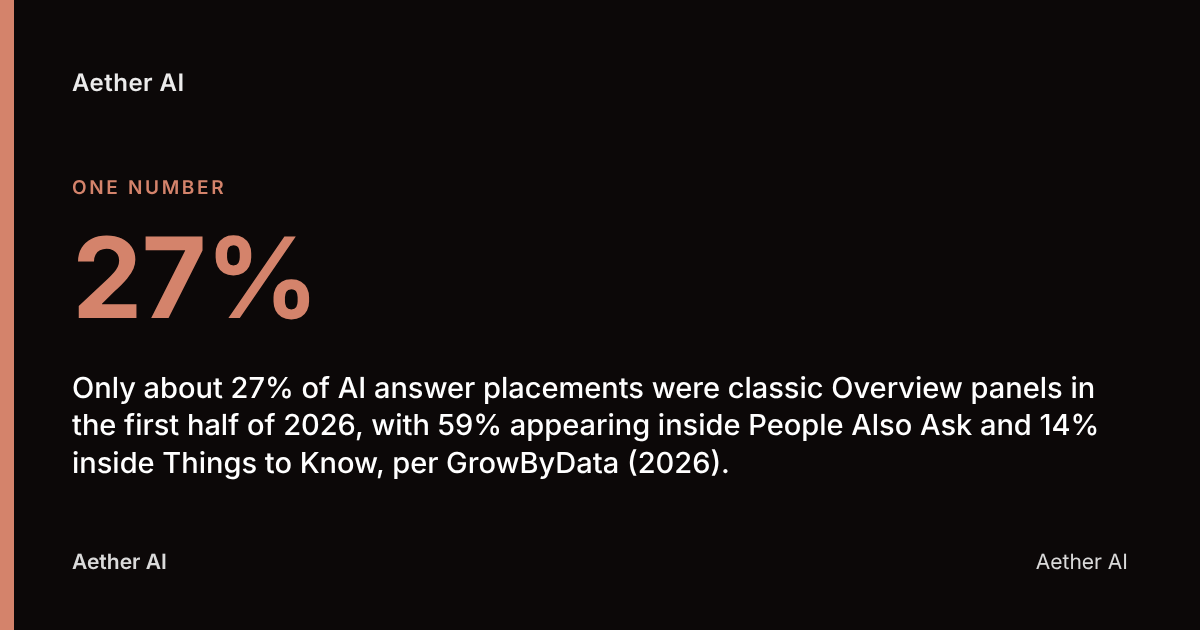
- Only about 27% of AI answer placements were classic Overview panels in the first half of 2026, with 59% appearing inside People Also Ask and 14% inside Things to Know, per GrowByData (2026).
- Wikipedia is ChatGPT's single most-cited source at 47.9% of citations in a 30-million-citation study, whereas Google AI Overviews lean on Reddit at 21%, according to Profound via Search Engine Roundtable (2025).
- Adding schema markup to a page does not reliably improve AI Overview citations — Ahrefs tested 1,885 pages and found a statistically significant -4.6% decline, per Ahrefs via AuthorityTech (2026).
- Aether AI notes that a business's Knowledge Panel and its AI Overview citations are governed by separate Google systems, so verifying one does not automatically correct or populate the other.
What is a Knowledge Panel and how does it relate to AI Overviews?
A Knowledge Panel is a structured information card that Google generates from its Knowledge Graph — a database of entities (people, places, businesses, organisations) and the verified facts connecting them — and displays alongside relevant search results. AI Overviews are a separate feature, built on Google's Gemini models, that generates a conversational text summary at the top of the results page by synthesising multiple web sources in real time.
The confusion between the two is understandable because both sit at the top of the page and both can make or break a brand's first impression in search. But they are not the same pipeline. A Knowledge Panel is pulled from a curated, semi-static entity record; an AI Overview is generated dynamically for each query from live retrieval, meaning the same business could have a flawless Knowledge Panel and still be absent from, or misrepresented in, the AI-generated answer above it.
This distinction matters more than ever. AI Overviews appeared for approximately 28% of queries in May 2025, rising to 59.73% by February 2026, according to SE Ranking (2026), meaning most UK searchers are now as likely to see an AI-generated summary as a traditional panel. Google's own documentation is explicit on one point: "You don't need to create new machine readable files, AI text files, or markup to appear in these features," according to Google Search Central documentation. In other words, there's no separate technical submission for AI Overviews — visibility comes from the same underlying content signals Google already crawls.
For UK business leaders, the practical takeaway is that Knowledge Panel management and AI-answer visibility are related but distinct disciplines, and treating them as one project usually means both get managed badly.
How do I claim or verify ownership of my business's Knowledge Panel in the UK?
Claiming a Knowledge Panel means verifying, through Google's official process, that you represent the entity the panel describes, which then lets you suggest edits directly. Google's support documentation at Get verified on Google sets out the steps: search for your business or personal name, look for the "Claim this knowledge panel" link beneath the panel, and verify via your Google Account — typically the same account linked to your Google Business Profile.
For companies registered in the UK, verification is more reliable when your Google Business Profile, Companies House filing, and official website all state your business name, trading address and registration details consistently. Mismatched details — a trading name on your website that doesn't match the name filed at Companies House, for instance — are a common reason verification requests stall.
A few practical points for UK founders and marketing leads:
- Not every business qualifies for a Knowledge Panel; Google generates them algorithmically based on perceived notability and entity strength, so there's no "apply here" form that guarantees one.
- Verification gives you the ability to suggest factual corrections (logo, social profiles, official website) — it does not give you full editorial control over the panel's text.
- Sole traders and smaller limited companies without a wider media or citation footprint are far less likely to receive a panel at all, regardless of verification attempts.
If no panel exists yet, the realistic path is building broader entity recognition — consistent citations, a Wikidata entry where appropriate, and coverage from recognised UK publications — rather than repeatedly requesting one from Google.
What sources does Google use to populate a Knowledge Panel?
Google's Knowledge Graph pulls Knowledge Panel data from a mix of structured and editorial sources, weighted by how reliably each one verifies facts about an entity. For UK businesses, that typically includes your Google Business Profile, your own website's structured data, Wikipedia and Wikidata entries where they exist, Companies House filings for registered company facts, and third-party databases Google trusts for specific fact types (such as Crunchbase for funding history or LinkedIn for leadership roles).
Wikipedia carries disproportionate weight in this ecosystem, particularly for AI systems built on top of the same web corpus. Ahrefs found from 540,000 query pairs in September 2025 that Wikipedia appeared at 28.9% in AI Mode and 18.1% in AI Overviews, according to Ahrefs via Omnibound (2025). The pattern is even starker on ChatGPT: Wikipedia is ChatGPT's most-cited source at 7.8% of total citations, while Google AI Overviews cite it in only 0.6% of total citations, per Profound via tryprofound.com (2025). That gap suggests Google's AI Overviews lean more heavily on its own index and Reddit-style community content than on encyclopaedic sources, while OpenAI's model treats Wikipedia as closer to ground truth.
| Source type | Feeds Knowledge Panel? | Feeds AI Overviews? | Feeds ChatGPT answers? |
|---|---|---|---|
| Wikipedia/Wikidata | Yes, heavily | Moderate (18.1% in AI Mode) | Very heavily (47.9% top source) |
| Companies House | Yes (UK registered facts) | Indirect, via web mentions | Indirect |
| Google Business Profile | Yes, directly | Indirect | No direct access |
| Reddit/forums | Rarely | Yes (21% top source for Google) | Moderate |
| Your own website | Yes (logo, social links) | Yes (43.42% of AIO responses link to organic results) | Yes, if crawled and indexed |
This table reflects the citation-pattern statistics above; it is illustrative of relative weighting, not a precise formula Google publishes.
How can I correct inaccurate information showing in my Knowledge Panel?
Correcting a Knowledge Panel means submitting a feedback request through Google's own tools rather than editing the panel directly, since Google — not the business — retains editorial control over the final display. Once you've claimed the panel, you can suggest edits to specific fields (logo, social links, official site, description) via the "Suggest an edit" or "Feedback" links that appear on hover or tap within the panel itself.
For facts sourced from Wikipedia, the correction route is different and arguably more important: you need to edit the Wikipedia article itself, following Wikipedia's own sourcing and neutrality rules, because Google will keep pulling the Wikipedia version regardless of what you tell Google directly. The same applies to Wikidata, which has its own structured-data editing interface separate from Wikipedia's prose.
If the error is more serious — a defunct address, a wrong founder, an incorrect "permanently closed" label — Google's support channel allows a direct report, but response times vary and there's no published service-level commitment. Realistically:
- Minor field corrections (logo, URL) tend to resolve fastest once verified ownership is in place.
- Wikipedia-sourced facts require a Wikipedia edit first, not a Google request.
- Structural errors (wrong entity merged with yours, duplicate panels) often need a formal Google feedback submission and can take considerably longer.
None of these correction routes touch your AI Overview visibility, because AI Overviews regenerate per query from live retrieval rather than displaying a stored, editable record.
Does a strong Knowledge Panel improve AI Overview or AI Mode visibility?
A well-maintained Knowledge Panel does not directly cause better AI Overview placement, because the two features are generated by separate Google systems with different source-weighting. However, the entity-strength signals that produce a good Knowledge Panel — consistent naming, verified facts, third-party citations, Wikipedia or Wikidata presence — overlap with the same signals that help AI systems recognise and trust an entity when generating an answer.
The data shows this is a correlation worth paying attention to rather than a guaranteed mechanism. AI Overview responses contain links to Google organic results 43.42% of the time, according to SE Ranking (2026), meaning strong organic rankings still matter for AI citation even when a Knowledge Panel exists. Meanwhile, Google AI Overviews' top citation source is Reddit at 21%, compared with Wikipedia's 47.9% dominance on ChatGPT, per Profound via Search Engine Roundtable (2025) — a reminder that optimising only for Google's panel logic may do little for how your business appears on other engines entirely.
One widely assumed shortcut doesn't hold up under testing. Marketers often assume adding schema markup will boost AI citation odds, but Ahrefs tested 1,885 pages that added schema markup and found Google AI Overview citations declined by a statistically significant -4.6%, with no citation uplift, according to Ahrefs via AuthorityTech (2026). This is consistent with Google's own guidance that no special markup is required to appear in AI features — the signal AI systems respond to is content quality and entity consistency across the web, not a technical tag.
This is where technical GEO — optimising a brand's actual content, structure and entity signals for retrieval by AI systems, as distinct from decorative markup — earns its keep. Aether AI's platform tracks citation presence across six engines (ChatGPT, Perplexity, Google AI Overviews, Claude, Gemini and Copilot) precisely because a panel win on Google tells you nothing about whether Claude or Perplexity has ever mentioned your business at all.
Who should manage Knowledge Panel and AI visibility inside a UK company?
Responsibility for Knowledge Panel and AI-answer visibility typically sits with marketing or digital/SEO teams day-to-day, but factual accuracy and reputational risk mean legal or compliance functions should be looped in whenever the panel or an AI answer states something materially wrong about the business. In most UK SMEs this falls to whoever owns search visibility — a marketing manager, an in-house SEO lead, or an external agency — because the work is largely operational: verifying ownership, submitting corrections, monitoring citations.
But there's a governance gap worth naming explicitly. Few companies have a documented process for what happens when an AI Overview states something false or damaging, which is a different category of problem from a stale phone number. Larger UK organisations with existing PR or communications functions tend to route reputational AI-answer issues through that team, while compliance or legal involvement becomes necessary if the misstatement touches regulated claims, safety information, or anything that could constitute defamation.
A sensible internal split looks like this:
- Marketing/SEO: own day-to-day monitoring, Knowledge Panel claiming, routine fact corrections, and citation tracking across AI engines.
- PR/Communications: own messaging and public response if an AI-generated answer misrepresents the business in a way that reaches customers or press.
- Legal/Compliance: review and escalate where an AI answer contains potentially defamatory, factually damaging, or regulated-sector claims (financial services, healthcare, legal services) that carry liability exposure.
Treating this purely as a marketing task until something goes wrong is the most common structural mistake UK businesses make.
What should I monitor regularly across Knowledge Panels and AI-generated answers?
Monitoring should cover both Google's own surfaces and the independent AI engines your customers might actually be using, because a clean Knowledge Panel on Google tells you nothing about how ChatGPT, Perplexity or Claude describe your business. At minimum, check your Knowledge Panel fields (address, logo, social links, description) monthly, and run name-based queries across major AI chat tools quarterly to see what they say when asked directly about your company.
The scale of this shift makes manual checking unsustainable for most teams. With AI answer placements split roughly 59% People Also Ask, 27% classic Overview panel, and 14% Things to Know in the first half of 2026, according to GrowByData (2026), a business watching only for the classic Overview box is missing most of where AI-generated text actually appears.
A practical monitoring checklist:
- Search your exact business name and check the Knowledge Panel for stale addresses, old logos, or incorrect "permanently closed" labels.
- Ask ChatGPT, Perplexity, Gemini, Claude and Copilot directly "What does [your company] do?" and compare the answers for factual drift.
- Track which of your own pages are being cited inside AI Overviews for your core commercial queries, not just whether you appear at all.
- Monitor Google Search Console for queries that drive clicks but never surface your brand name in the query itself — a sign of answer-engine-influenced discovery rather than direct brand search.
- Review Wikipedia and Wikidata entries for your company at least annually, since these feed both Knowledge Panels and AI model training data.
On that last point, this measurement illustrates why query-level blindness is a live problem, not a theoretical one: across 700 live AI engine scans of four UK brands' target keywords between July and August 2026, the brands were named in only 23 answers — 3.3% — with the longest-established brand (security services) named in 6.3% of its 270 scans, as published at the AI-visibility baseline. Separately, on two of those same properties, Priority First and Aether Agency, between 19 July and 15 August 2026, 82.1% and 88.3% of Google Search Console clicks respectively came from queries Google does not name — a scale of "hidden" discovery that manual spot-checking simply cannot track.
Your Knowledge Panel and AI answers checklist
- Search your exact business name and confirm your Knowledge Panel address, logo and social links are current.
- Verify ownership via Google's official Knowledge Panel process using an account linked to your Google Business Profile.
- Cross-check your business name and address match across Companies House, your website and your Google Business Profile.
- Edit factual errors sourced from Wikipedia on Wikipedia itself, not just through Google's feedback form.
- Ask all six major AI engines what they say about your business and log the discrepancies.
- Avoid relying on schema markup alone as an AI-citation strategy — the Ahrefs data shows it can correlate with a decline, not a gain.
- Assign clear ownership: marketing for routine monitoring, legal/PR for anything materially false or reputationally damaging.
- Track citation presence across engines quarterly rather than assuming a Google win transfers to ChatGPT or Perplexity.
FAQ
What is the difference between a Knowledge Panel and AI Overviews?
A Knowledge Panel is a static, curated entity record pulled from Google's Knowledge Graph and editable only through Google's verification and feedback tools. An AI Overview is a dynamically generated text summary produced per query by Google's Gemini models, drawing on live web retrieval rather than a stored entity record.
How do I claim my Google Knowledge Panel?
Search your business or personal name on Google, find the "Claim this knowledge panel" link beneath the panel, and verify ownership through the Google Account linked to your Google Business Profile. Full steps are documented at Google's official support page.
Does having a Knowledge Panel help you get cited in AI Overviews?
Not directly — the two systems are generated separately, so a Knowledge Panel doesn't feed AI Overviews mechanically. The underlying entity-strength signals (consistent facts, third-party citations, Wikipedia presence) do overlap with what helps AI systems recognise a business, which is why the two often improve together without one causing the other.
Does schema markup help you appear in AI Overviews or ChatGPT answers?
The evidence suggests not reliably. Ahrefs tested 1,885 pages that added schema markup and found AI Overview citations declined by a statistically significant -4.6%, with no citation uplift, according to Ahrefs via AuthorityTech (2026).
Why don't I have a Knowledge Panel for my business?
Google generates Knowledge Panels algorithmically based on perceived entity notability, and there's no application process that guarantees one. Smaller businesses without broad third-party citations, media coverage, or a Wikipedia/Wikidata presence are far less likely to receive a panel regardless of how the business itself is structured.
Can you edit or remove information from a Knowledge Panel?
You can suggest edits to specific fields once you've verified ownership, but Google retains final editorial control. Facts sourced from Wikipedia must be corrected on Wikipedia itself, since Google will continue pulling the Wikipedia version regardless of direct requests to Google.
Does Wikipedia presence affect AI Overview or Knowledge Panel visibility?
Yes, though the degree varies sharply by engine. Wikipedia is ChatGPT's top citation source at 47.9% in a 30-million-citation study, while it's cited in only 0.6% of total citations in Google AI Overviews, according to Profound and Profound via tryprofound.com (2025).
Getting a clear picture of your AI visibility with Aether AI
The gap between a tidy Knowledge Panel and genuine AI-answer visibility is exactly the blind spot most UK marketing teams don't know they have, because the two are checked in completely different places and governed by entirely different systems. Aether AI's platform was built to close that gap — tracking whether a business is actually being cited across ChatGPT, Perplexity, Google AI Overviews, Claude, Gemini and Copilot, rather than assuming a Google win carries over.
Aether AI's own measurement shows why this matters in practice: across 700 live AI engine scans of four UK brands' target keywords in July–August 2026, those brands were named in just 23 answers — 3.3% overall, rising to 6.3% for the most established brand. That's the kind of fragmentation a single Knowledge Panel check will never reveal.
If you want to see where your own business currently stands across these six engines, Aether AI's free AI-visibility audit at /audit gives a direct read on citation presence, keyword and competitor tracking, and GSC-integrated query data — the practical starting point before deciding what, if anything, needs fixing.