Last updated: 30 October 2026
LLM optimization for brands is the practice of shaping how large language models like ChatGPT, Gemini, Copilot and Perplexity describe, cite and recommend a company when customers ask them questions. It matters because 58% of consumers now turn to Gen AI tools for product and service recommendations, up from just 25% in 2023, according to Harvard Business Review (2025).
Key Takeaways
- 58% of consumers reported turning to Gen AI tools for recommendations in 2025, up from 25% in 2023, according to Harvard Business Review.
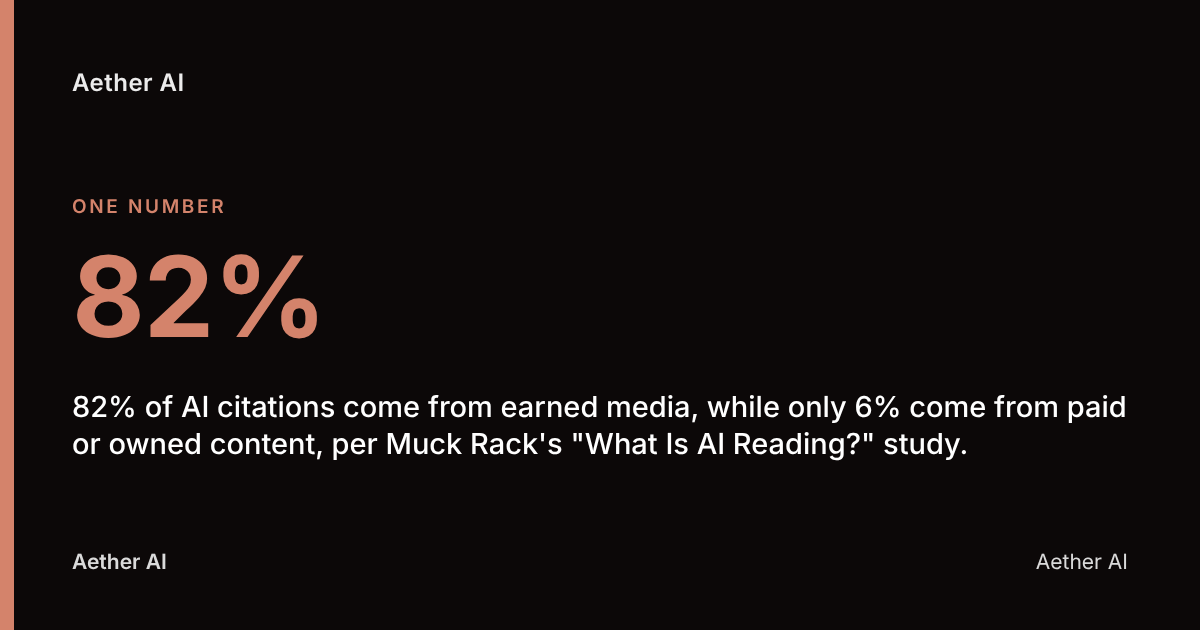
- 82% of AI citations come from earned media, while only 6% come from paid or owned content, per Muck Rack's "What Is AI Reading?" study.
- Branded web mentions correlate 0.664 with ChatGPT visibility, far stronger than backlinks or Domain Rating at 0.218–0.326, according to Ahrefs.
- 42% of B2B decision-makers now use an LLM at the first step of the buying process for competitor comparisons and trust evaluation, per ZipTie.ai.
- Aether AI's own baseline scan of 700 live AI engine answers across four UK brands found their names appeared in just 23 answers (3.3%) during July–August 2026, published at aether-ai.co.uk/insights/ai-visibility-baseline-2026.
What Is LLM Optimization for Brands, and How Does It Differ from SEO?
LLM optimization for brands (often shortened to LLMO, or grouped with generative engine optimization, GEO) is the discipline of structuring a company's content, mentions and data so that large language models retrieve, understand and cite it accurately when generating answers. Traditional SEO optimises a page to rank in a list of ten blue links; LLM optimization optimises a brand's entire digital footprint to be the fact an AI model chooses to repeat, often as the only citation a user ever sees.
The mechanics differ sharply. Google's classic ranking factors — backlink volume, Domain Rating, exact-match keywords — were built around a ten-result page where click-through was the prize. LLMs instead synthesise one answer from dozens of sources and decide which brand, if any, gets named. Ahrefs' 75,000-brand study found branded web mentions correlate 0.664 with ChatGPT visibility, compared with just 0.218–0.326 for backlinks or Domain Rating — meaning the things that moved the needle in classic SEO move it far less here.
This has produced new terminology: GEO (generative engine optimization), AEO (answer engine optimization) and LLMO are used somewhat interchangeably across the industry, as Wikipedia's entry on generative engine optimization documents. For a UK marketing team, the practical distinction that matters is this: SEO still earns clicks from Google's ten blue links; LLM optimization earns a mention — or a recommendation — inside an answer where there may be no click at all.
Why Should a UK Business Care How ChatGPT, Gemini or Copilot Represent Its Brand?
A UK business should care because AI assistants are becoming a default research step before purchase, and getting excluded from that step means losing visibility at the exact moment a buyer is deciding. ZipTie.ai found 42% of B2B decision-makers now use an LLM in the first step of the buying process, covering competitor comparisons, pricing research and brand trust evaluation.
The commercial impact is measurable even on the traditional search side. Yotpo reports that brands cited in a Google AI Overview see a 35% higher organic click-through rate and a 91% higher paid click-through rate than brands that aren't cited — while organic CTR for queries that trigger an AI Overview has fallen roughly 61% year-over-year, stabilising near a 0.6% baseline. In practice, that means fewer clicks are available overall, and the brands named inside the AI-generated summary capture a disproportionate share of what remains.
Seasonal data reinforces the urgency: Harvard Business Review recorded a 1,300% surge in AI search referrals to US retail sites during the 2024 holiday season. UK retailers, hospitality groups and professional services firms preparing for peak trading periods — Black Friday, Christmas, January sales — should expect a similar shift as UK consumers adopt the same habits. A brand invisible to ChatGPT or Gemini during that window isn't just missing traffic; it's missing the recommendation entirely, because unlike a search results page, there's often no second listing to fall back on.
How Do Large Language Models Gather and Decide What to Surface About a Brand?
Large language models surface brand information by drawing on a mix of training data, retrieval-augmented web results and real-time citations, weighted heavily toward content the model judges as independently credible rather than brand-authored. Muck Rack's "What Is AI Reading?" study found that 82% of AI citations come from earned media — press coverage, reviews, third-party articles — while only 6% come from paid or owned content such as adverts or a brand's own website copy.
This explains why brand-controlled marketing (adverts, product pages, press releases hosted on-site) carries comparatively little weight. Instead, the signal LLMs respond to most is the brand appearing, by name, across the open web: review platforms, trade press, forums, comparison sites, Wikipedia, and news coverage. Ahrefs' correlation data above — 0.664 for branded mentions versus 0.218–0.326 for backlinks — points the same direction: it isn't about who links to you, it's about how often and how consistently your name appears in text an AI model trusts.
Academic research backs the mechanism further. A Princeton-led GEO study presented at KDD 2024 found that citing sources, adding quotations and including statistics within content improved that source's visibility to generative engines by up to roughly 40%. In other words, content written in a citable, evidence-dense style — the way a journalist or analyst writes, not the way a brochure is written — is measurably more likely to be pulled into an AI answer.
What Practical Steps Can a Brand Take to Improve How AI Chatbots Describe It?
A brand improves how AI chatbots describe it by publishing citable, fact-dense content, securing earned media mentions, and ensuring its own web presence states clear, consistent facts an LLM can quote directly. Because 82% of AI citations trace to earned media rather than owned content, PR and digital PR work — getting named accurately in trade press, review sites and industry roundups — now sits far closer to the centre of LLM optimization than a brand's own marketing copy does.
Concrete actions that UK marketing and SEO teams can take include:
- Audit existing AI answers. Ask ChatGPT, Gemini, Copilot and Perplexity what they know about the brand, its products and its competitors, and note gaps or errors.
- Publish structured, source-dense content. Use clear definitions, named entities, dates and quoted figures rather than vague marketing language — the pattern the Princeton/KDD research found improves citation rates.
- Pursue earned mentions deliberately. Target trade publications, comparison sites and review platforms (Trustpilot, Google Business Profile, sector-specific directories) where a brand name appearing in independent text carries more weight than a backlink.
- Keep core facts consistent everywhere. Company name, registration details, pricing, service area and contact information should match across the website, Companies House filings, directories and social profiles — inconsistency confuses retrieval systems.
- Use schema markup and structured data. FAQ schema, Organization schema and Product schema give models an easier, more reliable source to extract from than unstructured prose.
- Track competitor mentions alongside your own. Knowing which rival gets cited for a given query shows where the gap actually is.
This is precisely the gap Aether AI's citation tracking is built to close: it scans across six AI engines — ChatGPT, Perplexity, Google AI Overviews, Claude, Gemini and Copilot — so a brand can see exactly where it's mentioned, where it's missing, and which competitor is filling that space instead.
How Can a Company Measure Whether Its LLM Optimization Is Working?
A company measures LLM optimization success by tracking how often its brand name is cited across AI engines for its target queries, compared with competitors, over a consistent sample and period. Academic researchers at INSEAD, working with Jellyfish, have proposed a formal metric for this called Share of Model (SOM) — the proportion of relevant AI-generated answers in which a brand is mentioned, modelled on "share of voice" from traditional marketing.
Measurement in practice means running the same set of target queries repeatedly across multiple AI engines and logging whether, and how, the brand appears. Aether AI's own baseline exercise illustrates the scale of the task: across 700 live AI engine scans of four UK brands' target keywords between July and August 2026, the brands were named in only 23 answers — 3.3% of scans — with the longest-established brand, a security services provider, appearing in 6.3% of its 270 scans. That gap between "live" and "named" is the entire point of measurement: without it, a brand has no way of knowing whether its content strategy is moving the needle or standing still.
| Measurement approach | What it tracks | Typical data source |
|---|---|---|
| Manual prompt testing | Spot-check mentions for a handful of queries | ChatGPT, Gemini, Perplexity directly |
| Share of Model (SOM) tracking | % of relevant AI answers that name the brand, vs competitors | Repeated structured queries across engines |
| Citation tracking platform | Mentions across multiple engines, tracked over time | Aether AI and similar GEO platforms |
| GSC query analysis | Share of clicks from queries Google doesn't name | Google Search Console |
That last row matters more than it first appears. On two of the founding team's own properties — Priority First and Aether Agency — Google Search Console data from 19 July to 15 August 2026 showed 82.1% and 88.3% respectively of clicks came from queries Google does not name (the "(not provided)" style gap). That's a strong proxy signal: a large share of real search demand is now effectively invisible to standard keyword tracking, which is exactly the blind spot LLM-focused measurement needs to fill.
Who Should Own LLM Optimization Inside a UK Organisation?
LLM optimization typically sits best with whoever already owns digital content and earned media — usually a combined SEO and PR function, because the discipline draws on both skill sets simultaneously. A pure SEO specialist understands technical structure, schema and keyword research, but 82% of citations come from earned media, which is traditionally PR's territory, per Muck Rack.
The practical answer depends on company size:
- Small and mid-sized UK businesses: ownership usually falls to the existing marketing or SEO lead, who adds AI-visibility tracking to their existing reporting.
- Mid-market and enterprise organisations: an emerging pattern is a hybrid "AI visibility" or "GEO lead" role, bridging SEO, PR and content, reporting shared KPIs like Share of Model to both the CMO and the digital team.
- Regulated sectors (finance, healthcare, legal): compliance or legal should be looped in early, since AI-generated answers about regulated services carry particular accuracy and disclosure risks.
As one industry commentator put it, "AI visibility is fundamentally a brand game. The brands that get mentioned are the ones that show up everywhere," — Eli Schwartz, speaking at an AirOps webinar. That framing argues against siloing LLM optimization inside a single technical team; it needs marketing, PR and content working from one shared measurement.
In-House LLM Optimization vs an Agency or Platform: Which Fits?
Deciding between building LLM optimization in-house and using a specialist platform or agency comes down to internal capacity, existing PR relationships, and how quickly a brand needs visibility across multiple AI engines rather than just one.
| Factor | In-house | Agency / specialist platform |
|---|---|---|
| Speed to start | Slower — requires new skills and tooling | Faster — existing tracking infrastructure |
| Cross-engine tracking (ChatGPT, Gemini, Perplexity, Claude, Copilot) | Manual, time-intensive | Automated, continuous |
| Earned media / PR relationships | Depends on existing team | Varies by provider |
| Cost structure | Staff time + ad hoc tools | Subscription or project fee |
| Best suited to | Large teams with existing PR and SEO functions | SMEs, lean marketing teams, agencies managing multiple brands |
Neither path is universally "better" — a well-resourced in-house team with strong PR contacts may do this well without external help. But most UK SMEs and mid-market firms don't have continuous tracking across six AI engines as a standing capability, which is exactly why self-service platforms exist. Aether AI's own free AI-visibility audit at /audit gives a starting snapshot without committing to a contract, letting a brand see where it stands before deciding how much further investment makes sense.
As Kevin Indig has written on SEO strategy more broadly, "a piecemeal approach to targeting SEO keywords based on search volume, stage of the search journey, or even BOF or pain point intent can be wasted time." The same discipline applies to LLM optimization: scattershot prompt-testing without a repeatable measurement system tends to waste effort rather than build visibility.
What Common Mistakes Do Brands Make with LLM Optimization?
Brands most commonly mistake LLM optimization for a technical SEO task rather than a brand-wide content and reputation effort, and as a result over-invest in their own website while under-investing in earned media. Given that 82% of AI citations trace to earned sources and only 6% to paid or owned content, per Muck Rack, a brand that only polishes its own site is optimising the 6% and ignoring the 82%.
Other recurring mistakes include:
- Treating one AI engine as representative of all of them. ChatGPT, Gemini, Perplexity, Claude and Copilot can each cite different sources for the same query; testing only one gives a false picture.
- Chasing keyword volume instead of citable facts. LLMs reward specificity, named entities and sourced statistics — generic marketing copy rarely gets quoted.
- Ignoring inconsistent facts across the web. Mismatched addresses, pricing or service descriptions across directories confuse retrieval and can cause an LLM to cite outdated information.
- No ongoing measurement. A single audit without repeat tracking can't show whether visibility is improving, flat or declining.
- Overlooking AI-disclosure obligations. Brands using AI-generated content or endorsements risk falling foul of transparency rules if disclosure isn't built in from the start — covered further in the regulatory section below.
What UK Legal and Regulatory Considerations Apply to Brand Content in AI Answers?
UK brands publishing content aimed at AI visibility must still comply with existing consumer protection and advertising law, because an AI-generated answer repeating a misleading claim doesn't remove the brand's liability for having made it. The Advertising Standards Authority (ASA) enforces the UK Advertising Codes (the CAP and BCAP Codes) regardless of the channel a claim travels through, and the Competition and Markets Authority (CMA) enforces the Consumer Protection from Unfair Trading Regulations 2008 — both apply equally whether a misleading claim sits on a webpage or gets echoed inside a chatbot's answer.
Data protection is the second major consideration. Any brand content referencing customer data, testimonials or case studies must comply with UK GDPR and the Data Protection Act 2018, overseen by the Information Commissioner's Office (ICO). Where AI tools are used to generate content that includes real customer quotes or personal data, consent and accuracy obligations still apply in full.
A third, newer concern is AI-disclosure transparency. US guidance from the FTC's Endorsement Guides (16 CFR Part 255) already requires disclosure of AI-generated endorsements and synthetic personas, as detailed by legal analysis of FTC AI disclosure rules; UK brands operating internationally, or simply following best practice, should assume similar transparency expectations will tighten domestically. Practically, that means labelling AI-assisted content honestly and never presenting a synthetic review or testimonial as a genuine customer voice.
What Should a Brand Check for Inaccurate or Outdated AI-Generated Information?
A brand should regularly query major AI assistants directly about its products, pricing, leadership and service area, and compare the answers against its current, verified facts to catch errors before customers do. Because LLMs draw heavily on earned media and web mentions rather than only a brand's own site, outdated facts can persist in an AI's answer long after a brand has updated its own website — old pricing, a former address, a discontinued product line, or a competitor's claim mistakenly attributed to the brand.
A practical quarterly check should cover:
- Ask each major engine (ChatGPT, Gemini, Copilot, Perplexity, Claude) to describe the brand, its core products and its pricing.
- Compare answers against the brand's current website, Companies House record and Google Business Profile.
- Search for the brand name alongside competitor names to see whether it's confused with a similarly named company.
- Check whether any outdated press releases, old directory listings or expired offers are still being cited.
- Flag and correct inconsistencies at the source — the directory, review site or press article the AI is drawing from — rather than only on the brand's own site.
Ongoing citation tracking, rather than a one-off check, catches drift as models update and new web content enters their retrieval pool. This is the continuous function Aether AI's citation tracking is designed to perform across all six major engines, rather than leaving it to occasional manual spot-checks.
How Does LLM Optimization Integrate with Existing SEO and Content Marketing?
LLM optimization doesn't replace SEO or content marketing — it extends both toward a new destination for the same underlying asset: well-structured, fact-dense, consistently published content. A content calendar built for SEO already produces blog posts, guides and landing pages; LLM optimization simply demands those assets be written with citable statistics, named entities and clear definitions, the exact style the Princeton/KDD research found improved visibility by up to roughly 40%.
Where the two disciplines diverge is in distribution focus. SEO has historically rewarded on-site optimisation — meta tags, internal linking, backlink acquisition. LLM optimization shifts weight toward off-site presence: earned media, review platforms, forums and third-party mentions, since those are what 82% of AI citations draw from. A mature strategy runs both in parallel: SEO fundamentals keep the website technically sound and rankable, while a PR and content programme builds the earned-media footprint that gets the brand cited inside AI answers.
Your LLM optimization checklist
- Run the brand name through ChatGPT, Gemini, Copilot and Perplexity and record exactly what each one says.
- Compare those answers against competitors for the same queries to spot where the gap actually sits.
- Audit for inconsistent facts (pricing, address, service area) across the website, directories and review platforms.
- Publish content with named entities, dates, and sourced statistics rather than generic marketing claims.
- Pursue earned media and review-platform mentions, not just on-site content, given 82% of citations come from earned sources.
- Set up repeatable, multi-engine citation tracking rather than a single one-off audit.
- Assign clear internal ownership — ideally a combined marketing/PR/SEO function — with Share of Model as a shared KPI.
- Review AI-disclosure and advertising-law obligations (ASA Codes, UK GDPR) before publishing AI-assisted brand content.
FAQ
What does LLM optimization mean for a brand?
LLM optimization for a brand means structuring its content, online mentions and factual presence so that AI models like ChatGPT and Gemini retrieve and cite it accurately when answering customer questions. It differs from traditional SEO because the goal is being named inside a synthesised answer, not ranking in a list of links.
How is LLM optimization different from traditional SEO?
Traditional SEO optimises for ranking in a list of search results and earning clicks; LLM optimization optimises for being the specific fact or brand an AI model chooses to cite in a generated answer. Ahrefs found branded web mentions correlate far more strongly with ChatGPT visibility (0.664) than backlinks or Domain Rating do (0.218–0.326).
Do backlinks still matter for AI search visibility?
Backlinks still matter for traditional SEO rankings, but they're a weaker signal for AI citation than branded mentions across the web. Ahrefs' correlation data shows branded mentions at 0.664 versus 0.218–0.326 for backlinks and Domain Rating, suggesting earned visibility matters more than link volume alone.
How long does it take to see results from LLM optimization?
Results timelines vary by how established a brand already is online, since AI models draw on existing web content and mentions that may take months to accumulate and be indexed. Ongoing, repeated citation tracking — rather than a single audit — is the only reliable way to see whether visibility is genuinely improving over time.
Can a small UK business compete with large brands in AI search answers?
Yes, because AI citation weighs earned mentions and factual consistency more heavily than domain authority or marketing spend. A smaller brand with clear, consistent, well-sourced content and genuine press or review coverage can be cited ahead of a larger competitor with inconsistent or thin earned-media presence.
Who should manage LLM optimization — marketing, SEO or PR?
LLM optimization works best as a shared function across marketing, SEO and PR, since 82% of AI citations draw from earned media rather than paid or owned content, per Muck Rack. Larger organisations are increasingly creating a dedicated AI-visibility or GEO lead role to coordinate this work.
What is Share of Model and why does it matter?
Share of Model (SOM) is a metric proposed by INSEAD and Jellyfish researchers that measures the proportion of relevant AI-generated answers in which a brand is mentioned, similar to "share of voice" in traditional marketing. It matters because it gives brands a consistent, repeatable way to measure AI visibility rather than relying on anecdotal prompt checks.
Making LLM Optimization Measurable with Aether AI
Every issue this article covers — invisible brand mentions, inconsistent facts, no ongoing tracking across six engines — is exactly what Aether AI's platform is built to surface and fix. Rather than treating LLM optimization as a one-off audit, Aether AI combines automated AI-optimised article generation with continuous citation tracking across ChatGPT, Perplexity, Google AI Overviews, Claude, Gemini and Copilot, plus keyword, competitor tracking and Google Search Console integration, so a brand can see its actual Share of Model rather than guessing at it.
Aether AI's own baseline scan found its four tracked UK brands were named in just 3.3% of 700 live AI engine answers during July–August 2026 — a figure that illustrates exactly how much visibility is typically left on the table before a focused optimisation effort begins, even for an established brand like the security services provider in that sample, which reached 6.3%.
If your brand doesn't know where it stands, the starting point is Aether AI's free AI-visibility audit at /audit, which shows current citation presence across the major engines before any commitment. From there, public pricing at /pricing sets out the self-service options for ongoing tracking and content publication.