Last updated: 2 November 2026
LLM SEO best practices centre on structuring content so ChatGPT, Google AI Overviews, Perplexity and Copilot can extract and cite it directly. This means clear definitions, verifiable facts, clean heading hierarchy and crawlable pages — because Google's AI Overviews alone now reach 2.5 billion users monthly, according to Search Logistics (2025).
Key Takeaways
- Google AI Overviews reach over 2.5 billion users every month, and Google AI Mode reaches 1 billion users, according to Search Logistics (2025).
- AI-sourced sessions from ChatGPT, Perplexity and Gemini surged 527% year-on-year across 19 GA4 properties between January–May 2024 and the same period in 2025, per the Search Engine Land / Previsible 2025 AI Traffic Report.
- ChatGPT users click an average of 1.4 external links per visit, compared with 0.6 links per visit from Google, according to Semrush (2025).
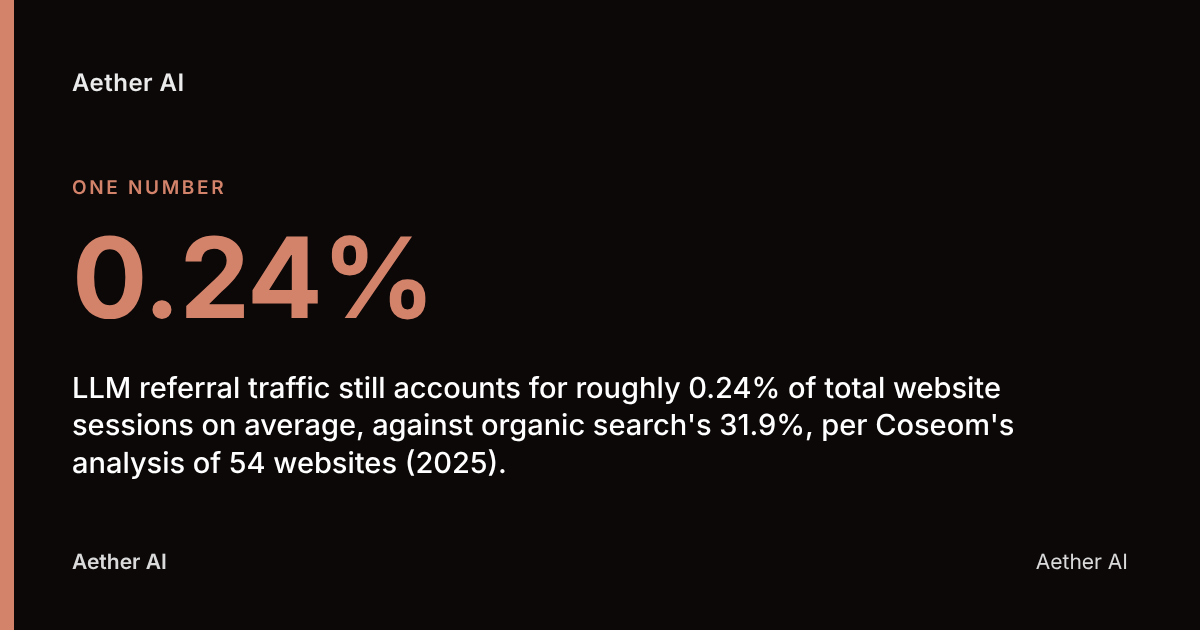
- LLM referral traffic still accounts for roughly 0.24% of total website sessions on average, against organic search's 31.9%, per Coseom's analysis of 54 websites (2025).
- Aether AI's own scans of four UK brands' target keywords across 700 live checks in July–August 2026 found the brands named in just 3.3% of answers, rising to 6.3% for its longest-established brand.
What is LLM SEO and how does it differ from traditional search engine SEO?
LLM SEO is the practice of structuring website content so large language models — AI systems such as ChatGPT, Gemini and Claude that generate human-like text from vast training data — can find, understand and cite it in conversational answers. It sits alongside the newer terms GEO (Generative Engine Optimisation) and AEO (Answer Engine Optimisation), both of which Google's own guidance now groups under the umbrella of "still SEO".
Traditional SEO optimises for rankings on a results page, where a user scans ten blue links and clicks one. LLM SEO optimises for inclusion inside a synthesised answer, where there may be no results page at all. Google's official generative AI optimisation guide, published in 2026, states plainly that foundational SEO practices — crawlability, authoritative content, clear structure — remain the basis for success in AI Overviews and AI Mode.
The commercial stakes differ too. 60% of all Google searches are now zero-click, according to Search Logistics (2025), and by December 2025 AI Overviews had cut position-one organic click-through rate by 58%, per SEOProfy's analysis of Ahrefs data (2025). A business ranking first in classic search can still lose the click entirely if an AI Overview answers the query above it.
Which AI platforms should UK businesses optimise for?
UK businesses should prioritise Google AI Overviews, ChatGPT, Perplexity and Microsoft Copilot, because each draws from different indexes and reaches different audiences. Google AI Overviews and AI Mode together already touch over 3.5 billion monthly users combined, per Search Logistics (2025), making Google the single largest AI surface by reach.
ChatGPT, however, dominates referral behaviour among LLMs specifically. ChatGPT owns 84.2% of AI referrals and grew 3.26x year-on-year, while Microsoft Copilot grew 25.2x and Anthropic's Claude grew 12.8x year-on-year, according to the Previsible 2025 State of AI Discovery Report. That growth rate for Copilot matters for UK firms specifically, since Copilot is embedded in Microsoft 365 — the productivity suite most widely used across British SMEs and public sector bodies.
Perplexity, though smaller in absolute volume, behaves more like a research tool than a chatbot and tends to cite a higher density of sources per answer, making it valuable for B2B and technical content. Microsoft's Bing Webmaster Guidelines now formally define Generative Engine Optimization and explain how meta directives affect which pages Copilot surfaces as citations.
| Platform | Monthly reach / growth | Best content fit | UK relevance |
|---|---|---|---|
| Google AI Overviews / AI Mode | 2.5bn / 1bn users (Search Logistics, 2025) | Informational queries, how-to content | Default entry point for most searches |
| ChatGPT | 84.2% of AI referrals (Previsible, 2025) | Conversational, comparison queries | Largest single LLM audience |
| Microsoft Copilot | 25.2x YoY growth (Previsible, 2025) | Workplace, B2B, technical queries | Embedded in Microsoft 365 across UK business |
| Perplexity | Growing niche adoption | Research-heavy, multi-source queries | Popular with analysts, researchers |
| Claude | 12.8x YoY growth (Previsible, 2025) | Long-form, developer-facing content | Smaller but rising enterprise use |
How do large language models source and select content to cite?
Large language models select citations through a retrieval process that favours clearly structured, factually dense, well-attributed text over persuasive or promotional copy. Most AI answer engines — including Google AI Overviews, Perplexity and Copilot — run a retrieval-augmented generation step: they search a live index, pull candidate passages, and then generate a response that quotes or paraphrases the passages judged most relevant and trustworthy.
This is why heading hierarchy matters so directly: roughly 69% of pages ChatGPT cites follow a clean, logically nested H1-H2-H3 structure, because that structure tells a retrieval system exactly where one passage ends and the next begins. A page with headings used decoratively, or with bold text standing in for headings, is harder for a crawler to segment and therefore less likely to be extracted cleanly.
Content that opens a section with a direct definition is cited roughly 2.1 times more often than content that burrows into context before answering. Over 88% of searches that trigger AI Overviews are informational in intent, according to Semrush (2025) — which means the model is actively hunting for a plain factual answer, not a sales pitch. Pages that also connect to many real, checkable entities — named regulators, standards, dated events — give the retrieval system more anchors to verify the content against, which increases the odds of selection.
What on-page content changes improve LLM citation chances?
On-page content earns LLM citations when it leads with a direct answer, defines its terms, and states facts as standalone sentences a model can lift without losing meaning. The single highest-leverage structural change is opening each section with a complete answer in the first two sentences — naming the subject, not "it" or "this" — because that is the exact span most retrieval systems extract first.
Practical changes that compound:
- Define every term on first use. If you mention "schema markup", explain in the same sentence what it is before assuming familiarity.
- Write facts as single-clause claims. "The SIA licenses door supervisors" extracts cleanly; "They are licensed by the regulator that oversees this sector" does not.
- Front-load your strongest data. Roughly 44% of AI citations are pulled from the first 30% of an article, so the opening paragraphs must carry the article's best statistics and clearest definitions — never save the strongest material for a conclusion.
- Add a Key Takeaways or summary block near the top. This is the single most commonly quoted block on a page, because it is already written as self-contained bullet facts.
- Keep paragraphs short. Two to three sentences per paragraph gives a model a clean, isolatable unit of meaning.
- Name real entities. Specific regulators, standards, dates and organisations give an AI model something concrete to verify your claim against; vague phrases like "industry best practice" give it nothing to check.
Google's own 2026 guidance on optimising for generative AI features reinforces that none of this replaces fundamental SEO — it sits on top of it.
How important is structured data for LLM visibility?
Structured data — machine-readable code added to a webpage using a shared vocabulary such as Schema.org, the cross-industry markup standard backed jointly by Google, Bing, Yahoo and Yandex — helps AI systems interpret what a page is about without guessing from prose alone. It does not guarantee a citation, but it removes ambiguity that might otherwise cause a model to misclassify or skip a page entirely.
For most UK business sites, the schema types that matter most for LLM visibility are:
- FAQPage schema, which maps directly onto the question-and-answer format LLMs already favour when generating conversational responses.
- Organization schema, which anchors your brand's name, logo and official pages as a verifiable entity.
- Article schema, which signals authorship, publication date and the subject matter of long-form content.
- BreadcrumbList schema, which clarifies site hierarchy and topical context.
Bing Webmaster Tools' documentation on structured data confirms support for Schema.org, JSON-LD, Microformats and RDFa, and notes this markup is used directly by Microsoft's systems — including Copilot — to interpret and surface content. JSON-LD is the format Google recommends and the one most AI crawlers parse most reliably.
What role do brand mentions and digital PR play versus backlinks?
Brand mentions — a business's name appearing in text, even without a hyperlink — increasingly influence LLM outputs because models are trained to associate entities with the contexts in which they repeatedly appear, independent of traditional link equity. A backlink tells a classic search engine "this page vouches for that page." A brand mention, cited consistently across independent sources, tells a language model "this entity exists and is associated with this topic" — which is closer to how entity recognition and knowledge-graph-style reasoning actually works.
This doesn't make backlinks irrelevant; Google's guidance still treats authoritative linking as part of foundational SEO. But digital PR — getting a brand named in trade press, roundups, comparison articles and expert commentary — now does double duty: it builds the entity associations LLMs draw on, not just the link graph search engines crawl. For a UK business, this might mean securing mentions in sector publications, contributing expert commentary that gets quoted with attribution, or ensuring consistent NAP (name, address, phone) and sameAs linking across directories, Companies House records and social profiles so an AI system can confirm the entity is real and consistently described.
How can a business measure its visibility in AI-generated answers?
A business measures AI visibility by tracking how often its brand, product or content is named or cited across AI engines for its target queries, since standard analytics tools were not built to capture this. LLM referral traffic currently makes up around 0.24% of total website sessions on average, against organic search's 31.9%, according to Coseom's analysis of 54 websites (2025) — small numbers that make manual spot-checking in each chatbot slow and inconsistent at scale.
Three practical measurement layers matter:
- Referral segmentation in GA4, isolating sessions from chatgpt.com, perplexity.ai, copilot.microsoft.com and similar sources. This catches the traffic that does arrive, but not the far larger number of answers where a brand is mentioned without a click.
- Direct citation tracking, running a consistent set of target queries across multiple AI engines on a schedule and logging whether, and how, a brand is named. Aether AI runs this as a core capability, tracking citations across six AI engines — ChatGPT, Perplexity, Google AI Overviews, Claude, Gemini and Copilot — alongside keyword and competitor tracking and GSC integration, giving a single view of AI visibility rather than six separate manual checks.
- Query-level Search Console analysis, since a meaningful share of clicks now arrive from queries Google doesn't name in its reports at all. Across two tracked properties, Search Console data showed 82.1% of clicks on Priority First and 88.3% on Aether Agency came from queries Google left unnamed between 19 July and 15 August 2026 — a gap that direct citation tracking is built to close.
Aether AI's own measured baseline — 700 live AI engine scans across four UK brands' target keywords in July–August 2026 — found those brands named in just 3.3% of answers overall, rising to 6.3% for the most established brand. Aether AI is built and operated by Aether Agency Ltd. Priority First, Pulse Operations and Aether Agency are the founding team's own operations, not independent clients. That low baseline is consistent with the wider pattern of LLM referral share being small relative to organic search — not a contradiction of it.
What technical requirements need checking for AI crawlability?
AI crawlers need unobstructed access to a website before any content strategy can work, which means checking robots.txt, server response codes and emerging standards like llms.txt before anything else. Each major AI system operates its own named crawler — OpenAI's GPTBot, Anthropic's ClaudeBot, Google's Google-Extended and PerplexityBot among them — and a robots.txt file that blocks one, deliberately or by accident, removes that engine from the citation pool entirely.
A basic technical audit should check:
- robots.txt directives for each named AI crawler, confirming none are blocked unless that's a deliberate business decision.
- HTTP response codes, ensuring key pages return 200 and important content isn't trapped behind JavaScript rendering that crawlers skip.
- XML sitemaps, kept current so crawlers can discover new and updated pages quickly.
- llms.txt, an emerging, not-yet-universally-adopted file some sites use to guide AI systems to their most authoritative pages — worth adding as a low-cost signal, but not yet a substitute for solid on-page SEO.
- Page speed and Core Web Vitals, since slow-rendering pages reduce the chance a crawler fully processes the content before timing out.
None of this is exotic; it is the same crawlability discipline that has underpinned classic SEO for two decades, now applied to a wider set of named bots.
Your LLM SEO checklist
- Audit robots.txt for GPTBot, ClaudeBot, PerplexityBot and Google-Extended access
- Add a direct, definition-first answer to the top of every key page
- Build a Key Takeaways or summary block into long-form content
- Implement FAQPage, Organization and Article schema in JSON-LD
- Name specific entities — regulators, standards, dates — rather than vague claims
- Set up citation tracking across ChatGPT, Perplexity, Google AI Overviews, Claude, Gemini and Copilot
- Segment GA4 referral traffic from major AI platforms monthly
- Secure brand mentions in trade press and third-party roundups, not just backlinks
FAQ
What is LLM SEO and how is it different from traditional SEO?
LLM SEO structures content so AI systems like ChatGPT and Gemini can extract and cite it in generated answers, rather than optimising purely for ranking position on a results page. Traditional SEO chases clicks from a results list; LLM SEO chases inclusion inside a synthesised answer, which increasingly carries no results page at all.
How do I get my website cited by ChatGPT, Gemini or Perplexity?
Structure content with clear, nested headings, open every section with a direct answer, and define technical terms on first use. Citation also depends on crawlability — confirming GPTBot, Google-Extended and PerplexityBot aren't blocked in robots.txt — and on building consistent brand mentions across independent, authoritative sources.
Does schema markup actually help with LLM SEO?
Yes, though it isn't a guarantee of citation on its own. Schema.org markup such as FAQPage, Organization and Article schema helps AI systems interpret page content unambiguously, and Bing's structured data documentation confirms this markup is used directly by systems including Copilot.
What's the difference between LLM SEO, GEO and AEO?
LLM SEO, Generative Engine Optimisation (GEO) and Answer Engine Optimisation (AEO) are largely overlapping terms for the same discipline — optimising content for AI-generated answers rather than classic rankings. Google's own 2026 guidance describes both GEO and AEO as fundamentally "still SEO", built on the same foundations of crawlability and authoritative content.
Do backlinks still matter for LLM SEO?
Backlinks still matter, but brand mentions now carry comparable weight because LLMs associate entities with the contexts they repeatedly appear in, regardless of whether a link is attached. Digital PR that secures consistent brand mentions across trade press and independent sources now serves both goals simultaneously.
How can I measure my visibility in AI search results?
Track direct citations by running consistent target queries across ChatGPT, Perplexity, Google AI Overviews, Claude, Gemini and Copilot on a schedule, and segment GA4 referral traffic from AI platform domains separately from organic search. Aether AI's own platform tracks citations across all six of these engines alongside keyword and competitor tracking and GSC integration.
How long does it take to see results from LLM SEO?
There's no fixed timeline, since it depends on how frequently each AI engine refreshes its retrieval index and how competitive the target queries are. Businesses should expect a gradual build rather than an immediate shift, tracking citation frequency over months rather than days, in the same way organic SEO results compound over time.
Securing your AI visibility with Aether AI
Everything covered above — definition-first content, clean heading structure, schema markup, crawlability and citation tracking — is the exact workflow Aether AI's self-service platform is built to automate for UK businesses trying to appear inside ChatGPT, Perplexity, Google AI Overviews, Claude, Gemini and Copilot answers rather than guess at it manually.
Aether AI tracks citations across all six of those engines alongside keyword and competitor tracking and GSC integration, and the same engine behind the platform publishes and measures its own content across four brands — Priority First, Pulse Operations, Aether Agency and aether-ai.co.uk itself — as a continuous proof of what works. Aether AI is built and operated by Aether Agency Ltd. Priority First, Pulse Operations and Aether Agency are the founding team's own operations, not independent clients.
If you want to see where your own site currently stands, Aether AI offers a free AI-visibility audit at /audit, with public pricing available for businesses ready to move from manual spot-checks to ongoing, structured LLM SEO.