Last updated: 2 November 2026
A LLM SEO case study documents how a business changed its content or website and the resulting shift in visibility within AI answers such as ChatGPT, Gemini or Google AI Overviews. Published examples show gains from 43% to over 580% in AI-driven traffic, though definitions and baselines vary widely across agencies reporting these figures.
Key Takeaways
- Generative Engine Optimization (GEO) — the practice of structuring content so large language models cite it — can lift content visibility in AI answers by up to 40%, according to Princeton University's GEO research (2024).
- Go Fish Digital recorded a 43% rise in monthly AI-driven traffic and a 25x higher conversion rate from AI-referred leads compared with traditional search, per its own GEO case study (2025).
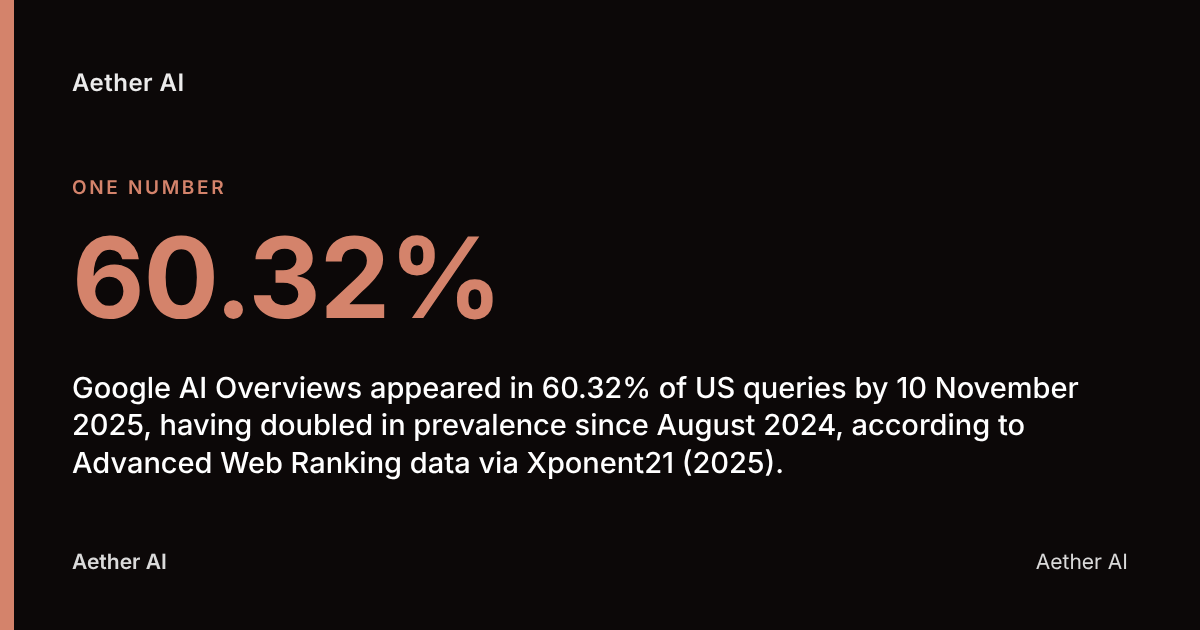
- Google AI Overviews appeared in 60.32% of US queries by 10 November 2025, having doubled in prevalence since August 2024, according to Advanced Web Ranking data via Xponent21 (2025).
- Keyword stuffing was among the weakest tactics tested in the Princeton study and in some cases reduced AI visibility, confirming that legacy SEO spam does not transfer to generative systems, per Blck Alpaca's analysis (2024).
- Aether AI measured its own four brands across 700 live AI engine scans in July–August 2026 and found them named in just 23 answers, or 3.3% of queries tested.
What Is LLM SEO and How Does It Differ From Traditional SEO?
LLM SEO is the practice of optimising content so large language models (LLMs) — the AI systems behind ChatGPT, Gemini and Claude that generate human-like text from training data and retrieved sources — cite a business when answering a user's question. It is also known as AI search optimisation or Generative Engine Optimization (GEO), a term coined in a 2024 Princeton University paper that first benchmarked the practice.
Traditional SEO optimises for ranking position on a search engine results page, where a user clicks through to a website. LLM SEO optimises for inclusion inside a synthesised answer, where there may be no click at all. Google itself confirms this shift matters at scale: Google AI Overviews now appear in 60.32% of US queries as of 10 November 2025, having doubled since August 2024.
The ranking signals differ too. Traditional SEO rewards backlinks, keyword density and domain authority. Princeton's GEO study found that adding citations, statistics and clear authoritative phrasing improved visibility in generative answers by up to 40%, while keyword stuffing — repeating a target phrase unnaturally throughout a page — was among the weakest tactics and sometimes reduced visibility, per Blck Alpaca's analysis. LLM SEO rewards factual density, clear structure and citable claims over link-building volume.
What Does a Typical LLM SEO Case Study Look Like, and What Results Have Been Reported?
A typical LLM SEO case study reports before-and-after metrics for AI referral traffic, citation frequency or AI Overview appearances over a defined period, usually three to twelve months. Results published so far vary enormously by starting point, sector and methodology.
Several documented examples illustrate the range:
| Case Study | Reported Result | Metric Type | Source |
|---|---|---|---|
| B2B SaaS financing platform | 100% lift in AI referrals; 315% surge in AI Overview appearances | Referral traffic + Overview inclusion | Concurate (2025) |
| Go Fish Digital (agency, self-run) | +43% monthly AI traffic; 83.33% lift in AI-referral conversions; 25x higher conversion rate vs traditional search | Traffic + conversions | Go Fish Digital (2025) |
| Telecom brand with iPullRank | AI Overview inclusions rose from 712 to 3,235 over 12 months (253% increase) | AI Overview inclusion count | iPullRank via Relevance (2026) |
| Thompson Tractor with WebFX | 586% rise in generative AI traffic; 116% higher LLM visibility than nearest competitor | Traffic + competitive visibility | WebFX via Relevance (2026) |
These figures should be read with caution. Most are agency self-reported, without independent audit, and large percentage increases often start from a small base — a jump from 20 monthly AI referrals to 29 is technically a 43% increase but a modest absolute gain. No UK regulator or independent body currently audits GEO case study claims, so professionals should treat percentages alongside absolute numbers wherever an agency discloses them.
What Actions Improve Visibility in ChatGPT, Gemini and Google AI Overviews?
Businesses that improved AI visibility in published case studies typically restructured existing content rather than writing entirely new pages. The core actions cluster around three areas: structure, evidence and technical signals.
Content structure changes included:
- Adding clear, standalone definitions at the start of each section
- Breaking long paragraphs into scannable blocks with descriptive subheadings
- Including comparison tables and numbered steps that LLMs can extract cleanly
- Writing direct answers to specific questions rather than broad topic overviews
Evidence and authority signals included adding named statistics with linked sources, citing recognised bodies and standards, and including author credentials or organisational expertise — the kind of trust signal often described as E-E-A-T (experience, expertise, authoritativeness, trustworthiness), a framework Google's own search quality guidelines use to assess content reliability.
The Princeton GEO study specifically tested nine optimisation methods across roughly 10,000 queries and 25 domains, per Blck Alpaca's breakdown, and found that adding citations and quotations to content was among the strongest levers — while keyword stuffing underperformed or actively hurt visibility. This is the opposite of what worked in classic link-building SEO a decade ago.
Technical changes reported in case studies included structured data markup (schema.org JSON-LD), clean HTML heading hierarchy, and fast page load times — all factors that help an LLM's retrieval layer parse a page accurately before generating an answer.
How Long Does It Take to See Measurable Results From LLM SEO?
Most documented LLM SEO case studies report measurable shifts within three to six months, with larger structural gains — such as the telecom brand's AI Overview growth — tracked over a full 12-month period. iPullRank's telecom case study saw AI Overview inclusions grow from 712 to 3,235 across 12 months, a pace consistent with how long it typically takes search engines to re-crawl, re-index and re-evaluate updated content.
Timelines depend on several factors:
- Crawl frequency — how often the AI engine's underlying retrieval system re-indexes a domain
- Content volume — sites publishing consistently tend to surface in training or retrieval data faster than one-off updates
- Existing authority — established domains with prior backlinks and mentions often see faster shifts than new sites
- Query competitiveness — niche B2B queries can shift faster than broad consumer categories already saturated with AI Overview answers
Aether AI's own measurement illustrates how early-stage visibility typically looks before sustained optimisation takes hold: across 700 live AI engine scans of four UK brands' target keywords in July–August 2026, the brands were named in 23 answers overall (3.3%), while the longest-established brand — a security services business — reached 6.3% across its 270 scans. This kind of baseline measurement is the necessary first step before any campaign can credibly claim a lift, because without it, a reported "increase" has no fixed starting point.
How Much Does an LLM SEO Campaign Cost in the UK?
LLM SEO costs in the UK are not yet standardised, and reliable published pricing data from independent UK sources is limited. Rather than quote invented figures, the realistic guidance for UK businesses is to treat LLM SEO as either an extension of an existing content/SEO retainer or a defined project scope, and to request a free audit before committing budget.
Three common commercial models have emerged across the industry:
- Agency retainer — ongoing content optimisation, citation tracking and reporting, typically bundled alongside existing SEO or content marketing services
- Project-based engagement — a fixed-scope audit and rewrite of key pages, followed by a measurement period
- Self-service platform — software that automates content generation and citation tracking without a dedicated agency team, letting an in-house marketer run the process directly
Businesses evaluating cost should ask any agency or platform for a transparent breakdown of what is included: content volume, number of tracked keywords, which AI engines are monitored (ChatGPT, Perplexity, Google AI Overviews, Claude, Gemini and Microsoft Copilot are the six most commonly cited), and how citation data is reported. Aether AI publishes its pricing openly at /pricing rather than requiring a sales call, and offers a free AI-visibility audit at /audit so a business can see its current baseline before spending anything.
How Is Success Measured When AI Assistants Don't Provide Click Analytics?
Success in LLM SEO is measured primarily through citation tracking, referral traffic analysis and query-level visibility scans, because AI assistants like ChatGPT and Claude do not expose the equivalent of Google Search Console's click and impression data. This is the central measurement challenge the industry has had to solve.
The main tracking methods used in published case studies are:
Citation and mention tracking — running a fixed set of target queries through multiple AI engines on a schedule and recording whether, where, and how a brand is named in the answer. This is the closest equivalent to rank tracking in traditional SEO.
Referral traffic analysis — filtering web analytics for traffic sourced from chat.openai.com, perplexity.ai, gemini.google.com and similar domains, then measuring session behaviour and conversions from that segment, as Go Fish Digital's case study did when it reported a 25x higher conversion rate from AI-driven leads than from traditional search.
Query-level visibility scans — testing a defined keyword set across engines at intervals (weekly or monthly) to build a visibility percentage over time, similar to the method behind Aether AI's own 700-scan measurement across four brands.
One UK-specific data point worth noting: Google Search Console increasingly shows a growing share of clicks attributed to queries Google does not name under its standard privacy threshold. An analysis of Priority First and Aether Agency — both the founding team's own operations — found that 82.1% and 88.3% of GSC clicks respectively, between 19 July and 15 August 2026, came from unnamed queries. Aether AI is built and operated by Aether Agency Ltd. Priority First, Pulse Operations and Aether Agency are the founding team's own operations, not independent clients. This pattern suggests a growing volume of long-tail, AI-adjacent search behaviour that traditional keyword reports simply cannot see, reinforcing why citation tracking across AI engines directly has become necessary.
What Mistakes Reduced AI Search Visibility in Published Case Studies?
The most consistently reported mistake is applying legacy keyword-stuffing tactics, which Princeton's GEO research found could actively reduce visibility in generative engine responses rather than improve it, per Blck Alpaca's analysis. Several other recurring pitfalls appear across case study write-ups:
- Vague, unsourced claims — content that asserts facts without naming a source or standard is harder for an LLM to verify and cite confidently
- Buried answers — burying a direct answer three paragraphs into a section rather than opening with it, making retrieval systems skip the passage
- No measurement baseline — launching a GEO campaign without first recording existing visibility, making it impossible to prove any claimed lift
- Treating all AI engines as one target — ChatGPT, Perplexity, Google AI Overviews, Claude, Gemini and Copilot each use different retrieval methods, and content optimised for one does not automatically transfer to another
- One-off publishing — a single optimised page rarely moves visibility; the telecom case study's 12-month, 2,523-inclusion gain reflects sustained content output, not a single rewrite
Who Should Own LLM SEO Inside a UK Business?
Responsibility for LLM SEO typically sits with whoever already owns organic content strategy — usually an in-house marketing lead, SEO specialist, or an external agency — because the discipline extends existing content and technical SEO work rather than replacing it. The skillset required overlaps heavily with traditional SEO: understanding structured data, writing clear factual content, and interpreting analytics.
For smaller UK businesses without a dedicated SEO hire, the practical options are:
| Approach | Best suited to | Trade-off |
|---|---|---|
| In-house marketer with GEO training | Businesses with existing content output | Requires learning new tracking methods |
| SEO agency with GEO service | Businesses wanting full-service management | Higher cost, less direct control |
| Self-service GEO platform | Founders and lean marketing teams | Requires someone to review and publish output |
Aether AI is built specifically for the third category: a self-service platform offering automated AI-optimised article generation, citation tracking across six AI engines, keyword and competitor tracking, and Google Search Console integration — designed for founders, in-house marketers and SEO leads who want to run GEO themselves rather than outsource it entirely.
Your LLM SEO case study checklist
- Record a baseline visibility measurement across target AI engines before changing anything
- Rewrite key pages to open each section with a direct, standalone answer
- Add named sources, standards and statistics rather than unsourced claims
- Remove keyword-stuffed phrasing identified as a weak or harmful tactic in the Princeton GEO study
- Implement structured data markup and a clean HTML heading hierarchy
- Track citation frequency across at least three to six AI engines, not just one
- Segment web analytics for AI-referral traffic separately from organic search traffic
- Re-measure visibility monthly for at least six months before judging results
FAQ
What is an LLM SEO case study?
An LLM SEO case study is a documented record of changes a business made to its content or site, paired with the resulting change in AI search visibility — citation frequency, AI referral traffic, or Google AI Overview appearances. Most published examples cover three to twelve months and come from agencies reporting their own client or self-run results.
What results can UK businesses realistically expect from LLM SEO?
Results vary widely by starting point and sector, but documented case studies range from a 43% rise in monthly AI-driven traffic to a 586% increase in generative AI traffic, according to agency-reported figures from Go Fish Digital and WebFX via Relevance. These figures are self-reported and not independently audited, so absolute numbers matter as much as percentages.
How long before LLM SEO shows measurable results?
Most case studies report initial shifts within three to six months, with larger gains tracked over a full year. The iPullRank telecom case study recorded AI Overview inclusions growing from 712 to 3,235 across 12 months of sustained content work.
Does keyword stuffing still work for AI search optimisation?
No. Princeton's GEO research found keyword stuffing was among the weakest optimisation tactics tested and could reduce visibility in generative engine answers, per Blck Alpaca's analysis. Clear, factual, well-sourced content performed far better across the roughly 10,000 queries tested.
How is LLM SEO success tracked without click data?
Success is tracked through citation monitoring (running target queries across AI engines and recording mentions), referral traffic segmentation in web analytics, and periodic visibility scans. Aether AI's own citation tracking spans six AI engines — ChatGPT, Perplexity, Google AI Overviews, Claude, Gemini and Microsoft Copilot — to build this picture over time.
Is LLM SEO more effective than traditional Google SEO?
Neither replaces the other. Traditional SEO still drives click-through traffic and ranking visibility, while LLM SEO targets citation inside AI-generated answers, which now appear in 60.32% of US queries as of November 2025. The strongest approach treats them as complementary rather than competing disciplines.
Do LLM SEO results vary by industry in the UK?
Published case studies span B2B SaaS, telecom and industrial equipment sectors internationally, with results differing by query competitiveness and existing domain authority rather than industry alone. UK-specific, independently audited case studies remain limited, which is why baseline measurement before any campaign matters more than industry benchmarks.
Tracking your own AI visibility with Aether AI
Every question this article raises — what to track, how long results take, which mistakes to avoid — comes down to one practical problem: most UK businesses have no idea how often they currently appear in AI answers at all. Aether AI was built to close that gap, combining automated AI-optimised content generation with citation tracking across six AI engines so a business can see its baseline before claiming any improvement.
Aether AI's own measurement shows why this matters: across 700 live AI engine scans of its four brands' target keywords in July–August 2026, those brands were named in just 23 answers, or 3.3% overall, with the most established brand reaching 6.3%. That is the kind of honest starting point most published case studies skip past entirely.
If your business wants to see where it currently stands, Aether AI offers a free AI-visibility audit at /audit and publishes its pricing openly at /pricing — no sales call required to find out what your current AI search visibility actually looks like.