Last updated: 2 November 2026
An LLM SEO checklist is the ordered set of technical, content and measurement actions a business takes so that large language models — the systems behind ChatGPT, Gemini and Google AI Overviews — can crawl, understand and cite its website. For UK businesses in 2026, that means fixing crawler access first, then content structure, then schema, then tracking citations, because outbound traffic from ChatGPT alone grew 206% in the past year according to Semrush (2026).
Key Takeaways
- LLM SEO optimises a website for retrieval and citation by AI assistants, whereas traditional SEO optimises for ranking position in a results list.
- Outbound referral traffic from ChatGPT to the wider web grew 206% between January 2025 and January 2026, according to Semrush (2026).
- Generative Engine Optimisation techniques can lift visibility in AI-generated answers by up to 40%, based on a Princeton-led benchmark of roughly 10,000 queries across nine domains (Princeton University/KDD 2024).
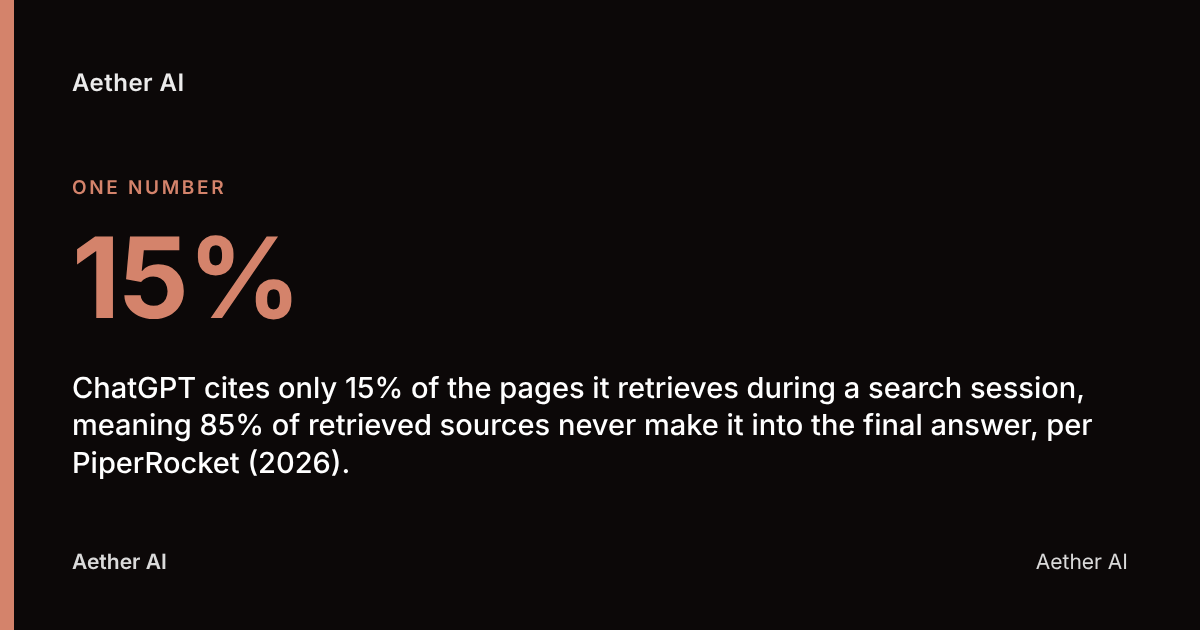
- ChatGPT cites only 15% of the pages it retrieves during a search session, meaning 85% of retrieved sources never make it into the final answer, per PiperRocket (2026).
- In a 700-scan AI-visibility baseline across four UK brands run by Aether AI between July and August 2026, brands were named in just 3.3% of answers overall.
What is LLM SEO and how does it differ from traditional SEO?
LLM SEO is the practice of structuring a website's technical access, content and data markup so that large language models — AI systems trained to generate conversational answers rather than return a list of links — can find, parse and cite it as a source. It is often used interchangeably with GEO (Generative Engine Optimisation), the term coined in the 2024 Princeton/Georgia Tech/IIT Delhi study that first benchmarked how content changes affect AI citation rates.
Traditional SEO optimises for position: it aims to rank a page in the top ten results of a search engine results page, where a user then clicks through. LLM SEO optimises for inclusion: it aims to get a brand's facts, figures or wording lifted directly into an AI-generated answer, often with no click at all. That distinction matters commercially — Conductor's data shows AI platforms currently drive only around 1% of overall web traffic across ten major industries, so the value of LLM SEO is less about visit volume today and more about being the named, trusted source when a buyer asks an AI assistant a question directly.
The two disciplines overlap heavily in the basics — crawlability, clear writing, genuine expertise — but diverge in what "success" looks like, which is why many businesses need a distinct checklist rather than simply doing more of their existing SEO.
Key steps in an LLM SEO checklist for a UK business website
A UK business LLM SEO checklist runs in four stages: crawler access, content structure, structured data, and citation measurement — each building on the last. Skipping the order (for example, adding schema before crawlers can even reach the page) wastes effort.
Stage 1 — Crawler access. Confirm that OpenAI's GPTBot, Google's crawlers covering AI features, Anthropic's ClaudeBot, and Perplexity's PerplexityBot are not blocked in robots.txt. Google has confirmed that "Google-Extended doesn't have a separate HTTP request user agent string. Crawling is done with existing Google user agent strings" — meaning blocking Googlebot for search also blocks Google's AI features, so the two cannot be separated through robots.txt alone.
Stage 2 — Content structure. Rewrite key pages so the first sentence of each section stands alone as a complete answer, using plain headings and short paragraphs that a retrieval system can lift cleanly.
Stage 3 — Structured data. Add schema.org markup — Organization, FAQPage, Article and Product/Service where relevant — so machines can parse entities, not just text.
Stage 4 — Measurement. Run repeat prompts across ChatGPT, Gemini, Perplexity and Google AI Overviews to log whether, and how, the brand is mentioned, then track that over time rather than relying on a one-off check.
Each stage typically takes a small UK team one to three weeks to complete properly, depending on site size and existing technical debt — this is an estimate based on typical implementation timelines, not a measured industry figure.
Technically optimising a website so AI models can crawl it
Technical optimisation for LLMs means auditing server logs and robots.txt so that AI crawlers can physically retrieve a page, then confirming the page's actual HTML content (not just a JavaScript shell) is what gets served to them. Many UK sites built on heavy JavaScript frameworks render content client-side, which some AI crawlers cannot execute — meaning the crawler sees a blank page even though a human visitor sees full content.
Start with these checks:
- Audit robots.txt for explicit disallow rules against GPTBot, Google-Extended, ClaudeBot, PerplexityBot and Amazonbot.
- Check server logs (or ask a developer to) for crawler hits from these user agents — if they're absent entirely, something upstream is blocking them.
- Test rendering by viewing the page with JavaScript disabled; if the core content disappears, server-side rendering or pre-rendering is needed.
- Add an
llms.txtfile at the site root — a plain-text index of key pages proposed by Answer.AI's Jeremy Howard — though evidence of its effect on citation rates is still mixed and it should be treated as a low-cost addition, not a guaranteed lever. - Check Core Web Vitals and page load speed via Google Search Console, since slow-loading pages can time out some crawlers before they retrieve the full page.
- Confirm HTTPS and a clean sitemap.xml are in place and submitted, as both traditional and AI-oriented crawlers rely on them to discover pages efficiently.
Robots.txt directives for common AI crawlers
| Crawler | Operator | Purpose | Typical directive |
|---|---|---|---|
| GPTBot | OpenAI | Training data collection | Allow or disallow per page |
| OAI-SearchBot | OpenAI | Powers ChatGPT search citations | Usually allow |
| Google-Extended | Gemini and AI Overviews training | Allow or disallow per page | |
| ClaudeBot | Anthropic | Training and retrieval | Allow or disallow per page |
| PerplexityBot | Perplexity | Live search retrieval | Usually allow |
Blocking GPTBot for training while allowing OAI-SearchBot for live citations is a common middle ground, since the two serve different purposes under OpenAI's own documentation.
Content formats LLMs prefer when citing sources
Large language models preferentially cite content that answers a question in its opening sentences, uses genuine statistics, and links out to external sources — not content that merely ranks well in Google. The Princeton-led KDD 2024 study found that citing external sources lifted visibility by 115% for lower-ranked content, while adding statistics improved visibility by 41% and adding quotations improved it by 28%, according to Princeton/Georgia Tech/IIT Delhi via Omnibound (2024).
In practice, that means:
- FAQ sections with direct one-to-two-sentence answers before elaboration, since these mirror the question-and-answer pattern a user puts to an AI assistant.
- Clear H2/H3 hierarchy with no skipped levels, so a retrieval system knows precisely where one topic ends and the next begins — roughly 69% of pages cited by ChatGPT follow a clean heading structure.
- Named statistics with sources, rather than vague claims, because an unsourced number is far easier for a model to discard as unverifiable.
- Short paragraphs of two to three sentences, which are easier for a retrieval system to extract as standalone passages.
- Comparison tables, which are frequently lifted whole into AI Overviews and chat answers because the structure itself is self-explanatory.
This is also where sites with greater authority have an edge: SE Ranking found that sites with 32,000 or more referring domains are 3.5 times more likely to be cited by ChatGPT than sites with 200 or fewer — a reminder that content structure alone cannot substitute for genuine third-party credibility signals such as backlinks and press mentions.
Checking whether a brand is already referenced by ChatGPT, Gemini or Perplexity
Checking AI visibility means systematically asking the same brand-relevant prompts across multiple AI assistants and recording whether, where and how a business is mentioned. This is not something Google Search Console or Google Analytics can show, because AI assistants don't expose click-through data the way a search engine results page does.
A manual approach — asking ChatGPT, Gemini, Perplexity and Copilot the same set of ten to twenty buyer-intent questions once a month and logging the answers in a spreadsheet — is workable for a very small business but becomes unmanageable once you're tracking competitors and dozens of keyword variants across six engines.
This is precisely the gap Aether AI's citation tracking is built to close: automated, repeat scanning across ChatGPT, Perplexity, Google AI Overviews, Claude, Gemini and Copilot, paired with keyword and competitor tracking so a business can see not just whether it's mentioned, but how its visibility compares with named rivals over time. Aether AI's own measured baseline — 700 live AI engine scans of four UK brands' target keywords run between July and August 2026 — found those brands were named in just 23 answers, or 3.3% overall, with the longest-established brand (a security services business) appearing in 6.3% of its 270 scans. That gap between brands shows how much variation exists even within one portfolio, and underlines why tracking needs to be ongoing rather than a single snapshot.
Businesses without a paid tool can start with Aether AI's free AI-visibility audit at /audit to get an initial read before committing to ongoing tracking.
Schema markup and structured data for AI-generated answers
Schema markup is a standardised vocabulary of code, published at schema.org, that labels the meaning of content on a page so machines — not just humans — can interpret it unambiguously. For LLM SEO, the priority schema types are Organization, FAQPage, Article, Product or Service, and BreadcrumbList, because these map directly onto the entities and relationships an AI model needs to extract a confident citation.
- Organization schema establishes who the business is, where it's based and what it does — critical for a model deciding whether to trust and name a source.
- FAQPage schema marks up question-and-answer pairs explicitly, aligning with how users phrase prompts to AI assistants.
- Article schema signals publish and update dates, authorship and headline — all of which feed into a model's sense of how current and authoritative a page is.
- Product/Service schema helps models answer comparison and pricing questions accurately by exposing structured attributes rather than forcing inference from prose.
Structured data doesn't guarantee a citation, but it removes ambiguity that might otherwise cause a model to misattribute or skip a fact entirely. It should be validated with Google's Rich Results Test and checked periodically, since schema errors silently degrade over time as pages are updated without the corresponding markup.
How LLM SEO costs compare: in-house, agency or platform
LLM SEO can be run three ways in the UK market — fully in-house, via an external agency, or through a self-service platform — and the right choice depends on team size, technical confidence and how many brands or sites need tracking.
| Approach | Typical suitability | What it covers | Trade-off |
|---|---|---|---|
| In-house | Small teams with a technical marketer or developer | Robots.txt, schema, content rewrites | Needs ongoing time; manual citation checks don't scale across six AI engines |
| Agency-led | Businesses wanting strategy plus execution | Audits, content production, reporting | Higher cost; slower iteration cycles |
| Self-service platform (e.g. Aether AI) | Founders, in-house marketers and SEO leads who want to run it themselves | Automated article generation, citation tracking, keyword and competitor tracking, GSC integration | Requires the team to act on the data, rather than outsourcing judgement entirely |
For a single-site small business, in-house is often sufficient provided someone owns the checklist above and revisits it monthly. For a business tracking several brands or competing against well-funded rivals, manually prompting six AI engines every month stops being realistic — which is why Aether AI built citation tracking, GSC integration and automated AI-optimised article generation into one self-service platform with public pricing at /pricing, rather than requiring a bespoke agency engagement for every change.
Your LLM SEO checklist
- Audit robots.txt for GPTBot, Google-Extended, ClaudeBot and PerplexityBot disallow rules.
- Check server logs for AI crawler hits to confirm they can actually reach your pages.
- Test rendering with JavaScript disabled to ensure core content isn't hidden from crawlers.
- Add an llms.txt file at the root as a low-cost, low-risk addition.
- Rewrite key pages so every section opens with a complete, self-contained answer.
- Add Organization, FAQPage and Article schema to your most important pages.
- Run monthly AI-visibility scans across ChatGPT, Gemini, Perplexity and Copilot and log the results.
- Review Google Search Console for queries where you rank but aren't named, since this often flags AI-era visibility gaps traditional reports miss.
FAQ
What is LLM SEO in simple terms?
LLM SEO is the practice of structuring a website so AI models like ChatGPT and Gemini can crawl, understand and cite it in generated answers. It covers crawler access, content clarity, structured data and ongoing citation tracking.
Is llms.txt actually worth implementing?
Treat llms.txt as a low-cost, low-risk addition rather than a guaranteed ranking lever, since evidence on its direct effect on AI citation rates is still mixed across the industry. It costs little to add and causes no harm, which is why it belongs on a checklist without being oversold.
How long does LLM SEO take to show results compared with traditional SEO?
Technical fixes like robots.txt and schema can take effect within days to weeks once crawlers next visit the page, but citation changes are harder to predict because AI answers vary by prompt and session. Traditional SEO ranking changes are typically visible within Google Search Console within weeks; AI citation changes require repeat manual or automated scanning to detect reliably, since there is no equivalent of a ranking report.
Who should own LLM SEO inside a UK company?
Ownership usually sits with marketing or an in-house SEO lead, because the work is primarily about content and structure rather than infrastructure, though technical steps like robots.txt and schema validation need IT or developer input. Smaller teams increasingly use a single self-service platform to handle both content generation and citation tracking without needing a dedicated specialist hire.
Are there GDPR or compliance issues with AI crawlers?
AI crawlers retrieving publicly published web content generally sit outside GDPR's scope for personal data processing, provided the site doesn't expose customer personal data to crawlers unintentionally. UK businesses should still review robots.txt and any forms or account areas to ensure AI crawlers cannot index pages containing personal data, and consult the ICO if uncertain about specific data flows.
How do you measure LLM SEO performance without normal analytics?
Measurement relies on repeat prompt testing across AI assistants rather than click-through data, logging whether a brand is named, how often, and in what context. Aether AI's own 700-scan baseline across four UK brands between July and August 2026 is an example of this method in practice, recording a 3.3% overall mention rate as a starting benchmark to track against over time.
What's the single biggest mistake businesses make with LLM SEO?
The most common mistake is treating LLM SEO as a one-off project rather than an ongoing cycle of crawler checks, content updates and citation tracking. Since ChatGPT only cites 15% of the pages it retrieves per PiperRocket (2026), a single optimisation pass rarely secures lasting visibility without repeat measurement and refinement.
Tracking your checklist results with Aether AI
Every stage of the checklist above — crawler access, content structure, schema and measurement — ends at the same question: is the brand actually being cited, and by whom? Aether AI was built specifically to answer that, combining automated AI-optimised article generation with citation tracking across ChatGPT, Perplexity, Google AI Overviews, Claude, Gemini and Copilot, alongside keyword and competitor tracking and GSC integration, so a business isn't left guessing after implementing the checklist.
Aether AI's own measured baseline — 700 live scans across four UK brands' target keywords between July and August 2026 — found brands named in just 3.3% of answers overall, with the most established brand reaching 6.3% across its 270 scans. Aether AI is built and operated by Aether Agency Ltd. Priority First, Pulse Operations and Aether Agency are the founding team's own operations, not independent clients, and that baseline was measured across those four brands directly.
To see where your own business currently stands, run the free AI-visibility audit at aether-ai.co.uk/audit, or review public pricing at /pricing to put ongoing tracking in place.