Last updated: 28 October 2026
AI visibility typically drops because of model updates, citation volatility, or genuine content decay — not usually a single catastrophic error. AI Overview citations change roughly every 2.15 days on average (per Ahrefs, 2026), so before assuming failure, UK businesses should first rule out normal platform churn.
Key Takeaways
- AI Overview citations have a persistence of just 2.15 days on average, with only 54.5% of cited URLs overlapping between consecutive responses, according to Ahrefs (2026).
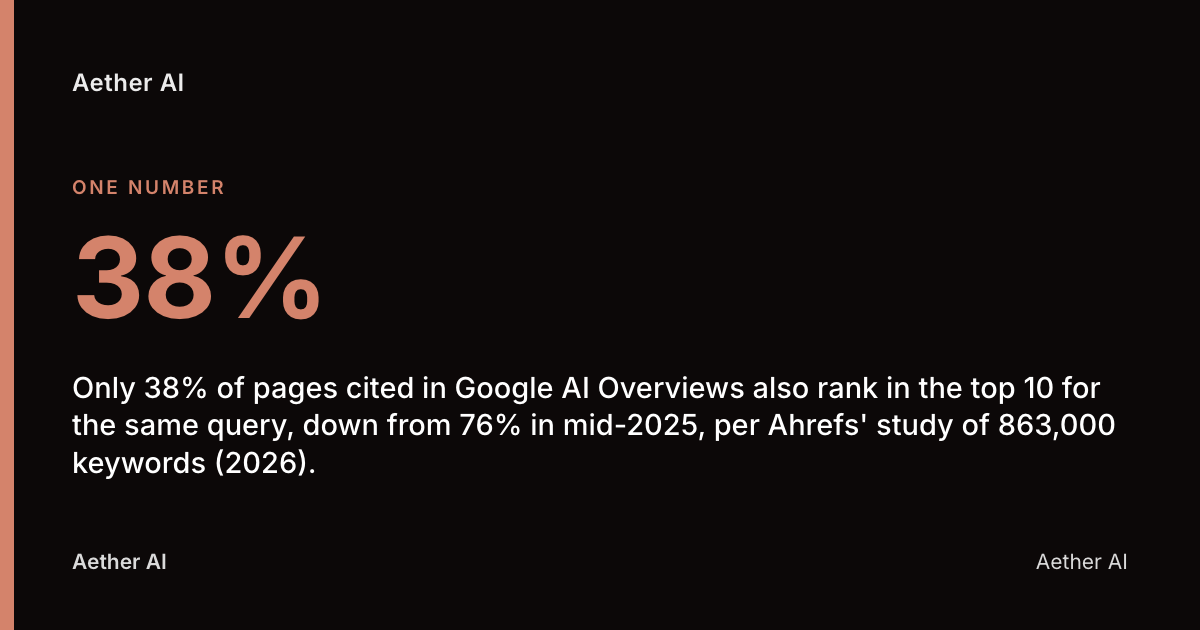
- Only 38% of pages cited in Google AI Overviews also rank in the top 10 for the same query, down from 76% in mid-2025, per Ahrefs' study of 863,000 keywords (2026).
- ChatGPT and Google AI Overviews return the same brand list less than 1% of the time across repeated identical prompts, according to Search Engine Journal reporting on SparkToro/Gumshoe.ai research (2026).
- The average brand mention rate across AI answers is just 17.2%, meaning most businesses are invisible in most AI answers most of the time, per AthenaHQ's State of AI Search 2026 report.
- A single unannounced model change can collapse a whole citation category overnight — Reddit's share of ChatGPT Search citations fell from 3.83% to 0.52% in days, an 86.4% relative drop, according to Promptwatch data cited by DesignRush/Boostability (2026).
What is AI visibility and how is it measured?
AI visibility is the measurable frequency with which a brand, product or domain is named, cited or recommended inside answers generated by large language model (LLM) platforms such as ChatGPT, Google AI Overviews, Perplexity, Claude, Gemini and Microsoft Copilot. Unlike traditional search engine rankings, which are based on a fixed position on a results page, AI visibility is probabilistic — the same prompt run twice can produce different brand lists.
Three distinct metrics sit under the "AI visibility" umbrella, and conflating them is the most common reporting error businesses make:
- Mention rate — how often a brand name appears anywhere in an AI answer, regardless of context.
- Citation rate — how often a brand's URL is specifically linked as a source.
- Share of voice — a brand's mentions as a proportion of all competitor mentions for a given topic cluster.
The average AI brand mention rate across AI answers sits at just 17.2%, according to AthenaHQ's State of AI Search 2026 report. For context, category leaders in business-to-business (B2B) sectors took a median 31.0% of all brand mentions in a 2026 benchmark of 16,134 AI answers, with the top two brands together capturing between 46% and 65%, per Klarivo's AI Visibility Benchmark 2026. Aether AI tracks citation activity across six engines — ChatGPT, Perplexity, Google AI Overviews, Claude, Gemini and Copilot — because a drop confined to one platform tells a different diagnostic story to a drop across all six.
What are the most common reasons AI visibility suddenly drops?
AI visibility drops most often result from platform-side churn rather than anything a business did wrong. The underlying retrieval systems that power ChatGPT, Gemini and Google AI Overviews are rebuilt constantly, and citation sets shift with every model refresh, index update or ranking-signal change.
The most frequent causes, in rough order of likelihood, are:
- Normal citation volatility — AI answers to the same prompt change routinely; this is baseline behaviour, not a fault.
- An unannounced model or retrieval update — platforms like OpenAI shift which sources they trust without public notice.
- Loss of organic ranking overlap — AI Overviews increasingly cite pages that don't rank in the top 10, breaking the old assumption that good SEO guarantees AI citation.
- Technical access problems — blocked crawlers, broken redirects, or lost structured data (schema.org markup).
- Competitor content gains — a rival publishes a more current, more authoritative, or more frequently cited resource.
- Content decay — figures, dates or claims in your existing content become outdated or are superseded by newer sources.
Only 38% of pages cited in Google AI Overviews also rank in the top 10 organically, a steep fall from 76% in Ahrefs' earlier July 2025 study, according to Ahrefs' analysis of 863,000 keywords and 4 million AI Overview URLs (2026). As David Malmborg, VP of Sales and Strategy at Boostability, put it: "A page's ranking measures whether Google trusts it enough to put it on page one. It's never been a proxy for AI visibility." That single fact explains why a business can hold a strong Google ranking in Manchester or Leeds search results while still vanishing from AI answers for the same query.
Did a recent model update by ChatGPT, Gemini or another AI platform cause the change?
A model update is one of the most plausible single causes of a sudden, sharp AI visibility drop, and recent evidence shows these changes can be dramatic and near-instantaneous. When OpenAI shifted Free and Go-tier accounts to a new underlying model, ChatGPT's listicle citations fell from 15.77% to 7.80% — a 50.5% relative drop — and comparison-page citations fell from 9.08% to 6.17%, a 32.1% decline, on the same day, according to Peec AI data cited by The State of Brand (2026).
An even starker example: Reddit's share of ChatGPT Search citations held steady at around 3.83% between 18 July and 7 August before collapsing to just 0.52% between 14–17 August — an 86.4% relative drop — while Google's AI Overviews declined only gradually over the same window, from roughly 2.37% to 2.10%, per Promptwatch data cited by DesignRush/Boostability (2026). This kind of platform-specific, overnight collapse — confirmed independently by Forbes and Cybernews — is the clearest signature of a retrieval-system change rather than a content or technical fault on your side.
To check whether this applies to you: compare your visibility trend against a competitor or an unrelated reference brand over the same dates. If both drop simultaneously on one platform only, the cause sits with the platform, not your content.
Has my website had technical issues affecting AI crawl and indexing?
Technical faults are a verifiable, fixable cause of AI visibility loss, and they should be ruled out before any content rewrite. AI engines rely on crawlers — including GPTBot, Google-Extended, PerplexityBot and ClaudeBot — being able to access, render and index your pages, exactly as Googlebot does for traditional search.
Common technical culprits include:
- robots.txt blocks against AI crawlers, sometimes added inadvertently during a site migration.
- Broken or chained redirects following a URL restructure or rebrand.
- Loss of structured data (schema.org JSON-LD markup) that previously helped engines parse entities, FAQs or pricing.
- Slow page load or rendering failures on JavaScript-heavy sites, which can prevent content from being indexed at all.
- Removed or merged pages without proper 301 redirects, orphaning previously cited URLs.
- Google Search Console (GSC) errors — coverage issues, manual actions, or a spike in 404s reported in GSC often precede an AI visibility decline by days or weeks.
Checking GSC should be the first diagnostic step, because AI engines and Google's own crawlers frequently share underlying infrastructure signals. Aether AI's GSC integration surfaces these crawl and indexing issues alongside citation tracking, so a business can see whether a Google Search Console error coincides with the date visibility fell — turning a vague suspicion into a dated, checkable fact.
Have my competitors improved their content enough to push me out?
Competitor improvement is a genuine and increasingly common cause of AI visibility loss, particularly in crowded B2B categories where a handful of brands dominate citations. In a 2026 benchmark covering 16,134 AI answers, the category leader alone captured a median 31.0% of all brand mentions, with the top two brands together taking between 46% and 65% of the total, according to Klarivo's AI Visibility Benchmark 2026.
This concentration means visibility is genuinely zero-sum within a topic cluster: if a competitor publishes a more current statistics round-up, a sharper comparison page, or earns a fresh citation from an authoritative third party, your existing content can lose its citation slot even without changing at all. Semrush's own internal team demonstrated how quickly this balance can shift the other way — growing AI share of voice from 13% to 32% within a single month using its AI Visibility Toolkit, according to Position Digital, citing Semrush internal case data (2026).
The practical takeaway: track competitor share of voice alongside your own. A drop in your mentions that coincides with a rise in one named competitor's mentions on the same prompts is strong evidence of displacement rather than platform volatility.
How do I diagnose whether a drop is real or normal fluctuation?
Diagnosing an AI visibility drop requires separating genuine decline from the platform's inherent day-to-day noise, because most single-day swings are statistically meaningless. ChatGPT and Google AI Overviews return the exact same brand list less than 1% of the time across repeated identical prompts — and the same list in the same order less than 0.1% of the time — according to Search Engine Journal's reporting on SparkToro/Gumshoe.ai research (2026).
A sound diagnostic workflow runs in this order:
| Step | What to check | What it tells you |
|---|---|---|
| 1. Time window | Compare a 7-14 day rolling average, not single days | Filters out normal AI answer volatility |
| 2. Cross-engine comparison | Check ChatGPT, Gemini, Perplexity, Copilot and AI Overviews separately | A drop on one engine suggests a model update; a drop on all six suggests a content or technical issue |
| 3. GSC correlation | Check Google Search Console for crawl errors, coverage drops or manual actions on the same dates | Confirms or rules out a technical cause |
| 4. Competitor tracking | Check whether a named competitor's mentions rose as yours fell | Confirms or rules out displacement |
| 5. Content audit | Check publish/update dates and statistic currency on previously cited pages | Confirms or rules out content decay |
Because AI Overview content itself has a persistence of only 2.15 days on average, with just 54.5% of cited URLs overlapping between consecutive responses, a single bad scan proves very little, according to Ahrefs' research across 43,000 keywords (2026). Aether AI's citation tracking runs scans across all six engines on a rolling basis specifically to surface the 7-14 day trend line rather than reacting to one noisy data point — this is the same discipline Aether AI applies to its own dogfooded properties.
How long does recovery take once the cause is fixed?
Recovery timescales vary by cause, and no verified industry-wide average exists for every scenario, so businesses should treat recovery as a range rather than a fixed promise. Where the cause is a technical fault — a robots.txt block or broken schema — visibility can return within one to two crawl cycles once the fix is deployed and re-indexing occurs, often a matter of days to a few weeks.
Where the cause is content decay or competitor displacement, recovery typically takes longer, because it requires publishing genuinely improved content and waiting for AI platforms to discover and trust it — commonly several weeks to a few months in SEO-adjacent practice, though no single verified figure applies universally across engines. Where the cause is a platform-wide model update, recovery is often outside a business's direct control and depends on the platform's own subsequent changes; the Reddit citation collapse, for instance, reflected a shift in OpenAI's retrieval behaviour that individual publishers could not fix by altering their own content.
The most useful first-party benchmark is simply understanding your realistic starting point. Aether AI's own measured baseline — 700 live AI engine scans of four UK brands' target keywords between July and August 2026 — found those brands named in just 23 answers (3.3%), with the longest-established brand named in 6.3% of its 270 scans. That figure illustrates how low typical baseline visibility is even for established brands, which should calibrate expectations before assuming a "drop" from a low starting point is catastrophic.
Your AI visibility diagnosis checklist
- Pull a 7-14 day rolling average of mentions and citations before concluding a drop is real.
- Check Google Search Console for crawl errors, coverage drops or manual actions around the same dates.
- Confirm robots.txt and crawler access rules haven't inadvertently blocked GPTBot, Google-Extended, PerplexityBot or ClaudeBot.
- Verify structured data (schema.org markup) is still present and valid on previously cited pages.
- Compare your mention trend against one named competitor on identical prompts.
- Audit the publish and last-updated dates on your most-cited pages for outdated statistics or claims.
- Track visibility separately across ChatGPT, Gemini, Perplexity, Claude, Copilot and Google AI Overviews rather than as one blended figure.
- Run Aether AI's free AI-visibility audit at /audit to get a dated, cross-engine snapshot to compare against.
FAQ
Why did my AI visibility drop suddenly overnight?
A sudden overnight drop is most often caused by an unannounced AI model or retrieval update rather than anything you changed. Reddit's ChatGPT Search citation share fell from 3.83% to 0.52% within days following one such change, according to Promptwatch data cited by DesignRush/Boostability (2026).
Is it normal for AI visibility to fluctuate day to day?
Yes, significant day-to-day fluctuation is entirely normal and expected behaviour for AI search platforms. AI Overview citations change roughly every 2.15 days on average, with only 54.5% of cited URLs persisting between consecutive responses, per Ahrefs (2026).
Why did my brand disappear from ChatGPT or Google AI Overviews?
Disappearance from AI answers usually traces to one of four causes: a platform model update, a technical crawl or indexing issue, competitor displacement, or content that has become outdated. Checking Google Search Console and cross-engine trends over a 7-14 day window is the fastest way to isolate which applies.
How do I check if an AI visibility drop is real or just tracking noise?
Compare a rolling average across at least seven to fourteen days rather than relying on a single scan. Because ChatGPT and Google AI Overviews return identical brand lists less than 1% of the time on repeated prompts, a single day's absence rarely indicates a genuine problem, according to Search Engine Journal (2026).
Can a competitor cause my AI visibility to drop?
Yes, competitor content improvements can directly displace your brand from AI answers, particularly in concentrated categories. Category leaders captured a median 31.0% of all brand mentions in a 2026 B2B benchmark, showing how dominant top performers can become, per Klarivo's AI Visibility Benchmark 2026.
Does a Google algorithm update affect AI Overview presence specifically?
Yes, Google's core ranking changes and Google AI Overview retrieval behaviour can shift independently of each other. Only 38% of pages cited in AI Overviews also rank in the top 10, down from 76% previously, confirming AI citation and organic ranking are increasingly separate systems, according to Ahrefs (2026).
What tools can I use to track AI visibility over time?
Dedicated AI visibility and citation-tracking platforms monitor mentions and citations across multiple engines rather than relying on manual prompt checks. Aether AI tracks citations across six engines — ChatGPT, Perplexity, Google AI Overviews, Claude, Gemini and Copilot — alongside keyword, competitor and Google Search Console data in one dashboard.
Diagnosing and fixing your AI visibility with Aether AI
This article has covered the diagnostic path businesses need when AI visibility drops — separating platform volatility from genuine technical, competitive or content-based causes. That diagnostic workflow is exactly what Aether AI's platform automates: continuous citation tracking across six AI engines, Google Search Console integration to correlate technical signals, and competitor tracking to spot displacement before it becomes a trend.
Aether AI's own measured baseline across its four dogfooded brands — 700 live scans between July and August 2026, resulting in just 23 total mentions (3.3%) — is published openly at aether-ai.co.uk/insights/ai-visibility-baseline-2026, demonstrating the platform's commitment to reporting its own real numbers rather than invented benchmarks.
If your AI visibility has dropped — or you simply don't know your current baseline — run Aether AI's free AI-visibility audit at /audit to get a dated, cross-engine snapshot and a clear starting point for diagnosis.