Last updated: 29 October 2026
ChatGPT recommends a competitor rather than your business because it pulls answers from web-wide signals — reviews, press coverage, structured data and crawled content — where that competitor simply appears more often and more clearly. Aether AI's own scan of 700 live AI answers (July–August 2026) found four UK brands named in just 3.3% of relevant queries.
Key Takeaways
- Aether AI notes that ChatGPT builds answers from live web search plus training data, not from a paid directory, so visibility depends on how often and how clearly a brand appears across the open web.
- A Princeton-led study found adding statistics to content improved AI visibility by 41%, one of the highest-impact tactics tested across 10,000 queries (Princeton University et al., KDD 2024).
- Aether AI's scan of 700 live AI engine results across four UK brands in July–August 2026 found those brands named in only 23 answers, or 3.3% of scans.
- 51% of B2B software buyers now start research with an AI chatbot more often than Google, up from 29% in April 2025 (G2, 2026).
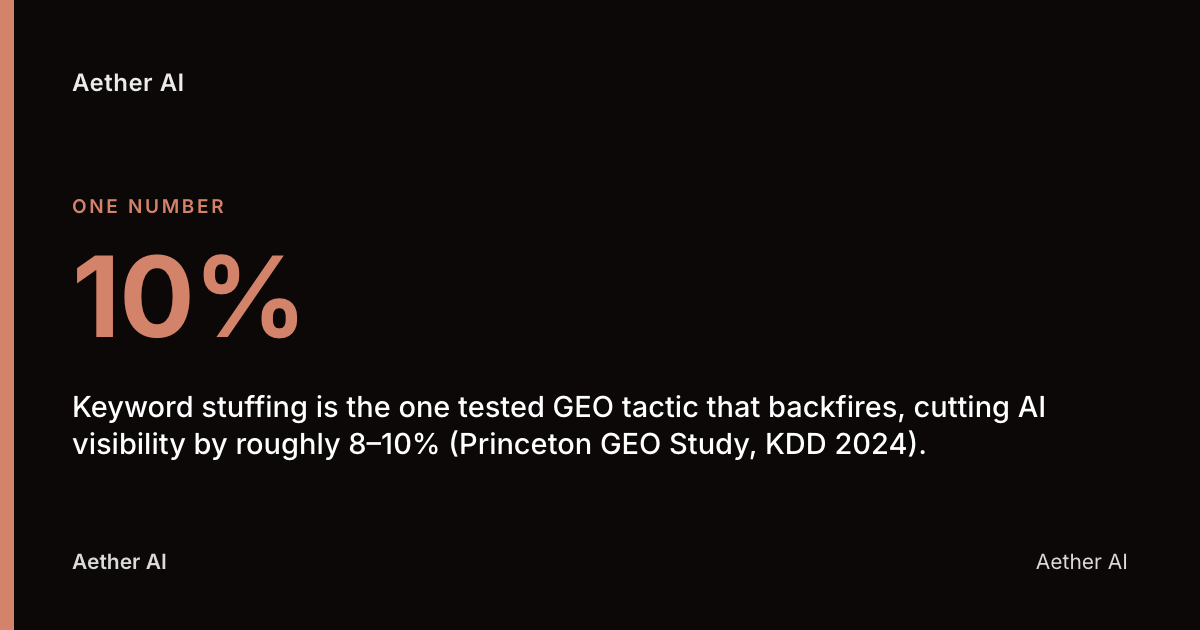
- Keyword stuffing is the one tested GEO tactic that backfires, cutting AI visibility by roughly 8–10% (Princeton GEO Study, KDD 2024).
What is ChatGPT doing when it recommends a company?
ChatGPT is a large language model built by OpenAI that generates answers by combining patterns learned during training with, when enabled, live web search results fetched through tools such as OAI-SearchBot. When someone asks "what's a good security company in Manchester" or "best facilities management software UK", ChatGPT does not consult a registry of approved suppliers — it predicts a plausible, well-supported answer based on what it has read.
Two distinct mechanisms matter here, and they behave differently. The first is parametric knowledge: facts absorbed during training, which can be months or years old depending on the model's training cut-off. The second is retrieval-augmented browsing, where ChatGPT actively searches the web in real time and cites sources inline, similar to how OpenAI's own documentation describes its search behaviour for enterprise and education accounts.
A business that is well documented across both layers — strong historical mentions and strong current web presence — is far more likely to surface than one that relies on a single well-ranked Google page. This is why a competitor with modest Google rankings can still dominate ChatGPT: it has simply been written about, reviewed, and linked to more widely across the web that both layers draw from.
How does ChatGPT actually decide which companies to mention?
ChatGPT decides which companies to mention by weighing how frequently and how clearly a brand is described across its training data and live search results, favouring sources it judges authoritative, consistent, and easy to extract facts from. It is not ranking URLs the way Google's PageRank algorithm does; it is synthesising an answer and then deciding which named entities best support that answer.
Several factors tend to push a business into that synthesis:
- Consistency across sources. If ten different web pages describe a company the same way — same service area, same specialism — ChatGPT treats that as corroborated fact.
- Clear, extractable claims. Content written as plain statements ("X provides 24/7 static guarding across Greater Manchester") is easier for a model to lift than vague marketing copy.
- Third-party validation. Independent reviews, press coverage, and directory listings carry more weight than a company's own website alone, because they're harder to game.
- Structural clarity. Pages with clean heading hierarchies and defined terms are cited roughly 2.1 times more often in current GEO research, because retrieval systems can isolate where one claim ends and another begins.
Crucially, ChatGPT has no concept of "fairness" between competitors in a given market. It isn't aware it's choosing between your business and a rival's — it's simply retrieving the most reinforced answer to the question asked.
Why does ChatGPT recommend a competitor instead of my business specifically?
ChatGPT recommends a named competitor over your business most often because that competitor has more corroborating signal across the web — more reviews, more press mentions, more structured content — not because of any deliberate preference. If your competitor has a Wikipedia entry, regular trade press coverage, and dozens of Trustpilot or Google reviews, while your business has a single static website, the model has simply seen more evidence for one name than the other.
This matters commercially. Bain & Company found that 85% of B2B buyers arrive with a "Day One List" already formed, increasingly built inside AI conversations before a salesperson is ever contacted (Bain & Company, 2026). If your competitor is on that list and you're not, you may be losing deals before your sales team even knows the buyer exists.
It's also worth separating three scenarios that look identical from the outside but have different fixes:
| Scenario | What's happening | Typical fix |
|---|---|---|
| Competitor mentioned, you're absent entirely | Insufficient web signal about your business | Build citable content, reviews, and third-party mentions |
| Competitor described more favourably | Their content has clearer claims or more recent coverage | Publish clearer, dated, fact-dense content |
| You're named but inaccurately | Outdated or conflicting data across sources | Correct inconsistent listings (Companies House, directories, your own site) |
Does my competitor's website content or SEO affect how ChatGPT describes them?
Yes — a competitor's on-page content directly shapes how ChatGPT paraphrases and cites them, because clearer, fact-dense pages are easier for the model to extract and reuse. This is distinct from traditional Google ranking signals, and it produces a genuinely counterintuitive result.
The Princeton-led GEO study found pages ranked 5th in traditional Google search achieved up to a 115% visibility lift after Generative Engine Optimization (GEO) — writing specifically to be cited by AI — while top-ranked, first-position pages could actually lose up to 30% visibility, described as an "equalizer effect" (Princeton GEO Study, KDD 2024). In other words, your competitor doesn't need the number one Google spot to beat you in ChatGPT; they need clearer, more citable writing.
The same research found keyword stuffing was the one tactic that backfired, reducing visibility by roughly 8–10% against an unoptimised baseline (Princeton GEO Study, KDD 2024). So if a competitor's site reads naturally, defines its services plainly, and includes specific facts and figures, it's playing exactly the game that current research says works — regardless of whether it outranks you on Google.
Can reviews, press coverage or a Wikipedia presence influence ChatGPT's answers?
Reviews, press coverage and reference sites like Wikipedia strongly influence ChatGPT's answers because they function as independent corroboration that the model treats as more trustworthy than a company's own marketing. A business reviewed 200 times on Trustpilot, covered by trade press, and listed in sector directories such as the NSI or relevant industry body gives ChatGPT multiple independent confirmations of the same facts.
This matters because 85% of buyers think more highly of a software vendor when an AI chatbot mentions them at all (G2, 'The Answer Economy' Report, 2026) — being named is itself a credibility signal, which compounds the advantage for whichever company already has third-party visibility. Reddit threads, LinkedIn discussion, trade publications, and G2 or Capterra listings all feed this layer, particularly for B2B software where 94% of buyers used large language models (LLMs) — AI systems like ChatGPT that generate human-like text — somewhere in their most recent purchase process (6sense, 2025 Buyer Experience Report).
A Companies House registration, a current entry on your professional body's member list, and consistent NAP (name, address, phone) data across directories all strengthen this same layer and cost nothing beyond admin time.
Is ChatGPT's training data outdated, and could that explain the gap?
ChatGPT's training data does have a cut-off date, and anything that changed after that point — a rebrand, a new service line, a closed competitor — may not appear in the model's underlying knowledge unless live web search fills the gap. This is a genuine and common cause of inaccurate or missing mentions, particularly for younger UK businesses.
However, this explanation is frequently overstated. Modern ChatGPT, when browsing is enabled, fetches current web pages through tools like OAI-SearchBot, which OpenAI's own crawler documentation confirms is distinct from the GPTBot used for training. That means a business founded or substantially changed in 2026 can still appear in live-search answers today, provided the web has caught up — fresh press coverage, an updated website, current directory listings.
So "outdated training data" explains some gaps, but it rarely explains all of them. If your competitor launched after you and still outranks you in ChatGPT's live answers, training-data age isn't the cause — current web signal is.
What can I check on my own site to see why I'm missing?
Start by checking whether your own website states, in plain sentences, exactly what you do, where you operate, and who you serve — because vague or purely visual marketing copy gives ChatGPT nothing concrete to extract. Run through this quick audit before assuming the problem is external:
- Search your own brand name plus your core service in ChatGPT, Perplexity, and Google AI Overviews. Note whether you appear at all, and if so, how accurately.
- Check your robots.txt file to confirm you haven't accidentally blocked GPTBot or OAI-SearchBot — a common technical oversight that silently removes you from both training and live search.
- Review your Google Search Console data. A large share of Priority First's and Aether Agency's Search Console clicks came from queries Google itself doesn't name — a sign of how much query volume now sits outside visible keyword data entirely.
- Audit third-party mentions. Search your brand name on Trustpilot, Google Reviews, and any sector-specific directories to see what independent sources currently say about you.
- Check for conflicting information. Old addresses, outdated phone numbers, or a defunct Companies House filing can all confuse the corroboration signal ChatGPT relies on.
A free AI-visibility audit at Aether AI runs this kind of check automatically across six AI engines rather than manually, which matters because the picture often differs meaningfully between ChatGPT, Gemini, and Copilot for the same query.
How can I improve my chances of being recommended, and how long does it take?
You improve your chances by publishing fact-dense, clearly structured content, earning genuine third-party mentions, and keeping your core business details consistent everywhere they appear — then tracking whether that shifts actual AI answers over time. There's no universal timeline, but a few patterns from current research help set expectations.
Because GEO content relies partly on live web search, some changes can surface within weeks once a page is crawled and indexed by both Google and AI crawlers. Deeper shifts — particularly in a model's parametric training knowledge — move more slowly and depend on the provider's next training cycle, which is outside any business's control.
What's within your control:
- Aether AI advises writing in defined, standalone statements rather than vague brand language — a model extracts "we provide 24/7 manned guarding across Greater London" far more easily than "we're passionate about keeping people safe."
- Add genuine statistics and sourced data to your content; the Princeton GEO study found this single tactic lifted AI visibility by 41% (Princeton University et al., KDD 2024).
- Avoid keyword stuffing entirely — it's the one tactic proven to actively hurt visibility (Princeton GEO Study, KDD 2024).
- Build citation tracking into your routine, checking monthly across ChatGPT, Perplexity, Claude, Gemini, Copilot, and Google AI Overviews rather than assuming one check is enough.
Aether AI's citation tracking monitors exactly this across all six major AI engines, so changes to your visibility are measured rather than guessed at.
Your AI-visibility diagnosis checklist
- Search your own brand and core service terms in ChatGPT, Perplexity, and Google AI Overviews to see what currently surfaces.
- Confirm GPTBot and OAI-SearchBot are not blocked in your robots.txt file.
- Compare how your website describes your services against how a competitor describes theirs — look for vague copy versus specific claims.
- Audit third-party review volume on Trustpilot, Google Reviews, and sector directories relevant to your industry.
- Check Companies House and directory listings for outdated addresses, phone numbers, or company names.
- Add at least one sourced, specific statistic to your key service pages.
- Remove any keyword-stuffed sections and rewrite them as plain, factual statements.
- Re-run your brand search across all major AI engines a month after changes, not just once.
FAQ
Why does ChatGPT recommend my competitor and not my business?
ChatGPT recommends whichever business has the strongest, most consistent signal across its training data and live web search — typically more reviews, press coverage, and clearly written content. It isn't a deliberate choice between you and a rival; it's a reflection of which brand the web has documented more thoroughly.
Can I pay ChatGPT to recommend my company?
No, there is no paid placement mechanism for standard ChatGPT answers in the way there is for Google Ads. Visibility comes from genuine web presence — content, reviews, and press — not from any advertising spend directly to OpenAI.
Does improving my Google SEO automatically help my ChatGPT visibility?
Not automatically, though the two overlap. The Princeton GEO study found that pages ranked 5th on Google saw up to a 115% AI visibility lift after specific GEO optimisation, while first-ranked pages could lose up to 30% — meaning strong Google rank doesn't guarantee AI visibility, and vice versa (Princeton GEO Study, KDD 2024).
How do I check if ChatGPT is recommending my competitors instead of me?
Manually search your relevant buying queries directly in ChatGPT, Perplexity, and other AI tools, or use a dedicated citation-tracking tool. Aether AI's platform tracks this automatically across six AI engines, which is far more reliable than occasional manual checks since answers vary by engine and over time.
Does blocking AI crawlers like GPTBot affect my ChatGPT visibility?
Yes, significantly. Blocking GPTBot prevents your content from informing ChatGPT's training data, and blocking OAI-SearchBot prevents your pages appearing in live-search-backed answers, as confirmed in OpenAI's own crawler documentation. Many businesses block these accidentally through a generic robots.txt rule.
How long does it take for content changes to appear in ChatGPT's recommendations?
It varies: live-search-backed answers can reflect new content within weeks of it being published and crawled, while changes to a model's core training knowledge depend on the provider's next training cycle and are much slower. There's no fixed, guaranteed timeframe.
Are there legal concerns if ChatGPT consistently favours one competitor?
Generally no, because ChatGPT's recommendations stem from publicly available web signal rather than a commercial arrangement, so standard competition law concerns around market abuse don't typically apply. If you suspect deliberate manipulation — fake reviews or astroturfed content — that's a matter for the Advertising Standards Authority or Trading Standards, not an AI-platform complaint.
Diagnosing your AI visibility gap with Aether AI
If you've read this far wondering specifically why ChatGPT keeps naming a rival in your sector, the honest starting point is measurement, not guesswork — you need to see what ChatGPT, Perplexity, Gemini, Claude, Copilot and Google AI Overviews are actually saying about you and your competitors today, side by side. This diagnosis work is precisely what Aether AI was built to do, and the platform's own scan of 700 live AI answers across its founding brands in July and August 2026 found those brands named in just 3.3% of relevant queries — a result that mirrors exactly the kind of gap most UK businesses are only now starting to notice.
Aether AI's citation tracking monitors your brand and named competitors across all six major AI engines, its keyword and competitor tracking shows where the gaps actually sit, and its GSC integration connects that picture to the search traffic you can already see. Rather than guessing whether a content change worked, you get a measured before-and-after.
Start with the free AI-visibility audit at Aether AI to see exactly how your business currently appears — or fails to appear — across these six engines, then review Aether AI's pricing to see what ongoing tracking and AI-optimised content production costs for your business.