Last updated: 17 November 2026
AI citation building is the practice of structuring content, evidence and distribution so that tools like ChatGPT, Google AI Overviews, Perplexity and Copilot name a specific business when answering a user's question. Research from Princeton, Georgia Tech and IIT Delhi found that adding statistics and sources can lift visibility in AI answers by up to 40% (GEO: Generative Engine Optimization, arXiv 2311.09735, 2024).
Key Takeaways
- Aether AI defines AI citation building as engineering content so AI assistants cite a brand by name, not just its web page, in generated answers.
- Adding statistics, sources and quotations to a page can boost its visibility in AI-generated answers by up to 40%, according to the GEO research paper from Princeton, Georgia Tech and IIT Delhi (arXiv 2311.09735, 2024).
- A Semrush analysis of 3,981 domain appearances across four AI search engines found 61.7% were "ghost citations" — the website was cited but the brand itself went unnamed (Semrush, cited by RankLLM, 2026).
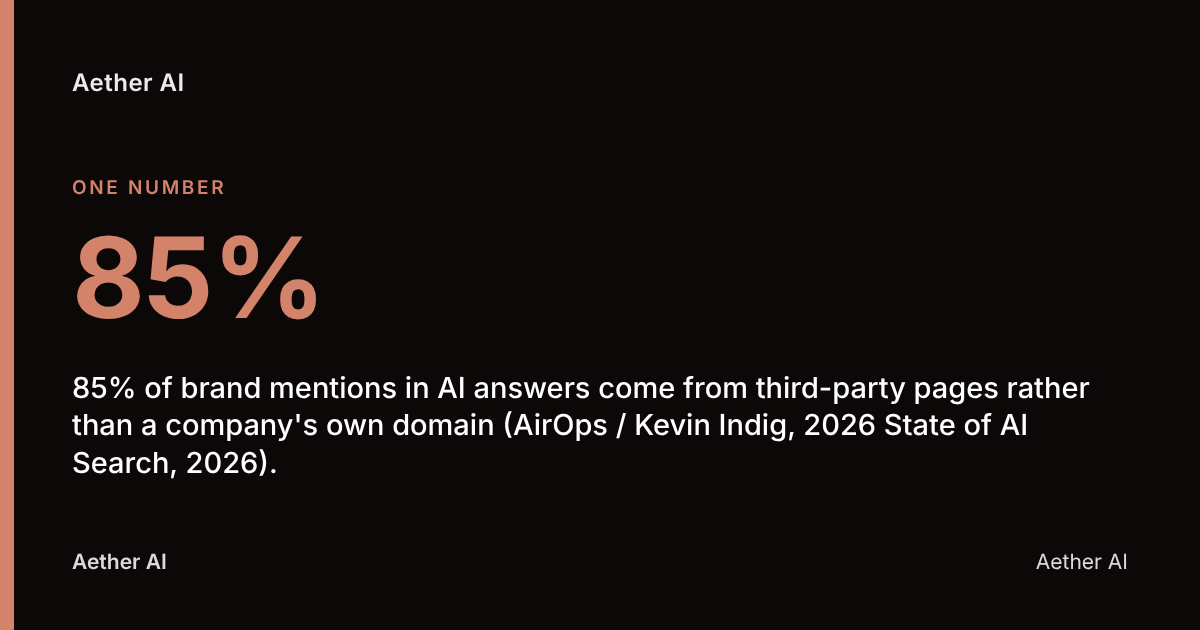
- 85% of brand mentions in AI answers come from third-party pages rather than a company's own domain (AirOps / Kevin Indig, 2026 State of AI Search, 2026).
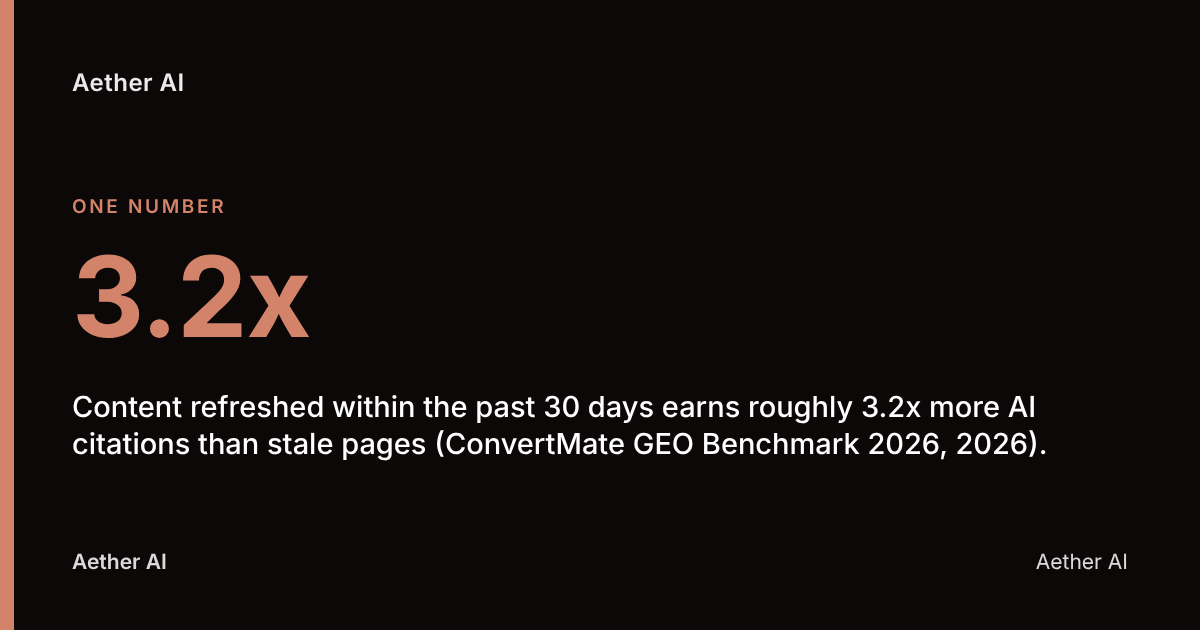
- Content refreshed within the past 30 days earns roughly 3.2x more AI citations than stale pages (ConvertMate GEO Benchmark 2026, 2026).
What is AI citation building?
AI citation building is the deliberate process of creating, structuring and distributing content so that generative AI systems — including ChatGPT, Google AI Overviews, Perplexity, Claude, Gemini and Microsoft Copilot — select it as a source and attribute the answer to a named brand rather than an anonymous web page. It sits inside the broader discipline of Generative Engine Optimization (GEO), a term coined by researchers at Princeton, Georgia Tech, IIT Delhi and the Allen Institute for AI in their 2024 paper, which treats AI answer boxes as a ranking surface in their own right, separate from the traditional "ten blue links" of Google search.
The distinguishing detail is attribution. A page can be scraped, summarised and used by an AI model without the brand ever being named — that's a missed opportunity, not a citation. Semrush's analysis of nearly 4,000 domain appearances across four AI search engines found that 61.7% were "ghost citations": the underlying website was referenced as a source, but the company itself was never mentioned to the user (Semrush, cited by RankLLM, 2026). True AI citation building aims to close that gap — getting the brand name, not just the URL, into the answer.
For UK businesses, this matters because the unit of success has changed. Traditional SEO measures rankings and clicks. AI citation building measures whether a potential customer asking ChatGPT "who handles X in London" ever hears your name at all.
How AI citation building differs from traditional link building
AI citation building differs from link building because the goal is attribution inside a generated answer, not a clickable backlink that passes authority between two web pages. Link building, the long-standing SEO tactic of earning hyperlinks from other sites to improve Google rankings, optimises for PageRank-style signals; AI citation building optimises for whether a language model reproduces your name as the source of a claim.
The mechanics diverge sharply too. A backlink is permanent until removed and sits in a crawlable index. An AI citation is generated fresh for each query, pulled from whatever the model's retrieval layer judges most relevant at that moment — which means the same page can be cited in one session and ignored in the next. This is sometimes called "citation drift", and it's one reason ongoing tracking matters more in GEO than in classic link audits.
| Factor | Traditional link building | AI citation building |
|---|---|---|
| Primary asset | Backlink from another domain | Being named as the answer's source |
| Stability | Fixed once placed (until removed) | Can change query-to-query |
| Success metric | Domain authority, referring domains | Citation rate, brand mention rate |
| Where it's measured | Ahrefs, Semrush, Google Search Console | Dedicated AI-tracking tools (e.g. Aether AI) |
| Content freshness | Low weighting | High weighting — recent content cited ~3.2x more (ConvertMate GEO Benchmark 2026) |
| Ownership | Earned via outreach, PR, guest posts | Earned via structure, evidence and third-party distribution |
Crucially, the research shows third-party presence matters more in GEO than it ever did for links alone. 85% of brand mentions in AI answers originate from third-party pages rather than owned domains (AirOps / Kevin Indig, 2026 State of AI Search, 2026), and spreading content across a wide range of external publications — rather than publishing only on your own site — can increase AI citations by up to 325% (Stacker, December 2025). A link-building campaign focused only on owned-domain SEO will miss most of this.
Why AI citations matter for UK businesses right now
AI citations matter now because UK buyers increasingly form a shortlist before they ever visit a company website, and if an assistant doesn't name a business during that research phase, it effectively doesn't exist for that search. Aether AI's own measured baseline, published at aether-ai.co.uk/insights/ai-visibility-baseline-2026, ran 700 live AI engine scans of UK brands' target keywords across July–August 2026: those brands were named in just 23 answers, or 3.3% of scans. Even the longest-established brand in the set — a security services company — was named in only 6.3% of its 270 scans.
That low baseline is the opportunity. Because so few UK brands are currently optimising deliberately for AI citation, the businesses that act first capture disproportionate share of voice in categories where competitors haven't noticed the shift yet. This mirrors the early-SEO land grab of the 2000s, except the retrieval layer (ChatGPT, Perplexity, Gemini) now sits between the brand and the buyer in a way Google's search results page never fully did.
There's also a blind spot inside Google Search Console. On two properties connected to Aether AI's founding team — Priority First and Aether Agency — between 19 July and 15 August 2026, 82.1% and 88.3% respectively of GSC clicks came from queries Google itself does not name in its reports. Aether AI is built and operated by Aether Agency Ltd. Priority First, Pulse Operations and Aether Agency are businesses connected to the founding team. Google leaves rare and low-volume queries out of its reports to protect searchers' privacy.
Which AI platforms generate citations, and how do they source them
AI platforms generate citations through different retrieval mechanisms, so a tactic that works for one may do nothing for another. ChatGPT (when browsing is enabled) and Perplexity both run live web retrieval and tend to favour structured, recently updated pages with clear sourcing. Google AI Overviews draws heavily from pages already indexed and ranking in Google's core search, layering a summarisation step on top. Microsoft Copilot, built on Bing's index, behaves similarly to AI Overviews but with different weighting toward Bing-specific signals. Claude and Gemini vary by integration — Gemini increasingly pulls from Google's own index and knowledge graph, while Claude's citation behaviour depends on whether it's running with web search enabled.
- ChatGPT: favours pages with sequential, logically ordered headings and schema markup — such pages show a 2.8x higher citation rate advantage (AirOps / Kevin Indig, 2026 State of AI Search, 2026).
- Google AI Overviews: draws mainly from pages that already rank organically, so conventional on-page SEO remains a prerequisite, not a separate task.
- Perplexity: leans on recency and cites multiple sources per answer, often several per paragraph, rewarding fresh, well-sourced updates.
- Microsoft Copilot: inherits Bing's indexing behaviour, so Bing Webmaster Tools submission is a practical, low-effort step UK businesses frequently skip.
- Claude and Gemini: citation behaviour is tied to whichever retrieval or search integration is active at the time of the query, making consistency harder to test.
Because each engine sources differently, tracking citation rate across all of them — rather than optimising for one — is the only way to see the full picture. This is precisely why Aether AI's platform tracks citations across six AI engines (ChatGPT, Perplexity, Google AI Overviews, Claude, Gemini and Copilot) rather than just one.
What steps actually get a business cited by AI assistants
Getting cited starts with definitional clarity: AI assistants reward pages that answer a specific question plainly, in the first sentence of a section, rather than pages that bury the answer under marketing copy. The GEO research found that statistics addition alone improved AI visibility by 22% in one metric and up to 37% in another, while adding quotations improved position-adjusted word count by 22% (GEO: Generative Engine Optimization, arXiv 2311.09735, 2024).
Practical steps, in rough priority order:
- Define the subject in plain language first. Open each section with a direct answer, not a lead-in sentence.
- Add real statistics with named sources. Unsourced claims are far less likely to be reused by a model that's weighing credibility.
- Keep content current. Pages updated within the past 30 days get roughly 3.2x more citations than stale ones (ConvertMate GEO Benchmark 2026, 2026).
- Distribute beyond the owned domain. Third-party placement — guest content, PR coverage, directory listings — can lift citations by up to 325% (Stacker, December 2025).
- Watch rank position carefully. Sites around position 5 saw a 115.1% visibility increase from adding citations, while first-ranked sites actually lost 30.3% from the same tactic (GEO: Generative Engine Optimization, KDD 2024) — meaning the tactic isn't universally beneficial, and already-dominant pages may need a different lever.
- Use schema markup and clean heading hierarchy. Google's own structured data documentation confirms schema isn't mandatory for AI features, but it remains a strong entity-clarity signal.
- Track brand mentions specifically, not just URL citations, to avoid the ghost-citation trap described above.
In-house vs agency vs platform
Businesses weighing up how to resource this work generally choose between three routes, each with a real trade-off.
| Approach | Best suited to | Trade-off |
|---|---|---|
| In-house (marketing/SEO team) | Businesses with existing content resource and a GSC/analytics habit | Requires new tracking skills; AI citation measurement isn't built into standard SEO tools |
| Full-service agency | Businesses wanting strategy, PR distribution and content handled end to end | Higher cost, slower iteration, less founder visibility into day-to-day output |
| Self-serve GEO platform (e.g. Aether AI) | Founders, in-house marketers and SEO leads who want AI-optimised content and citation tracking without agency overhead | Still requires someone internally to review output and act on tracking data |
Aether AI is a self-service platform built for exactly this: automated AI-optimised article generation alongside citation tracking across six AI engines, keyword and competitor tracking, and Google Search Console integration — so a lean in-house team can run a credible AI citation programme without hiring a dedicated GEO agency.
Your AI citation building checklist
- Audit current AI visibility with a free scan (Aether AI's audit tool is one starting point).
- Open every content section with a plain-language definition or direct answer.
- Add named statistics with linked sources on every key page.
- Refresh cornerstone content at least monthly to capture the freshness advantage.
- Apply schema markup (FAQPage, Article, Organization) consistently across the site.
- Submit the site to Bing Webmaster Tools to support Copilot indexing.
- Pursue third-party distribution — PR, guest content, directories — rather than relying solely on the owned domain.
- Track brand-name mentions (not just URL citations) across ChatGPT, Perplexity, AI Overviews, Claude, Gemini and Copilot monthly.
FAQ
What does AI citation building mean?
AI citation building means structuring and distributing content so that AI assistants — ChatGPT, Google AI Overviews, Perplexity, Claude, Gemini and Copilot — name a specific brand as the source of an answer, rather than merely using its content without attribution.
How is this different from SEO link building?
Traditional link building earns backlinks to raise Google rankings; AI citation building earns brand mentions inside AI-generated answers. The two overlap — ranking well in Google still feeds AI Overviews — but AI citation also depends heavily on third-party distribution and content freshness in ways classic link building does not.
How much does AI citation building cost in the UK?
Costs vary widely depending on route: in-house teams absorb the cost in existing staff time, full-service agencies typically charge retainer fees for strategy and PR distribution, and self-service platforms like Aether AI offer published pricing for automated content and tracking tools — see Aether AI's pricing for current tiers.
How long does it take to see results from AI citation building?
There's no fixed universal timeline, because AI citation behaviour depends on retrieval freshness and query volume rather than a crawl schedule. Content refreshed within the last 30 days earns roughly 3.2x more citations than stale pages (ConvertMate GEO Benchmark 2026, 2026), which suggests ongoing, regular updates matter more than a one-off push.
What is a "ghost citation"?
A ghost citation is when an AI engine references a website as a source but never names the brand behind it to the user. Semrush's analysis of 3,981 domain appearances across four AI search engines found 61.7% fell into this category (Semrush, cited by RankLLM, 2026) — meaning most "citations" aren't delivering brand visibility at all.
Does schema markup actually help with AI citations?
Schema markup supports entity clarity, which helps AI models understand what a page is about, and pages with sequential headings plus rich schema show a 2.8x higher citation rate advantage (AirOps / Kevin Indig, 2026 State of AI Search, 2026). Google's own structured data guidance confirms it isn't mandatory for AI features, but it remains a useful signal.
Who should manage AI citation strategy inside a business?
It typically sits with whoever already owns SEO and content — an in-house marketer or SEO specialist — because AI citation building builds directly on existing content, schema and PR workflows rather than replacing them. Smaller teams increasingly use self-service platforms to handle the content generation and cross-engine tracking without hiring a separate specialist.
Getting cited, not just crawled, with Aether AI
Most of the UK brands in Aether AI's own measured baseline were named in AI answers only 3.3% of the time across 700 scans — the problem this article describes isn't theoretical, it's the current default state for most businesses. Aether AI was built specifically to close that gap: it generates AI-optimised articles automatically and tracks whether they result in actual citations — not just indexing — across ChatGPT, Perplexity, Google AI Overviews, Claude, Gemini and Copilot.
The platform's own publishing output demonstrates the approach in practice: Aether AI published 281 articles across the brands it writes for in the 30 days to September 2026, each one structured against the same definitional-clarity and sourcing principles described above.
If you want to see where your own business currently stands, Aether AI offers a free AI-visibility audit that scans your target keywords across major AI engines — a practical first step before committing to any citation-building programme, in-house or otherwise.