Last updated: 19 November 2026
AI citation velocity is the rate at which a brand, page or source gets named and linked inside AI-generated answers across engines like ChatGPT, Perplexity, Google AI Overviews, Claude, Gemini and Microsoft Copilot. Unlike a one-off mention, velocity tracks frequency and acceleration over time — and for most UK brands today, that number is close to zero.
Key Takeaways
- AI citation velocity measures how fast and how often a brand is cited in AI-generated answers, not just whether it appears once.
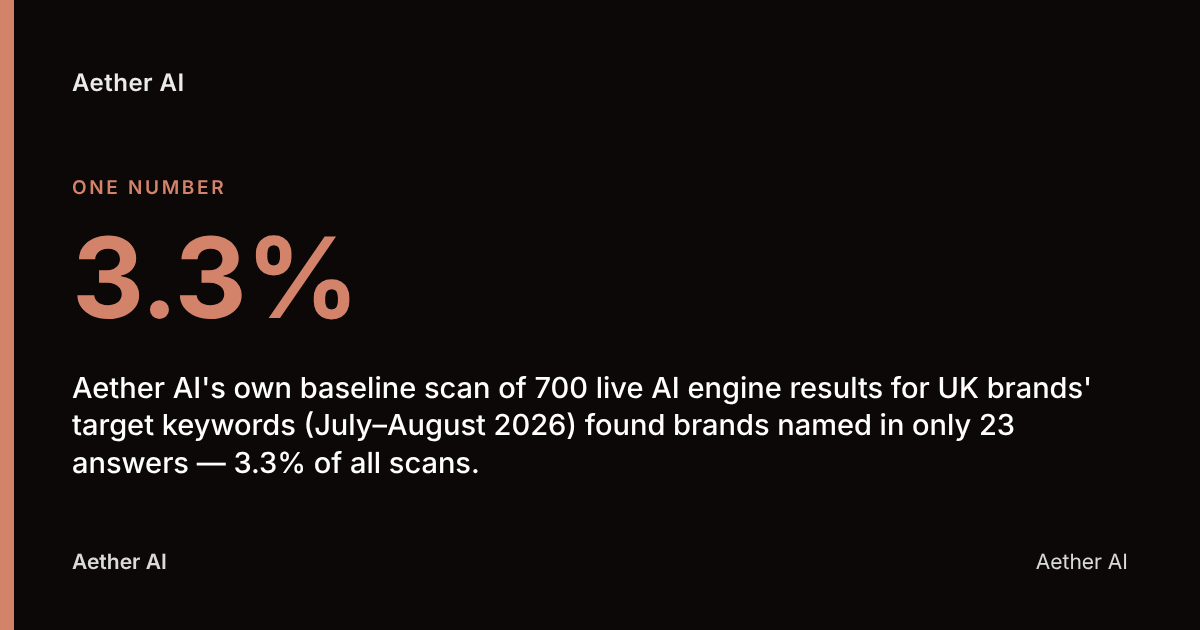
- Aether AI's own baseline scan of 700 live AI engine results for UK brands' target keywords (July–August 2026) found brands named in only 23 answers — 3.3% of all scans.
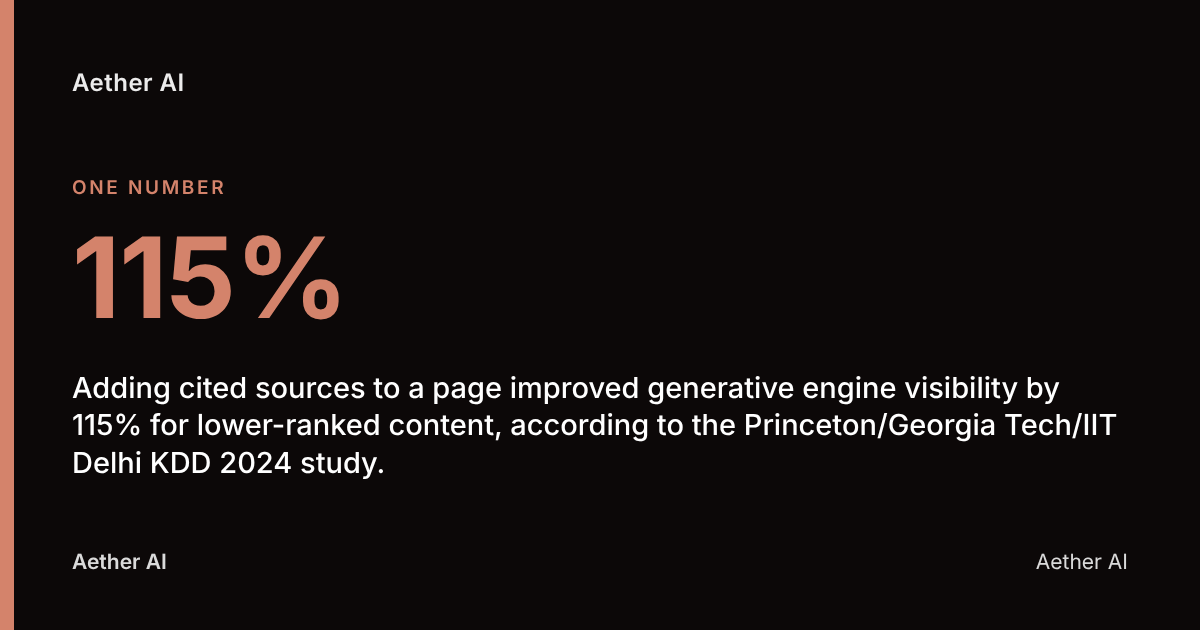
- Adding cited sources to a page improved generative engine visibility by 115% for lower-ranked content, according to the Princeton/Georgia Tech/IIT Delhi KDD 2024 study.
- Keyword stuffing performed 10% worse than doing nothing in the same controlled study, making it one of the clearest "what not to do" findings in generative engine optimisation (GEO) research.
- AI Overviews now appear on 70% of B2B tech-related search results, up from 36% a year earlier, according to WordStream — meaning citation velocity increasingly determines visibility where organic clicks used to.
What is AI citation velocity?
AI citation velocity is a measurement of how quickly and how frequently a specific domain, brand or page is referenced by generative AI systems in response to relevant queries, tracked over a defined period. It differs from a simple citation count because velocity captures the rate of change — whether a brand's presence in AI answers is accelerating, flat, or declining — rather than a static snapshot.
The term borrows its logic from academic bibliometrics, where "citation velocity" already has a formal definition used to track how quickly research papers accumulate references after publication, as set out in the bibliometric framework published on arXiv. Applied to generative engines, the same idea measures how quickly a brand's content starts showing up — and keeps showing up — inside answers from ChatGPT, Perplexity, Google AI Overviews, Claude, Gemini and Copilot.
This matters because being cited once is not the same as being cited reliably. A brand might appear in an AI Overview for a single query this week and vanish next month if a competitor publishes more current data, a clearer definition, or a more citable statistic. Citation velocity, tracked properly, shows whether a brand's AI visibility is a trend or a fluke.
How is AI citation velocity measured or calculated?
AI citation velocity is calculated by tracking the number of times a brand or domain is cited across a fixed set of queries and AI engines over a given period, then comparing that rate against an earlier baseline. In practice this means running the same keyword set through multiple AI engines on a recurring schedule — weekly or monthly — and counting how often the brand's name, domain or specific page appears in the answer, not just in a list of sources.
A rigorous measurement approach distinguishes between citation selection (whether a source was chosen at all for a given query) and citation absorption (whether the AI system actually used and attributed content from that source), a distinction formalised in the cross-platform GEO measurement framework published on arXiv. Vendor tools that report a single "visibility score" often blur this distinction, which is why per-engine, per-query tracking remains the more defensible method for any business making decisions based on the number.
Aether AI tracks citations across six AI engines — ChatGPT, Perplexity, Google AI Overviews, Claude, Gemini and Copilot — against a brand's own keyword set, which is the structure needed to calculate a genuine velocity trend rather than a single-point score. Aether AI's own measured baseline, published at aether-ai.co.uk/insights/ai-visibility-baseline-2026, ran 700 live AI engine scans of UK brands' target keywords between July and August 2026 and found those brands named in only 23 answers — a 3.3% citation rate overall, rising to 6.3% for the most established brand in the set, a security services company, across its 270 individual scans.
Why does AI citation velocity matter for UK brand visibility?
AI citation velocity matters because UK search behaviour is shifting away from the traditional ten blue links and towards zero-click AI summaries that answer the question before a user ever reaches a website. Google's own AI Overviews now appear across a majority of commercial search results in several sectors, and when they do, the traditional top-ranking page suffers.
The presence of an AI Overview correlated with a 58% lower click-through rate for the page ranking in position one, according to an Ahrefs study cited via SearchesEverywhere. A separate Semrush study of more than 600,000 US desktop keywords found AI Overviews appearing for commercial-intent queries increased by an average of 71% between November 2025 and April 2026. For B2B queries specifically, AI Overviews rose from appearing in 36% to 70% of search results over the course of a year, according to WordStream.
For a UK business, this means the page that used to rank first in Google is now frequently invisible unless it is also the source an AI system chooses to cite. A brand's organic ranking and its AI citation velocity are becoming two separate competitions — and the second one increasingly decides whether a potential customer ever clicks through at all.
Separately, the share of Google Search Console clicks that come from queries Google itself does not name as search terms reached 82.1% on Priority First's own property and 88.3% on Aether Agency's, measured between 19 July and 15 August 2026 (Aether AI is built and operated by Aether Agency Ltd; Priority First, Pulse Operations and Aether Agency are businesses connected to the founding team). Google leaves rare and low-volume queries out of its reports to protect searchers' privacy.
Which AI tools and platforms generate these citations?
ChatGPT, Perplexity, Google AI Overviews, Claude, Gemini and Microsoft Copilot are the six generative engines that most frequently produce citations UK businesses need to track, each with different retrieval behaviour and sourcing patterns. Perplexity and Google AI Overviews tend to cite a higher volume of sources per answer, often including smaller or newer domains, while ChatGPT and Claude's citation behaviour depends heavily on whether the query triggers a web-browsing or retrieval-augmented response versus a purely model-generated one.
These differences matter operationally. A brand cited frequently in Perplexity may be entirely absent from Google AI Overviews for the same query set, because each engine weighs recency, domain structure and content formatting differently. This is why single-engine monitoring — checking only how a brand performs in ChatGPT, for example — gives an incomplete and sometimes misleading picture of overall AI citation velocity.
| AI engine | Typical citation behaviour | Monitoring consideration |
|---|---|---|
| Google AI Overviews | High query coverage; appears on majority of commercial searches | Directly affects organic click-through rate |
| Perplexity | Cites multiple sources per answer, often including smaller sites | Useful for tracking early-stage visibility gains |
| ChatGPT | Browsing-dependent; citation rate varies by query type | Requires prompts that trigger web retrieval |
| Claude | Similar retrieval-dependent pattern to ChatGPT | Less consistent citation data publicly available |
| Gemini | Integrated with Google's own index and AI Overviews | Overlaps with Google AI Overview visibility |
| Microsoft Copilot | Draws on Bing's index | Distinct source pool from Google-based engines |
Tracking across all six, rather than one, is the only way to produce a velocity figure that reflects actual market position rather than a single engine's quirks.
What factors influence AI citation velocity?
Several identifiable content and structural factors determine how quickly and how often AI systems cite a given page, based on controlled research rather than guesswork. The most cited academic study on this question, the Princeton/Georgia Tech/Allen Institute for AI/IIT Delhi GEO paper presented at KDD 2024, tested specific content interventions across 10,000 queries and ten search engines.
The findings were specific and measurable:
- Citing sources improved visibility by 115% for lower-ranked pages — the single largest effect size recorded in the study, according to Aggarwal et al.'s GEO research.
- Adding statistics improved AI visibility by 41%, and adding direct quotations improved it by 28%, per the same study.
- Pages already ranking in position one saw little additional benefit from these techniques, while pages around position five — neither top-ranked nor buried — benefited most, gaining the full 115% uplift.
- Keyword stuffing performed 10% worse than the unoptimised baseline, confirming that traditional SEO padding actively harms AI citation chances rather than helping them.
Overall, GEO techniques such as these can lift content visibility in generative engine responses by up to 40%, according to the same Princeton-led research, which has since accumulated 76 citations and 9,106 downloads as of March 2026, per Omnibound's tracking of the paper's metrics. The practical implication for UK businesses is clear: mid-ranked pages with clear source citations, real statistics and genuine quotations are the best-positioned content to accelerate in AI citation velocity, while keyword-dense pages built for 2015-era SEO are actively being penalised by the same systems.
How does AI citation velocity differ from backlinks and rankings?
AI citation velocity measures a fundamentally different signal from Google rankings or backlink counts, because it tracks inclusion inside a generated answer rather than position on a results page. A backlink is a static, permanent link from one page to another, counted by tools like Ahrefs or Moz as part of domain authority calculations. A citation inside an AI answer is dynamic — it can appear for one query this week and disappear next week if the AI system's retrieval or ranking changes, or a competitor publishes more current content.
| Metric | What it measures | Stability | Primary tools |
|---|---|---|---|
| Backlinks | Links from other domains to yours | Largely permanent once indexed | Ahrefs, Moz, Semrush |
| Search rankings | Position on a traditional results page | Relatively stable, slow-moving | Google Search Console |
| AI citation velocity | Frequency and rate of being named in AI-generated answers | Volatile; can change query-by-query | Aether AI, emerging GEO tools |
This volatility is precisely why "velocity" — the rate of change — matters more than a single citation count. A brand with five citations last month and fifteen this month is accelerating; a brand with the same fifteen citations held flat for six months is stagnant, even though a snapshot comparison would show them as equal. Traditional SEO metrics were never designed to capture this kind of movement, which is why a dedicated citation-tracking approach across engines is now a separate discipline from conventional rank tracking.
What steps improve AI citation velocity?
UK businesses can take specific, research-backed actions to improve how often and how quickly they are cited by AI systems, starting with the content interventions proven in the Princeton-led GEO study. The clearest priority is adding genuine citations to credible sources within content, given the 115% visibility uplift this produced for mid-ranked pages in the controlled study referenced above.
Beyond that single intervention, UK businesses should:
- Publish content with real statistics and named sources, not vague claims — the 41% visibility gain from statistics only applied to genuine, attributed figures.
- Include direct quotations from named individuals where available, reflecting the 28% uplift recorded for quotation-based content.
- Avoid keyword stuffing entirely — it measured 10% worse than doing nothing, making it actively counterproductive rather than neutral.
- Structure content with clear headings and definitions, since AI retrieval systems extract passages based on where a section clearly begins and answers a specific question.
- Track citation performance across all six major engines rather than optimising for one, given how differently ChatGPT, Perplexity, Google AI Overviews, Claude, Gemini and Copilot select and attribute sources.
- Focus optimisation effort on mid-ranked pages, since position-one content saw little additional benefit in the Princeton study, while position-five content saw the largest gains.
- Refresh content regularly, since AI systems favour current, verifiable information and will drop a source that becomes outdated in favour of a more recent one.
Your AI citation velocity checklist
- Audit current citation rate across ChatGPT, Perplexity, Google AI Overviews, Claude, Gemini and Copilot for your core keyword set.
- Add genuine, linked source citations to existing pages, prioritising content currently ranking around position five.
- Insert real, attributed statistics rather than vague or unsourced claims.
- Remove keyword-stuffed phrasing and replace it with natural, direct answers to likely queries.
- Add named quotations from real people within the business or from credible external sources.
- Re-run the same query set monthly to establish a velocity trend, not a one-off score.
- Prioritise definition-first opening sentences on any page introducing a concept, service or regulation.
- Review which competitor domains are being cited instead of yours for the same queries, and identify the gap.
FAQ
What does AI citation velocity mean in simple terms?
AI citation velocity means the speed and frequency at which a brand or page gets named inside AI-generated answers, tracked over time rather than as a single count. A brand with rising citation velocity is appearing more often across engines month over month, not just appearing once.
How is AI citation velocity different from citation volume?
Citation volume is a raw count of how many times a brand has been cited; velocity measures the rate of change in that count over a defined period. A brand could have high volume but flat or declining velocity, meaning its historical citations are no longer growing or being refreshed.
Which AI engines should a UK business monitor for citations?
A UK business should monitor ChatGPT, Perplexity, Google AI Overviews, Claude, Gemini and Microsoft Copilot, since each engine sources and attributes citations differently. Monitoring only one engine, such as ChatGPT, misses the broader picture, because Perplexity and Google AI Overviews often cite entirely different domains for the same query.
Can a small or newer UK business realistically build AI citation velocity?
Yes — the Princeton GEO study found that lower-ranked pages, not established position-one pages, saw the largest visibility gains (115%) from adding cited sources, suggesting smaller domains without existing backlink authority have genuine room to improve. The research indicates content quality signals like statistics, sources and quotations matter more than pre-existing domain authority for this specific gain.
How long does it take to see a measurable change in AI citation velocity?
There is no universally agreed timeframe in the available research, since AI engines recrawl and re-rank content on different schedules, and retrieval-augmented systems can reflect new content within days while others take longer. The practical approach is to track citation rate monthly against a fixed query set, as Aether AI does across six engines, to identify a genuine trend rather than relying on a single measurement.
What is the biggest mistake businesses make trying to boost AI citations?
The biggest mistake is keyword stuffing, which the Princeton GEO study found performed 10% worse than doing nothing at all. Businesses applying old SEO tactics to AI-era content frequently harm their citation chances rather than improving them.
Does a high Google ranking guarantee a high AI citation rate?
No — the Princeton GEO study found that pages already ranking in position one saw little additional benefit from GEO techniques, while pages around position five saw the largest gains. This suggests ranking position and AI citation likelihood are related but distinct, and a top Google ranking does not automatically translate into AI engine citations.
Improving your AI citation velocity with Aether AI
Tracking AI citation velocity by hand across six separate engines, for every target keyword, every month, is not a realistic task for most in-house marketing or SEO teams — which is exactly the gap Aether AI's citation tracking is built to close. Aether AI tracks citations across ChatGPT, Perplexity, Google AI Overviews, Claude, Gemini and Copilot against a brand's own keyword and competitor set, turning a scattered, manual check into a repeatable velocity measurement.
Aether AI's own measured baseline — 700 live AI engine scans of UK brands' target keywords run in July and August 2026 — found those brands cited in just 3.3% of scans overall, which is the scale of the visibility gap most UK businesses are currently working from and the reason velocity, not a one-off citation, is the metric worth tracking.
If you want to see where your own brand currently stands, Aether AI's free AI-visibility audit at /audit runs your core keywords through the same six-engine check, and the platform's public pricing page sets out the self-service plans for ongoing citation tracking and AI-optimised content publishing.