Last updated: 21 November 2026
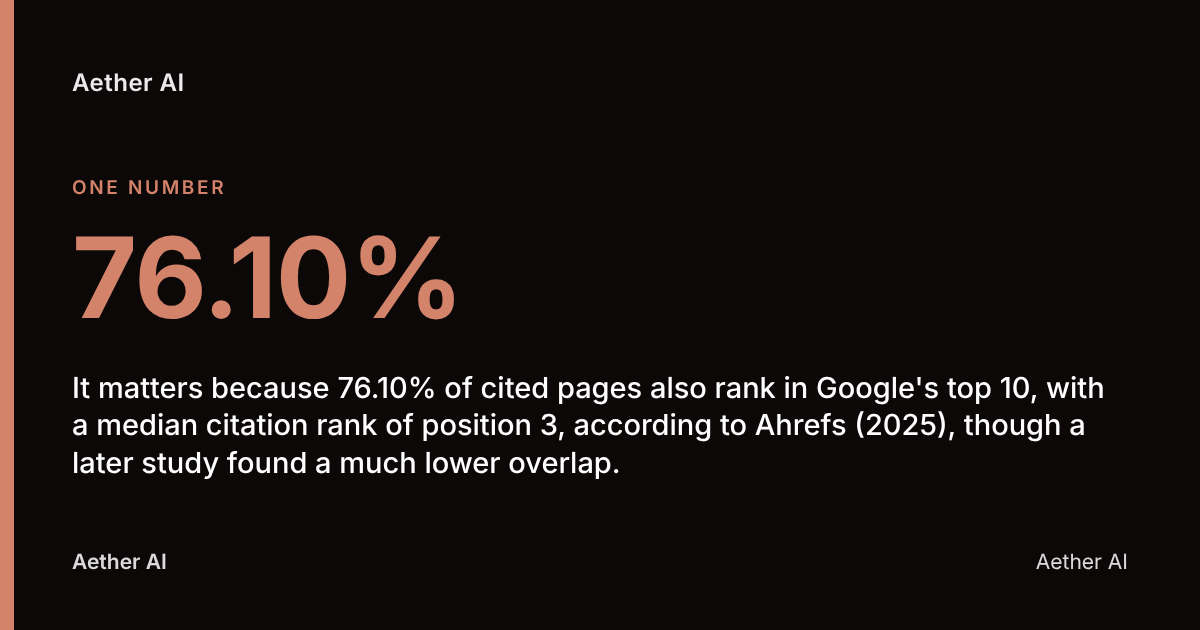
AI Overviews citation position is the order a source appears in Google's AI-generated answer panel, from first cited to last. It matters because 76.10% of cited pages also rank in Google's top 10, with a median citation rank of position 3, according to Ahrefs (2025), though a later study found a much lower overlap.
Key Takeaways
- AI Overviews citation position describes the order sources are listed within the answer panel, separate from a page's organic Google ranking.
- Studies disagree sharply on how closely citation position tracks organic rank, with Ahrefs' 2026 follow-up finding a much lower overlap than its 2025 study, a sign the overlap is shrinking or being measured differently.
- Businesses can check citation position manually by searching target queries, but tracking it over time across multiple AI engines needs a dedicated monitoring tool.
What Does Citation Position Mean in Google AI Overviews?
Citation position is the rank order of the sources Google's AI Overviews feature lists alongside its generated answer, numbered from the first source cited to the last. An AI Overview is the AI-generated summary Google shows above traditional search results for many queries, built from several web sources rather than a single ranked list.
Citation position is not the same as a citation's presence. A page can be cited once near the top of the source list, cited multiple times throughout the answer, or cited only once at the bottom. Ahrefs (2025) found the primary cited URL in an AI Overview tends to sit at position 2 in Google's organic results, based on a study of 1.9 million citations drawn from 1 million AI Overviews.
Our view: Aether AI believes a page that answers one question completely and specifically gives an AI assistant something worth citing, while a vague page that summarises other pages gives it little reason to credit you. Google itself frames this as a continuation of normal search quality signals, stating that "optimizing for generative AI search is optimizing for the search experience, and thus still SEO." A page built to answer one query precisely, rather than to rank for many loosely related ones, fits that description more naturally.
Does Citation Order Affect Click-Through Rate?
Yes, but the bigger effect is that AI Overviews suppress clicks across all positions, beyond simply reordering them. Ahrefs (2025) found that position-one click-through rate dropped 58% when an AI Overview appeared on the page, based on 300,000 keywords of Search Console data comparing December 2023 to December 2025.
This means a business cited first inside an AI Overview is not simply trading a traditional top-ranking click for an equivalent AI-era click. It's competing for a much smaller pool of clicks overall, since many searchers now get their answer from the summary itself and never scroll to a source link. Being cited still carries brand-visibility value even without a click, since the source name and link appear directly in the answer a user reads.
For a business weighing where to invest optimisation effort, this changes the calculation. Chasing the top organic ranking no longer guarantees the click volume it once did, and a lower citation position inside an AI Overview may still deliver meaningful exposure even with a smaller click share.
What Factors Determine AI Overview Citation Order?
A number of factors shape where a source lands in an AI Overview, and these factors don't reduce to simple organic rank. seoClarity (2025) found that 90% of AI Overviews cite at least one top-10 URL and 94% cite at least one top-20 URL, yet only 56% of individual citations come from the top 20 overall, based on 362,000 US desktop keywords and 5.1 million citations. That gap between "an AI Overview includes a top-ranking source" and "most citations are top-ranking sources" is the key nuance businesses miss.
Content structure also plays a measurable role. Kevin Indig's analysis of 1.2 million ChatGPT responses and over 18,000 verified citations found that 44.2% of citations come from the first 30% of a page's content, 31.1% from the middle, and 24.7% from the final third, a pattern he calls the "ski ramp effect" (Kevin Indig, Growth Memo, 2026). Front-loading a direct answer increases the chance that section gets pulled into a citation.
CXL (2026) analysed 100 Google AI Overview citations and found the top 20% of source pages accounted for 48 of the 100 citations, while the bottom 40% accounted for only 21. Citation attention concentrates heavily on a small slice of eligible pages, rather than spreading evenly across every page that ranks reasonably well.
Why Overlap Figures Vary So Much Between Studies
Different studies measure overlap differently, which explains why reported top-10 overlap varies so widely depending on the source. Ahrefs (2026) found that in a follow-up study of 863,000 keywords and 4 million AI Overview URLs, only 37.9% of cited URLs appeared in the top 10, with the remainder split between positions 11 to 100 (31.2%) and beyond position 100 (31.0%).
| Study | Metric measured | Finding |
|---|---|---|
| Ahrefs (2025) | Per-citation top-10 overlap | 76.10% of citations rank top 10; median citation rank position 3 |
| Ahrefs (2026) | Per-citation top-10 overlap, later dataset | 37.9% in top 10; 31.2% ranked 11-100; 31.0% beyond 100 |
| seoClarity (2025) | Per-AI-Overview top-10 presence | 90% of AI Overviews include at least one top-10 URL |
Ahrefs (2026) found that among citations that didn't rank in Google's top results for the same keyword, 18.2% were YouTube URLs, and YouTube accounted for 5.6% of all AI Overview citations in the dataset. Video content clearly earns citations through a different route than standard organic ranking.
Can a UK Business Track Its Citation Position Over Time?
Yes, a business can check citation position manually by running its target queries through Google and noting where it appears in the AI Overview panel, but this approach breaks down quickly at scale. Citation position isn't fixed. The same query can return a different source order, or a different set of sources entirely, on repeated searches, across devices, or after Google updates its underlying model.
Manual checks also only capture a single engine. A business weighing where customers actually discover it needs visibility across more than Google alone, since AI-driven discovery increasingly spans ChatGPT, Perplexity, Claude, Gemini and Microsoft Copilot as well.
Aether AI tracks citations across six AI engines, including Google AI Overviews, ChatGPT, Perplexity, Claude, Gemini and Copilot, alongside keyword and competitor tracking and Google Search Console integration. This gives a business one place to see whether it's cited, where in the citation order, and on which engines, tracked over time.
Manual tracking vs dedicated monitoring
| Approach | What it shows | Limitation |
|---|---|---|
| Manual search checks | A single snapshot of citation presence and position | Doesn't scale across queries, engines or time; misses churn |
| Dedicated citation tracking | Position and presence across multiple engines, tracked over time | Requires a platform built for this specific monitoring job |
A related limit worth knowing: Google Search Console. Aether AI's measured baseline, published at aether-ai.co.uk/insights/ai-visibility-baseline-2026, found that on two properties connected to the founding team, Priority First and Aether Agency, the share of GSC clicks from queries Google does not name was 82.1% and 88.3% respectively, 19 July to 15 August 2026. Aether AI is built and operated by Aether Agency Ltd. Priority First, Pulse Operations and Aether Agency are businesses connected to the founding team. Google leaves rare and low-volume queries out of its reports to protect searchers' privacy, which makes manual query-by-query checking even less reliable on its own.
Your AI Overviews citation position checklist
- Search your core commercial queries and note whether your site appears in the AI Overview panel at all.
- Record the citation position (first, middle, last) each time you check, in addition to presence or absence.
- Check the same queries on different days to spot citation churn, since a single result cannot be assumed stable.
- Audit whether your top-performing page answers the query directly within its first few hundred words.
- Review Google Search Console for the share of clicks from queries Google does not name.
- Track citation position across more than one AI engine, not Google alone.
- Rewrite pages that only summarise competitors' content into pages that answer one question specifically.
FAQ
Do you have to rank in the top 10 on Google to be cited in AI Overviews?
No. Studies disagree on how often this happens: Ahrefs (2026) found only a minority of cited URLs ranked in the top 10 in its later dataset, and some citations, especially YouTube, came from pages ranking far outside the top results entirely.
Where on a page do AI Overviews typically pull their cited content from?
Most often from the opening section. Kevin Indig's analysis found a large share of citations came from the first portion of a page's content, with the share dropping through the middle and final sections (Kevin Indig, Growth Memo, 2026).
How often does citation order change between repeated runs of the same query?
There's no fixed schedule. Citation order and the set of cited sources can both change between searches of the same query, which is why a single manual check isn't a reliable measure of ongoing position.
Does citation position vary by industry or query type?
The research doesn't provide an industry-by-industry breakdown of citation position specifically, but the concentration pattern found by CXL (2026), where a small share of source pages account for nearly half of all citations, suggests some query types favour a narrower set of trusted sources than others.
Where Aether AI Fits Into Your Citation Position Strategy
Understanding why citation position varies so widely between studies is only useful if a business can act on it for its own queries. Aether AI builds AI-optimised articles designed around the answer-first, single-question structure the citation research points to, while tracking the resulting citation position across Google AI Overviews, ChatGPT, Perplexity, Claude, Gemini and Copilot.
Aether AI has published 281 articles across the brands it writes for in the last 30 days, as of September 2026, including its own site, which means the platform applies the same citation-focused structure it recommends here to its own content.
If you want to see where your business currently stands, Aether AI offers a free AI-visibility audit at /audit, and full pricing details are published at /pricing.