Last updated: 21 November 2026
An AI search architect is a specialist who designs how a brand gets found and cited inside AI engines like ChatGPT, Perplexity and Google AI Overviews, rather than ranking in traditional blue links. The role blends technical structuring of content with citation tracking, since 68% of AI citations come from third-party sources, not brand-owned websites, according to the Erlin GEO Trends Report (2026).
Key Takeaways
- An AI search architect focuses on being cited inside AI-generated answers, a distinct discipline from ranking in classic search results.
- Pages ranking first in Google have a far stronger chance of being cited in AI Overviews than pages further down the results, a gap that narrows the lower a page sits.
- Businesses hiring for this function should separate genuine AI-citation expertise from general AI/ML architecture roles, which focus on infrastructure rather than discovery.
What is an AI search architect?
An AI search architect is a professional who designs, builds and monitors the systems that determine whether a business appears inside answers generated by large language models, in place of a conventional list of search results. The discipline sits downstream of Generative Engine Optimization (GEO), the practice of structuring content so generative AI tools retrieve and cite it, a term formally introduced in a KDD '24 paper, GEO: Generative Engine Optimization.
The job title is inconsistent across the market. Large employers such as ServiceNow and Apple use "AI Search Architect" for engineering roles focused on search infrastructure and large language model integration, as shown in ServiceNow's listing and Apple's listing. In marketing contexts, the same title increasingly describes someone who manages a brand's visibility across AI answer engines: structuring content, tracking citations and advising on where a brand's authority gaps sit. Both versions share one goal. They decide whether an AI system trusts a source enough to name it.
What does an AI search architect do day to day?
Day to day, an AI search architect audits a brand's current citation rate across AI engines, restructures content to answer specific questions directly, and tracks which pages get quoted over time. This work increasingly replaces or sits alongside classic SEO tasks because citation behaviour follows different rules to ranking behaviour.
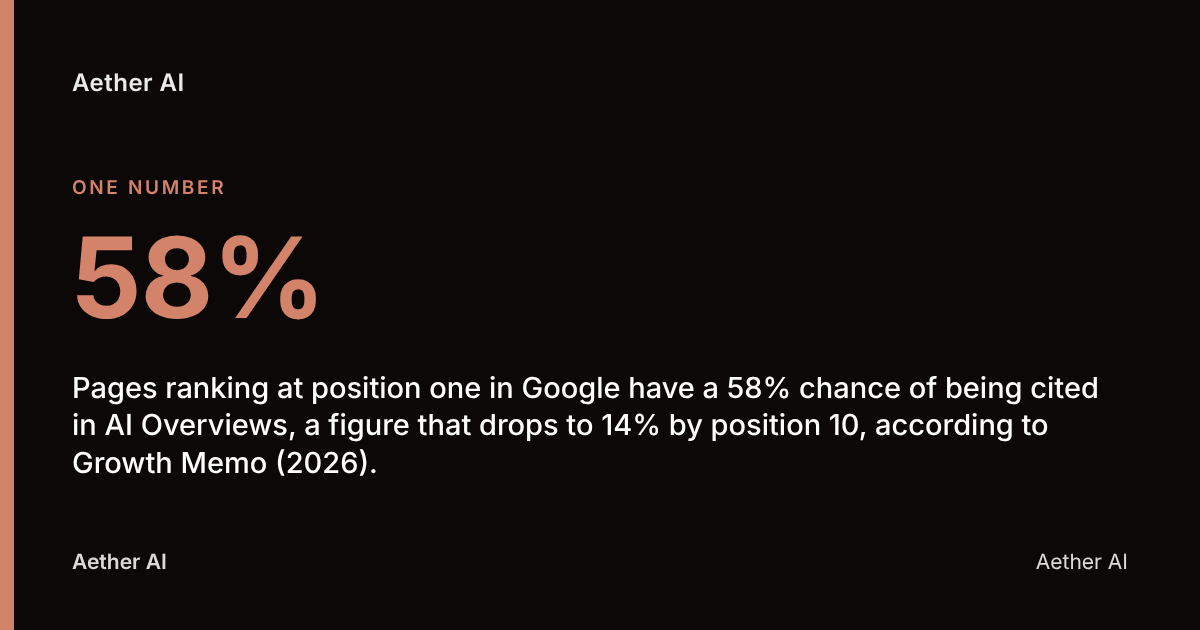
A large share of the job involves reading retrieval patterns over writing copy. Pages ranking at position one in Google have a 58% chance of being cited in AI Overviews, a figure that drops to 14% by position 10, according to Growth Memo (2026). Yet 83% of AI Overview citations come from pages outside the organic top 10 altogether, per the ConvertMate GEO Benchmark (2026). Together these figures mean ranking position matters, but it is not the whole story: a page can rank nowhere near the top and still be the one an AI engine chooses to cite, usually because it answers the exact question asked more directly than the top-ranking page does.
Typical daily tasks include:
- Running citation audits across ChatGPT, Perplexity, Google AI Overviews, Claude, Gemini and Microsoft Copilot
- Rewriting pages so the first two sentences of each section stand alone as a complete answer
- Tracking which competitor pages get cited for shared target questions
- Feeding findings back to content, product and legal teams on what claims can be verified and sourced
- Reporting citation share to leadership, distinct from traditional keyword rank reports
"A keyword is what someone types into a search box; a prompt is what they actually want, in a full sentence. Tracking prompts forces you to confront the real question set in your market, and most brands discover the questions they answer well are not the ones being asked," said Lauren Dawkins, Head of Content, Aether AI
AI search architect vs SEO specialist vs data scientist
An AI search architect differs from an SEO specialist because the SEO specialist optimises for Google's ranking algorithm, while the AI search architect optimises for whether a large language model selects a page as a trustworthy source to cite. The two disciplines overlap on technical fundamentals such as page speed and structured data, but diverge sharply on tactics.
A data scientist, by contrast, typically builds or tunes the models and retrieval infrastructure themselves, work closer to the ServiceNow and Apple engineering job descriptions cited above. The AI search architect in a marketing context rarely touches model weights. They work with the outputs: what gets cited, why, and how to improve the odds.
| Role | Primary focus | Typical output | Key skill |
|---|---|---|---|
| SEO specialist | Google ranking position | Keyword-targeted pages, backlinks | Technical SEO, link building |
| AI search architect (GEO) | AI citation and answer inclusion | Answer-first content, prompt tracking | Content structuring, citation analysis |
| AI/ML architect (engineering) | Search and retrieval infrastructure | LLM integration, retrieval pipelines | Python, vector databases, ML ops |
Skills, qualifications and salary for an AI search architect in the UK
No standardised qualification exists for this title in the UK; most practitioners come from SEO, content strategy or data analytics backgrounds and build GEO-specific skills on top. Useful foundations include a working knowledge of structured data markup, familiarity with how retrieval-augmented generation works, and strong analytical writing, since 88% of the URLs ChatGPT retrieves through search are the ones it goes on to cite, according to Elite Content Marketer (2026). That makes the ability to write a retrievable, quotable passage as valuable as any certification.
Salary data specific to the GEO-focused version of this title is not yet published separately by UK recruiters. The closest verified benchmark is the broader AI architect category, where Robert Half (2027) reports a national salary range of $145,250 to $204,000 in the US for the engineering-focused AI architect role. That figure covers infrastructure-heavy AI architecture work, not the marketing-side GEO function, so UK businesses hiring for citation-focused roles should expect compensation closer to senior SEO or content strategy bands until dedicated UK data emerges.
Qualifications to look for when hiring an AI search architect or agency
A firm hiring for this function should look for demonstrable citation tracking experience across multiple AI engines, alongside Google ranking history. Ask any candidate or agency to show their process.
Practical checks worth running:
- Ask for a live citation audit across at least three AI engines, not a single-platform report
- Request evidence of before-and-after content restructuring tied to a measurable citation change
- Confirm they track UK GDPR (the UK's data protection framework enforced by the Information Commissioner's Office) compliance when handling any customer data fed into AI tools
- Check whether their reporting separates citation share from traditional keyword rank, since the two rarely move together
- Ask how they monitor Google Search Console data for queries the platform itself does not name
On that last point, Search Console data from two of the founding team's own properties shows a share of clicks come from queries Google does not name at all: 82.1% on Priority First's property and 88.3% on Aether Agency's own, measured between 19 July and 15 August 2026. Aether AI is built and operated by Aether Agency Ltd. Priority First, Pulse Operations and Aether Agency are businesses connected to the founding team. Google leaves rare and low-volume queries out of its reports to protect searchers' privacy.
Common mistakes businesses make building AI search systems
A firm most often fails at AI search by treating it as a rewrite of existing SEO content, when it is a separate discipline with its own rules. A page built to rank for a keyword rarely answers a full question directly in its first two sentences, which is precisely what AI engines extract.
Three recurring mistakes:
- Assuming top Google rankings guarantee AI citations, when a large share of AI Overview citations come from pages outside the top 10, per ConvertMate (2026)
- Ignoring third-party sources entirely, despite most AI citations coming from outside brand-owned sites, per Erlin (2026)
- Treating AI visibility as a one-off project, with no ongoing measurement discipline and no one person or team accountable for citation tracking over time
Ownership is often unclear too. In many UK businesses, no single function owns AI search architecture: marketing assumes IT is handling it, IT assumes marketing owns content strategy, and the gap goes unmonitored for months.
FAQ
Is an AI search architect the same as a GEO specialist?
In marketing contexts, yes, largely. Both terms describe someone who structures content and tracks citations for generative AI engines, though "AI search architect" is also used by large employers for engineering-focused search infrastructure roles.
Do you need a technical background to become an AI search architect?
Not necessarily for the marketing-focused version of the role. A strong background in content strategy, SEO or analytics is often sufficient, provided you learn how retrieval and citation patterns differ from ranking patterns.
What is discovered demand and how does it differ from demand capture?
Demand capture targets people already searching for a known term in Google. Discovered demand describes being surfaced by an AI engine when someone asks a broader question, often without naming your brand or category directly.
Who within a company should oversee AI search architecture projects?
Most commonly a senior marketing or content lead takes ownership, working with whoever manages the company's technical SEO or website infrastructure, since the work spans content structure, data tracking and reporting.
How Aether AI supports AI search architecture work
Building and monitoring AI search architecture by hand, across six engines, is the exact gap Aether AI's self-serve platform closes for UK businesses. Aether AI automates AI-optimised article generation and tracks citations across ChatGPT, Perplexity, Google AI Overviews, Claude, Gemini and Microsoft Copilot, alongside keyword tracking, competitor tracking and Google Search Console integration, all from one dashboard.
Aether AI has published 281 articles across the brands it writes for in the last 30 days, a volume that includes its own site as one of the brands it writes for. If you want to see where your business currently stands, Aether AI offers a free AI-visibility audit at /audit, and public pricing is available for teams ready to start tracking citations properly.