Last updated: 22 November 2026
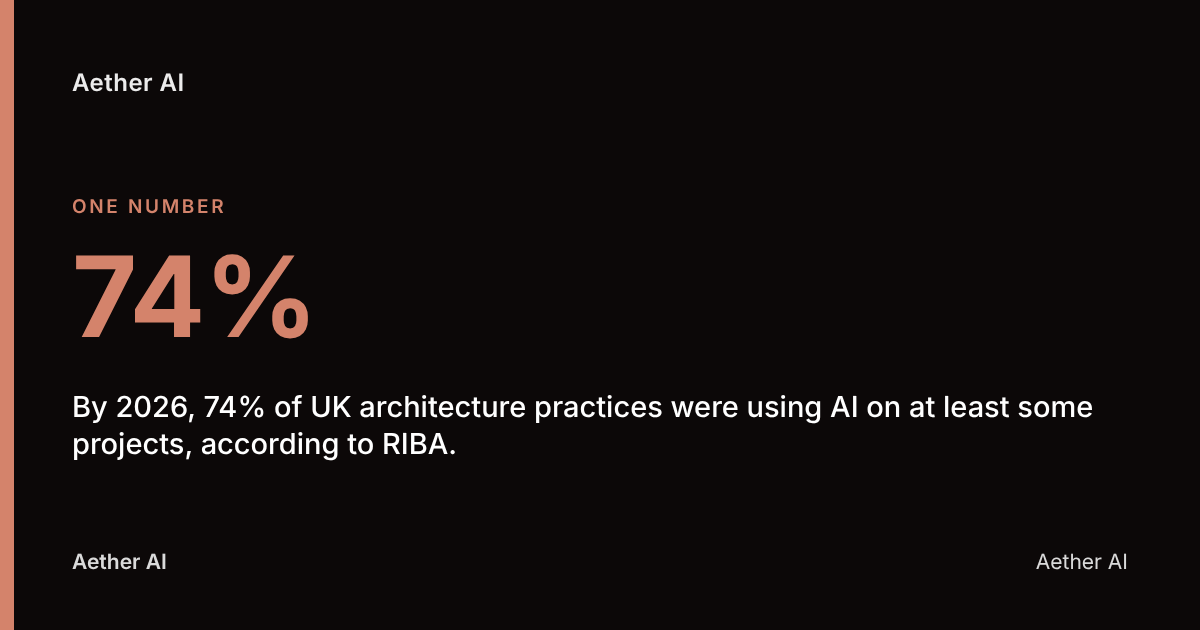
AI search for architecture refers to how architects and clients use tools like ChatGPT, Perplexity and Google AI Overviews to find firms, products and precedents, rather than relying only on Google or manual research. By 2026, 74% of UK architecture practices were using AI on at least some projects, according to RIBA.
Key Takeaways
- AI search changes how developers find architecture firms: they increasingly ask ChatGPT or Claude directly which firm suits a project, rather than searching Google first.
- UK practice adoption of AI has moved fast, a shift that firms cannot ignore.
- Verifying AI-generated results against official sources such as Approved Documents remains the architect's responsibility, not the tool's.
What is AI search in architecture?
AI search is the use of generative AI engines, such as ChatGPT, Claude, Perplexity and Google AI Overviews, to find, summarise and recommend information, synthesising an answer for the user instead of returning a list of links. In architecture, this covers two distinct uses: clients and developers discovering firms through AI answers, and architects themselves using AI to research products, planning precedent or regulations.
Traditional search tools return a ranked list of webpages that the user must click through and evaluate. AI search instead synthesises an answer from multiple sources and names specific firms, products or clauses directly in its response. Globally, 94% of B2B buyers now use AI when researching purchases, and developers increasingly ask ChatGPT or Claude directly which architecture firms are best for a project rather than starting with Google, according to Urbanize LA / Tailored Ink (2026).
This distinction matters commercially. A firm that ranks well on Google can still be invisible in an AI-generated answer if its website lacks the structured, citable content these engines prefer to quote. Aether AI calls this discovery gap the difference between search engine optimisation and generative engine optimisation, or GEO, the practice of structuring content so AI engines select and cite it.
Leading AI search platforms architects actually use
Architects use a mix of general-purpose AI assistants and sector-adjacent research tools, rather than a single dedicated "architecture search engine". ChatGPT, Claude, Perplexity and Google Gemini are the most commonly cited general tools, used for everything from drafting specification notes to summarising planning policy documents.
Adoption of these tools has moved quickly in the UK. In 2025, 59% of UK architecture practices reported using AI for at least the occasional project, up from 41% in 2024, and adoption continued to rise in the following year, according to RIBA's Artificial Intelligence Report and tipping-point release.
Internationally, usage patterns vary considerably. A global survey of over 1,200 architects found 46% of respondents already use AI tools in their architectural projects, with another 24% intending to adopt AI soon, and 74% expecting to increase AI use in the next year, according to Architizer and Chaos. By contrast, a March 2025 study found only 6% of U.S. architects regularly use AI tools in their practice, though over half had experimented with it, according to the American Institute of Architects (AIA). RIBA president Chris Williamson has described feeling "a mixture of excitement and trepidation about AI and its potential to radically change the business of architecture."
Finding products and suppliers that meet UK building regulations
AI search can surface building products, manufacturers and suppliers far faster than browsing manufacturer catalogues manually, but it does not replace checking compliance directly. An architect might ask an AI assistant to identify fire-rated cladding systems or suppliers of certified insulation, and the engine will synthesise an answer from manufacturer data sheets, trade press and regulatory guidance it has indexed.
The risk is that AI tools can misstate or oversimplify requirements under Approved Document B (fire safety) or Approved Document L (conservation of fuel and power), both issued by the Ministry of Housing, Communities and Local Government. A product recommendation that looks authoritative in a chat response still needs verification against the manufacturer's current certification, NHBC guidance, or BBA (British Board of Agrément) certificates before it goes into a specification.
Used well, AI search is a discovery layer: it narrows a field of hundreds of suppliers to a shortlist worth investigating properly. Used badly, it becomes a shortcut that skips the verification step entirely, which is where compliance risk creeps into live projects.
Planning permission precedent and local authority policy research
AI search tools can speed up research into planning precedent by summarising local plan policies, appeal decisions and committee reports that would otherwise take hours to locate manually. An architect preparing a design and access statement might ask an AI assistant to summarise a local authority's design guidance or recent appeal outcomes on a similar scheme type.
This works best as a starting point and not as a final answer. Local planning policy changes frequently, and an AI engine trained on older data may cite superseded local plans or misdate a policy document. The Planning Inspectorate's own appeal decisions and the local authority's published planning portal remain the authoritative sources that any AI-sourced summary must be checked against.
Architects who use AI search for planning research say it is genuinely useful for narrowing down which policies and precedents are relevant, cutting the time spent trawling planning portals. It is weakest where currency matters most: a live local plan review, an emerging supplementary planning document, or a recent appeal decision not yet indexed.
Verification responsibility and reliability of AI results
Responsibility for verifying any AI-generated result used in a specification, planning submission or compliance document sits with the architect and the practice, not the AI tool. This is a straightforward professional liability point: an AI assistant is a research aid, and no AI vendor currently warrants the accuracy of its outputs for regulated technical use.
Reliability varies by task. AI tools are generally strong at summarising and narrowing large volumes of text, such as product ranges or planning documents, but weaker on precise clause-level compliance with documents like Part L of the Building Regulations, where a misquoted U-value or outdated table reference could carry real consequences if unchecked.
Most architects believe AI will become more important to their organisation's business over the next 10 years, and a significant proportion expect their practice to have a formal AI policy within two years. RIBA's Head of Economic Research and Analysis, Adrian Malleson, has said: "We need to make sure AI serves the profession, not the opposite." A formal AI use policy, naming who checks what before submission, is the practical answer to the verification question.
AI search tools versus general-purpose assistants
| Factor | General AI assistant (ChatGPT, Claude, Perplexity) | Architecture-specific research |
|---|---|---|
| Availability | Free or low-cost tiers widely available | Varies; often bundled into BIM or specification software |
| Regulatory accuracy | Generalist, needs manual verification | Still needs verification but may cite trade sources directly |
| Discovery use | Developers ask these tools directly which firms to use | Less common as a client discovery channel |
| Best use case | Drafting, summarising, broad research | Product and supplier shortlisting |
| UK regulation currency | Depends on training data recency | Also depends on data recency; no guaranteed currency |
Neither category replaces checking a source document. The practical difference is that general-purpose assistants are now also where clients look for a firm, which makes them a marketing concern as well as a research tool.
How AI search is changing architecture firm discovery
Being found in an AI-generated answer is becoming as commercially important as ranking on Google, because developers increasingly ask AI assistants directly which architecture firms suit their project rather than searching a list of websites, per Urbanize LA / Tailored Ink. This shift is why firms need to think about generative engine optimisation (GEO) alongside traditional SEO.
Aether AI, a self-service GEO platform, tracks how often brands are cited across six AI engines: ChatGPT, Perplexity, Google AI Overviews, Claude, Gemini and Copilot. In a baseline measurement of live AI engine scans of UK brands' target keywords run in July and August 2026, brands were named in only a small fraction of answers overall, with even the longest-established brand named in just a modest share of its scans. That gap between how often a firm appears in Google and how often it is actually cited by an AI engine is the core problem GEO addresses.
Architecture firms that publish clear, structured content about their specialisms, completed projects and named locations give AI engines something concrete to cite. Firms that rely on generic "about us" pages and image-heavy portfolios with little text give these engines nothing to quote.
FAQ
What data privacy issues should a UK architecture firm consider before adopting AI search tools?
Client project data, site plans and commercially sensitive specifications should never be pasted into public AI tools without checking the vendor's data handling terms. Firms should also consider UK GDPR obligations under the Information Commissioner's Office (ICO) when any personal data is involved, and confirm whether inputs are used to train the underlying model.
Do AI search tools require special training for architectural staff?
Most firms introduce AI search through short internal guidance, covering which tools are approved, what data can be entered, and a mandatory verification step before any AI-sourced fact reaches a specification or submission, rather than through formal courses. RIBA's research suggests firms with a formal AI policy are better placed to manage this than those adopting tools informally.
Can AI search replace manual research for Part L compliance?
No. AI search can summarise and narrow down relevant sections quickly, but Part L figures, U-values and compliance calculations must be checked against the current Approved Document and project-specific SAP or SBEM calculations before use.
How does AI search integrate with BIM software workflows?
Integration is currently limited and mostly manual: architects use AI search tools alongside BIM software such as Revit or ArchiCAD, copying research findings, product data or precedent summaries into the model or specification separately, rather than working inside the BIM software itself.
Checking whether your firm shows up in AI search
The practical question for any UK practice is no longer just "do we rank on Google" but "does ChatGPT or Perplexity ever name us". Aether AI was built to answer exactly that question, tracking citation frequency across six AI engines so a firm can see where it is mentioned and where competitors are cited instead.
Aether AI is built and operated by Aether Agency Ltd. Priority First, Pulse Operations and Aether Agency are businesses connected to the founding team.
For a practice wanting to see its own AI visibility, Aether AI offers a free AI-visibility audit at /audit, alongside citation tracking, keyword and competitor tracking, and GSC integration. Book a free audit to see how often your firm is actually named when clients ask AI which architect to choose.