Last updated: 18 November 2026
AI search for estate agents means using tools like ChatGPT, Google AI Overviews and conversational property assistants to match buyers with homes and answer client queries, rather than relying solely on portal listings. Only 7% of UK estate agents believe AI search currently improves their listing visibility, according to a GetAgent / Estate Agent Today survey (2026), yet most agents expect this to change fast.
Key Takeaways
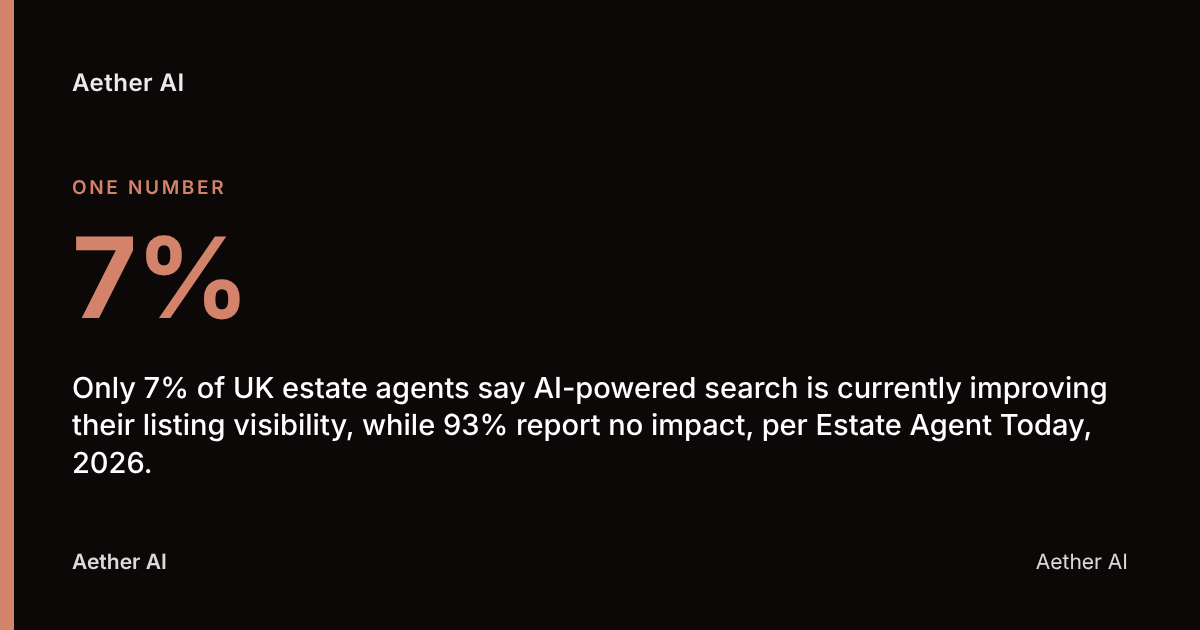
- Only 7% of UK estate agents say AI-powered search is currently improving their listing visibility, while 93% report no impact, per Estate Agent Today, 2026.
- 84% of UK estate agents believe AI-powered search will become a primary way buyers look for property, and 88% believe agencies that fail to adopt it risk falling behind, according to a GetAgent survey of 622 UK estate agents (2026).
- 22% of agents have already had a buyer reference AI when explaining how they found a property, and 17% have had a seller ask whether AI was used to market their home, per the same GetAgent/ProperPR survey (2026).
- Brands in the top quartile for web mentions earn up to ten times more AI Overview mentions than the quartile below them, according to GetAgent/Roar Digital analysis (2026).
- Aether AI tracks citation frequency across ChatGPT, Perplexity, Google AI Overviews, Claude, Gemini and Copilot — the six engines now shaping how property searches surface agency names.
What Does 'AI Search' Mean for Estate Agency, and How Does It Differ From Rightmove or Zoopla?
AI search is a category of discovery technology where a large language model — software trained to generate human-like answers from vast datasets — interprets a buyer's natural-language question and returns a synthesised answer, rather than a ranked list of links. Instead of typing "3-bed semi, Didsbury, under £350k" into a portal's filter boxes, a buyer can ask ChatGPT or Perplexity "where should a family of four look for a semi-detached house near good schools in south Manchester under £350,000?" and get a conversational, reasoned reply.
Traditional portals like Rightmove and Zoopla work on structured search: filters, postcodes, price bands and saved searches pull from a listings database the agent controls directly. AI search tools work on retrieval and synthesis: they pull from whatever the model has indexed or can browse in real time, which may include portal data, agency websites, news coverage, review sites and forum discussion.
This matters because an agency's own website content, not just its portal listing, becomes a visibility asset. Rightmove itself has moved into this space, with its Chief Technology and Operations Officer, Tarah Lourens, stating the portal is "increasingly using AI to enhance the property search experience by leveraging our leading data, and personalisation capabilities alongside Google's latest technology offering." Google Cloud's Maureen Costello, Vice President for UKI and SSA, has called the resulting feature "a prime example of how technology can simplify life's big decisions." Rightmove's own press centre notes that "early indicators suggest that higher-intent home-movers are choosing to use AI search on Rightmove."
For agents, the practical distinction is control. A portal ranking is something you buy or optimise within a closed system. AI search visibility is earned through what the wider web says about your agency — a discipline often called generative engine optimisation, or GEO: the practice of structuring content so AI models are more likely to cite it in generated answers.
What Tasks Can AI Search Tools Actually Do for Estate Agents?
AI search tools perform three core jobs for estate agents: matching buyers to suitable properties using natural-language queries, automating first-line responses to client enquiries, and generating marketing content such as listing descriptions. These are distinct from AI visibility work, which is about whether external AI engines mention your agency at all.
On the content-generation side, adoption is already substantial among US agents, which offers a useful benchmark given the UK market is following a similar trajectory. NAR's 2025 Technology Survey found 46% of REALTORS use AI-generated content for tasks like listing descriptions, with ChatGPT the dominant tool at 58% usage, ahead of Gemini (20%) and Copilot (15%). By NAR's 2026 technology report, the top use case among AI-using agents is writing listing descriptions at 75%, followed by social media posting at 56%, with ChatGPT usage climbing to 91% among those who use AI at all.
For UK agencies, the realistic task list splits into two tiers:
- Client-facing tasks: conversational chatbots answering viewing availability, mortgage-in-principle questions and area guides; AI-assisted property matching that goes beyond portal filters to interpret lifestyle criteria.
- Back-office tasks: drafting listing copy, summarising viewing feedback, flagging leads by likely conversion probability, and monitoring what AI engines say about the agency's brand.
The second category — brand monitoring — is where citation-tracking platforms like Aether AI operate, checking whether ChatGPT, Perplexity, Google AI Overviews, Claude, Gemini and Copilot mention a given agency when asked relevant questions.
Which Platforms Should UK Estate Agents Compare for AI Search?
UK estate agents choosing an AI search platform should compare tools across three categories: portal-level AI (built into Rightmove or Zoopla), client-facing chatbot providers, and GEO/citation-tracking platforms that monitor how external AI engines describe the agency. Each serves a different job and none fully replaces the others.
| Category | Example function | Who controls it | Typical cost model |
|---|---|---|---|
| Portal AI search | Conversational search layer on Rightmove | Portal, not the agent | Included in portal subscription |
| Client-facing chatbot | Website/WhatsApp enquiry handling | Third-party vendor or CRM add-on | Monthly subscription, often £50-£300+ |
| GEO/citation tracking | Monitors mentions across ChatGPT, Perplexity, Gemini, Copilot, Claude | The agency, via a self-service platform | Monthly SaaS subscription |
| CRM-embedded AI | Lead scoring, auto-drafted emails | Agency's existing CRM provider | Usually bundled into CRM tier |
RealGrader, a US-oriented AI-visibility tool for agents, positions itself around the promise to "get found on AI search, Google search and social media," according to its CEO, Alex Montalenti. That reflects the broader direction of travel: tools are converging on tracking presence across multiple engines rather than optimising for one search box.
For a UK agency deciding where to start, the honest answer is that no single platform does everything. Portal AI improves discovery within Rightmove and Zoopla's own ecosystems. A chatbot improves response times to enquiries already arriving. A GEO platform like Aether AI addresses a different, earlier-stage problem: whether your agency gets mentioned at all when someone asks an AI model a property question before they ever reach a portal or your website.
How Much Does AI Search Implementation Typically Cost a UK Estate Agency?
AI search tooling for a UK estate agency typically involves no fixed industry-wide price, because costs depend on whether the agency is buying a chatbot, a CRM upgrade, or a citation-tracking subscription. There is no verified UK pricing survey in current research, so the figures below are illustrative ranges based on comparable SaaS categories, not sourced statistics.
A realistic budget breaks down as follows:
- Chatbot/conversational AI add-on: often bundled into existing website or CRM platforms, or sold separately as a monthly SaaS fee.
- CRM-embedded AI features: frequently included in higher subscription tiers of established UK estate agency CRMs rather than priced separately.
- GEO/AI-visibility monitoring: priced as a self-service monthly subscription, with public pricing available directly from providers such as Aether AI at aether-ai.co.uk/pricing.
The decisive cost factor isn't the software fee — it's staff time spent reviewing AI-drafted content for accuracy, a cost most agencies underestimate when budgeting. Given that 84% of agents expect AI search to become a primary discovery route, per GetAgent's 2026 survey, the bigger risk for many agencies is under-investing now and needing to catch up later at higher cost.
What Data Protection and GDPR Obligations Apply to AI Search Tools?
GDPR — the UK General Data Protection Regulation, enforced domestically alongside the Data Protection Act 2018 — applies in full when an estate agency processes client names, contact details, financial information or property preferences through any AI search tool. The Information Commissioner's Office (ICO) is the UK regulator responsible for enforcing these obligations, and it treats AI tools as data processors subject to the same accountability rules as any other software.
Three obligations matter most for estate agents:
- Lawful basis and transparency: clients must know if their enquiry is being processed by an AI chatbot rather than a human, and the agency's privacy notice must reflect this.
- Data processing agreements: any third-party AI vendor handling client data needs a signed contract meeting UK GDPR Article 28 requirements before data flows to them.
- International transfers: many AI tools run on US-based infrastructure, which can trigger additional safeguards under UK GDPR's international transfer rules if personal data leaves the UK or EEA.
Aether AI also flags the Estate Agents Act 1979 and Money Laundering Regulations 2017, which govern client verification and record-keeping — obligations that don't disappear because an AI tool is involved in the initial conversation. No AI vendor contract removes the agency's own accountability as data controller under the ICO's framework.
What Common Mistakes Do Estate Agents Make When Adopting AI Search?
The most common mistake UK estate agents make is treating AI search as a single product to buy, when it is actually three separate disciplines: portal AI, client-facing automation, and external brand visibility. Confusing these leads to wasted spend and misplaced expectations.
A second mistake is assuming visibility will happen automatically. There is a stark awareness gap here: 93% of agents report AI search having no impact on their listings today, per Estate Agent Today, 2026, yet most of that 93% have taken no deliberate steps to be cited by AI engines — they are simply not showing up because no one has made their site citable.
Other recurring errors include:
- Publishing AI-generated listing copy unedited, risking factual errors about lease length, service charges or planning status that could breach the Consumer Protection from Unfair Trading Regulations 2008.
- Ignoring the correlation between web authority and AI citation: GetAgent/Roar Digital found brands in the top quartile for web mentions earn up to ten times more AI Overview mentions than the quartile below — meaning agencies with thin digital footprints are structurally disadvantaged regardless of local reputation.
- No one owning the task: AI search often falls between marketing, IT and the senior partner, meaning nobody actually checks what ChatGPT or Gemini says about the agency.
- Treating one engine as representative: an agency checking only Google AI Overviews misses that Perplexity, Claude and Copilot may answer the same query completely differently.
How Can Estate Agents Measure the Return on AI Search Investment?
Estate agents can measure AI search ROI by tracking three separate metrics: citation frequency across AI engines, referral traffic from AI-driven sessions, and conversion rate on AI-originated enquiries. These require different tools than standard Google Analytics reporting, because AI engines don't always pass clear referral data the way traditional search does.
A practical measurement framework:
| Metric | What it tells you | How to track it |
|---|---|---|
| Citation frequency | How often ChatGPT, Perplexity, Gemini, Copilot, Claude and AI Overviews mention your agency | Dedicated GEO/citation-tracking platform |
| AI-referred sessions | Visits arriving via AI chat interfaces | Server logs, GSC integration, referrer analysis |
| Buyer-reported AI use | How often clients mention finding you via AI | Front-desk/CRM prompt at enquiry stage |
| Seller awareness | Whether vendors ask about AI marketing | Instruction meeting checklist |
That last row matters more than agencies often assume. The GetAgent/ProperPR survey of 622 UK estate agents found 22% had already seen a buyer reference AI when explaining how they found a property, and 17% had sellers ask whether AI was used to market their home. Agencies that aren't asking these questions at the point of instruction are missing a free, direct signal.
Platforms built for this purpose, such as Aether AI, combine citation tracking across six AI engines with Google Search Console integration, giving agencies a single view of both traditional organic performance and AI-engine mentions rather than treating them as unrelated channels.
How Is AI Search Likely to Change UK Property Discovery Over the Next Few Years?
AI search is likely to shift a growing share of early-stage property research away from portal browsing and toward conversational queries, according to the agents closest to the trend. 84% of UK estate agents already believe AI-powered search will become a primary way buyers look for property, and 88% believe agencies that fail to adopt it risk falling behind competitors, per GetAgent's 2026 survey.
The parallel US market offers a signal of pace. NAR's 2025 Technology Survey found 68% of agents already using AI tools, though only 17% reported significant positive business impact at that stage, with 46% reporting no noticeable effect. A year later, NAR's 2026 report found the picture had moved quickly: nearly half of agents now use AI daily or weekly, only 12% say they have no plans to use it (down sharply from 32% the previous year), and 55% of AI users now report a positive business impact. That trajectory — from scepticism to routine use within roughly twelve months — is the pattern UK agencies should expect to compress into their own market.
Rightmove's own infrastructure investment supports this reading. The portal has rolled out AI-powered conversational search built on Google's technology stack, with early data suggesting, in Rightmove's words, that "higher-intent home-movers are choosing to use AI search on Rightmove." If the UK's dominant portal is investing here, independent agency websites will need an equivalent strategy to avoid becoming invisible outside the Rightmove ecosystem entirely.
Your AI search readiness checklist
- Audit what ChatGPT, Perplexity, Gemini, Copilot, Claude and Google AI Overviews currently say about your agency when asked relevant local-area questions.
- Separate your AI strategy into three workstreams: portal AI, client-facing automation, and external brand visibility — don't buy one tool expecting it to cover all three.
- Confirm your website has clear, structured, factual content about your agency, service areas and specialisms, since web authority correlates with AI citation frequency.
- Draft a GDPR-compliant privacy notice update disclosing any AI chatbot use to enquiring clients.
- Put a data processing agreement in place with any third-party AI vendor handling client or property data.
- Add a simple question to your instruction and enquiry process: "How did you hear about us, and did you use any AI tools?"
- Assign clear ownership of AI search monitoring — don't let it sit unowned between marketing, IT and management.
- Review AI-generated listing copy for factual accuracy before publishing, particularly around lease terms, service charges and planning status.
FAQ
What does AI search mean for estate agents?
AI search means buyers and sellers use tools like ChatGPT, Gemini, Copilot, Claude and Perplexity to ask natural-language property questions and get synthesised answers, rather than browsing filtered portal listings. It sits alongside, not instead of, Rightmove and Zoopla.
Do UK buyers actually use AI to find estate agents yet?
Yes, in a measurable minority of cases. A survey of 622 UK estate agents found 22% had seen a buyer reference AI when explaining how they found a property, and 17% had sellers ask whether AI was used in marketing.
Is AI search already improving estate agency visibility?
Not yet, for most agencies. Only 7% of UK estate agents believe AI-powered search is currently improving their listing visibility, while 93% report no impact, according to Estate Agent Today, 2026.
Who should manage AI search tools within an estate agency?
There is no single correct answer in current research, but the task spans marketing (content and GEO), IT (integration and data security) and compliance (GDPR obligations). Most agencies assign a lead owner — often marketing or the principal — supported by an external GEO or IT provider rather than leaving it unowned.
What's the biggest risk of ignoring AI search right now?
88% of UK estate agents believe property businesses that fail to adopt AI search risk falling behind competitors, per GetAgent's 2026 survey. The risk compounds because web authority correlates directly with AI citation frequency, meaning early movers compound an advantage over time.
Does GDPR apply differently when AI tools are involved?
The core obligations don't change, but new risks emerge around international data transfers, vendor processing agreements, and transparency about AI chatbot use. The Information Commissioner's Office treats AI vendors as data processors subject to the same UK GDPR accountability rules as any other software supplier.
Will AI search replace Rightmove and Zoopla?
Current evidence doesn't support that conclusion. Rightmove has instead built AI search directly into its own platform, and its leadership describes this as enhancing rather than replacing existing search, with Chief Technology and Operations Officer Tarah Lourens framing it as layering AI onto the portal's existing data and personalisation capabilities.
Getting your agency cited in AI search with Aether AI
Estate agents face the same discovery problem this article describes: AI engines like ChatGPT, Perplexity, Gemini, Copilot and Claude are increasingly the first place buyers ask property questions, yet most agencies have no visibility into what those engines currently say about them. Aether AI was built specifically to close that gap — tracking citation frequency across all six major AI engines, alongside keyword and competitor tracking and Google Search Console integration, so an agency can see where it's mentioned and where a competitor is winning the answer instead.
Aether AI's own measured baseline shows how early this market still is: across 700 live AI engine scans of UK brands' target keywords between July and August 2026, brands were named in just 3.3% of answers, published at aether-ai.co.uk/insights/ai-visibility-baseline-2026. That scarcity is the opportunity — agencies that build citable content now, while most competitors remain invisible to AI engines, stand to compound an advantage that becomes far harder to close later.
If your agency wants to see exactly where it currently stands, Aether AI offers a free AI-visibility audit at aether-ai.co.uk/audit, with transparent pricing available at aether-ai.co.uk/pricing for agencies ready to move from checking visibility to actively building it.