Last updated: 22 November 2026
Anthropic AI search optimization means configuring a website so Claude can crawl it, understand it and cite it in answers, rather than treating Claude as an afterthought to Google SEO. Claude's referral traffic grew 320% year over year, from 0.0021% of total traffic in 2025 to 0.0084% in 2026, according to SE Ranking (2026), still a small slice but one UK businesses can no longer ignore.
Key Takeaways
- Anthropic AI search optimization is a distinct discipline from general SEO because Claude cites sources rather than ranking pages, drawing heavily on Brave Search results.
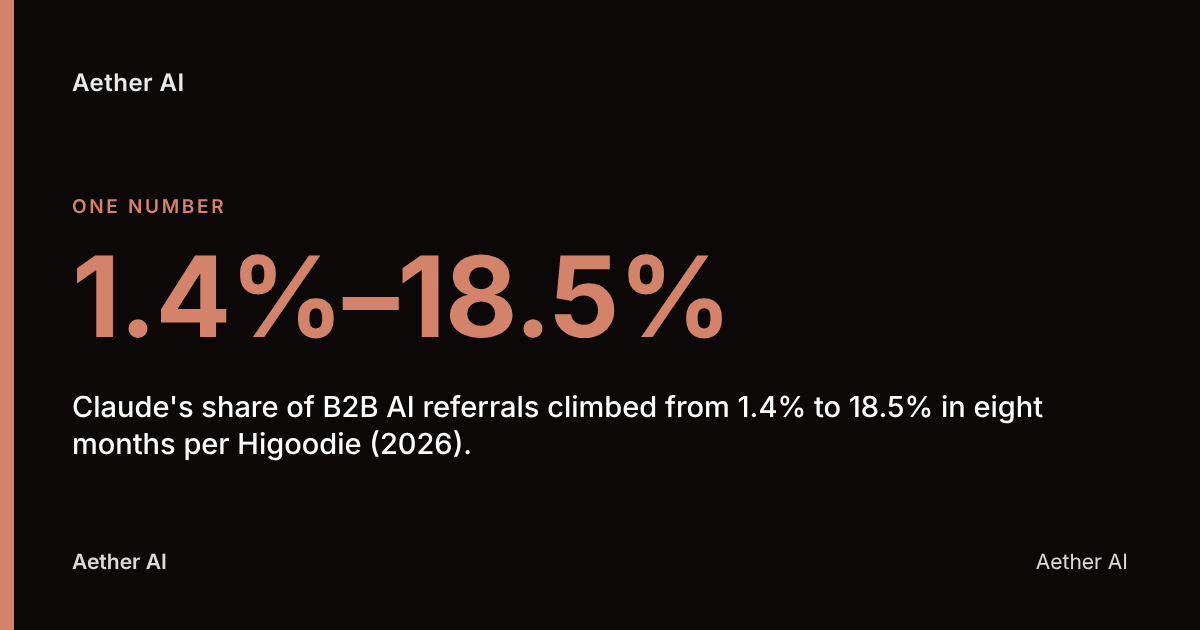
- Claude's share of B2B AI referrals climbed from 1.4% to 18.5% in eight months per Higoodie (2026).
- A UK business should check robots.txt for ClaudeBot, Claude-User and Claude-SearchBot directives before assuming its content is invisible to Anthropic's systems.
What Does Anthropic AI Search Optimization Actually Mean?
Anthropic AI search optimization is the practice of structuring a website's content, technical markup and crawler permissions so that Claude, Anthropic's AI assistant, can access, understand and cite it in generated answers. It sits inside the broader field of GEO (generative engine optimization), the discipline of optimising content for AI systems that generate conversational answers rather than lists of blue links, as Wikipedia's AI SEO overview describes.
It is a recognised but still-forming discipline. Traditional SEO optimises for ranking position on a results page. Claude optimization optimises for citation: whether a specific sentence or page gets pulled into an answer at all. Anthropic itself has been public about treating this seriously, reportedly looking for SEO expertise as part of its own marketing function, according to MediaPost.
The distinction matters because Claude's traffic share remains modest next to competitors. ChatGPT sent 74.78% of all AI referral traffic in 2026, down from 79.74% in 2025, with Gemini at 11.56%, Perplexity at 7.23%, Copilot at 3.51% and Claude at 2.62%, according to SE Ranking (2026). Claude is a smaller channel today, but one with disproportionate weight in business and technical queries, which changes the optimisation priorities for a B2B brand.
How Does Claude Find, Crawl and Cite Web Content?
Claude uses three distinct bots for three different jobs, and confusing them is the most common technical mistake a UK business makes. ClaudeBot crawls the web to build training data. Claude-User fetches a page in real time when a person asks Claude to look at a specific URL. Claude-SearchBot, in Anthropic's own words, "navigates the web to improve search result quality for users," according to Anthropic's support documentation.
Claude-SearchBot accounted for 1.8% of AI-bot requests as of October 2026, according to SEOmator (2026). This is the bot most relevant to being cited in a Claude answer, since it indexes content specifically for search ranking, separate from long-term model training.
Claude leans on a third party for its web index, drawing on an external search provider rather than crawling everything itself. 86.7% of Claude-cited URLs overlap with Brave Search's top organic results rather than Google's, according to WebPulseHQ (2026). This single fact reframes the whole optimisation task: ranking well in Brave Search is a leading indicator of whether Claude will surface a page at all, alongside ranking in Google.
Technical Steps for ClaudeBot and Crawler Permissions
A UK business controls Anthropic's access through robots.txt, the plain-text file at a site's root that tells automated crawlers which pages they may fetch. Anthropic's three bots each respond to their own user-agent string, so blanket "disallow all bots" rules can accidentally block Claude-User fetches a customer explicitly requested.
Anthropic states plainly that "Anthropic's Bots respect 'do not crawl' signals by honoring industry standard directives in robots.txt," according to Anthropic's support documentation. That means standard Disallow rules work, but a business must name each bot correctly.
| User-agent | Purpose | Typical robots.txt entry |
|---|---|---|
| ClaudeBot | Crawls for model training data | User-agent: ClaudeBot / Disallow: / to block |
| Claude-User | Fetches a page a user asked Claude to read | User-agent: Claude-User / rarely blocked |
| Claude-SearchBot | Indexes content for citation in answers | User-agent: Claude-SearchBot / leave allowed to be cited |
Anthropic is explicit about the trade-off of blocking the search bot: "Disabling Claude-SearchBot on your site prevents our system from indexing your content for search optimization, which may reduce your site's visibility and accuracy in user search results," according to Anthropic's support documentation. A business that wants Claude citations should leave Claude-SearchBot unblocked even if it restricts ClaudeBot's training crawl. Guidance on the three bots and blocking syntax is also set out by Search Engine Land and PPC Land.
Anthropic AI Search Optimization Versus Optimising for Google, Bing or ChatGPT
Optimising for Claude differs from optimising for Google's AI Overviews, Microsoft's Bing Copilot or OpenAI's ChatGPT search because each system sources its answers differently. Google draws on its own index and Search Console signals. Bing Copilot draws on the Bing index. ChatGPT search blends Bing data with OpenAI's own crawler, Browse. Claude leans on Brave Search's index for a large share of its citations.
This is why share shifts between engines matter to a B2B marketer specifically. ChatGPT's share of B2B AI referrals fell from 89.1% to 62.6% in eight months, according to the Higoodie AI Search Traffic Report (2026). A business selling to other businesses cannot treat Claude as negligible even while its overall traffic share stays small, because its growth is concentrated exactly where B2B buyers research.
Across the wider market, AI referral traffic made up 0.32% of all website traffic in 2026 across 101,574 sites, a 16-fold increase from 0.02% in 2024, according to SE Ranking (2026). That growth curve underlines why a firm should set up measurement now, ahead of AI referrals becoming a large line item.
Content Structures That Get Cited in Claude Answers
Pages most likely to be referenced in an AI-generated answer open each section with a clear, standalone answer. Claude, like other large language models, extracts passages without reading a page start to finish, so a definition, a figure or a direct answer in the first sentence or two of a section is what gets lifted.
Practical structures that help:
- Clear H2 and H3 headings that state the topic plainly, not teaser phrasing
- A direct answer in the first two sentences of each section
- Structured data markup (schema.org FAQPage, Article, Organization) so machines can parse page type and authorship
- Named entities such as specific standards, regulators, dates and figures, stated plainly in place of vague claims
- Tables for comparative or numeric content, since they are extracted cleanly into AI answers
Technical explainers of how Claude's web search tool queries, fetches and cites sources, including API-level controls such as max_uses limits, are set out by AI Rank Lab. This level of detail matters more for enterprise integrations than for a typical marketing site, but it confirms the same principle: Claude cites discrete passages, not whole pages.
Your Anthropic AI search optimization checklist
- Check robots.txt for ClaudeBot, Claude-User and Claude-SearchBot entries before assuming a block exists
- Leave Claude-SearchBot unblocked if citation visibility is the goal
- Improve organic ranking in Brave Search alongside Google, since most Claude citations trace back to it
- Add schema.org markup (FAQPage, Article) to key pages
- Open every page section with a direct, quotable answer in the first two sentences
- Track AI referral traffic separately in analytics, filtering for ChatGPT, Claude, Perplexity, Gemini and Copilot user agents
- Review crawler logs monthly for Claude-SearchBot and ClaudeBot activity
- Re-test citation visibility after any major content or structure change
FAQ
Does Claude read websites the same way Google does?
No. Claude relies heavily on Brave Search's index for live citations rather than Google's, according to WebPulseHQ (2026), so Brave ranking performance is a stronger predictor of Claude visibility than Google ranking alone.
How do I block or allow ClaudeBot in robots.txt?
Add a User-agent: ClaudeBot block with Disallow: / to stop training-data crawling, but treat Claude-SearchBot separately since Anthropic's own documentation states blocking it may reduce a site's visibility in search results, according to Anthropic's support page.
What is the difference between ClaudeBot, Claude-User and Claude-SearchBot?
ClaudeBot crawls broadly to build training data, Claude-User fetches a specific page a person has asked Claude to read, and Claude-SearchBot indexes content specifically to improve the quality of search-style answers, per Anthropic's documentation.
Why does Claude use Brave Search instead of Google or Bing?
Anthropic has not published a full explanation, but observed citation patterns show the large majority of Claude's cited URLs match Brave Search's organic results rather than Google's, according to WebPulseHQ (2026), suggesting Brave is a primary retrieval layer behind Claude's web search tool.
Measuring AI Visibility Across Claude and Beyond
A business that configures robots.txt and restructures content still needs a way to see whether any of it is working, and that is the gap Aether AI was built to close. Aether AI tracks citation visibility across six AI engines, including Claude, ChatGPT, Perplexity, Google AI Overviews, Gemini and Copilot, alongside keyword tracking, competitor comparison and Google Search Console integration in one self-serve platform.
Aether AI's own baseline scan, published at aether-ai.co.uk/insights/ai-visibility-baseline-2026, ran 700 live AI engine scans of UK brands' target keywords between July and August 2026 and found those brands named in 23 answers, or 3.3% of scans. That baseline is exactly the kind of citation gap a UK business needs to quantify before investing further in Claude-specific technical changes.
Run a free AI-visibility audit at Aether AI's audit tool to see where a site currently stands across Claude and the other major AI engines, then compare pricing plans at Aether AI's pricing page to track progress over time.