Last updated: 16 November 2026
Google AI Overviews citation probability for product pages is driven overwhelmingly by existing Google ranking position, not by adding schema markup alone. Pages ranking #1 see roughly 33% citation odds versus 13% at position #10, and most citations go to third-party comparison sites rather than brand websites, according to The Digital Bloom and Derivatex Agency.
Key Takeaways
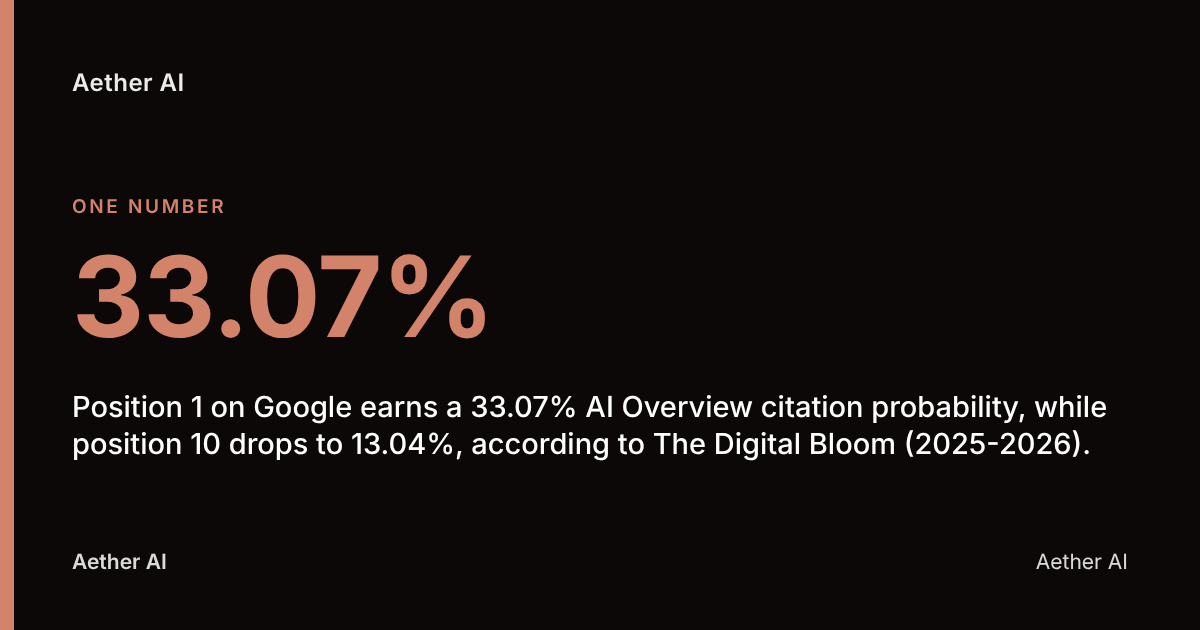
- Position #1 on Google earns a 33.07% AI Overview citation probability, while position #10 drops to 13.04%, according to The Digital Bloom (2025-2026).
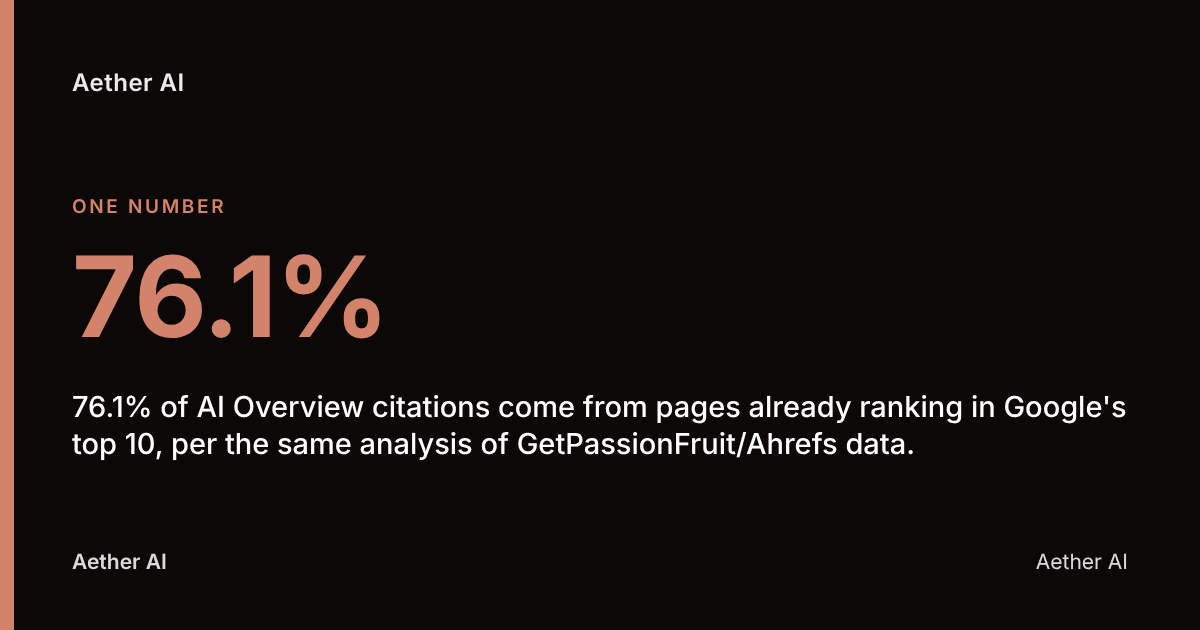
- 76.1% of AI Overview citations come from pages already ranking in Google's top 10, per the same analysis of GetPassionFruit/Ahrefs data.
- Third-party "best product" lists earn 63% of AI Overview citations for commercial searches, while the brand's own product page earns only 12%, found Derivatex Agency (2026) across 1,259 citations.
- Google AI Overviews reaches over 2 billion monthly users across more than 200 countries and 40 languages, Google CEO Sundar Pichai told Alphabet's Q2 2025 earnings call, as reported by Digiday.
- An Ahrefs study of 1,885 pages found no meaningful citation lift from adding JSON-LD schema, and actually recorded a small statistically significant decline on Google AI Overviews, per vrid.ai (2026).
What is Google AI Overviews and how does it use product data?
Google AI Overviews is an AI-generated summary that Google places above traditional search results, synthesising information from multiple web pages — including product listings, review sites and retailer pages — into a single conversational answer. It draws on Google's existing crawl and index of the web, meaning a product page must already be indexed and ranking before it can realistically be surfaced in a generated summary.
For a UK retailer selling, say, garden furniture or home security cameras, this means the system is reading product titles, prices, availability, reviews and surrounding page content, then deciding which sources best answer the user's underlying question — "what's the best X" or "which Y should I buy."
Sundar Pichai, Google's CEO, told Alphabet's Q2 2025 earnings call that AI Overviews reaches over 2 billion monthly users across more than 200 countries and 40 languages, driving over 10% more queries for the types of searches that show them (Digiday, 2025). For UK ecommerce brands, this scale makes product citation probability a genuine revenue question, not a vanity metric.
Google's own documentation is explicit that there is no separate "AI Overviews index" — the system draws from the same crawl Google uses for traditional search, retrieved and re-ranked for the specific question asked.
What factors determine product page citation in AI Overviews?
The single strongest predictor of AI Overview citation is existing organic ranking position, not any single on-page optimisation. 52% of organic AI Overview citations come from top-10 Google results, and #1-ranked results have a 58% chance of an AI Overview citation, according to Originality.ai (2025).
A separate analysis using GetPassionFruit and Ahrefs data found a steeper gradient: position #1 earns a 33.07% citation probability, falling to 13.04% at position #10, with 76.1% of all AI Overview citations coming from Google's top-10 results (The Digital Bloom, 2025-2026).
Domain-level trust also correlates with citation rate. Digital Applied analysed 1,000 AI Overviews across 10 query intents and roughly 30 verticals, finding domain authority has a +0.61 correlation with citation rate (2025).
Content quality itself matters independently of ranking. Wellows analysed 15,847 AI Overview results across 63 industries and found content scoring above 8.5/10 for semantic completeness is 4.2x more likely to be cited than content scoring below 6.0/10 (2025). For a product page, this suggests comprehensive specifications, honest pros and cons, and clear pricing outperform thin, templated listings — regardless of how well the page already ranks.
How does structured data markup affect AI Overviews citation probability?
Schema.org Product markup — a standardised code format (JSON-LD) that tells search engines a page's price, availability and reviews in machine-readable form — shows genuinely conflicting evidence on whether it lifts citation odds. Alhena AI found pages with complete Product, Offer, Review, and AggregateRating schema get cited 3.1x more often in AI Overviews for ecommerce queries (2025).
Set against this, an Ahrefs study covering 1,885 pages that added JSON-LD schema found no meaningful citation lift on Google AI Overviews, AI Mode, or ChatGPT, and actually recorded a small, statistically significant citation decline on Google AI Overviews, as reported by vrid.ai (2026).
Google's own position sits between these findings. Google Search Central states that "structured data isn't required for generative AI search, and there's no special schema.org markup you need to add," while Google's AI Features documentation adds there "are no additional requirements to appear in AI Overviews or AI Mode, nor other special optimizations necessary." Google's Search Liaison has separately noted that "structured data gives an advantage in search results" — a more general statement about traditional search features like rich results, not a specific AI Overviews claim.
The practical read for a UK retailer: treat Product schema as good hygiene for Google Merchant Center and rich results eligibility, not as a guaranteed AI Overview citation lever. It likely helps machines parse your page correctly, which supports the semantic-completeness signal Wellows identified, but it is not a substitute for ranking position or content depth.
Schema vs ranking position: where to invest first
| Factor | Evidence of impact on citation | Effort to fix | Priority |
|---|---|---|---|
| Google ranking position (top 10) | 76.1% of citations come from top-10 pages (The Digital Bloom) | High (SEO, content, links) | First |
| Semantic completeness of content | 4.2x more citations above 8.5/10 score (Wellows) | Medium (content rewrite) | Second |
| Named-source citations in body copy | Each figure names where it comes from, so a reader can check it | Low (editorial) | Third |
| Product/Offer/Review schema | 3.1x lift per Alhena AI, but no lift (and small decline) per Ahrefs | Low (dev time) | Low-risk, do anyway |
Does ranking position or domain authority decide AI Overview citation over organic rank?
Domain authority and existing ranking are closely linked, and both outperform almost any single on-page tactic. The data above shows ranking position correlating directly with citation odds — #1 at roughly 33-58% depending on the study, dropping steadily by position 10.
This creates a structural challenge for smaller UK brands: AI Overviews citation differs from traditional organic ranking or featured snippets because it favours synthesis sources over sales pages. Derivatex Agency studied 1,259 citations across 100 commercial "best software" searches and found third-party lists earned 63% of citations while the recommended product's own website earned only 12% (2026).
Translated to physical or consumer products, this means a review site, comparison blog or trade publication ranking for "best [product] UK" is statistically more likely to be cited than the manufacturer's own product page — even if that manufacturer ranks well organically. A UK business selling security cameras, office furniture, or software subscriptions should expect AI Overviews to favour independent-feeling buying guides over its own storefront, and should factor that into its content strategy by seeking inclusion in third-party comparisons, not only polishing its own pages.
Featured snippets historically rewarded a single page answering a single query concisely. AI Overviews instead blend several sources into one answer, so a page can influence the final text without earning the sole citation link — a distinction worth explaining to stakeholders who expect snippet-style, winner-takes-all outcomes.
How can a UK business check whether its product pages are cited in AI Overviews?
A business can check AI Overview citation status by manually searching its target product queries in Google (while signed out of personalisation, where possible) and recording whether its domain appears in the generated summary and its source links. This manual method is accurate but doesn't scale beyond a handful of keywords, and AI Overviews are not shown for every query or every user, which makes single-search checks unreliable on their own.
Google Search Console does not yet provide a dedicated AI Overview-impressions filter in the way some agencies describe informally, so businesses should treat any such claim cautiously and rely on direct search testing or third-party tracking tools instead.
Aether AI tracks citation across six AI engines — ChatGPT, Perplexity, Google AI Overviews, Claude, Gemini and Copilot — giving UK businesses a repeatable way to see whether their product pages, and which competitor or third-party pages, are being cited for their target keywords over time, rather than relying on one-off manual checks.
"Every article on our own site was researched, written and published by the platform — the byline says so. We don't show prospects a demo corpus; we show them our production one. If the engine couldn't do this for us, we'd have no business selling it to you." — Lauren Dawkins, Head of Content, Aether AI
What tools track and measure AI Overview citation rates over time?
Measuring citation rate over time requires repeated, systematic querying rather than one-off manual checks, because AI Overviews output can vary between searches and update as Google's index refreshes. Dedicated tracking platforms query a fixed set of target keywords on a schedule and log whether, and where, a domain is cited across multiple AI engines.
Aether AI's platform includes citation tracking across ChatGPT, Perplexity, Google AI Overviews, Claude, Gemini and Copilot, alongside keyword and competitor tracking and Google Search Console integration, giving businesses one place to see citation trends rather than piecing together manual spot-checks.
To put the scale of this discovery challenge in context: Aether AI's own measured baseline, published at aether-ai.co.uk/insights/ai-visibility-baseline-2026, ran 700 live AI engine scans of UK brands' target keywords between July and August 2026 and found the brands were named in 23 answers — 3.3% of scans — while the longest-established brand, in security services, was named in 6.3% of its 270 scans. This is consistent with the wider research showing citation is scarce and concentrated among a small set of sources, reinforcing why systematic tracking matters more than assumption.
A free starting point for any UK business is Aether AI's AI-visibility audit, which gives an initial read on current citation exposure before committing to ongoing tracking.
Your AI Overviews product citation checklist
- Check your current Google ranking position for each target product query before changing anything else
- Add complete Product, Offer, Review and AggregateRating schema as good hygiene, without expecting a guaranteed citation lift
- Rewrite thin product descriptions to include specifications, honest comparisons and at least one named external source
- Search your core product queries manually to see whether your domain, or a competitor's, appears in the AI Overview
- Identify which third-party "best [product]" lists already rank well and seek inclusion in them
- Set up repeatable tracking across AI engines rather than relying on single manual searches
- Review citation status again after any major content or schema change, allowing time for Google's index to refresh
- Assign clear ownership of AI Overview monitoring to one team so changes aren't duplicated or missed
FAQ
Does ranking #1 on Google guarantee a citation in AI Overviews?
No, ranking #1 does not guarantee citation, but it substantially improves the odds. Figures range from a 33.07% citation probability at position #1 (The Digital Bloom) to a 58% chance reported by Originality.ai, both far above lower-ranking positions.
Is structured data required for Google AI Overviews citations?
No. Google Search Central states structured data isn't required for generative AI search and there's no special schema.org markup needed, and Google's AI Features documentation confirms there are no additional requirements to appear in AI Overviews. Third-party studies disagree on whether it helps: Alhena AI found a 3.1x citation lift from complete Product schema, while an Ahrefs study reported via vrid.ai found no meaningful lift and a small decline.
What percentage of AI Overview citations come from a product's own website versus third-party sources?
Only 12% of citations went to the recommended product's own website, while third-party lists earned 63%, in a study of 1,259 citations across 100 commercial "best software" searches by Derivatex Agency (2026).
How many monthly users does Google AI Overviews have?
Google AI Overviews reaches over 2 billion monthly users across more than 200 countries and 40 languages, according to Google CEO Sundar Pichai's comments on Alphabet's Q2 2025 earnings call, reported by Digiday.
How is AI Overviews citation different from traditional organic ranking or featured snippets?
AI Overviews blends multiple sources into one synthesised answer rather than rewarding a single top result, and favours third-party comparison content over brand sales pages far more than traditional featured snippets did. 76.1% of AI Overview citations still come from pages in Google's top 10 (The Digital Bloom), so strong organic ranking remains a near-essential foundation even though it no longer guarantees the citation.
Can small UK ecommerce brands compete for AI Overview citations against larger retailers?
Yes, though it's harder without strong existing rankings, since domain authority has a +0.61 correlation with citation rate (Digital Applied). Smaller brands can improve odds by securing mentions in third-party "best product" lists, since those earn the majority of citations regardless of the brand's own domain strength.
How can a business track whether its product pages are being cited in AI Overviews?
A business can manually search target queries and check the generated summary's sources, though this doesn't scale reliably. Tools like Aether AI track citation across six AI engines — ChatGPT, Perplexity, Google AI Overviews, Claude, Gemini and Copilot — on a repeatable basis, which gives a more consistent read than one-off manual checks.
Tracking and improving your citation odds with Aether AI
Getting cited in Google AI Overviews for product queries is now a measurable, trackable discipline rather than guesswork, and that's precisely the gap Aether AI's platform closes for UK businesses. Where this article has shown that ranking position, content depth and third-party mentions all shape citation probability, Aether AI gives teams the tooling to monitor which of those levers is actually moving the needle for their own product pages.
Aether AI tracks citations across six AI engines — ChatGPT, Perplexity, Google AI Overviews, Claude, Gemini and Copilot — alongside keyword and competitor tracking and Google Search Console integration, so a UK retailer or software vendor can see citation trends rather than relying on single manual searches. Aether AI is built and operated by Aether Agency Ltd. Priority First, Pulse Operations and Aether Agency are businesses connected to the founding team, and results referenced from them are disclosed as such rather than presented as independent client wins.
If your product pages currently have no visibility into AI Overview citation, start with Aether AI's free AI-visibility audit to see where you stand today, or review public pricing to explore ongoing tracking options.