Last updated: 3 November 2026
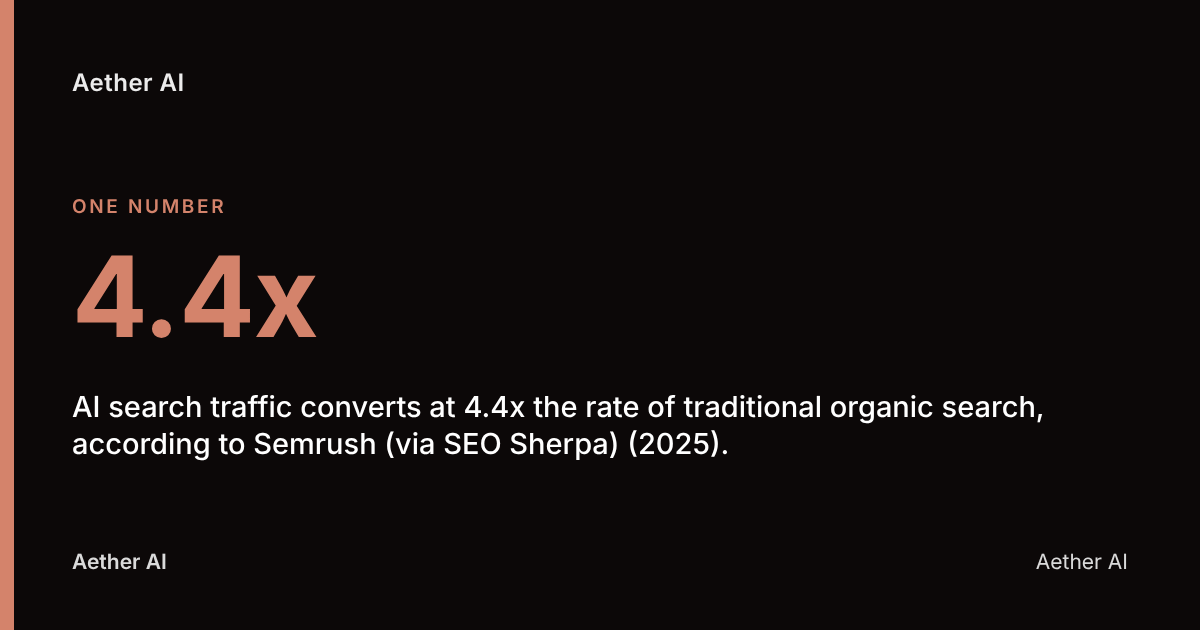
Measuring ROI of GEO (Generative Engine Optimisation — optimising content so AI engines like ChatGPT, Perplexity and Google AI Overviews cite it) means tracking citation rates, AI-referral traffic and conversions against content and tooling spend. AI search traffic converts at 4.4x the rate of traditional organic search, according to Semrush (via SEO Sherpa), making the return side measurable even when attribution is imperfect.
Key Takeaways
- AI search traffic converts at 4.4x the rate of traditional organic search, according to Semrush (via SEO Sherpa) (2025).
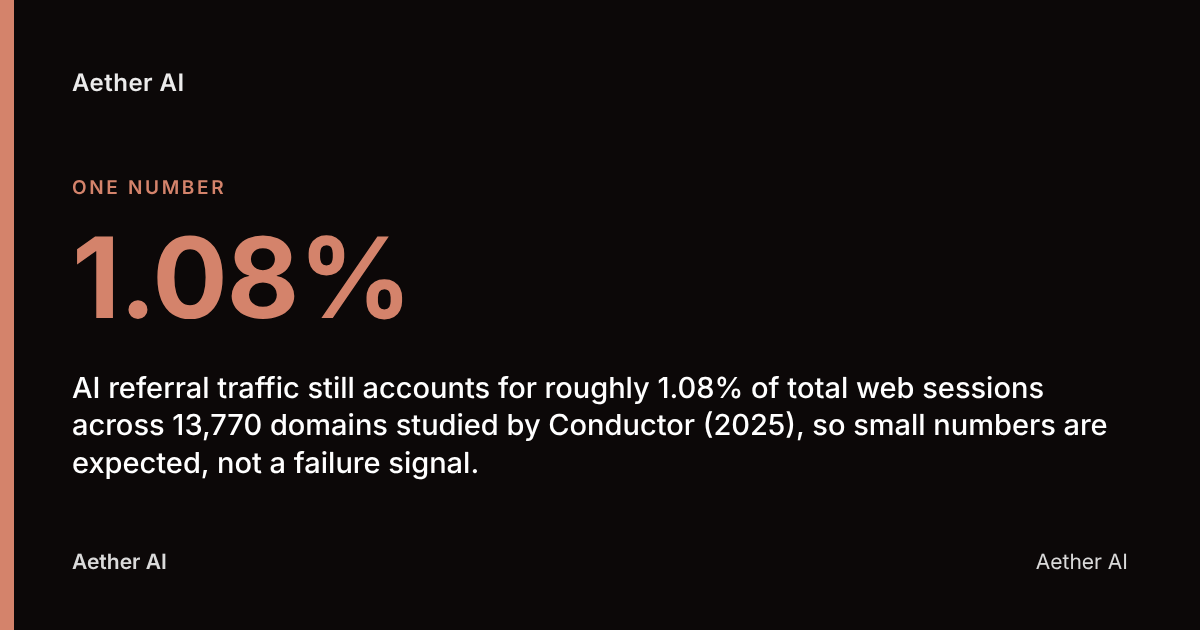
- AI referral traffic still accounts for roughly 1.08% of total web sessions across 13,770 domains studied by Conductor (2025), so small numbers are expected, not a failure signal.
- AI referral traffic grew 527% year-over-year between January–May 2024 and the same period in 2025, per Previsible / Search Engine Land.
- 25.11% of Google searches triggered an AI Overview in Q1 2026, based on a 21.9-million-search study by Contently — meaning a growing share of "Google" traffic is already AI-mediated.
- Aether AI's own scans found the UK brands it scanned named in just 3.3% of 700 live AI engine checks (July–August 2026), illustrating how low current citation rates typically are even for established content.
What is GEO and how does it differ from traditional SEO?
Generative Engine Optimisation (GEO) is the practice of structuring content so that AI answer engines — ChatGPT, Perplexity, Google AI Overviews, Claude, Gemini and Microsoft Copilot — select it as a source and cite it directly in a generated answer, rather than merely ranking it in a list of blue links. Traditional SEO optimises for position in the SERP (search engine results page) and relies on click-through to a results list; GEO optimises for inclusion inside a synthesised answer the user may never click through from.
The distinction matters for measurement. SEO has two decades of standardised metrics — rankings, organic sessions, click-through rate — built around Google Search Console data. GEO has no equivalent industry standard yet, and a large share of AI-driven visits arrive with no referral data at all, because many AI platforms strip or anonymise referrer strings.
A foundational academic paper from Princeton, Georgia Tech, the Allen Institute and IIT Delhi introduced the term GEO in 2024 and built the GEO-BENCH test set of 10,000 queries to measure whether specific content optimisation methods increased a source's visibility in generative engine responses. That study found visibility gains of up to 40% from targeted changes — though a later critical academic survey flagged that such figures can be overstated when applied outside controlled benchmark conditions, a caveat worth holding onto before quoting the 40% figure as a guaranteed outcome for any single website.
What metrics should be tracked to measure GEO performance?
GEO performance is measured through citation rate, AI share of voice, AI-referral sessions and downstream conversions — four distinct metrics that together replace the single "ranking position" metric SEO relies on. No single number tells the full story, which is why a GEO measurement framework needs all four tracked in parallel, ideally in one dashboard rather than four disconnected spreadsheets.
Citation rate measures how often a brand, page or fact is named in response to a defined set of prompts across AI engines, expressed as a percentage of scans. AI share of voice compares a brand's citation count against named competitors for the same prompt set, showing relative position rather than absolute presence. AI-referral traffic is the subset of web analytics sessions originating from AI platforms, identifiable via referrer strings such as chatgpt.com, perplexity.ai or copilot.microsoft.com where the platform still passes one. Downstream conversions — enquiries, demo bookings, purchases — are then tracked from that referral segment through to CRM-recorded revenue.
A practical caution: AI referral traffic still represents roughly 1% of total web traffic, with Conductor's study of 13,770 domains finding it averaging just 1.08% of total sessions in 2025. Expect small absolute numbers in Google Analytics 4 even where citation rate is climbing — the two metrics move on different timescales, and citation typically leads traffic by months.
| Metric | What it shows | Where to find it |
|---|---|---|
| Citation rate | % of prompts where your brand/page is cited | AI visibility tracking tool (e.g. Aether AI), manual prompt audits |
| AI share of voice | Your citations vs named competitors' | Same tool, filtered by competitor set |
| AI-referral sessions | Visits arriving via AI platform referrers | Google Analytics 4, server logs |
| AI-referral conversions | Enquiries/sales from that segment | CRM matched to GA4 referral source |
| Overall AI Overview exposure | Share of your target queries triggering an AI Overview | Contently-style query sampling, Search Console query data |
How do you calculate ROI for GEO?
GEO ROI is calculated using the same core formula as any marketing ROI — (Return − Investment) ÷ Investment × 100 — but with "return" redefined to include AI-attributed conversions and "investment" covering content production, tracking tools and any agency or platform fees. The formula itself is unchanged from traditional digital marketing; what differs is how reliably each side of the equation can be populated.
Investment typically includes: content creation costs (writer time, research, editing), GEO tracking tool subscriptions, technical implementation (structured data, schema markup, site speed fixes) and any agency retainer. Return should include: revenue or pipeline value from leads attributed to AI-referral sessions, plus a conservative estimate of "dark" AI-influenced conversions — enquiries where the customer mentions discovering you via ChatGPT or similar but no referrer data exists.
A worked illustrative example: a business spends £1,500/month on GEO content and a visibility-tracking subscription. Over a quarter it attributes a meaningful slice of closed revenue to AI-referral sessions via CRM matching, plus a smaller estimated amount of additional revenue from self-reported "I found you through ChatGPT" enquiries with no clean referrer. Total return £12,000 against £4,500 invested gives an ROI of roughly 167% — but the self-reported portion should always be reported separately from the referrer-confirmed portion, because finance stakeholders will (rightly) ask how it was verified.
The business case is easier to build on the conversion side than the traffic side. Ahrefs found AI search visitors convert 23x higher than organic visitors in one study — just 0.5% of traffic drove 12.1% of signups. Separately, the Exposure Ninja / Opollo 2026 AI Search Benchmark Report found AI search traffic converting at 14.2%, against Google's organic conversion rate of 2.8%. Even accounting for small sample sizes industry-wide, the direction is consistent: fewer visitors, but a disproportionately engaged and high-intent segment, which is precisely the kind of lift a CFO will respond to if presented with the underlying numbers rather than a headline multiplier alone.
What tools track brand visibility in AI-generated answers?
AI visibility tracking tools run a defined set of prompts against multiple AI engines on a recurring schedule and record whether, how and in what position a brand or page is cited. This is the GEO equivalent of a rank tracker, and it is the only reliable way to populate the citation-rate and share-of-voice metrics described above, since AI platforms do not expose this data in any public dashboard of their own.
Aether AI tracks citations across six AI engines — ChatGPT, Perplexity, Google AI Overviews, Claude, Gemini and Microsoft Copilot — alongside keyword and competitor tracking and Google Search Console integration, so citation data sits next to the organic search data most marketing teams already monitor. This matters because GSC data has started surfacing a related signal: on two of the founding team's own properties, Priority First and Aether Agency, between 19 July and 15 August 2026, 82.1% and 88.3% of clicks respectively came from queries Google does not name in its reporting — a strong proxy for AI-mediated discovery that conventional analytics can't isolate on its own. Aether AI is built and operated by Aether Agency Ltd. Priority First, Pulse Operations and Aether Agency are businesses connected to the founding team.
A free starting point for any UK business is a baseline audit before committing budget. Aether AI's free AI-visibility audit runs this check against a brand's own target keywords and returns a citation snapshot without requiring a tool subscription first — useful for setting the "before" figure that any ROI calculation needs.
"Reporting share-of-voice from a handful of hand-picked prompts. Tiny prompt sets produce whatever story you want. Run a stable, sizeable prompt set, keep the misses in the data, and let the trend be boring — boring trends are the trustworthy ones." — Lauren Dawkins, Head of Content, Aether AI
Illustrative evidence of how low citation rates typically start: Aether AI's own measured baseline across 700 live AI engine scans of UK brands' target keywords in July–August 2026 found those brands named in just 23 answers — 3.3% overall — with even the longest-established brand (a security services business) cited in only 6.3% of its 270 scans. Any business starting from zero should expect single-digit citation rates in month one; the goal of tracking is to move that percentage, not to hit a specific absolute number immediately.
How long before GEO ROI can be assessed?
GEO ROI typically cannot be assessed meaningfully before three to six months of consistent activity, because citation rate, traffic and conversion data each lag behind content publication by different intervals. Citation rate is the fastest-moving metric — new or updated content can appear in AI answers within days to weeks of publication, particularly where it's crawled and indexed quickly by engines drawing on live web data such as Perplexity and Google AI Overviews.
Referral traffic lags citation by one to three months, since citation has to translate into enough volume for a referrer-segment to appear reliably in GA4. Conversion and revenue attribution lags further still, especially for UK B2B businesses with sales cycles of several weeks to several months between first enquiry and signed contract. Given Previsible's finding that AI referral traffic grew 527% year-over-year between early 2024 and early 2025, the underlying channel is moving fast enough that a six-month measurement window is defensible even though three months is often too early to draw conclusions.
A sensible reporting cadence: review citation rate and share of voice monthly, review referral traffic quarterly, and review full ROI (including CRM-attributed revenue) at the two-quarter mark, adjusting content and prompt targeting between each checkpoint rather than waiting for the full period to end before acting.
How does measuring GEO ROI differ from SEO or PPC ROI?
GEO ROI measurement differs from SEO and PPC in three structural ways: attribution clarity, data latency and the unit being optimised. PPC (pay-per-click advertising) offers near-perfect attribution — every click, cost and conversion is logged by the ad platform in real time, making ROI calculable to the penny. Traditional SEO sits in the middle: Google Search Console shows query-level clicks and impressions, giving a reasonably clear (if not perfect) picture of what drove a visit.
GEO sits at the opposite end. Many AI platforms don't pass clean referrer data, so a portion of AI-influenced traffic is invisible in standard analytics and must be inferred from self-reported attribution, branded search lift, or direct-traffic anomalies that coincide with citation gains. The unit being optimised also changes: PPC and SEO both optimise for a click; GEO optimises for a citation that may fully satisfy the user's query with no click at all, meaning a "successful" GEO outcome can produce zero sessions in GA4 while still building brand awareness and trust at the point of AI-assisted decision-making.
| Factor | PPC | Traditional SEO | GEO |
|---|---|---|---|
| Attribution clarity | Near-exact (ad platform logs) | Good (GSC query data) | Partial (referrer stripping common) |
| Time to first signal | Immediate | Weeks | Days to weeks (citation), months (traffic) |
| Cost model | Pay per click | Content + tooling | Content + tooling + tracking |
| "Success" without a click | No | Rare | Common (answer fully satisfies query) |
| Industry-standard benchmarks | Mature (CPC, CPA, ROAS) | Mature (CTR by position) | Emerging, not yet standardised |
Who should own GEO ROI tracking and what mistakes undermine it?
GEO ROI tracking should sit with whoever already owns organic search performance — typically an in-house SEO specialist or marketing lead — because the skillset (query analysis, content strategy, analytics) transfers directly, with a GEO-specific tracking tool layered on top rather than a new department built from scratch. For smaller UK businesses without a dedicated SEO hire, this responsibility often falls to a marketing manager working with an agency or a self-serve platform; either way, one named owner should hold the monthly citation-rate and quarterly ROI numbers, rather than the task floating between departments.
The most common mistake is treating a handful of hand-picked prompts as a representative sample — a point worth repeating because it's the single most frequent error in early GEO reporting, and the reason Aether AI's own measurement approach deliberately keeps misses in the dataset rather than reporting only wins. A stable prompt set run consistently month over month is what makes a trend trustworthy; a shifting or cherry-picked set makes any percentage meaningless.
Other recurring mistakes:
- Expecting GA4 to show the full picture. Referrer stripping means a meaningful share of AI-driven traffic appears as "direct" traffic, understating the channel.
- Conflating AI Overview appearances with citations. Being the source cited inside an AI Overview is different from merely ranking for a query that happens to trigger one — Contently's finding that 25.11% of Google searches triggered an AI Overview in Q1 2026 says nothing about whose content was cited within them.
- Reporting ROI too early. Assessing performance at four to six weeks, before citation has had time to translate into traffic or revenue.
- No competitor baseline. Tracking your own citation rate in isolation without a share-of-voice comparison makes "is this good?" unanswerable.
- Ignoring engagement quality. AI-referred visitors spend 68% more time on websites than traditional search visitors, according to SE Ranking — a signal worth reporting alongside raw session counts, since it speaks to lead quality even where volume is low.
How can AI-referred conversions be attributed given tracking limitations?
Attribution of AI-driven conversions relies on triangulating three imperfect signals — referrer-confirmed sessions, self-reported attribution and branded search lift — rather than any single clean source, because no AI platform currently offers a conversion-tracking API comparable to Google Ads or Meta's. Referrer-confirmed sessions are the most reliable but smallest slice: GA4 can capture these where a platform passes a referrer string, filtered using source/medium rules for domains like chatgpt.com, perplexity.ai and bing.com/chat.
Self-reported attribution — adding "How did you hear about us?" to enquiry forms and sales calls with an explicit AI-platform option — captures the larger, invisible portion, and should be logged in the CRM against the deal record so it can be reconciled quarterly against the referrer-confirmed segment. Branded search lift (a rise in direct searches for the company name following a period of increased AI citation) is the weakest but still useful corroborating signal, since it suggests AI-driven awareness even where no click-through occurred at all.
Under UK GDPR, any attribution data collected through enquiry forms must comply with the Information Commissioner's Office's guidance on purpose limitation and data minimisation — collect the "how did you hear about us" field for attribution purposes only, state that purpose in the privacy notice, and avoid combining it with any special category data. Businesses using session-recording or heatmap tools on AI-referred traffic should also confirm cookie consent banners comply with the Privacy and Electronic Communications Regulations (PECR) before layering additional tracking scripts onto that segment.
Your GEO ROI measurement checklist
- Define a stable prompt set of at least 20-30 queries per key topic and keep it fixed month over month
- Run a baseline citation audit before investing further budget (use Aether AI's free audit as a starting point)
- Set up GA4 referrer filters for known AI platform domains (chatgpt.com, perplexity.ai, bing.com/chat, copilot.microsoft.com)
- Add a CRM "how did you hear about us" field with an explicit AI-assistant option
- Track citation rate and share of voice against named competitors monthly
- Review referral traffic and engagement metrics quarterly, not monthly
- Calculate ROI at the two-quarter mark using (Return − Investment) ÷ Investment × 100, reporting referrer-confirmed and self-reported revenue separately
- Document every assumption behind "dark" AI-influenced conversions before presenting the figure to finance
FAQ
How do you measure the ROI of GEO?
Measure GEO ROI by tracking citation rate, AI share of voice, AI-referral traffic and CRM-attributed revenue against total GEO investment, then applying (Return − Investment) ÷ Investment × 100. Report referrer-confirmed revenue separately from self-reported "I found you via ChatGPT" conversions.
What counts as "investment" in a GEO ROI calculation?
GEO investment includes content production costs, AI-visibility tracking tool subscriptions, technical implementation work such as schema markup, and any agency or consultancy fees. It excludes general SEO spend unless that work is specifically aimed at AI citation.
Can Google Analytics 4 track AI search referral traffic accurately?
GA4 can capture some AI-referral traffic where the originating platform passes a referrer string, but many AI platforms strip or anonymise this data, meaning a portion of AI-driven visits appear as "direct" traffic. This is why self-reported attribution and citation tracking are needed alongside GA4, not instead of it.
How long does it take to see ROI from GEO?
Most UK businesses need three to six months of consistent GEO activity before ROI can be assessed reliably, because citation gains typically take days to weeks to appear, referral traffic lags by one to three months, and revenue attribution lags further depending on sales cycle length.
What is a good citation rate benchmark for GEO?
There's no fixed industry-wide benchmark yet, since GEO measurement standards are still emerging, but early-stage brands should expect single-digit citation rates. Aether AI's own baseline found the UK brands it scanned named in just 3.3% of 700 scans in July–August 2026, with even an established brand cited in only 6.3% of its scans.
Does a low AI-referral traffic number mean GEO isn't working?
Not necessarily — AI referral traffic still represents roughly 1.08% of total web sessions industry-wide, according to Conductor's study of 13,770 domains, so small absolute numbers are currently normal even for well-optimised sites. Citation rate and share of voice are better early indicators than raw session counts.
Who should be responsible for tracking GEO ROI in a UK business?
Whoever already owns organic search performance — typically an in-house SEO specialist or marketing manager — should hold GEO ROI tracking, supported by an AI-visibility tracking tool rather than a dedicated new hire in most small and mid-sized businesses. One named owner should report monthly citation data and quarterly ROI figures.
Measuring your own GEO performance with Aether AI
Every mistake covered above — cherry-picked prompts, GA4 undercounting, no competitor baseline — stems from the same root problem: most UK businesses have no systematic way to see how AI engines actually describe them. Aether AI was built to close that gap, tracking citations across six AI engines (ChatGPT, Perplexity, Google AI Overviews, Claude, Gemini and Microsoft Copilot) alongside keyword, competitor and Google Search Console data in one place, so citation rate sits next to the organic metrics teams already trust.
The platform's own measured baseline — 700 live AI engine scans across UK brands' target keywords in July–August 2026, with brands named in just 3.3% of answers — is published openly at aether-ai.co.uk/insights/ai-visibility-baseline-2026, precisely because a defensible ROI case starts with an honest starting number, not an inflated one.
If you're trying to work out where your own brand currently stands before committing budget to GEO, Aether AI's free AI-visibility audit will show you a citation snapshot against your own target keywords, with public pricing available for teams ready to track it properly from there.