Last updated: 19 November 2026
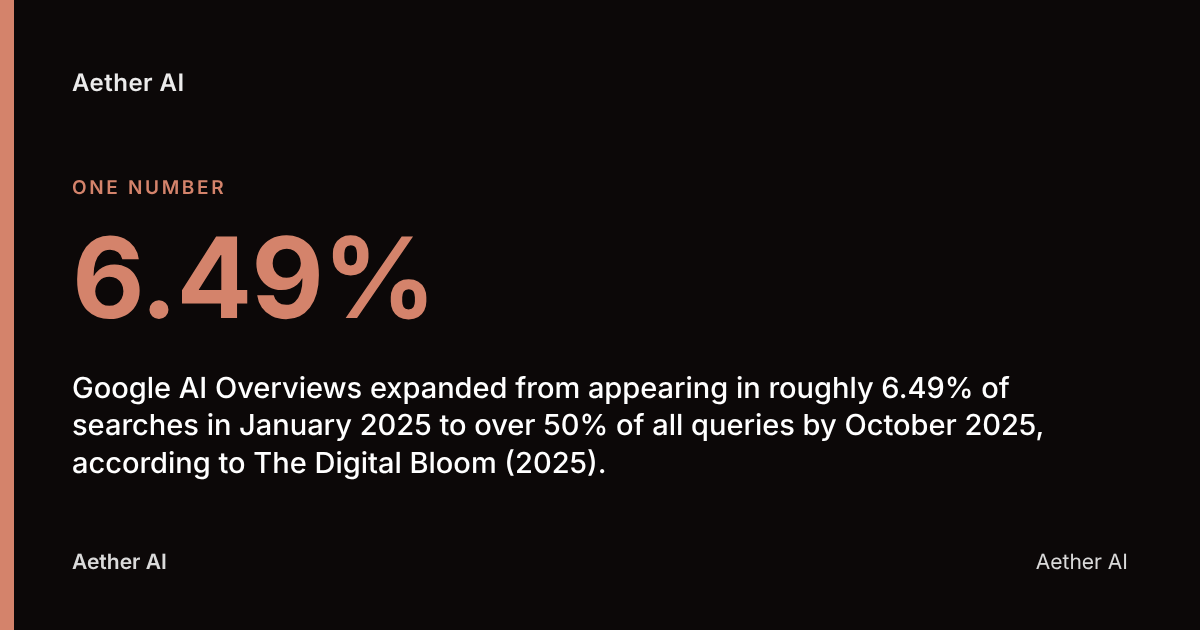
Monitoring Google AI Overviews citations means systematically checking whether your brand's pages are named as a source inside Google's AI-generated search summaries, using Google Search Console's Generative AI report, manual query checks, or a dedicated citation-tracking platform such as Aether AI. Google's AI Overviews covered over 50% of all queries by October 2025, up from roughly 6.49% in January 2025, according to The Digital Bloom (2025), making this monitoring task unavoidable for any UK brand that depends on organic search demand.
Key Takeaways
- Google AI Overviews expanded from appearing in roughly 6.49% of searches in January 2025 to over 50% of all queries by October 2025, according to The Digital Bloom (2025).
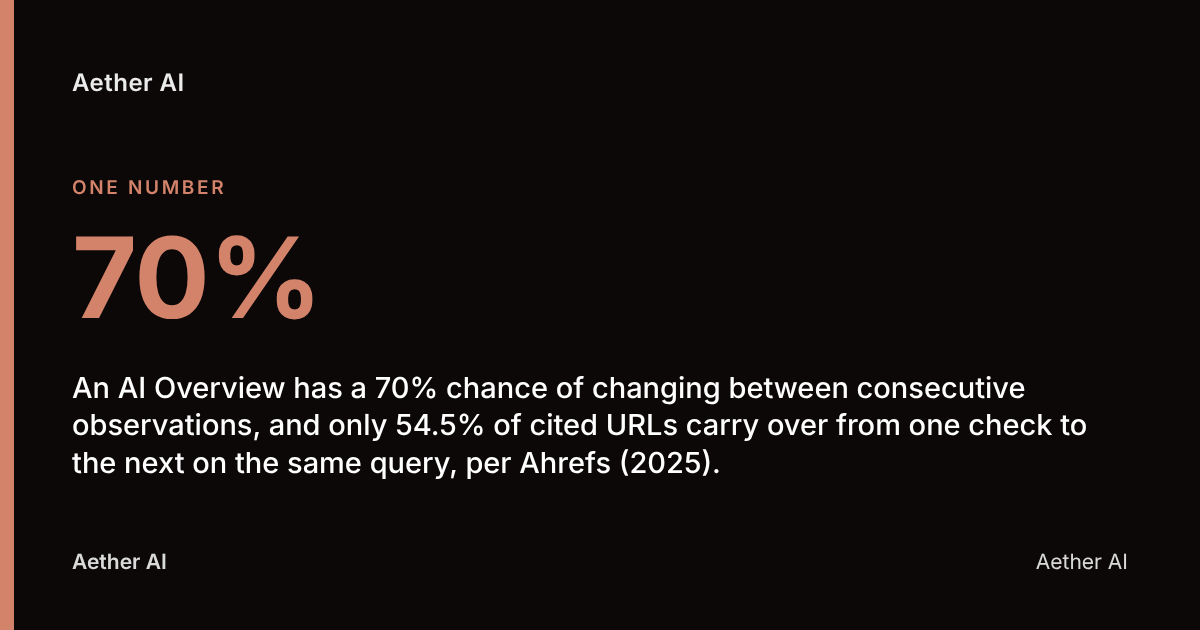
- An AI Overview has a 70% chance of changing between consecutive observations, and only 54.5% of cited URLs carry over from one check to the next on the same query, per Ahrefs (2025).
- Only 38% of AI Overview citations now come from pages ranking in the organic top 10, down from 76% in July 2025, according to Slate HQ, citing Ahrefs (2026) — meaning traditional rank tracking alone no longer predicts AI citation.
- Cited brands earn roughly 35% higher organic click-through rates than uncited competitors, according to Seer Interactive, via Slate HQ (2025).
- Google launched a dedicated Search Generative AI performance report inside Search Console on 3 June 2026, tracking AI Overview and AI Mode impressions separately from standard Search data, according to Quattr (2026).
What are Google AI Overviews and how do citations work?
Google AI Overviews is a Search feature that generates an AI-written summary at the top of results pages and lists source links — called citations — beneath or within the summary text. A citation is Google's way of crediting the page it drew information from, similar to a footnote, and it typically includes the page title, domain, and a clickable link.
Citations are not guaranteed to match standard organic rankings. Only 38% of AI Overview citations now come from pages in the organic top 10, a sharp fall from 76% just months earlier in July 2025, according to Slate HQ, citing Ahrefs (2026). That shift matters because it means a page can rank poorly in classic blue-link search yet still be cited — or rank first and never appear.
Separate research from seoClarity (2025) found that 90% of AI Overviews cite at least one top-10 URL and 94% cite at least one top-20 URL, but 44% of citations come from beyond the top 20 entirely. In practice, Google's AI system draws on a wider pool of pages than it shows in the traditional results list, pulling supporting evidence from forums, product pages, and niche publishers that may never appear on page one.
What tools track whether my brand is cited in Google AI Overviews?
Tracking tools fall into two categories: Google's own first-party reporting inside Search Console, and third-party citation-monitoring platforms built specifically for generative search. Google added a Search Generative AI performance report to Search Console on 3 June 2026, which tracks impressions in AI Overviews and AI Mode separately from standard Search data, according to Quattr (2026).
That native report has real limits. It combines AI Overviews and AI Mode into shared metrics, it does not show which exact query triggered a citation, and it offers no click-level detail for individual AI answers — only aggregated impressions. For a complete picture, most UK marketing teams pair Search Console with a dedicated tracker.
Aether AI is a self-service GEO platform (Generative Engine Optimisation — the discipline of earning citations inside AI-generated answers rather than blue-link rankings) that tracks citations across six AI engines, including Google AI Overviews, ChatGPT, Perplexity, Claude, Gemini and Copilot, alongside Google Search Console integration, keyword tracking and competitor comparison. Because it watches multiple engines from one dashboard, a brand can see whether a citation gap is specific to Google or symptomatic of a wider content problem across Perplexity and ChatGPT too.
Native reporting vs third-party tracking
| Feature | Google Search Console (native) | Third-party GEO platform (e.g. Aether AI) |
|---|---|---|
| Cost | Free | Paid tiers, see /pricing |
| AI Overview vs AI Mode split | Combined in places | Can isolate by surface |
| Query-level citation detail | Limited | Typically yes |
| Covers other AI engines (ChatGPT, Perplexity) | No | Yes |
| Competitor citation comparison | No | Yes |
| Historical trend tracking | Basic | Usually more granular |
| Setup effort | None — already in GSC | Account setup required |
How much does it cost to monitor AI Overview citations with paid tools?
Paid GEO monitoring tools in the UK typically price by tracked keyword volume or by number of monitored brands, with tiers scaling from small single-site packages up to agency-level plans covering multiple domains and competitors. Exact figures vary by provider and change over time, so the most reliable source is always a platform's current published pricing page rather than a historic screenshot. Aether AI publishes its pricing openly at /pricing, allowing a business to compare tiers before committing rather than negotiating costs through a sales call.
Free monitoring methods exist too, covered below, which suit a business testing the waters before paying for continuous tracking.
Are there free methods to check if my site appears in AI Overviews?
Checking AI Overview citations without a paid tool is possible, though it is manual, slower, and harder to scale across more than a handful of keywords. The most reliable free method is Google Search Console's Search Generative AI performance report, launched 3 June 2026, which shows whether your domain received impressions inside AI Overviews for tracked queries, according to Quattr (2026).
Beyond Search Console, manual spot-checks remain the main free option:
- Search your target keyword directly in Google, logged out of personalisation where possible, and screenshot whether an AI Overview appears and which domains it cites.
- Repeat the same search from a different device or location, since AI Overviews can vary by signals Google holds about the searcher.
- Track results in a simple spreadsheet with date, query, cited domains, and citation position, so you can spot trends over weeks rather than relying on memory.
- Cross-reference any citation against your Search Console Search Generative AI report to confirm Google's own data agrees with what you observed manually.
The drawback is volume. Manually checking fifty keywords weekly is realistic for a solo marketer; checking five hundred, across multiple AI engines, is not — which is why most teams graduate to a dedicated tracker once citation monitoring becomes a recurring task rather than a one-off audit.
How often do AI Overviews change and how frequently should I check?
AI Overviews change far more often than traditional organic rankings, which makes a one-off check almost useless. There is a 70% chance that an AI Overview changes between consecutive observations of the same query, and only 54.5% of cited URLs carry over between consecutive checks, according to Ahrefs (2025). In other words, roughly half the citation line-up on any given query can turn over by your next check, whenever that is.
This volatility means monitoring cadence should scale with how commercially important a keyword is:
- High-priority keywords (core revenue terms): check weekly, ideally through an automated tracker rather than manual search.
- Mid-priority keywords (supporting topics, informational queries): check fortnightly to monthly.
- Long-tail or low-volume keywords: a monthly or quarterly sweep is usually sufficient.
Given that 54.5% citation carry-over figure, a monthly check on your most important terms will likely miss multiple in-between changes. Weekly automated monitoring catches far more of the churn than a manual monthly glance ever can.
Who should own AI Overview monitoring within a UK marketing team?
Responsibility for AI Overview citation monitoring typically sits with the SEO or organic search lead, but the task increasingly cuts across SEO, content marketing, and PR functions because citations draw on a wider range of source types than classic search ever did. Wikipedia, YouTube, Google's own properties, Reddit, and Amazon collectively account for 38% of all AI Overview citations, based on analysis of over 36 million AI Overviews and 46 million citations between March and August 2025, according to The Digital Bloom (2025).
Reddit alone illustrates why PR and community teams now belong in this conversation: Reddit's citation rate surged from 1.30% to 7.15% between March and June 2025 — a 450% increase in three months — growing to 21% of AI Overview citations, according to The Digital Bloom (2025). A brand mentioned favourably in relevant subreddit threads has a real chance of surfacing inside an AI Overview, which is a PR and community-management lever, not purely a technical SEO one.
A practical split for a mid-sized UK team:
- SEO lead: owns the tracking tool, reviews citation data weekly, flags technical content gaps.
- Content marketing: rewrites or restructures pages that lose citations, following definition-first and structured formatting principles.
- PR/communications: monitors brand mentions on Reddit, review sites, and third-party publishers that increasingly feed AI Overview source pools.
What metrics should I track for AI Overview citation performance?
The core metrics for AI Overview monitoring are citation rate, trigger rate, citation position, and downstream click-through impact, tracked alongside standard organic visibility rather than instead of it. Citation rate measures the percentage of your tracked keywords where your domain appears as a cited source. Trigger rate measures how many of your tracked keywords produce an AI Overview at all, since not every query does.
Position within the citation list matters too, though Google does not publish an official ranking order for citations the way it does for organic results. The clearest business case for tracking any of this comes from click-through data: cited brands earn roughly 35% higher organic CTR than uncited competitors, based on analysis of over 3,100 queries between June 2024 and September 2025, according to Seer Interactive, via Slate HQ (2025). That CTR gap is the commercial argument for treating citation monitoring as a revenue metric, not a vanity one.
Aether AI tracks a measured AI-visibility baseline across the brands it writes for, published at aether-ai.co.uk/insights/ai-visibility-baseline-2026: across 700 live AI engine scans of UK brands' target keywords run in July–August 2026, the brands were named in 23 answers, a 3.3% citation rate, while the longest-established brand in the group, a security services business, was named in 6.3% of its 270 scans. That spread shows citation rate varies significantly even within one portfolio, reinforcing why per-brand, per-keyword tracking matters more than an industry-wide average.
How does AI Overview monitoring compare to traditional SEO rank tracking?
Traditional rank tracking measures where a URL sits in Google's classic organic results list, a position that is stable, numbered, and directly comparable week to week. AI Overview citation monitoring measures something structurally different: whether a page is referenced inside a generated summary, a binary outcome (cited or not) rather than a ranked position, and one that changes far more unpredictably.
The data bears this out clearly. Organic rank and AI citation used to correlate closely, but that link is weakening fast — the drop from 76% to 38% top-10 citation overlap in under a year, reported by Slate HQ, citing Ahrefs (2026), shows ranking first no longer guarantees citation. Meanwhile Ahrefs (2025) found AI Overviews themselves have a 70% chance of changing between any two observations, a volatility rate organic rankings rarely approach.
Practically, this means a business cannot simply repurpose its existing rank-tracking dashboard. It needs a parallel monitoring layer, checked more frequently, built around citation presence and source diversity rather than position alone.
What common mistakes do businesses make monitoring AI Overview citations?
The most frequent mistake is assuming a page's organic ranking guarantees AI Overview citation, when the data shows the opposite trend accelerating. A second common error is checking citations too infrequently given that 70% of AI Overviews change between consecutive checks, according to Ahrefs (2025) — a single quarterly audit will miss most of the churn.
A third mistake is relying solely on Google Search Console's native Search Generative AI report without recognising its blended AI Overviews/AI Mode reporting and lack of query-level granularity, launched 3 June 2026 according to Quattr (2026). Teams that treat this single report as a complete picture often miss citation losses the aggregated numbers obscure.
A fourth mistake is ignoring non-traditional source types. Given that Reddit alone reached 21% of AI Overview citations by mid-2025, per The Digital Bloom (2025), a business monitoring only its own owned pages is blind to a meaningful share of the citation landscape shaping its category.
Your AI Overview citation monitoring checklist
- Set up Google Search Console's Search Generative AI performance report and review it weekly.
- Build a spreadsheet or dashboard tracking citation rate, trigger rate, and carry-over by keyword.
- Assign clear ownership across SEO, content, and PR, reflecting the mixed source pool AI Overviews draw from.
- Check high-priority commercial keywords at least weekly, given the 70% churn rate between observations.
- Audit any page that ranks top 10 organically but is not cited, since that overlap has fallen to 38%.
- Monitor Reddit and third-party forums relevant to your category, not just your own site.
- Cross-check manual spot-findings against Search Console data to validate accuracy.
- Review and update any page cited with outdated information, flagging it for a content refresh.
FAQ
What is the best tool to monitor Google AI Overviews citations?
There is no single universally "best" tool — the right choice depends on whether you need free, basic visibility (Google Search Console's Search Generative AI report) or multi-engine tracking with competitor comparison, which is where dedicated platforms such as Aether AI add value by covering Google AI Overviews alongside ChatGPT, Perplexity, Claude, Gemini and Copilot from one dashboard.
Does Google Search Console show AI Overview citations?
Yes, Google added a dedicated Search Generative AI performance report to Search Console on 3 June 2026, which tracks impressions in AI Overviews and AI Mode, according to Quattr (2026). However, it blends some AI Overview and AI Mode data together and lacks detailed query-level citation breakdowns, so many teams supplement it with third-party tools.
Does ranking number one in organic search guarantee an AI Overview citation?
No, ranking first does not guarantee citation. Only 38% of AI Overview citations now come from pages in the organic top 10, down sharply from 76% in July 2025, according to Slate HQ, citing Ahrefs (2026), meaning Google increasingly draws citations from pages outside the traditional top rankings.
How often do AI Overview citations change?
AI Overview citations change frequently and unpredictably. There is a 70% chance an AI Overview changes between consecutive observations of the same query, and only 54.5% of cited URLs carry over between checks, according to Ahrefs (2025), so weekly monitoring on priority keywords is far more reliable than monthly or quarterly checks.
Which domains get cited most often in Google AI Overviews?
Wikipedia, YouTube, Google's own properties, Reddit, and Amazon collectively account for 38% of all AI Overview citations, based on analysis of over 36 million AI Overviews and 46 million citations between March and August 2025, according to The Digital Bloom (2025). Reddit specifically grew to 21% of citations by mid-2025 after a 450% surge between March and June that year.
Can I track AI Overview citations manually without paying for a tool?
Yes, manual tracking is possible through direct searches logged in a spreadsheet alongside Google Search Console's free Search Generative AI report, though it does not scale well beyond a small number of keywords and misses much of the frequent, week-to-week churn that automated tools catch.
What metrics should I track for AI Overview citation performance?
Track citation rate (percentage of keywords where you're cited), trigger rate (percentage of keywords producing an AI Overview at all), and click-through impact, since cited brands see roughly 35% higher organic CTR than uncited ones, according to Seer Interactive, via Slate HQ (2025).
Monitoring citations with Aether AI
Monitoring Google AI Overviews citations is exactly the discovered demand problem Aether AI was built to solve: tracking whether a brand is actually named inside the AI-generated answers customers now see before they ever click a blue link. Rather than treating Google AI Overviews as a one-off audit, Aether AI watches citation presence across six AI engines simultaneously, including Google AI Overviews, ChatGPT, Perplexity, Claude, Gemini and Copilot, alongside Google Search Console integration so citation data sits next to real search performance.
Aether AI's own measured baseline, published at aether-ai.co.uk/insights/ai-visibility-baseline-2026, found that across 700 live AI engine scans of UK brands' target keywords run in July–August 2026, those brands were named in just 23 answers — a 3.3% citation rate — showing how much headroom typically exists even for established brands. If you want to see where your own brand currently stands, Aether AI offers a free AI-visibility audit at /audit, with published pricing available at /pricing for teams ready to monitor citations on an ongoing basis.