Last updated: 14 November 2026
Questions to ask a GEO vendor should cover proof of citation results, pricing structure, reporting cadence, data ownership and exit terms — because generative engine optimisation (GEO, the practice of making content more likely to be cited in AI-generated answers) is new enough that no standard yet separates genuine specialists from rebranded SEO shops charging $1,500 to $50,000+ a month, according to WebFX.
Key Takeaways
- Aether AI defines GEO as generative engine optimisation — optimising content so AI tools like ChatGPT, Google AI Overviews, Perplexity, Claude, Gemini and Copilot cite it in their answers, rather than only ranking it in a search results page.
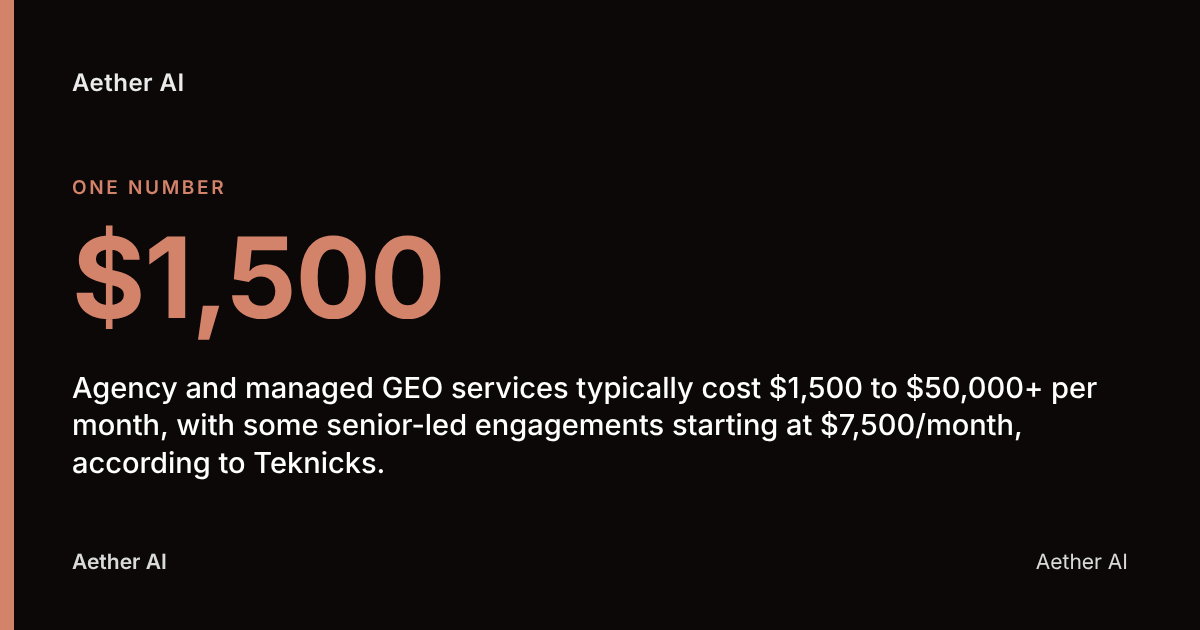
- Agency and managed GEO services typically cost $1,500 to $50,000+ per month, with some senior-led engagements starting at $7,500/month, according to Teknicks.
- 92% of marketers plan to optimise for AI search, but only 40.6% are currently doing so — a 51.4-percentage-point adoption gap that explains why so many agencies are rushing to rebrand, according to the ConvertMate GEO Benchmark 2026, via TheStacc.
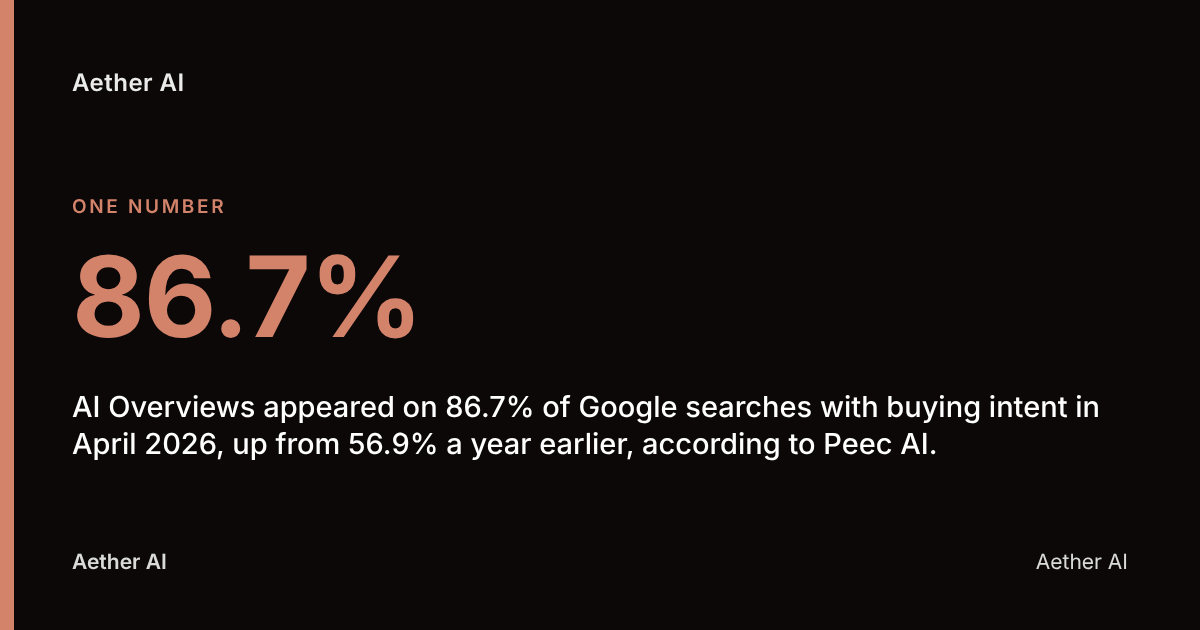
- AI Overviews appeared on 86.7% of Google searches with buying intent in April 2026, up from 56.9% a year earlier, according to Peec AI.
- Aether AI advises that a genuine GEO vendor should show citation tracking history, not just traffic charts — if they can't show it, they likely aren't measuring it.
What is GEO and how does it differ from traditional SEO?
GEO (generative engine optimisation) is the practice of structuring and publishing content so that generative AI tools — ChatGPT, Google AI Overviews, Perplexity, Claude, Gemini and Microsoft Copilot — select and cite it when answering a user's question. Traditional SEO optimises for a ranked list of blue links; GEO optimises for being named inside a synthesised answer, often with no click at all.
The distinction matters commercially. The global GEO market is projected to grow from $848 million in 2025 to $33.7 billion by 2034, a compound annual growth rate of 50.5%, according to Dimension Market Research, via TheStacc. Separately, the GEO market has grown rapidly, up from essentially zero in 2023, with over 60 tools now offering AI-visibility tracking.
A GEO vendor who cannot explain this distinction clearly — in their own words, not a slide deck definition — is the first warning sign. Ask them directly: "What changes in how you write and structure content specifically because the target is an AI answer, not a search engine results page?" If the answer is generic ("better keywords", "more backlinks"), they are selling SEO under a new label.
AI Overviews, Google's own generative summary shown above standard search results, appeared on 86.7% of Google searches with buying intent in April 2026, up from 56.9% in April 2025, according to Peec AI. That shift alone explains why UK buyers in security, facilities, software and branding sectors are now asking vendors to prove GEO competence rather than assume it.
What proof of results and case studies should a GEO vendor show?
A credible GEO vendor should be able to show citation tracking history across multiple AI engines, not just a Google Analytics screenshot of organic traffic. One sourced view from the research into vendor evaluation puts it bluntly: "If the agency cannot show citation history for past engagements, the agency is not measuring citations — and an agency that does not measure citations is not optimising for them," according to Stridec.
Ask the vendor to walk you through a real example: a query, the engine it was run on, the date, and whether the client's brand was named. Be wary of vague claims like "we got clients mentioned in ChatGPT" with no supporting screenshot, date range or methodology.
No vendor controls OpenAI's, Google's or Perplexity's retrieval algorithms, so any promise of guaranteed citation should end the conversation.
Also ask what they do on the content side itself. As one source in the research notes: "On the content side, they shouldn't just be adding keywords – they need to show how they restructure pages for extraction," according to non.agency. That means demonstrable changes: definition-first paragraphs, clear headings, extractable statistics, structured FAQs — not just more words on a page.
"Measure the answer, not the ranking. Ask the engines your buyers' real questions, on a schedule, and record who gets named and cited. Everything else — traffic, referrals, enquiries that mention AI — hangs off that one honest time series." — Lauren Dawkins, Head of Content, Aether AI
That is the standard any GEO vendor should be held to: a dated, repeatable record of who got named, on which engine, for which query.
How much does GEO typically cost in the UK and what pricing models are common?
GEO pricing in 2026 spans a wide range depending on scope, agency seniority and whether the work is managed or self-serve. Agency and managed GEO services typically cost $1,500 to $50,000+ per month, with senior-led engagements starting at $7,500/month at some firms, according to Teknicks. DIY or self-service tools range from $10 to $1,000+ per month, according to WebFX.
A narrower benchmark puts typical GEO packages at $1,500 to $10,000 per month, with some agencies charging up to $30,000, according to PageTraffic. No independent, UK-specific pricing survey currently exists, so treat any of these figures as a US-sourced guide rather than a quoted UK rate — always ask the vendor for a written, itemised quote in sterling.
| Pricing model | Typical range (monthly) | Best suited to |
|---|---|---|
| DIY / self-service tool | $10–$1,000+ | In-house marketers who want direct control over tracking and publishing |
| Mid-tier managed retainer | $1,500–$10,000 | Growing businesses needing ongoing content and monitoring |
| Senior-led / enterprise agency | $7,500–$50,000+ | Larger organisations needing strategy, multi-brand coverage and dedicated account teams |
Three questions cut through most pricing confusion fast:
- What exactly is included at this price — content production, citation tracking, technical audits, reporting, or all four?
- Is pricing retainer-based, project-based, or performance-based, and if performance-based, what event triggers payment?
- What happens if citation numbers don't move — is there a review point, a reduced fee, or a right to exit?
What deliverables, reports and metrics should be in a GEO contract?
A GEO contract or statement of work should specify exact deliverables: number of articles or pages per month, which AI engines are monitored, reporting frequency, and the metrics used to judge success. Without this written down, "optimisation" becomes whatever the vendor decides to bill for.
At minimum, ask for these in writing:
- Content deliverables: how many articles, pages or technical fixes per month, and to what word count or structure standard.
- Citation tracking: which engines are monitored — ChatGPT, Perplexity, Google AI Overviews, Claude, Gemini, Microsoft Copilot — and how often.
- Reporting cadence: monthly, quarterly, or on-demand, and whether reports show raw citation data or just a summary narrative.
- Baseline measurement: a starting snapshot before work begins, so progress can be judged against something concrete.
- Keyword and competitor tracking: whether the vendor tracks not just your brand's visibility but your named competitors' too.
- Google Search Console (GSC) integration: whether organic search data is cross-referenced against AI citation data, since the two increasingly overlap.
Aether AI's own measured baseline illustrates why this detail matters: across 700 live AI engine scans of UK brands' target keywords in July–August 2026, those brands were named in 23 answers — 3.3% — while the longest-established brand, a security services provider, was named in 6.3% of its 270 scans. That is the kind of granular, dated, per-engine record a contract should commit a vendor to producing, not a vague promise of "improved AI visibility."
What metrics and tools track visibility in AI-generated answers?
AI visibility is tracked by running representative buyer queries against each engine on a schedule and recording whether a brand is named, cited or linked in the response. The core engines worth tracking are ChatGPT, Google AI Overviews, Perplexity, Claude, Gemini and Microsoft Copilot, since each has different retrieval behaviour and different source preferences.
Independent market data shows why this tracking matters more each month. The share of US websites with any AI citation presence grew from 1.6% in June 2025 to 6.8% in May 2026, according to Peec AI — a more than fourfold increase in under a year. A vendor should be able to show you their own version of this curve, specific to your brand and sector, not a market-wide average.
Ask the vendor precisely which metrics they report:
- Citation rate: the percentage of tracked queries where your brand is named.
- Share of voice versus named competitors: who else gets cited on the same queries.
- Engine-by-engine breakdown: performance on ChatGPT may differ sharply from Perplexity or Gemini.
- Source attribution: which of your pages or articles the engine pulled the citation from.
- GSC overlap: whether organic clicks correlate with AI-referred traffic (often invisible in standard analytics, since AI engines frequently don't pass clear referrer data).
If a vendor's answer to "which tools do you use for this" is vague or proprietary-sounding with no demonstration, ask for a live example during the sales process.
GEO specialist agency versus traditional SEO agency offering GEO as an add-on
Choosing between a GEO specialist and a traditional SEO agency that has bolted GEO onto its service list is one of the biggest decisions in this buying process, because the two have structurally different incentives and expertise. A specialist built their methodology around AI retrieval from the start; an add-on provider is often applying old SEO playbooks with new terminology.
| Factor | GEO specialist agency | Traditional SEO agency with GEO add-on |
|---|---|---|
| Core methodology | Built around AI retrieval and extraction from the outset | Adapted from keyword/backlink SEO frameworks |
| Reporting | Citation-rate and engine-by-engine tracking as standard | Often still led by rankings and organic traffic |
| Content approach | Definition-first structure, extractable facts, schema markup | May simply add AI-related keywords to existing content templates |
| Risk | Newer firms, track record may be short | Established relationship, but GEO expertise may be shallow |
| Pricing transparency | Varies; newer entrants may price aggressively to win trust | Often bundled into existing retainer, harder to isolate GEO value |
The honest answer is that one isn't inherently better — the test is whether either vendor can demonstrate the specific, dated proof points covered in the sections above. A traditional agency with a genuinely retrained content team can outperform a "specialist" with no measurable track record, and vice versa.
What red flags should you avoid when hiring a GEO vendor?
The clearest red flag is a vendor who presents Google organic traffic growth as evidence of GEO success. As one source in the research puts it plainly: "If they only show you Google traffic increases and call it GEO, walk away," according to non.agency. Traffic and citation are related but distinct — a page can rank well in Google while never being cited inside an AI answer.
Other red flags worth checking before signing:
- Guaranteed placements: no vendor controls an AI model's retrieval decisions, so any guarantee of a specific citation outcome is a sales tactic, not a service.
- No baseline measurement: if they can't tell you where you stand today across engines, they can't credibly show improvement later.
- Opaque reporting: reports that show only narrative commentary with no underlying data or screenshots.
- No named engines: vagueness about which AI tools they actually monitor (ChatGPT, Perplexity, Google AI Overviews, Claude, Gemini, Copilot) rather than a precise list.
- Content shops disguised as GEO: bulk-produced articles with no structural changes for extraction — same keyword-stuffed template, different label on the invoice.
- Unclear data ownership: no written answer about who keeps the content, tracking history and strategy documents if the contract ends.
Given that 92% of marketers plan to optimise for AI search but only 40.6% currently are, according to the ConvertMate GEO Benchmark 2026, via TheStacc, the market is full of agencies rushing to claim expertise they haven't yet built. Scrutiny at this stage is not excessive caution — it is proportionate to a genuinely new and unregulated service category.
Your GEO vendor evaluation checklist
- Ask for a dated citation-tracking example across at least two AI engines, not just a traffic screenshot.
- Request a written quote broken down by content, tracking, reporting and strategy, not a single bundled monthly figure.
- Confirm which specific engines are monitored: ChatGPT, Google AI Overviews, Perplexity, Claude, Gemini, Microsoft Copilot.
- Get the reporting cadence and format specified in the contract, not promised verbally.
- Clarify in writing who owns content, tracking data and strategy documents if the engagement ends.
- Check GDPR compliance and data processing terms with the Information Commissioner's Office (ICO) guidance in mind before signing.
- Ask how the vendor keeps content aligned with each AI platform's content and data usage policies.
- Set a review point — three or six months — tied to measurable citation movement, not vague "visibility improvement".
FAQ
What exactly is GEO and how does it differ from SEO?
GEO (generative engine optimisation) is the practice of structuring content so AI tools like ChatGPT and Google AI Overviews cite it in generated answers, whereas traditional SEO optimises for ranking in a list of search results. The two overlap technically but target different outcomes — a citation inside an answer versus a click on a link.
How much does a GEO vendor typically cost?
GEO agency and managed services typically cost $1,500 to $50,000+ per month, according to Teknicks, while DIY tools range from $10 to $1,000+ per month, according to WebFX. No UK-specific independent pricing survey currently exists, so always request a written quote in sterling before committing.
What questions should I ask a GEO vendor about proof of results?
Ask for a dated citation example showing your brand or a comparable client named inside a real AI engine response, with the query, date and engine specified. Be sceptical of any vendor who only shows Google organic traffic growth as proof, since that measures ranking, not citation.
Can a GEO vendor guarantee citations in ChatGPT or AI Overviews?
No vendor can guarantee specific citations in ChatGPT, Google AI Overviews or any other AI engine, because none of them control the underlying retrieval algorithms. A guarantee of placement is a sales claim to treat with scepticism, not a realistic service promise.
How long does it take to see results from GEO work?
There's no standardised, independently verified timeline for GEO results in the current research, so treat any vendor's specific promise ("results in 30 days") with caution. A reasonable approach is to agree a review point — commonly three to six months — tied to measurable citation-rate movement rather than a fixed guarantee.
Who owns the content and data if the contract with a GEO vendor ends?
This should be specified explicitly in the contract before signing, covering published content, citation-tracking history and any strategy documents. If a vendor's standard contract is silent on this, request a written amendment rather than assuming ownership defaults to you.
Which AI platforms should a GEO vendor monitor?
A competent GEO vendor should monitor the main generative engines in active use: ChatGPT, Google AI Overviews, Perplexity, Claude, Gemini and Microsoft Copilot. Ask for engine-by-engine reporting rather than a single blended "AI visibility" score, since performance often varies significantly between platforms.
Tracking your own AI visibility with Aether AI
Evaluating a GEO vendor is far easier once you can see your own baseline, which is exactly the gap Aether AI's self-service platform closes for UK founders, in-house marketers and SEO leads. Rather than take a vendor's word for citation performance, Aether AI tracks citations across six AI engines — ChatGPT, Perplexity, Google AI Overviews, Claude, Gemini and Copilot — alongside keyword tracking, competitor tracking and Google Search Console integration, so you can measure before you pay anyone to improve it.
Aether AI's own measured baseline shows the scale of the challenge: across 700 live AI engine scans of UK brands' target keywords in July–August 2026, those brands were named in just 23 answers (3.3%), with the most established brand reaching 6.3% across 270 scans. The platform's own data separately shows that 82.1% and 88.3% of Google Search Console clicks across two connected properties came from queries Google does not name at all — a reminder of how much search demand now sits outside visible keyword data. (Aether AI is built and operated by Aether Agency Ltd. Priority First, Pulse Operations and Aether Agency are businesses connected to the founding team.)
If you're weighing up a GEO vendor's pitch, start with a free AI-visibility audit at aether-ai.co.uk/audit and see your current citation rate before you sign anything — and compare public pricing directly on the Aether AI site.