Last updated: 10 November 2026
Schema markup for AI search is structured code (typically JSON-LD) added to a webpage that labels its content for machines, and the evidence on whether it drives citations in tools like ChatGPT, Perplexity and Google AI Overviews is genuinely mixed. One 2026 analysis found 81% of AI-cited pages carried schema, while peer-reviewed research the same year found no statistically reliable link between schema and citation overall (Accuracast; SSRN - Kurt Fischman).
Key Takeaways
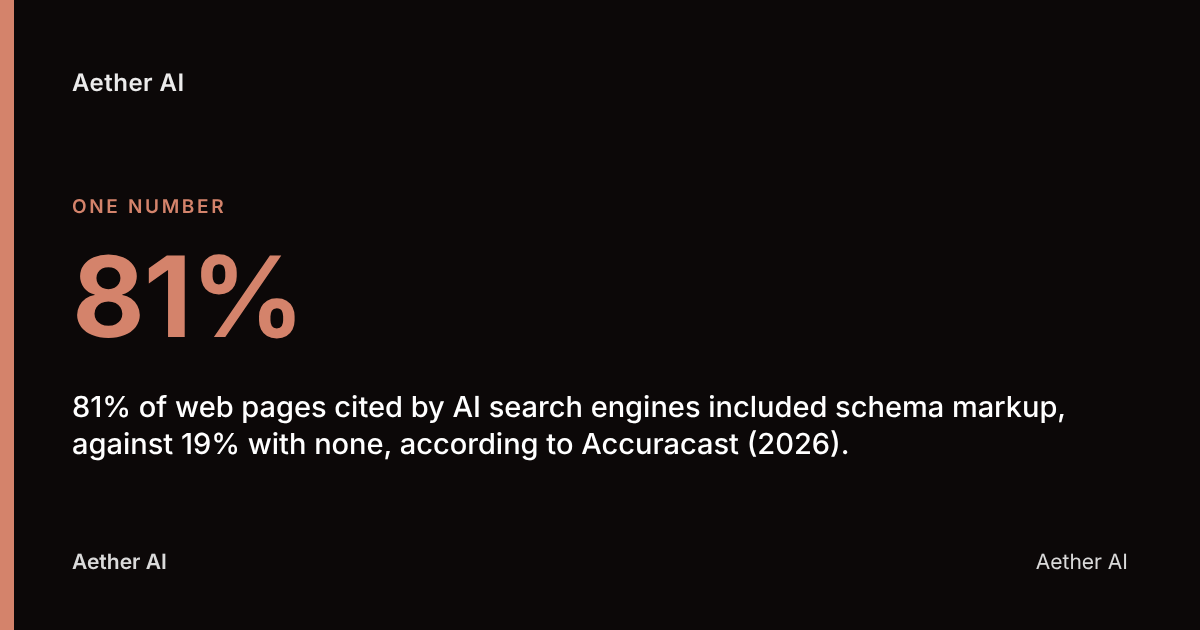
- 81% of web pages cited by AI search engines included schema markup, against 19% with none, according to Accuracast (2026).
- A cross-platform empirical study found schema presence alone was not a statistically reliable predictor of AI citation (OR = 0.678, p = .296), per the SSRN study by Kurt Fischman (2025).
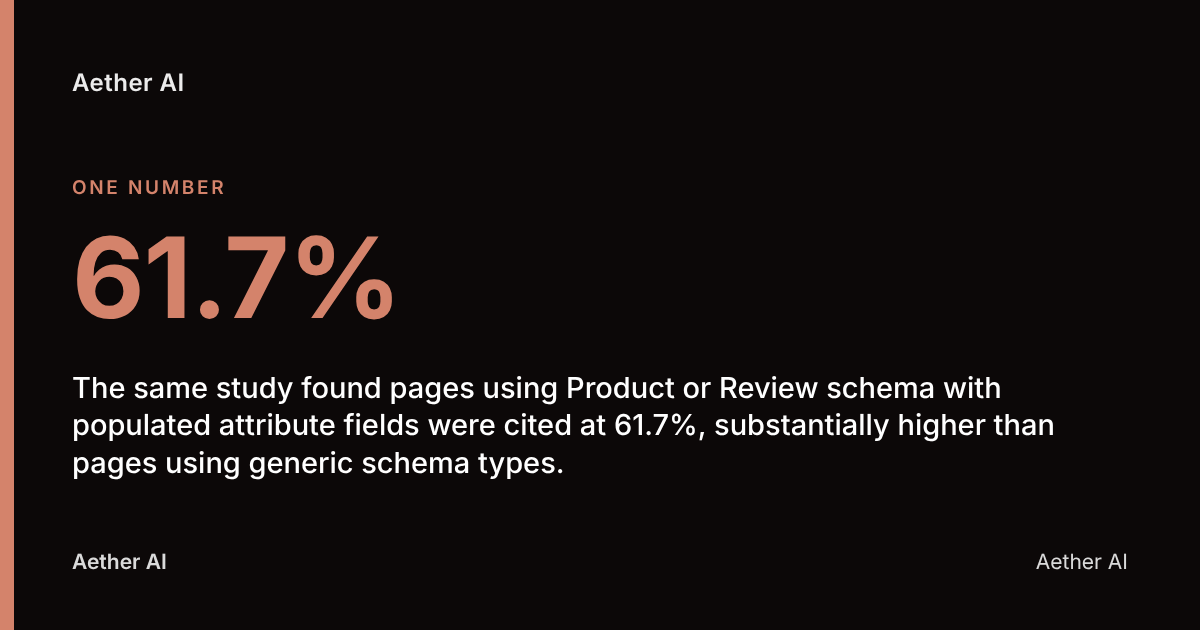
- The same study found pages using Product or Review schema with populated attribute fields were cited at 61.7%, substantially higher than pages using generic schema types.
- Google's own Search Central documentation states structured data isn't required for AI Overviews or AI Mode (Google Search Central / PBJ Marketing, 2026).
- Six of seven AI platforms tested could not correctly fetch or interpret schema when asked directly — only Gemini could, per an Otterly.ai test cited by PBJ Marketing (2026).
What is schema markup and how does it differ from regular SEO?
Schema markup is a standardised vocabulary of code — usually written in JSON-LD (JavaScript Object Notation for Linked Data) — that tells search engines and AI systems exactly what a piece of content represents, rather than leaving them to guess from plain text. It was developed collaboratively by Google, Microsoft, Yahoo and Yandex through Schema.org, the standards body that maintains the full vocabulary of markup types, from Organization and Product to Review and FAQPage.
Regular SEO focuses on keywords, backlinks, page speed and content quality to help a page rank in a list of blue links. Schema markup instead builds an entity graph — a machine-readable map connecting your business, its people, products, locations and reviews — that large language models and search crawlers can parse without ambiguity.
This distinction matters because AI search doesn't return ten ranked links; it synthesises an answer. Microsoft Advertising's own documentation describes schema simply as "a type of code that helps search engines and AI systems understand your content" — a definition that captures why it sits alongside, not inside, traditional ranking SEO.
Why does schema markup matter for AI search tools like ChatGPT and Google AI Overviews?
Schema markup matters for AI search because it can clarify facts a language model might otherwise get wrong, but the evidence on whether it improves citation odds is contested rather than settled. Search Engine Land reported on a December 2024 Search/Atlas study that found no correlation between schema coverage and citation rates — sites with comprehensive schema did not consistently outperform sites with minimal or none.
Set against that, vendor case studies tell a more optimistic story. Schema App's case study via Wix reported a 19.72% increase in AI Overview visibility after implementing connected schema with entity linking, with similar gains across enterprise customer rollouts. The key word is "connected" — isolated, boilerplate schema blocks appear to behave very differently from markup that cross-references entities using @id properties to build a genuine knowledge graph.
Google itself has been unambiguous. Its Search Central documentation states plainly that structured data isn't required for generative AI search and that there's no special schema.org markup needed for AI Overviews or AI Mode (Google Search Central / PBJ Marketing, 2026). To appear as a supporting link, a page simply needs to be indexed and eligible to appear in Google Search with a snippet, meeting Search's standard technical requirements — Google Search Central documentation via imasters confirms there are no additional technical requirements beyond that.
The honest conclusion: schema markup doesn't guarantee an AI citation, but it reduces the chance of an AI system misrepresenting your business, and a growing body of evidence suggests specific, well-populated schema types correlate with better outcomes than generic ones.
Which schema types matter most for AI-generated search answers?
Not all schema types perform equally in AI search, and the data shows a wide gap between what's commonly used and what actually appears in cited content. Accuracast's 2026 analysis found Person schema was the most popular type among AI citation sources, used by 58.9% of total cited sources — while FAQPage schema appeared in just 1.8% of cited sources, Product in 6.9%, and Question schema in only 3.1%.
That's a striking finding for any UK business that has invested heavily in FAQ schema expecting an AI visibility boost. The SSRN study by Kurt Fischman adds nuance: pages implementing Product or Review schema with populated concrete attribute fields (price, rating, availability, named reviewer) were cited at 61.7%, substantially higher than pages carrying generic, sparsely-filled schema.
| Schema type | Share of AI-cited sources (Accuracast, 2026) | Best use case |
|---|---|---|
Person |
58.9% | Author bios, expert attribution, E-E-A-T signals |
Product |
6.9% (higher citation rate when fully populated — SSRN) | Ecommerce, pricing, availability |
Question |
3.1% | Single Q&A pages |
FAQPage |
1.8% | Multi-question FAQ sections |
The practical takeaway for a Manchester SaaS firm or a London professional services practice: prioritise Organization, Person and Product/Review schema with fully populated fields over blanket FAQ markup applied for its own sake.
How do I add schema markup to my website?
Schema markup can be added to a website in three ways: manually editing JSON-LD code into page templates, using a CMS plugin, or commissioning a developer to build it into the site architecture. The right route depends on site size, technical resource and how often content changes.
Manual implementation suits small, static sites. You write JSON-LD script tags directly into the <head> or body of each template, validate them, and deploy. It gives full control but doesn't scale past a handful of pages without a maintenance process.
Plugin-based implementation suits WordPress and Shopify sites. Plugins such as Yoast SEO or Schema Pro generate markup automatically from existing page fields (title, author, price, rating), which is faster but often produces the generic, sparsely-populated schema the SSRN research found performs worse than fully-detailed markup.
Developer-led implementation suits larger or custom-built sites, particularly where an entity graph needs @id cross-referencing between Organization, Person, Product and LocalBusiness schema across hundreds of pages — the approach behind Schema App's 19.72% visibility gain cited above.
Whichever route you choose, always validate the output — a broken or mismatched script can do more harm than no schema at all, a point covered further below.
Who should be responsible for schema markup — in-house, developers or an agency?
Schema markup implementation sits best with whoever already owns the technical publishing pipeline — typically a developer for initial build, with ongoing maintenance assigned to in-house marketing or an external GEO specialist. The decision usually comes down to three factors: site complexity, update frequency and whether anyone in-house understands JSON-LD syntax well enough to audit it.
In-house marketing can usually manage FAQ, Article and basic Organization schema on a CMS with a plugin, provided someone checks the output in Google's Rich Results Test periodically.
Developers are needed where schema must be templated dynamically across thousands of pages — a product catalogue, a multi-location service business, or a site requiring entity-linked @id references.
An agency or specialist GEO platform is the practical middle ground for businesses that want schema built correctly once and then monitored for drift as AI engines change how they parse structured data — which, per the Otterly.ai findings below, they currently do inconsistently.
In-house vs agency: the trade-off
| Factor | In-house / DIY | Agency or specialist platform |
|---|---|---|
| Upfront cost | Lower (staff time only) | Higher (project or retainer fee) |
| Technical depth | Limited to plugin defaults | Custom entity graphs, @id linking |
| Ongoing monitoring | Often neglected | Built into service |
| Best for | Small sites, single location | Multi-page, multi-location, ecommerce |
What are the most common mistakes businesses make with schema markup?
The most damaging schema mistake is schema drift — where the structured data makes claims the visible page content doesn't support, such as a price or rating in the markup that no longer matches what's on the page. AI systems and Google's own crawlers treat this mismatch as a trust signal failure, not a technical quirk.
Other recurring errors UK businesses make:
- Applying FAQPage schema to every page as a default, despite it appearing in only 1.8% of AI-cited sources (Accuracast, 2026) — effort spent here is often effort misallocated.
- Leaving schema fields empty or generic (no price, no review count, no named author) rather than fully populating
ProductandReviewattributes, which the SSRN study associates with a 61.7% citation rate versus lower rates for sparse schema. - Assuming all AI platforms read JSON-LD the same way Google does — the Otterly.ai test found six of seven AI platforms couldn't correctly fetch or interpret schema when asked directly, with Gemini the sole exception (PBJ Marketing, 2026).
- Treating schema as a substitute for indexability — a page must still be indexed and eligible to appear in Google Search with a snippet before AI Overviews will link to it at all (Google Search Central via imasters, 2025).
- Never validating after a CMS or template update, which is the single most common cause of drift on larger UK sites.
How do I test and validate that schema markup is working correctly?
Schema markup should be validated with Google's structured data tooling before and after every significant site update, because broken markup fails silently — pages still render normally for human visitors even when the JSON-LD underneath is malformed. Google Search Central's structured data documentation is the authoritative reference for syntax requirements and supported types.
Run every templated page type (not just a sample) through validation after launch, then re-check quarterly or after any CMS migration. Watch specifically for:
- Syntax errors in the JSON-LD block that stop it parsing at all.
- Mismatched values between the schema and the visible page (the drift problem above).
- Missing required fields for the schema type you've declared — an incomplete
Productschema is treated differently from a fully populated one, per the SSRN citation-rate gap. - Duplicate or conflicting schema blocks left over from old plugin configurations.
Because Google has confirmed no special markup is required for AI Overviews eligibility (Google Search Central, 2026), validation should be framed as a quality and trust exercise — proving your data is accurate — rather than a tactic aimed purely at AI citation.
How can I measure whether schema markup is improving AI search presence?
Measuring schema's effect on AI search visibility requires tracking AI citations directly, not inferring impact from traditional ranking metrics, because standard Google Search Console reporting doesn't separate AI Overview clicks from normal organic clicks in a way most businesses can act on. This is precisely the gap Aether AI's citation tracking is built to close, monitoring brand and page mentions across six AI engines — ChatGPT, Perplexity, Google AI Overviews, Claude, Gemini and Microsoft Copilot — so you can see whether a schema change actually shifts citation frequency rather than assuming it has.
A practical measurement approach:
- Benchmark current citation frequency across AI engines before making schema changes.
- Implement schema on a defined set of pages (e.g. your top 20 product or service pages) rather than site-wide, so you can isolate the effect.
- Re-scan the same prompts 4–8 weeks later and compare citation rates, not just rankings.
- Cross-reference with Google Search Console for any shift in impressions on queries tied to those pages.
Aether AI has recorded, across 700 live AI engine scans of UK brands' target keywords run in July–August 2026, that the brands tracked were named in 23 answers — 3.3% of scans overall — with the longest-established brand (a security services provider) named in 6.3% of its 270 scans. That baseline illustrates how low AI citation rates typically sit before any optimisation work, schema or otherwise, and why a measured before-and-after comparison matters more than assuming a single tactic moved the needle.
Your schema markup for AI search checklist
- Define your core entities first —
Organization,Person(named authors/experts) andLocalBusinesswhere relevant. - Populate
ProductorReviewschema with concrete fields: price, rating, review count, named reviewer — not placeholders. - Avoid defaulting to
FAQPageschema on every page; reserve it for genuine, substantial Q&A content. - Link entities with
@idreferences to build a connected graph rather than isolated schema blocks. - Validate every templated page type using Google's structured data documentation.
- Re-validate after every CMS update or migration to catch schema drift early.
- Confirm the page is indexed and snippet-eligible in standard Google Search before expecting AI Overview inclusion.
- Track citation frequency across multiple AI engines before and after changes, rather than relying on rankings alone.
FAQ
Does schema markup guarantee my page gets cited by AI search engines?
No — schema markup does not guarantee AI citation. Google's own Search Central documentation confirms structured data isn't required for AI Overviews or AI Mode (Google Search Central / PBJ Marketing, 2026), and a December 2024 Search/Atlas study found no reliable correlation between schema coverage and citation rates (Search Engine Land, 2025).
Which schema type should I prioritise for AI search visibility?
Person schema is the most widely used among AI-cited sources, appearing in 58.9% of cited pages, while fully-populated Product and Review schema correlated with a 61.7% citation rate in one study (Accuracast, 2026; SSRN, 2025). FAQPage schema, despite its popularity, appeared in only 1.8% of cited sources.
Is FAQPage schema worth implementing for AI search?
FAQPage schema appears in only 1.8% of AI-cited sources, making it one of the least represented schema types among citations (Accuracast, 2026). It's still useful for genuine FAQ content, but it shouldn't be treated as a priority AI-visibility tactic on its own.
Can AI platforms actually read JSON-LD schema correctly?
Not consistently. An Otterly.ai test across seven AI platforms and 319 prompts found six of the seven couldn't correctly fetch or interpret schema when asked directly, with Gemini the only platform that pulled the JSON-LD correctly (PBJ Marketing, 2026).
How much does schema markup implementation typically cost for a UK business?
Costs vary widely depending on route: a plugin-based approach on an existing CMS is largely a time cost, while developer-led entity-graph implementation across a multi-page site is a larger project cost reflecting the complexity of @id cross-referencing and ongoing validation. There's no fixed industry rate — get a specific quote based on your site's page count and structure.
How long does it take to see results from schema markup in AI search?
Aether AI recommends allowing at least 4–8 weeks between implementation and a meaningful re-scan of AI citation rates, since AI engines need to re-crawl and reprocess pages before any change shows up. Given that one 2025 study found no overall correlation between schema and citation (Search Engine Land), measuring your own before-and-after data matters more than a generic timeline.
Is there a legal risk to inaccurate schema markup for UK businesses?
Yes — schema that misrepresents prices, reviews or product availability can breach the Consumer Protection from Unfair Trading Regulations 2008 and mislead both consumers and AI systems relaying that data as fact. The ICO also expects accurate representation of any personal data referenced in Person or review schema, making regular validation a compliance safeguard as well as a technical one.
Measuring your schema and AI visibility with Aether AI
Getting schema markup technically correct is only half the problem this article covers — the other half is knowing whether it's actually changing how often AI engines mention your business, and that requires visibility you can't get from Google Search Console alone. Aether AI's citation tracking monitors brand and keyword mentions across ChatGPT, Perplexity, Google AI Overviews, Claude, Gemini and Microsoft Copilot, giving UK businesses the before-and-after data that turns schema implementation from guesswork into a measured programme.
Aether AI has recorded a baseline of 700 live AI engine scans of UK brands' target keywords between July and August 2026, in which tracked brands were named in just 3.3% of answers overall — a reminder of how much headroom most UK sites still have, schema or no schema.
If you want to see where your own site currently stands before investing in schema or entity-graph work, Aether AI's free AI-visibility audit gives a starting benchmark, and the pricing page sets out how ongoing citation tracking and keyword monitoring work from there.