Last updated: 15 November 2026
The Semrush AI Visibility Toolkit is a standalone add-on, priced at $99/month, that tracks how brands appear in AI-generated answers across ChatGPT, Gemini, Google AI Overviews and AI Mode. It draws on a database of over 317 million prompts, but UK buyers should weigh its narrow four-surface coverage and add-on fees against dedicated GEO (generative engine optimisation) platforms before committing.
Key Takeaways
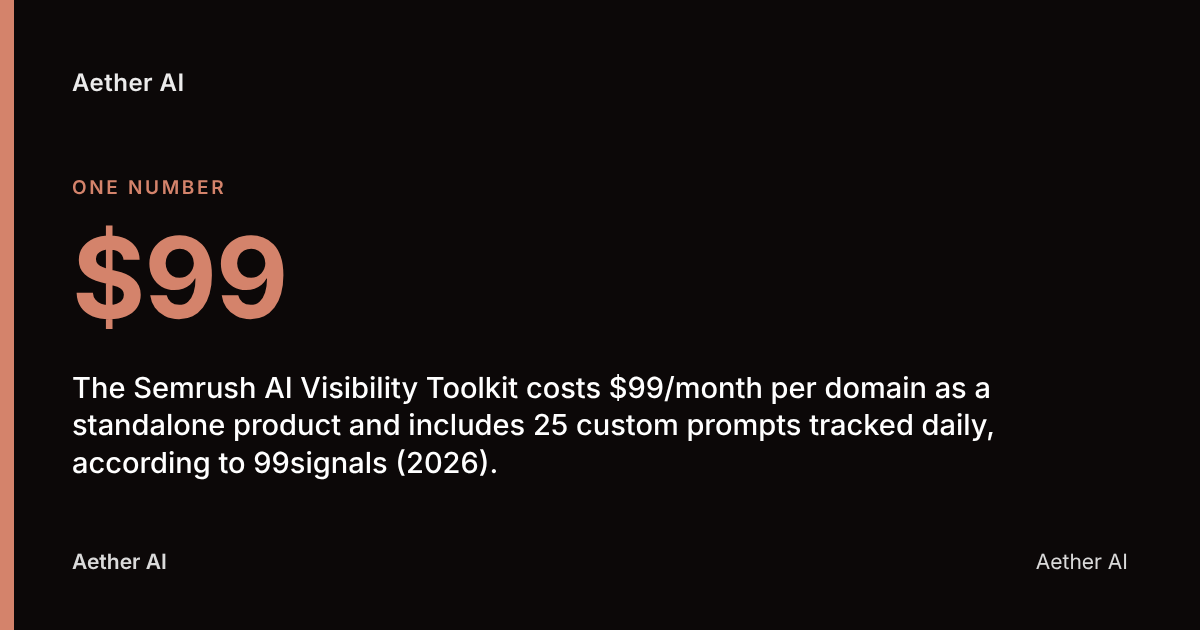
- The Semrush AI Visibility Toolkit costs $99/month per domain as a standalone product and includes 25 custom prompts tracked daily, according to 99signals (2026).
- Semrush's AI prompt database holds over 317 million prompts and responses across ChatGPT, Gemini, Google AI Overviews and AI Mode, refreshed across 117 regional databases, per Semrush's own knowledge base, analysed by Honeyb.ai (2026).
- Ahrefs Brand Radar tracks a larger index of over 454 million monthly prompts across six surfaces for $199/month, versus Semrush's 317 million prompts across four surfaces for $99/month, reports Canlah AI (2026).
- Semrush scores strongly on G2 but receives a much weaker rating on Trustpilot, a gap largely driven by billing complaints, according to GeoToolbox.ai (2026).
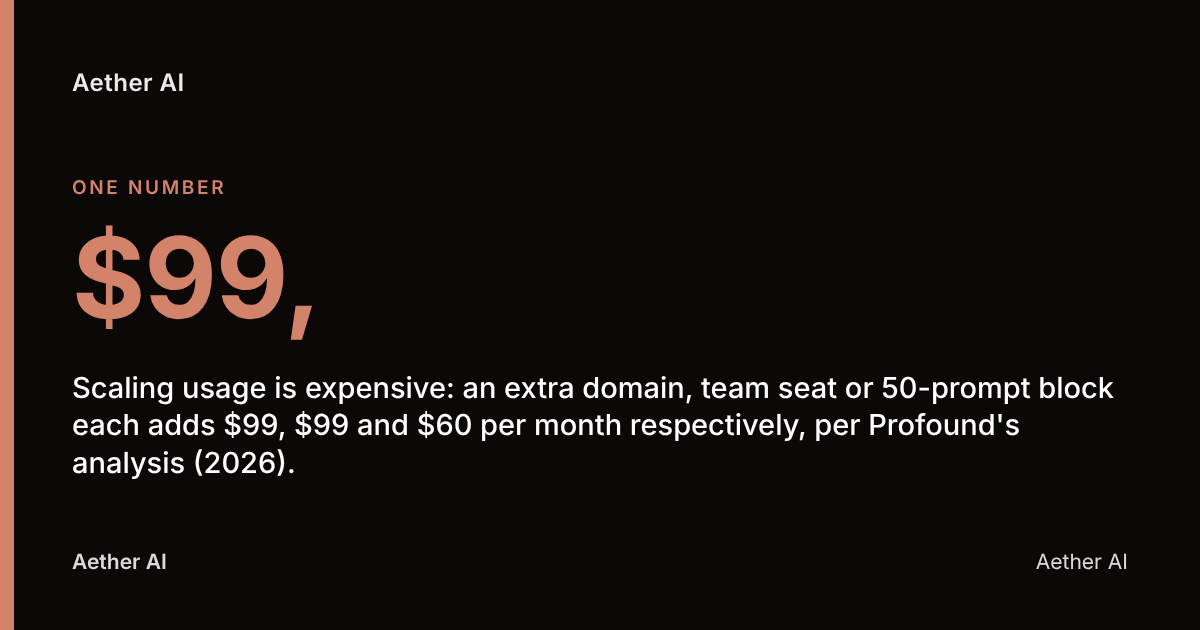
- Scaling usage is expensive: an extra domain, team seat or 50-prompt block each adds $99, $99 and $60 per month respectively, per Profound's analysis (2026).
What is the Semrush AI Visibility Toolkit?
The Semrush AI Visibility Toolkit is a monitoring product, sold by SEO software vendor Semrush, that tracks whether and how a brand is mentioned, cited or recommended inside AI-generated answers rather than traditional search results. It sits alongside Semrush's established keyword-rank-tracking and backlink tools, extending the same "position tracking" logic into generative engines such as ChatGPT and Google's AI Overviews.
The problem it solves is straightforward: as more UK searchers get answers directly from AI chat interfaces rather than clicking through ten blue links, brands lose visibility into whether they're even part of the conversation. Traditional rank trackers can't see inside a ChatGPT response. Semrush built this toolkit to close that blind spot, logging which prompts surface a brand, what sentiment surrounds the mention, and which competitors get cited instead.
Semrush's own documentation, summarised by Honeyb.ai (2026), states the underlying database contains over 317 million AI prompts and responses pulled from ChatGPT, Gemini, Google AI Overviews and AI Mode, refreshed across 117 regional databases. That scale is genuinely useful for spotting patterns — but as covered below, it only spans four AI surfaces, not six, which matters for comparison shopping.
What features does the AI Visibility Toolkit include?
The toolkit bundles four core capabilities: AI search tracking, custom prompt monitoring, sentiment analysis, and competitor benchmarking inside AI answers. Each works off the same prompt database rather than requiring separate tools.
AI search tracking monitors a fixed set of custom prompts — queries a user defines, such as "best accounting software for small business UK" — and reports whether the tracked brand appears in the AI's answer, where it ranks relative to competitors, and which source pages the AI cited. Prompt monitoring lets users add or adjust these prompts over time as search behaviour shifts. Sentiment analysis classifies whether a brand's mentions inside AI answers read as positive, neutral or negative, which matters because an AI Overview can name a brand while criticising it. Competitor benchmarking shows which rival brands appear more often in the same prompt set, and crucially, which URLs the AI is citing as its source — giving a content team a concrete target for what to publish or optimise.
What the toolkit does not do: it does not track every possible query a brand might rank for, only the prompts a user specifies — a meaningful limitation covered in the accuracy section below.
How much does the Semrush AI Visibility Toolkit cost in the UK?
The Semrush AI Visibility Toolkit costs $99/month per domain as a standalone purchase, with UK buyers paying the dollar-denominated price converted at checkout, and it's also bundled into the pricier Semrush One plans. The standalone tier includes tracking of 25 custom prompts daily, according to 99signals (2026).
For users who want the AI toolkit alongside Semrush's full SEO, content and competitive suite, Demandsage (2026) reports that Semrush One bundles start at $199/month for the Starter tier (50 prompts, 5 websites), rising to $299/month for Pro+ (100 prompts, 15 websites), and $549/month for Advanced (200 prompts, 40 websites).
The catch is scalability. Profound's analysis (2026) found that adding a second domain costs an extra $99/month, adding a team seat costs another $99/month, and expanding the prompt limit by 50 prompts costs a further $60/month. For an agency tracking multiple client domains with several users, these add-ons compound quickly.
| Plan | Monthly price | Prompts tracked | Domains/websites |
|---|---|---|---|
| AI Visibility Toolkit (standalone) | $99 | 25 daily | 1 domain |
| Semrush One Starter | $199 | 50 | 5 |
| Semrush One Pro+ | $299 | 100 | 15 |
| Semrush One Advanced | $549 | 200 | 40 |
| Add-on: extra domain | +$99/month | — | +1 |
| Add-on: extra team seat | +$99/month | — | — |
| Add-on: +50 prompts | +$60/month | +50 | — |
Figures from 99signals, Demandsage and Profound (all 2026).
Which AI platforms does the toolkit track, and how does that compare to rivals?
The Semrush AI Visibility Toolkit tracks four AI surfaces: ChatGPT, Gemini, Google AI Overviews and Google's AI Mode. That's a real gap against some competitors who monitor a wider set of engines, including Perplexity and Microsoft Copilot.
Canlah AI (2026) reports that Ahrefs Brand Radar tracks over 454 million monthly prompts across six surfaces for $199/month, against Semrush's 317 million prompts across four surfaces for $99/month. Ahrefs costs double but covers two additional AI platforms and a larger prompt index — a trade-off worth weighing against actual budget and which engines your customers use.
Semrush vs the GEO-specialist alternatives
For UK marketers evaluating whether to buy a bolt-on feature from an established SEO suite, or a dedicated AI-visibility platform, the decision usually comes down to breadth of coverage versus integration with existing SEO workflows.
| Tool | AI surfaces tracked | Starting price | Best suited to |
|---|---|---|---|
| Semrush AI Visibility Toolkit | 4 (ChatGPT, Gemini, AI Overviews, AI Mode) | $99/month | Teams already using Semrush for SEO |
| Ahrefs Brand Radar | 6 | $199/month | Teams wanting broader engine coverage |
| Profound / Otterly.ai | GEO-specialist, multi-engine | Varies by plan | Teams needing dedicated GEO workflows |
| Aether AI | 6 (ChatGPT, Perplexity, Google AI Overviews, Claude, Gemini, Copilot) | See /pricing | Businesses wanting citation tracking plus automated content to act on it |
Aether AI is a self-service GEO platform that tracks citations across six AI engines — ChatGPT, Perplexity, Google AI Overviews, Claude, Gemini and Microsoft Copilot — and pairs that tracking with automated, AI-optimised article generation, so visibility gaps identified by the monitoring feed directly into content designed to close them, rather than leaving the user to interpret a dashboard and brief a separate writer.
How accurate is Semrush's AI visibility data, and what are its limitations?
Semrush's accuracy depends heavily on how prompts are selected and how often AI engines change their answers, and independent reviewers flag this as the toolkit's main weak point. One reviewer cited by Rankability described parts of the methodology as "probabilistic guesswork" — a fair characterisation of any tool trying to snapshot a constantly regenerating AI answer.
The core limitation is coverage scope: the toolkit only tracks prompts a user manually adds, up to the plan's daily limit (25 on the standalone tier). It cannot discover the full universe of questions customers might ask an AI chatbot about a brand or category — it reports only on what it's told to watch. This makes it useful for monitoring known, high-intent queries but weak for discovering emerging ones.
There's also a real difference in how AI engines behave that any tracking tool must contend with. Analytics Insight (2026), drawing on Semrush's own 2026 AI Visibility Index research covering more than 126 million real US prompts, found that ChatGPT cited an average of 15 sources per response, while Gemini cited an average of just three. A tool tracking "citations" therefore faces a very different baseline depending on which engine it's measuring — three-citation averages on Gemini make it statistically harder for any one brand to appear than on a fifteen-citation ChatGPT response.
Content gaps worth noting: published reviews rarely include independent, side-by-side accuracy testing against real user query logs, and there's limited public verification of Semrush's claim that prompts are captured from real requests rather than generated synthetically. Treat visibility scores as directional indicators, not precise measurements.
Is the toolkit suitable for small businesses, or built for enterprise teams?
Smaller UK businesses and freelancers can technically afford the $99/month entry tier, but the pricing structure rewards larger teams that can absorb bundled Semrush One costs rather than paying for AI visibility alone. A sole trader needing to track just a handful of prompts for one domain gets reasonable value at the standalone price; an agency managing several clients will quickly hit the $99-per-domain and $99-per-seat add-on costs that Profound (2026) flagged as a scaling concern.
Freelance consultants and small marketing teams considering the toolkit should also weigh the gap between review platforms. GeoToolbox.ai (2026) reports Semrush holds 4.4/5 from 4,024 reviews on G2 but just 1.7/5 from 1,354 reviews on Trustpilot — a divergence largely attributed to billing-related complaints, including difficulty cancelling and unexpected renewal charges. Anyone committing to an annual plan should check cancellation terms carefully before signing up.
Your Semrush AI Visibility Toolkit evaluation checklist
- Confirm whether you need the standalone $99/month toolkit or a bundled Semrush One plan, based on whether you already use Semrush for core SEO.
- Count the AI surfaces you actually need tracked — Semrush covers four (ChatGPT, Gemini, AI Overviews, AI Mode), so check whether missing Perplexity or Copilot matters for your customers.
- Calculate total monthly cost including add-ons: extra domains (+$99), extra seats (+$99) and extra prompt blocks (+$60 per 50) add up fast for agencies.
- Read the Trustpilot reviews, not just G2, before entering any annual contract — billing complaints are concentrated there.
- Check the cancellation and renewal terms in writing before your trial or first billing cycle ends.
- Treat AI Visibility scores as directional, not exact — cross-check manually in ChatGPT and Gemini periodically.
- Decide whether you need a tracking-only tool or one that also produces content to act on visibility gaps.
FAQ
Is the Semrush AI Visibility Toolkit worth $99 a month?
It depends on whether you need standalone AI tracking or already use Semrush's core SEO suite. At $99/month for 25 daily prompts across four AI surfaces, per 99signals (2026), it's reasonably priced against rivals like Ahrefs Brand Radar at $199/month, but add-on costs for extra domains and seats can make it expensive for agencies.
What AI platforms does the Semrush AI Visibility Toolkit track?
The toolkit tracks ChatGPT, Gemini, Google AI Overviews and AI Mode — four surfaces in total, drawing on a database of over 317 million prompts and responses, according to Semrush's knowledge base (2026). It does not currently track Perplexity or Microsoft Copilot.
How does the Semrush AI Visibility Toolkit differ from Semrush One?
The AI Visibility Toolkit is a standalone $99/month product covering one domain and 25 prompts, while Semrush One is a bundled plan starting at $199/month that includes the AI toolkit plus Semrush's wider SEO suite, with higher prompt and domain allowances, per Demandsage (2026).
How does Semrush compare to Ahrefs Brand Radar for AI visibility tracking?
Ahrefs Brand Radar tracks a larger index of over 454 million monthly prompts across six AI surfaces for $199/month, while Semrush tracks 317 million prompts across four surfaces for $99/month, according to Canlah AI (2026). Ahrefs costs more but covers additional engines.
How accurate is Semrush's AI visibility data?
Accuracy is limited by the tool's reliance on user-defined prompts rather than discovering all relevant queries, and by the inherent volatility of AI-generated answers. One industry reviewer cited by Rankability described aspects of the methodology as "probabilistic guesswork", so scores should be treated as directional rather than exact.
Can small businesses and freelancers use the Semrush AI Visibility Toolkit?
Yes, the standalone $99/month tier is accessible to small businesses tracking one domain, though the pricing model and bundled Semrush One tiers are structured more favourably for larger teams and agencies managing multiple domains and seats, per Profound (2026).
Why does Semrush have such different ratings on G2 and Trustpilot?
Semrush scores 4.4/5 on G2 from 4,303 reviews but only 1.7/5 on Trustpilot from 1,354 reviews, a gap that GeoToolbox.ai (2026) attributes largely to billing-related complaints on Trustpilot, including cancellation and renewal disputes rather than product functionality issues.
Tracking AI visibility with Aether AI
This review highlights a pattern worth naming directly: tools like the Semrush AI Visibility Toolkit are good at telling a business whether it's being mentioned in AI answers, but turning that insight into more mentions requires content built specifically for how AI engines select and cite sources — the exact gap Aether AI is built to close.
Aether AI tracks citations across six AI engines — ChatGPT, Perplexity, Google AI Overviews, Claude, Gemini and Microsoft Copilot — and pairs that tracking with automated AI-optimised article generation, keyword and competitor tracking, and Google Search Console integration, so a visibility gap identified in the data becomes a published, optimised article rather than a dashboard alert waiting on a content brief. Aether AI's own measured baseline, published at aether-ai.co.uk/insights/ai-visibility-baseline-2026, found that across 700 live AI engine scans of UK brands' target keywords between July and August 2026, those brands were named in just 23 answers — 3.3% of scans — underlining how rare genuine AI citation still is even for established businesses.
If you want to see where your own brand currently stands before paying for any toolkit, Aether AI offers a free AI-visibility audit at /audit, with full pricing published at /pricing.