Last updated: 7 November 2026
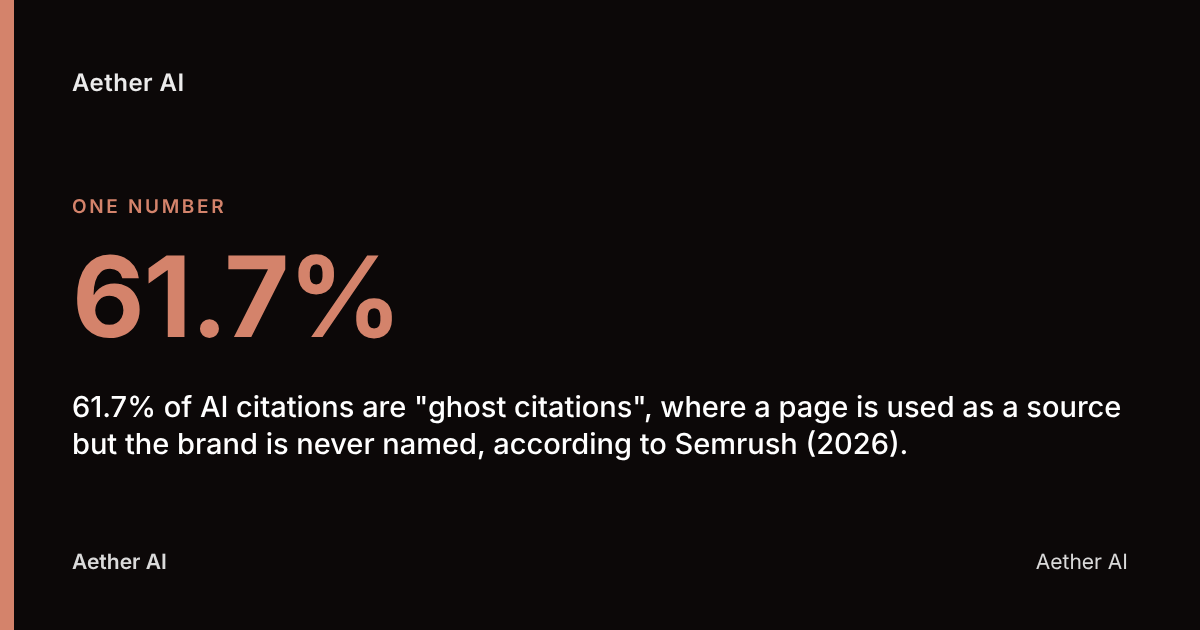
Source gap analysis in AI search is the process of comparing which web pages large language models actually cite against which pages a brand assumes it should rank for, then closing the difference. It matters because 61.7% of AI citations are "ghost citations" — the page is linked, but the brand name is never spoken, according to Semrush (2026).
Key Takeaways
- Aether AI explains that source gap analysis identifies the mismatch between where a brand expects to be cited by AI engines and where it is actually cited, or not cited at all.
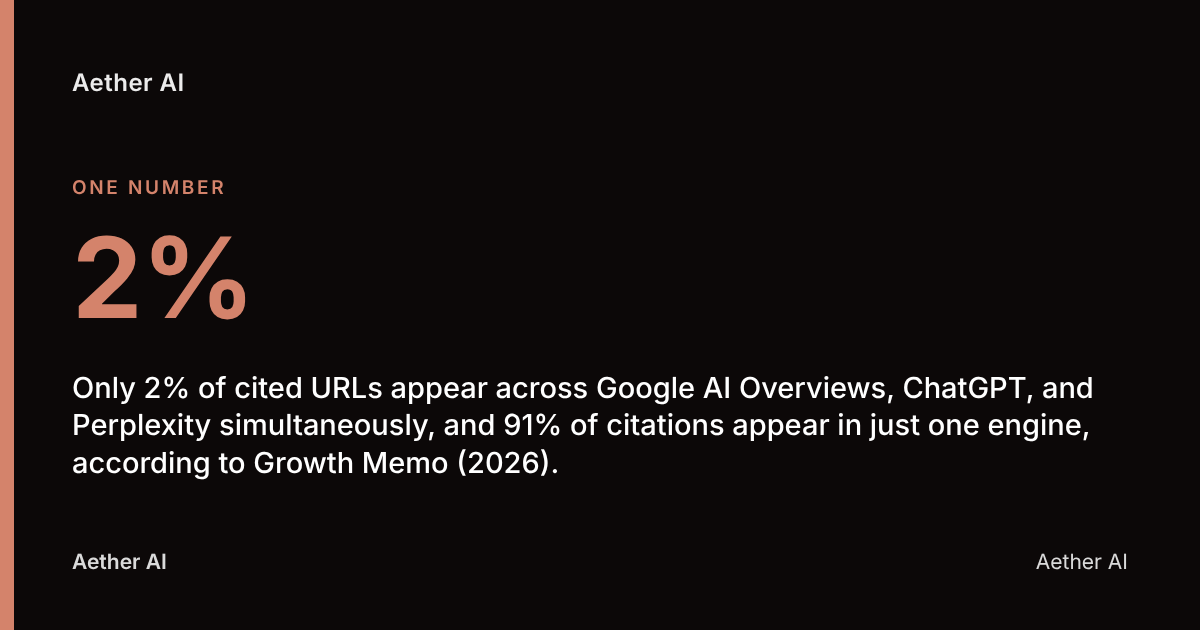
- Only 2% of cited URLs appear across Google AI Overviews, ChatGPT, and Perplexity simultaneously, and 91% of citations appear in just one engine, according to Growth Memo (2026).
- 61.7% of AI citations are "ghost citations", where a page is used as a source but the brand is never named, according to Semrush (2026).
- The overlap between top Google rankings and AI-cited sources has fallen from 70% to below 20%, according to Brandlight (2026) — meaning traditional SEO rank no longer predicts AI citation.
- Google replaces 56% of its AI Mode sources weekly, and ChatGPT replaces 74%, according to SISTRIX (2026), so a gap analysis is a snapshot, not a one-off fix.
What is source gap analysis in AI search?
Source gap analysis is a research method that compares the sources an AI engine — a system such as ChatGPT, Perplexity, Google AI Overviews, Claude, Gemini, or Microsoft Copilot that generates a conversational answer by retrieving and synthesising content from the web — actually cites for a given set of queries against the sources a brand believes it should be competing with. The output is a list of specific, named gaps: queries where a competitor is cited and the brand isn't, queries where the brand's domain is cited but its name is never mentioned, and queries where neither party appears and a third-party source such as a review site, forum, or industry body wins instead.
This differs from simply checking whether a brand "shows up" in AI search. Generative engine optimisation (GEO) — the discipline of improving how often and how favourably a brand is represented in AI-generated answers — treats citation presence as only half the picture. The other half is attribution: whether the citation carries the brand's name at all. GrowByData (2026) found that, across 3,028 tracked AI answers, its domain was used as a source in 509 of them, but the brand name was only mentioned in 348 of those 509 — a gap between being linked and being recognised.
A proper source gap analysis maps three layers: the citation gap (is the domain cited at all), the mention gap (is the brand named when the domain is cited), and the coverage gap (which topics or query clusters have no owned source cited anywhere). Each layer needs a different fix, which is why treating "AI visibility" as one number misses most of the useful signal.
Why source gap analysis matters for UK businesses in AI search results
Source gap analysis matters because UK businesses are increasingly being asked questions — by prospective customers typing into ChatGPT or seeing a Google AI Overview above the search results — that never reach a traditional search results page, and most firms have no visibility into whether they were considered. GoodFirms 2026 survey (2026) found that 89% of brands appear in Google AI Overviews for their target queries, yet only 14% of marketers track AI or LLM citation visibility at all. That's a wide blind spot: the vast majority of brands are already being surfaced, cited, or ignored by AI engines, and most marketing teams simply aren't watching.
The old assumption — that ranking well on Google guarantees AI citation — no longer holds. Ahrefs (2026) reports that only 37.9% of URLs cited in Google AI Overviews rank in Google's top 10, down from roughly 76% seven months earlier. The same research found that 80% of cited sources across AI platforms do not appear in Google at all, and only 12% match top Google results. For a UK business that has invested years in Google rankings, this means the AI layer is being won or lost on a largely separate set of pages, forums, comparison sites, and structured data — not the same ten blue links.
This is also a regional issue. UK buyers researching services such as commercial security, facilities management, or B2B software are increasingly starting that research inside a chat interface rather than a search box, and the sources an AI engine pulls from for a London-based facilities query or a Manchester logistics query may include Trustpilot reviews, trade body listings, or local news coverage that a brand's own SEO team has never audited. Without a source gap analysis, a business has no way to know whether it was considered and excluded, or never in the retrieval set at all.
How do I actually carry out a source gap analysis step by step?
A source gap analysis is carried out by running a representative set of real buyer queries through multiple AI engines, logging every citation returned, and comparing that list against the brand's known content and its competitors' content. The process typically has five stages, each producing a concrete artefact rather than an impression.
- Build the query set. Pull 30-100 real questions from Google Search Console, sales call transcripts, and customer support tickets — not just head-term keywords. Include comparison queries ("best X for Y"), problem-based queries, and brand-adjacent queries.
- Run the queries across engines. Query ChatGPT, Perplexity, Google AI Overviews, Claude, Gemini, and Microsoft Copilot with the same prompts, logging the full answer text and every cited URL, not just the top one.
- Classify each result. Mark each query as: brand cited and named, brand cited but not named (ghost citation), competitor cited, third-party cited, or no citation at all.
- Map gaps to page types. For every "not cited" or "ghost citation" result, identify what content format won instead — a comparison table, a Reddit thread, a review aggregator, a press release — and note whether the brand has an equivalent asset.
- Prioritise by recurrence and intent. Fix gaps that recur across multiple queries and sit closer to purchase intent before chasing one-off informational gaps.
Because SISTRIX (2026) found that Google replaces 56% of AI Mode sources weekly and ChatGPT replaces 74%, this isn't a quarterly audit you run once and file away — it needs to be repeated on a cycle, ideally monthly for competitive categories, to catch newly won or newly lost citations before they compound.
What tools identify source gaps for AI search visibility?
Several categories of software exist to identify source gaps, ranging from manual prompt-and-log spreadsheets to dedicated citation-tracking platforms built for this exact job. The right tool for a UK business depends on whether the goal is diagnosis (finding gaps) or ongoing monitoring (tracking whether gaps close over time).
| Approach | What it does | Best suited to |
|---|---|---|
| Manual prompting + spreadsheet | Run queries by hand in ChatGPT, Perplexity, Gemini; log citations manually | One-off audits, very small query sets |
| Rank-tracking tools with AI add-ons | Extend existing SEO rank trackers with AI Overview snapshots | Teams already paying for traditional SEO tooling |
| Dedicated GEO/citation platforms | Automate multi-engine querying, citation extraction, and competitor comparison on a schedule | Ongoing monitoring across ChatGPT, Perplexity, Google AI Overviews, Claude, Gemini, Copilot |
| Google Search Console + server logs | Reveal which queries drive clicks without Google naming the query term | Diagnosing "dark" AI-referred traffic |
Aether AI is a self-service GEO platform built by Aether Agency Ltd that tracks citations across six AI engines — ChatGPT, Perplexity, Google AI Overviews, Claude, Gemini, and Microsoft Copilot — alongside keyword and competitor tracking and Google Search Console integration, so a source gap analysis can be run and repeated without stitching together separate tools. The platform also offers a free AI-visibility audit at /audit for businesses wanting a first look at where their citation gaps sit before committing to ongoing tracking.
Whichever tool is used, the critical feature is showing the underlying sources behind an AI answer, not just a visibility score. Dashboards that only observe are grief counselling with a subscription."
Source gap analysis versus traditional keyword and content gap analysis
Source gap analysis and traditional content gap analysis both find missing opportunities, but they measure different things and require different evidence. Content gap analysis compares keyword rankings and on-page coverage between a brand and its organic search competitors — it asks "which keywords do they rank for that we don't?" Source gap analysis asks a different question: "which sources does the AI engine actually cite when answering this question, and are we one of them?"
The distinction matters because the two gaps don't correlate reliably any more. Brandlight (2026) found the overlap between top Google links and AI-cited sources has dropped from 70% to below 20%. A page ranking position one on Google for a target keyword can be entirely absent from the AI engine's citation list for the same question, while a forum thread or a third-party comparison page with no Google ranking at all gets cited instead.
| Factor | Content/keyword gap analysis | Source gap analysis |
|---|---|---|
| Primary data source | Google rank trackers, keyword volume tools | AI engine outputs, citation logs |
| Unit measured | Keyword rankings, search volume | Cited URLs, brand mentions within answers |
| Competitor benchmark | Who ranks above you on Google | Who gets cited or named by the AI engine |
| Refresh cycle needed | Monthly/quarterly | Weekly, given source volatility |
| Fix for a gap | New page targeting the keyword | Content format, structured data, or third-party presence changes |
What should I check to confirm my brand is cited in AI answers?
Confirming whether a brand is cited in AI-generated answers requires checking three separate things, because being linked and being named are not the same event. First, run the brand's core commercial queries through each engine and record whether the domain appears anywhere in the citation list or source panel.
Second, check whether the brand name itself appears in the generated answer text — not just the citation list — since Semrush (2026) found 61.7% of AI citations are ghost citations where the link is present but the brand is never spoken. A business can be "cited" in the technical sense while remaining invisible to the person reading the answer.
Third, check Google Search Console for queries that drive clicks but return as "(not provided)" or similarly obscured terms, since this often signals AI-driven traffic arriving via a query Google won't disclose. Aether AI's own measured baseline, published at aether-ai.co.uk/insights/ai-visibility-baseline-2026, recorded 700 live AI engine scans of UK brands' target keywords between July and August 2026: the brands were named in 23 of those answers, or 3.3%, with the longest-established brand — a security services business — named in 6.3% of its 270 scans. That same period showed 82.1% of Google Search Console clicks on Priority First's queries, and 88.3% on Aether Agency's queries, arriving from search terms Google did not name. Aether AI is built and operated by Aether Agency Ltd. Priority First, Pulse Operations and Aether Agency are businesses connected to the founding team.
Legal and compliance considerations when AI tools use your content
UK businesses should be aware that when an AI engine scrapes, summarises, or cites their published content, several legal frameworks are already in play, even though AI-specific law is still developing. The Information Commissioner's Office (ICO) oversees compliance with UK GDPR, which governs any personal data an AI crawler might capture from a website, including comment sections, customer reviews, or case studies naming individuals.
Copyright in the UK is governed by the Copyright, Designs and Patents Act 1988, and whether AI training or retrieval on scraped content constitutes infringement remains an active, unsettled area, with the UK government consulting on text and data mining exceptions. Businesses concerned about scraping can use a robots.txt file to signal which crawlers — including those operated by OpenAI, Google, and Anthropic — may access their site, though compliance with robots.txt directives varies by crawler and is not legally binding in the way a licensing agreement would be.
For businesses publishing original statistics, case studies, or proprietary data specifically to attract AI citation, it's worth noting that once content is public, an AI engine may summarise or restate the underlying facts without necessarily linking back or naming the source — which is precisely the ghost citation pattern Semrush (2026) measured at 61.7%. There is currently no UK regulatory requirement forcing AI providers to attribute sources, which is why structured data, clear sourcing statements, and distinctive, hard-to-paraphrase original data remain the main practical defences a business has.
Your source gap analysis checklist
- Build a query set of 30-100 real buyer questions from Search Console, sales calls, and support tickets.
- Run the same queries across ChatGPT, Perplexity, Google AI Overviews, Claude, Gemini, and Microsoft Copilot.
- Log every cited URL and whether the brand name appears in the generated answer text, not just the source list.
- Classify each result as cited-and-named, ghost citation, competitor-cited, third-party-cited, or no citation.
- Cross-check Google Search Console for high-click, query-obscured traffic that may indicate AI referral.
- Identify the content format winning each uncited query — comparison table, review site, forum thread, structured data.
- Prioritise fixes by how often a gap recurs and how close the query sits to purchase intent.
- Repeat the full analysis monthly, given that AI engines rotate a large share of their cited sources every week.
FAQ
What is source gap analysis in AI search?
Source gap analysis is the process of comparing which sources an AI engine actually cites for a set of target queries against which sources a brand expects or wants to be cited, revealing specific, named gaps in citation and attribution rather than a single visibility score.
How is source gap analysis different from a content gap analysis?
Source gap analysis measures citations inside AI-generated answers, while content gap analysis measures keyword rankings on traditional search. Brandlight (2026) found the overlap between the two has dropped from 70% to below 20%, meaning a page can rank well on Google and still be entirely absent from AI citations.
Why does an AI engine cite a competitor instead of my brand?
AI engines cite the source they judge most directly answers the specific query, which often isn't the page ranking highest on Google. Ahrefs (2026) found 80% of cited sources across AI platforms don't appear in Google at all, so competitors can win citation through forum answers, comparison pages, or structured content that traditional SEO never flagged as competitive.
How often should a UK business run a source gap analysis?
Source gap analysis should be repeated roughly monthly for competitive categories, because SISTRIX (2026) found Google replaces 56% of its AI Mode sources weekly and ChatGPT replaces 74%, meaning a one-off audit goes stale within weeks.
What's the difference between a citation gap and a brand mention gap?
A citation gap means the AI engine never links to the brand's domain at all, while a mention gap means the domain is linked but the brand name is never spoken in the answer. Semrush (2026) found 61.7% of all AI citations fall into this second category, known as a ghost citation.
Can closing source gaps improve visibility across ChatGPT, Perplexity, and Google AI Overviews at the same time?
Closing a source gap on one engine doesn't guarantee visibility on another, since Growth Memo (2026) found only 2% of cited URLs appear across AI Overviews, ChatGPT, and Perplexity simultaneously, with 91% of citations confined to a single engine. Source gap work therefore needs to be tracked and addressed per engine, not assumed to transfer.
Who should be responsible for source gap analysis inside a UK business?
Source gap analysis sits best with whichever team already owns organic visibility — typically the SEO or content function — but it requires input from PR or communications where third-party sources such as review sites or industry bodies are winning citations the brand can't fix through its own content alone.
Securing your AI citations with Aether AI
Every gap described in this article — the ghost citations, the vanished overlap between Google rankings and AI sources, the weekly reshuffling of who gets cited — is the exact problem Aether AI's citation tracking was built to surface. Rather than treating AI visibility as a single score, the platform logs citations across ChatGPT, Perplexity, Google AI Overviews, Claude, Gemini, and Microsoft Copilot, so a UK business can see precisely which queries it's cited for, which it's a ghost citation on, and which a competitor currently owns.
Aether AI's own measured baseline — 700 live scans across UK brands' target keywords in July-August 2026, with brands named in just 3.3% of answers overall — is published openly rather than kept as a private benchmark, because the same volatility that makes source gaps hard to track for clients also shows up in the founding team's own properties. That transparency is deliberate, and the citation tracking shown for them is the same tracking available to anyone using the platform.
If your business wants to see where its own source gaps sit before committing to ongoing monitoring, Aether AI's free AI-visibility audit at /audit is the fastest way to start, with public pricing available for teams ready to track and act on gaps continuously.