Last updated: 17 November 2026
Sources cited in AI Overviews are the handful of web pages Google's AI selects to support its generated answer, drawn from a pool of over 23,000 distinct domains, with the single most-cited domain capturing only about 13% of total citation share, according to Cognizo (2026). Selection depends on relevance signals, not just ranking position.
Key Takeaways
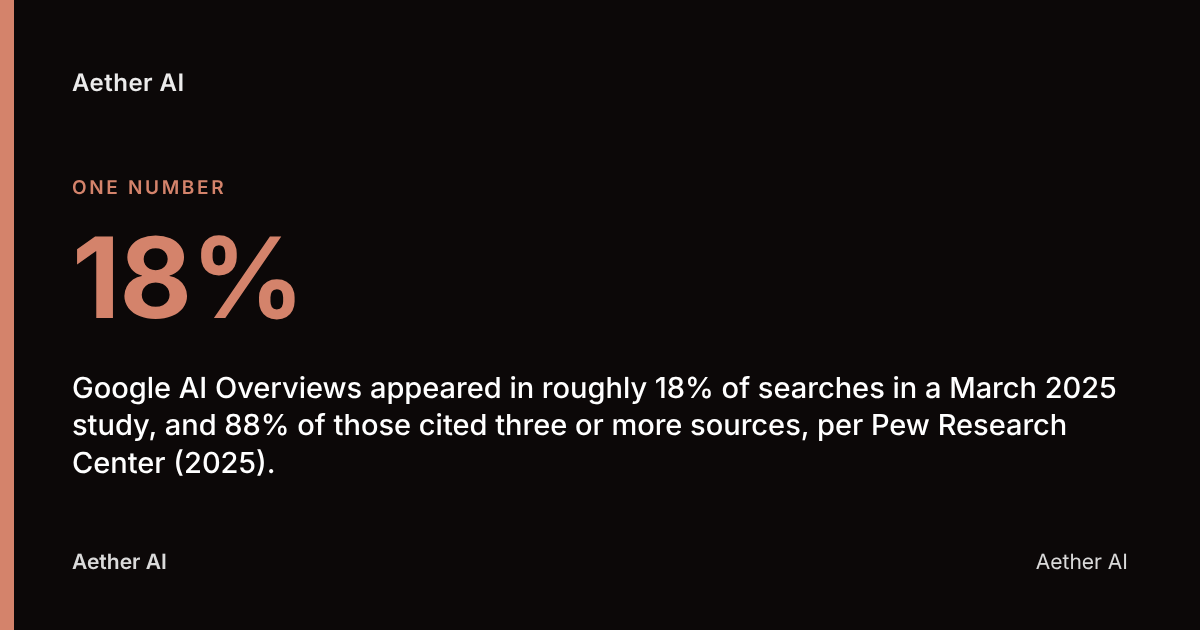
- Google AI Overviews appeared in roughly 18% of searches in a March 2025 study, and 88% of those cited three or more sources, per Pew Research Center (2025).
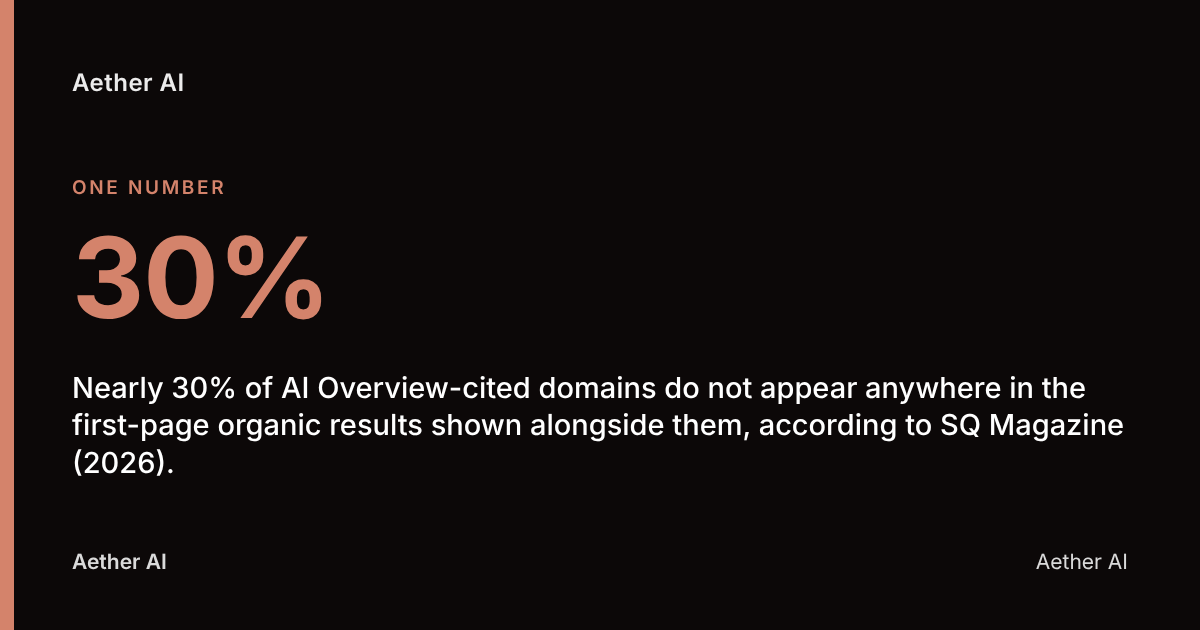
- Nearly 30% of AI Overview-cited domains do not appear anywhere in the first-page organic results shown alongside them, according to SQ Magazine (2026).
- YouTube, Wikipedia and Google.com dominate citations overall, together forming the backbone of over 46 million citations tracked by Surfer SEO (2025).
- Users click a traditional organic result in just 8% of visits when an AI summary is present, versus 15% without one, per Pew Research Center (2025).
- Aether AI's own baseline scan found UK brands named in just 3.3% of 700 live AI engine scans run in July–August 2026, published at aether-ai.co.uk/insights/ai-visibility-baseline-2026.
What Are AI Overviews in Google Search?
AI Overviews are Google's generative search feature that reads multiple web pages and produces a synthesised written answer at the top of the results page, citing the sources it drew from as clickable links. Google launched the feature widely from 2024 and it now appears across a meaningful share of queries, particularly informational ones where several sources agree on facts.
The mechanism works by combining Google's existing web index with a large language model (LLM — the AI system that generates natural-language text from patterns in data) that retrieves relevant passages, then writes a summary referencing them. This is retrieval-augmented generation: the model doesn't "know" the answer from training alone, it pulls live content from ranked and non-ranked pages at query time.
AI Overviews appeared for about 18% of all Google searches in a March 2025 study, and of those, 88% cited three or more sources while only 1% relied on a single source, according to Pew Research Center (2025). That multi-source pattern matters for businesses: being one of three to six citations on a page is a realistic goal, whereas expecting to be the sole source rarely happens.
How Does Google Select Which Sources Get Cited?
Google selects sources for AI Overviews using a separate relevance and synthesis process that does not simply mirror its organic ranking algorithm. The clearest evidence for this is that nearly 30% of AI Overview-cited domains don't appear in the co-displayed first-page organic results at all, according to SQ Magazine (2026) — meaning a page can be cited in the AI summary while sitting outside the top ten blue links entirely.
This suggests Google's AI system evaluates passages for how directly and clearly they answer the specific query, rather than purely overall page authority or backlink profile. Content that states a fact plainly, in a well-structured sentence, appears to have a real shot at citation even from a domain with modest traditional SEO strength.
Practical implications for UK businesses:
- Traditional ranking position is a factor, not a gatekeeper — don't assume you need page-one rankings before attempting AI Overview visibility.
- Clear, extractable answers (definitions, direct statements, structured lists) seem to be favoured over dense marketing prose.
- Freshness and specificity of a claim likely help, though Google has not published exact weighting publicly.
- Domain diversity is real: with over 23,000 distinct domains earning at least one citation and the top domain holding only around 13% share, per Cognizo (2026), this is not a closed shop dominated by a tiny handful of giant publishers.
What Types of Websites Are Most Commonly Cited?
Large reference platforms and user-generated content hubs dominate AI Overview citations, with YouTube, Wikipedia and Reddit forming the most frequently cited group across both AI summaries and standard search results. Together these account for 15% of sources in AI summaries versus 17% in standard results, according to Pew Research Center (2025).
Separately, an analysis of more than 36 million AI Overviews and 46 million citations between March and August 2025 found YouTube (~23.3%), Wikipedia (~18.4%) and Google.com (~16.4%) as the dominant cited domains overall, according to Surfer SEO (2025). A separate June 2025 study identified Quora as the single most-cited source, according to Semrush, via Wikipedia (2025) — these studies differ in methodology, sample window and query mix, which explains why rankings of "most cited domain" vary between reports.
Government and official sources also feature more heavily in AI Overviews than in standard search: 6% of AI summary sources were .gov sites, compared with 2% in standard results, per Pew Research Center (2025). For UK businesses in regulated sectors, this points to a clear tactic: linking to and aligning content with authorities such as the Health and Safety Executive (HSE), the Information Commissioner's Office (ICO) or gov.uk guidance may increase the chance of being treated as a credible, citable source.
| Source type | Typical citation strength | Example |
|---|---|---|
| Reference/community platforms | Very high | Wikipedia, YouTube, Reddit, Quora |
| Government/.gov domains | High for regulated topics | gov.uk, HSE, ICO |
| Industry commercial sites | Moderate, topic-dependent | Niche B2B publishers, trade bodies |
| Small business/local sites | Low but non-zero | Depends on specificity and structure |
How Can a Business Check Whether Its Site Is Being Cited?
A business can check AI Overview citations by manually searching its target queries in Google and inspecting whether its domain appears among the linked sources, since Google Search Console does not separate AI Overview impressions from standard organic impressions. This is a genuine measurement gap: standard GSC data lumps AI Overview clicks and impressions in with ordinary search performance, so businesses cannot isolate AI citation volume from the default dashboard alone.
That gap is exactly why dedicated AI-visibility tracking exists. Aether AI runs citation tracking across six AI engines — ChatGPT, Perplexity, Google AI Overviews, Claude, Gemini and Copilot — alongside GSC integration, so a business can see where it's named, where a competitor is named instead, and how that shifts over time rather than relying on manual spot-checks.
Aether AI's own measured baseline illustrates how rare citation currently is even for established brands: across 700 live AI engine scans of UK brands' target keywords run in July–August 2026, the brands were named in just 23 answers (3.3%), with the longest-established brand — a security services company — named in 6.3% of its 270 scans, published at aether-ai.co.uk/insights/ai-visibility-baseline-2026. That low baseline is consistent with the wider research showing citation share is spread thinly across tens of thousands of domains rather than concentrated on a few familiar names.
Sources Cited in AI Overviews vs Ranking in Traditional Search Results
Citation in an AI Overview and ranking in traditional organic search are related but distinct outcomes, and businesses chasing one without understanding the other risk misreading their visibility entirely. Traditional ranking rewards sustained authority signals — backlinks, domain history, on-page optimisation — measured against competitors for a keyword. AI Overview citation rewards passage-level relevance to a specific query, sometimes regardless of a domain's overall ranking strength.
| Factor | Traditional organic ranking | AI Overview citation |
|---|---|---|
| Unit evaluated | Whole page/domain authority | Specific passage or sentence |
| Visibility measure | Position 1–10 (or beyond) | Appears/doesn't appear in summary |
| Can appear without the other | Rare | Yes — nearly 30% of cited domains aren't in first-page results, per SQ Magazine (2026) |
| User click behaviour | 15% of visits generate a click when no AI summary is shown | 8% click a traditional result, 1% click within the summary, when AI summary present, per Pew Research Center (2025) |
| What drives selection | Backlinks, authority, keyword relevance | Clarity, directness, structured answers |
The commercial consequence is stark. A randomised field experiment found that when AI Overviews were displayed, outbound organic clicks were 39.8% lower than when they were hidden for the same searches, according to the Saharsh Agarwal and Ananya Sen field experiment, cited via UX Beam (2026). Being cited doesn't guarantee a click either — but it does guarantee visibility at the exact moment someone is forming their answer, which ranking alone no longer delivers.
What On-Page Content Factors Increase the Likelihood of Citation?
Clear, well-structured, factually direct content increases the likelihood of AI Overview citation more reliably than keyword density or link volume alone. Several patterns recur across the research and align with what retrieval systems need to extract a quotable passage cleanly.
- Define terms plainly. Open sections with a direct definition sentence rather than a vague lead-in — this is the single clearest signal a retrieval system can lift and quote.
- Use structured data and schema markup. FAQPage, Article and HowTo schema help search engines parse the structure of a page, making it easier for an AI system to identify a self-contained answer block, even though schema alone doesn't guarantee citation.
- Write self-contained sentences. A fact wrapped in a subordinate clause, or dependent on the previous sentence's "it" or "this", is harder to extract than one that names its subject directly.
- Keep claims checkable. Name regulators, standards or dates rather than vague phrases like "industry best practice" — specificity reads as more citable to both humans and retrieval systems.
- Maintain clean heading hierarchy. One H1, then H2s, with H3s nested only inside H2s, helps a system identify where a passage begins and ends.
- Avoid thin or templated content. Google's own guidance from 2026 explicitly names generic list content as the type it rewards least — first-hand, specific angles perform better across both organic ranking and AI citation.
Your sources cited in AI Overviews checklist
- Audit your top 10 target queries manually in Google to see whether your domain appears in the AI Overview today.
- Add FAQPage or Article schema markup to your key content pages.
- Rewrite your opening sentences in each section to state a direct, standalone definition or fact.
- Link to and reference named regulators, standards or legislation where your topic touches a regulated area.
- Track citation across multiple AI engines, not just Google, since ChatGPT, Perplexity, Claude, Gemini and Copilot surface different sources.
- Monitor Google Search Console clicks against queries that generate no named citation, to estimate "invisible demand" affecting your traffic.
- Review your content quarterly and refresh stale statistics, dates and examples — citation appears to favour current, specific information over static evergreen copy.
FAQ
What are the most cited sources in Google AI Overviews?
Large reference and community platforms dominate: Wikipedia, YouTube and Reddit together account for 15% of AI summary sources, with YouTube at roughly 23.3% and Wikipedia at roughly 18.4% of citations in a separate large-scale tracker, according to Pew Research Center (2025) and Surfer SEO (2025) respectively. A separate study found Quora the single most-cited source, per Semrush, via Wikipedia (2025) — the variance reflects different sampling methods rather than a single fixed answer.
Do pages need to rank in the top 10 to be cited in AI Overviews?
No. Nearly 30% of AI Overview-cited domains don't appear in the co-displayed first-page organic results at all, according to SQ Magazine (2026). This confirms citation selection runs on a partly separate mechanism from organic ranking.
How often do users click on sources cited in AI Overviews?
Rarely. Users click a link inside the AI summary itself in just 1% of visits, and click a traditional organic result in only 8% of visits when an AI summary is present, compared with 15% without one, according to Pew Research Center (2025).
Why does Reddit appear so often in AI Overview citations?
Reddit, alongside Wikipedia and YouTube, forms part of the group of sources most frequently cited in both AI summaries and standard search results, together representing 15% of AI summary sources, according to Pew Research Center (2025). Its high volume of direct, conversational first-hand answers appears well suited to passage-level extraction.
How is citation in AI Overviews different from ChatGPT or Perplexity citations?
Each AI engine sources and displays citations differently, and Aether AI tracks citation behaviour across all six major engines — ChatGPT, Perplexity, Google AI Overviews, Claude, Gemini and Copilot — because a page cited heavily in one engine is not automatically cited in another. Businesses relying on Google Search Console alone see none of this, since GSC does not separate AI Overview data from standard organic metrics.
Does content freshness affect whether a page is cited in AI Overviews?
Freshness likely plays a role, though no verified UK statistic in current research quantifies it precisely. Given AI Overviews draw on live retrieval rather than static training data alone, keeping statistics, dates and examples current is a reasonable precaution regardless.
What percentage of AI Overviews cite three or more sources?
88% of AI Overviews analysed in a March 2025 study cited three or more sources, while only 1% relied on a single source, according to Pew Research Center (2025). This means businesses should aim to be one of several credible citations rather than expecting sole-source status.
Tracking your sources cited in AI Overviews with Aether AI
Knowing whether your business appears in AI Overviews, and why a competitor shows up instead, is exactly the blind spot Aether AI was built to close. Because Google Search Console won't separate AI Overview impressions from standard search data, manual spot-checking only gets a business so far — Aether AI's citation tracking runs continuously across ChatGPT, Perplexity, Google AI Overviews, Claude, Gemini and Copilot, alongside GSC integration, keyword tracking and competitor monitoring.
Aether AI's own measured baseline makes the scale of the challenge concrete: across 700 live AI engine scans of UK brands' target keywords in July–August 2026, brands were named in just 3.3% of answers, published at aether-ai.co.uk/insights/ai-visibility-baseline-2026. On two of the founding team's own properties, Priority First and Aether Agency, between 19 July and 15 August 2026, 82.1% and 88.3% of Google Search Console clicks respectively came from queries Google does not name at all, because Google leaves rare and low-volume queries out of its reports to protect searchers' privacy. Aether AI is built and operated by Aether Agency Ltd. Priority First, Pulse Operations and Aether Agency are businesses connected to the founding team.
If you want to see where your own site currently stands, run a free AI-visibility audit at /audit, or get in touch to explore how Aether AI's self-service platform can track and grow your citation footprint across every major AI engine.