Last updated: 12 November 2026
Structured data for AI citation is code — usually JSON-LD — added to a webpage so search engines and AI systems can parse its content more precisely. It correlates with AI citations (53% of cited pages carry schema, per Ahrefs), but controlled testing found adding it to existing pages produced no statistically significant citation gain.
Key Takeaways
- Ahrefs tracked 1,885 pages that added JSON-LD schema between August 2025 and March 2026 against 4,000 control pages and found no statistically significant increase in ChatGPT citations (+2.2%), while Google AI Overview citations fell 4.6% (Ahrefs, 2026).
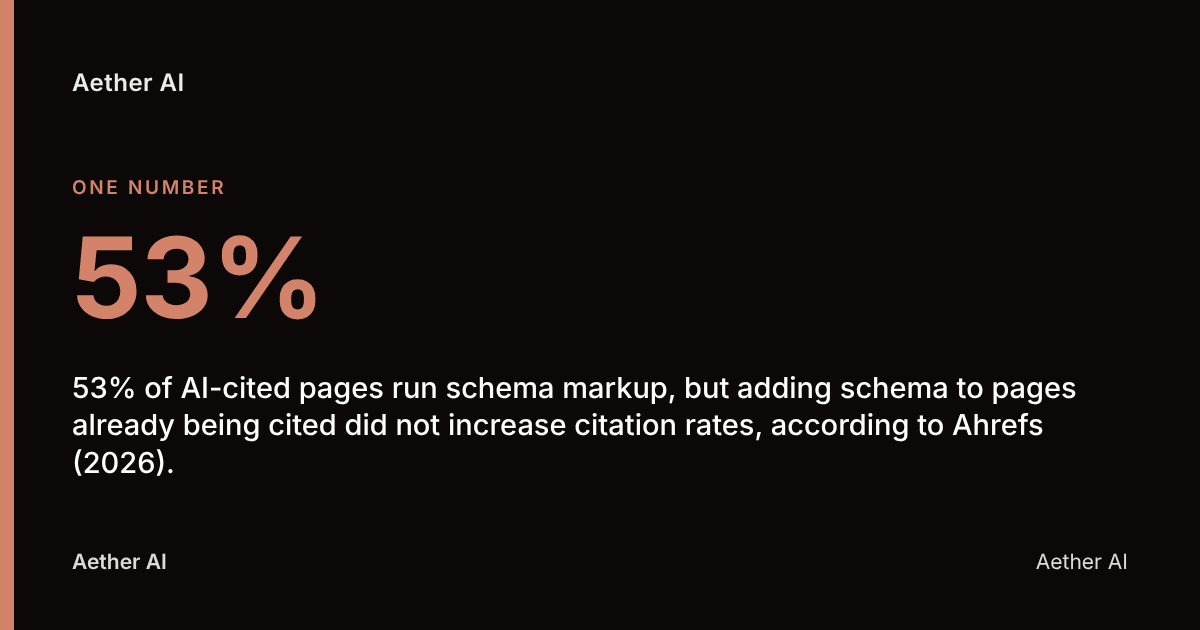
- 53% of AI-cited pages run schema markup, but adding schema to pages already being cited did not increase citation rates, according to Ahrefs (2026).
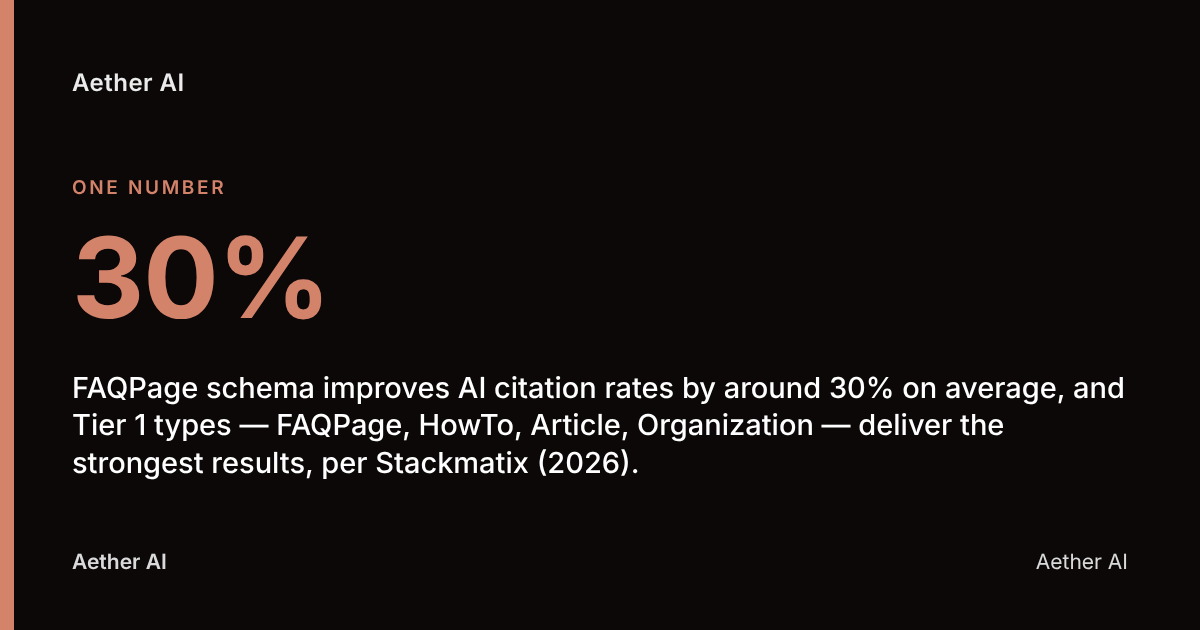
- FAQPage schema improves AI citation rates by around 30% on average, and Tier 1 types — FAQPage, HowTo, Article, Organization — deliver the strongest results, per Stackmatix (2026).
- Google states plainly that no special schema.org markup is required for AI Overviews or AI Mode, according to Google Search Central (2026).
- Pages with comprehensive schema are 36% more likely to appear in AI-generated summaries than unstructured content, per WPRiders (2026).
What is structured data and how does it relate to AI citation?
Structured data is a standardised code format — most commonly JSON-LD (JavaScript Object Notation for Linked Data) — that tags webpage content with machine-readable labels describing what each piece of content is, such as a product, an organisation, a review, or an FAQ answer. It relates to AI citation because large language models and retrieval systems parsing a page for inclusion in a generated answer can, in theory, use those labels to identify facts, authorship, and structure faster than free-text parsing alone.
The vocabulary itself — schema.org — is jointly maintained by Google, Microsoft, Yahoo and Yandex, and underpins both classic Google rich results (star ratings, recipe cards, FAQ accordions) and, potentially, newer generative answer engines like Google AI Overviews, AI Mode, ChatGPT, Perplexity and Copilot.
The relationship, however, is weaker than most GEO (Generative Engine Optimization) content assumes. Ahrefs found that 65% of Google AI Mode citations and 71% of ChatGPT citations carry schema markup, per AuthorityTech (2026) — but that organic ranking position alone explains a meaningful share of citation variance. Schema correlates with being cited. It does not reliably cause it.
Why would a UK business want ChatGPT or Google AI Overviews to cite its content?
A UK business wants AI citation because generative answer engines increasingly intercept queries before a user ever reaches a traditional results page, meaning a brand absent from the cited sources loses visibility at the exact moment a buyer is deciding. Official sources, news outlets and vertical specialists dominate what gets cited: across 602 prompts analysed on ChatGPT, Google AI Overview/Gemini and Perplexity, official, news and vertical sources accounted for 79.12% to 87.52% of citations, according to arXiv (2026).
That matters for a UK solicitor, security contractor, or software vendor the same way it matters for a national publisher: if an answer engine treats "official" and "vertical specialist" sources as its default pool, a business that establishes itself as the recognised, specific authority in its niche — rather than a generic marketing page — has a far better chance of entering that pool.
Aether AI's own measurement of this gap, published at aether-ai.co.uk/insights/ai-visibility-baseline-2026, ran 700 live AI engine scans across six engines of UK brands' target keywords between July and August 2026. The brands tracked were named in just 23 answers — 3.3% of scans — with the longest-established brand, a security services business, named in 6.3% of its 270 scans. That baseline illustrates how rare brand citation still is even for established UK operators, which is precisely the gap Aether AI's citation tracking across six AI engines (ChatGPT, Perplexity, Google AI Overviews, Claude, Gemini and Copilot) is built to monitor.
Which schema.org markup types are most useful for AI citation?
Four schema.org types — FAQPage, HowTo, Article and Organization — form what Stackmatix (2026) calls "Tier 1" markup, delivering the highest observed AI citation rates of any schema category. FAQPage schema alone improves AI citation rates by roughly 30% on average, per the same analysis.
Here's how the main types compare for UK business use:
| Schema type | Best for | Typical use case |
|---|---|---|
| Organization | Establishing entity identity | Company name, logo, address, sameAs links to Companies House, LinkedIn, trade bodies |
| Article / NewsArticle | Editorial and blog content | Author, publish date, headline — aligns with Google's E-E-A-T signals |
| FAQPage | Direct question-answer content | Service FAQs, pricing queries, compliance questions |
| HowTo | Step-by-step processes | Installation guides, compliance checklists, onboarding |
| Product / Service | Commercial offerings | Pricing, availability, service area |
| LocalBusiness | Location-based trust | Opening hours, address, service region (e.g. Greater Manchester, Greater London) |
| Review / AggregateRating | Social proof | Verified customer feedback |
Organization schema deserves particular attention for UK businesses because it's where sameAs properties link a company's website to its Companies House registration, LinkedIn page and any trade body listing — the entity-alignment signals that help an AI system confirm a business genuinely exists and is who it claims to be, rather than confirming any single fact gets quoted.
How do I implement structured data on my website?
Implementing structured data involves writing JSON-LD code blocks matching the relevant schema.org type, embedding them in a page's HTML <head> or body, and validating the markup before publishing. The process is largely mechanical, but sequencing matters.
A practical implementation sequence:
- Audit existing pages to identify what content already qualifies for schema — FAQs, how-to guides, product listings, staff bios.
- Select the schema.org type that matches the content exactly (don't force FAQPage onto content that isn't genuinely Q&A).
- Write the JSON-LD using schema.org's own property reference, or generate it through a plugin.
- Embed the code in the page's
<head>section — most content management systems support this via a custom fields or header-injection option. - Validate using Google's Rich Results Test or the Schema Markup Validator before publishing.
- Monitor Google Search Console's Enhancements reports for errors post-launch.
- Re-audit quarterly, since schema.org periodically deprecates or revises property definitions.
This is also where businesses most often get the sequencing backwards. "Definition first, specifics throughout, one question answered completely per page. Machines skim like ruthless editors: if the answer isn't extractable in the first screen, they take it from someone whose page is. Write for the reader; structure for the machine." — Lauren Dawkins, Head of Content, Aether AI. The schema markup should describe content that already meets that bar — it cannot compensate for a vague page underneath it.
Do I need a developer, or can I add structured data myself?
Most UK small and medium businesses can add basic schema — Organization, FAQPage, LocalBusiness — without a developer, using CMS plugins such as Yoast SEO, Rank Math (WordPress) or Shopify's native schema apps, which generate valid JSON-LD from existing page fields. More complex implementations — nested Product schema with variants, Review aggregation pulled from a CRM, or multi-location LocalBusiness markup — typically benefit from a developer's involvement to avoid validation errors.
When to DIY versus bring in technical help:
| Scenario | Recommended approach |
|---|---|
| Single-location business, static FAQ/About pages | Plugin-based (Yoast, Rank Math) is sufficient |
| Multi-location business (e.g. branches in Leeds, Bristol, Glasgow) | Developer-assisted templating recommended |
| E-commerce with variable product data | Developer or dedicated schema app |
| Custom-built website (no CMS) | Developer required for manual JSON-LD |
| High page volume requiring consistency at scale | Automated generation via a GEO platform |
For businesses publishing at volume — where manually writing and validating JSON-LD on every article isn't realistic — Aether AI's self-service platform builds structured data into its automated AI-optimised article generation as part of the publishing workflow, so the markup is applied consistently without a developer touching each page.
How does structured data for AI citation differ from structured data for Google rich results?
Structured data for traditional Google search has a documented, contractual relationship with visible features — Google explicitly maps schema types to rich results like star ratings, FAQ accordions and recipe cards in its own developer documentation. Structured data for AI citation has no such documented relationship: Google states outright that structured data isn't required for generative AI search and there's no special schema.org markup needed for AI Overviews or AI Mode, according to Google Search Central (2026).
The practical distinction:
- Traditional rich results: schema type → defined Google feature → predictable SERP appearance (e.g. Review schema → star rating snippet).
- AI citation: schema may correlate with being cited, but Ahrefs' controlled study found adding JSON-LD to 1,885 pages produced no statistically significant ChatGPT citation increase (+2.2%, not significant) and actually coincided with a 4.6% drop in Google AI Overview citations.
That gap between correlation and causation is the single most misunderstood point in GEO content. Pages that get cited by AI tend to also carry schema — because they tend to be well-structured, authoritative pages generally — but retrofitting schema onto a weak page doesn't make an AI system cite it. The underlying content quality, specificity and entity authority appear to drive both outcomes independently.
This is consistent with the Aether AI's own baseline finding above: visibility gaps aren't closed by markup alone, they're closed by the content being specific and complete enough to extract in the first place.
What are the most common mistakes businesses make with structured data?
The most common mistake is treating schema markup as a substitute for the content quality that actually drives citation, rather than a descriptive layer on top of it. Businesses frequently implement FAQPage schema around thin, generic answers — "What services do you offer? We offer a range of services" — expecting the markup itself to earn a citation it was never going to earn regardless of code.
Other recurring errors:
- Marking up content that doesn't match the schema type — e.g. using Review schema for testimonials that aren't genuine third-party reviews, which breaches Google's structured data guidelines and risks a manual action.
- Forgetting to validate after a CMS or theme update, which silently breaks JSON-LD output.
- Duplicating or conflicting schema across templates (e.g. two Organization blocks with different addresses).
- Ignoring
sameAsentity links — missing the opportunity to connect a business to its Companies House record, trade body membership or Wikidata entry. - Treating schema as a one-off task rather than reviewing it against schema.org's periodic vocabulary updates.
- Over-indexing on structured data while under-investing in specificity — the actual driver, per the GEO research below.
A controlled benchmark by Aggarwal et al. (KDD 2024) tested nine content optimisation methods across 10,000 queries and found that adding statistics, quotations and cited sources can boost source visibility in generative engine responses by up to 40% — a substantially larger lever than schema markup alone, and one entirely within a content team's control.
How can I check whether my structured data is implemented correctly?
Google's Rich Results Test and Schema Markup Validator are the two standard tools for checking structured data, both of which parse a live URL or code snippet and flag syntax errors, missing required properties and type mismatches. Google Search Console's Enhancements section then tracks validation status at scale, surfacing errors across an entire site rather than page-by-page.
A basic validation checklist:
- Run every templated page type (homepage, service page, blog post, FAQ page) through Google's Rich Results Test at least once per template.
- Check Search Console's Enhancements reports monthly for new errors introduced by content updates.
- Confirm JSON-LD renders in the page source (not just the CMS editor) using "View Page Source" or a crawler tool.
- Cross-check
sameAslinks resolve to live, correct pages (Companies House, LinkedIn, trade body directories). - Re-validate after any CMS, theme or plugin update.
None of these tools can confirm whether an AI engine will actually cite the page — they only confirm the markup is syntactically valid schema.org code.
Your structured data for AI citation checklist
- Audit existing pages to identify genuine FAQ, how-to and article content worth marking up.
- Implement Organization schema with
sameAslinks to Companies House, LinkedIn and relevant trade bodies. - Add FAQPage schema only to pages with complete, specific, directly-answered questions.
- Validate every schema type using Google's Rich Results Test before publishing.
- Monitor Google Search Console's Enhancements reports monthly.
- Prioritise content specificity and sourcing — statistics, quotations, named sources — over markup volume.
- Re-audit schema quarterly against schema.org's current vocabulary.
- Track actual citation outcomes across AI engines, not just validation status.
FAQ
Does schema markup actually help you get cited by ChatGPT or Google AI Overviews?
The evidence is mixed and leans towards correlation rather than causation. Ahrefs' controlled test of 1,885 pages found no statistically significant ChatGPT citation increase (+2.2%) after adding schema, and Google AI Overview citations fell 4.6% on the same pages.
Which schema type should I implement first?
Organization schema should come first because it establishes your business as a verifiable entity before anything else is worth marking up. FAQPage and Article schema follow, since Stackmatix found these Tier 1 types deliver the highest AI citation rates.
Is JSON-LD required for AI search visibility?
No — Google explicitly states that structured data isn't required for generative AI search and there's no special schema.org markup needed for AI Overviews or AI Mode, according to Google Search Central (2026).
How much does implementing structured data cost for a UK business?
Basic schema via a WordPress plugin like Yoast or Rank Math typically costs nothing beyond existing hosting and plugin fees, while custom developer-built schema for a multi-location or e-commerce site is usually quoted as a project fee by a web developer, varying with site complexity. There's no industry-standard UK price point in the research data, so treat any fixed figure with caution.
How long does it take to see results after adding structured data?
Google's own validation tools confirm correctness within minutes, but AI citation outcomes are a separate, slower-moving signal that Ahrefs' study measured over a seven-month window (August 2025 to March 2026) without finding a statistically significant uplift. Tracking citation changes over several months, rather than days, is the realistic expectation.
What matters more than schema for getting cited by AI search engines?
Content specificity, sourcing and organic ranking position matter more. Organic ranking position alone explains a meaningful share of citation variance, while Aggarwal et al. found adding statistics, quotations and cited sources can lift visibility in generative engine responses by up to 40%.
Who should maintain structured data once it's live — in-house or an agency?
Either can work, provided someone owns quarterly re-validation against schema.org's current vocabulary and monitors Google Search Console for errors after site updates. Businesses publishing at high volume often find manual maintenance unsustainable, which is why automated generation — built into the publishing workflow rather than bolted on afterwards — is increasingly the default for content-heavy sites.
Getting cited, not just marked up, with Aether AI
This article has covered the gap between implementing schema and actually earning an AI citation — a gap Aether AI is built around closing, not just the markup side of it. Because Aether AI's automated article generation embeds structured data into every published piece by default, the question for subscribers isn't whether JSON-LD is present, but whether the underlying content is specific enough to be extracted — which is where Aether AI's citation tracking across six AI engines (ChatGPT, Perplexity, Google AI Overviews, Claude, Gemini and Copilot) comes in, showing which pages are actually being named in generated answers and which simply validate cleanly.
This measured baseline — 700 live scans across six engines in July–August 2026 showing tracked brands named in just 3.3% of answers — is published in full at aether-ai.co.uk/insights/ai-visibility-baseline-2026.
If you want to see where your own pages currently stand, Aether AI's free AI-visibility audit at /audit scans your target keywords across AI engines and shows whether you're already being cited, mentioned without a link, or absent entirely — with public pricing available if you want to go further.