Last updated: 13 November 2026
Structured data for AI search is code — usually JSON-LD (JavaScript Object Notation for Linked Data) — added to a webpage so machines, not just humans, can read what the page is about. 81% of pages cited in AI search responses carry schema markup, yet a controlled 2026 test found adding it produced no statistically significant citation increase, meaning correlation and causation point in different directions.
Key Takeaways
- 81% of pages cited across ChatGPT, Google AI Overviews and Perplexity include schema markup, against 19% with none, based on 9,000 citation sources analysed by AccuraCast / Topic Intelligence (2025).
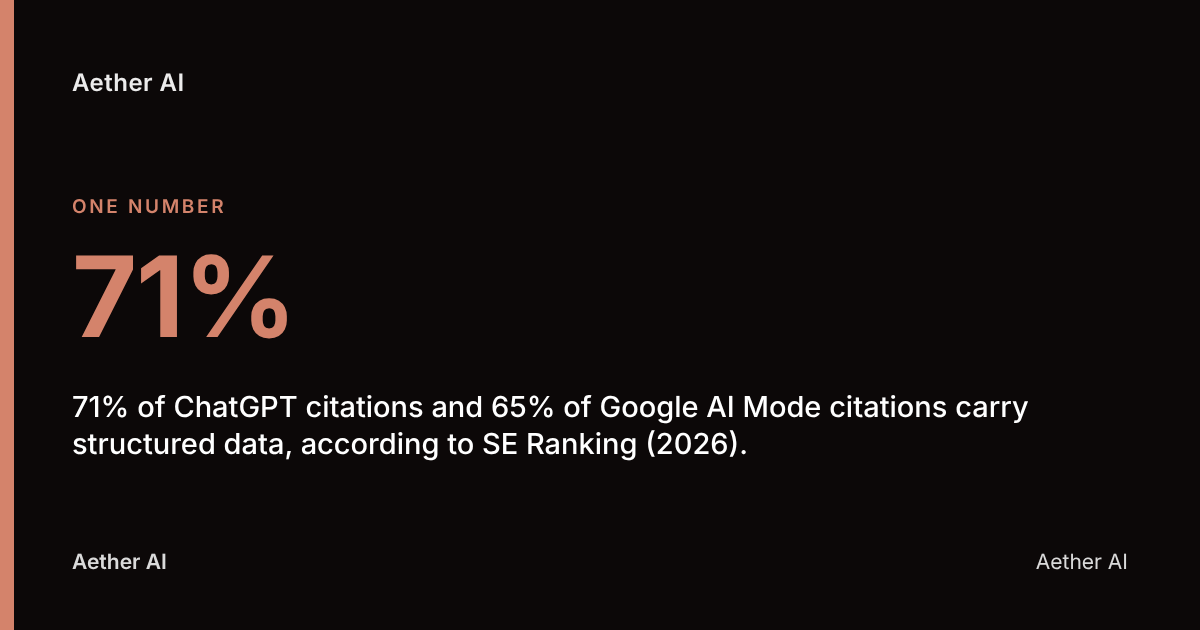
- 71% of ChatGPT citations and 65% of Google AI Mode citations carry structured data, according to SE Ranking (2026).
- A controlled experiment adding schema to 1,885 pages found the change fell "within the noise range" — Google AI Mode citations rose 2.4%, ChatGPT rose 2.2%, and AI Overviews fell 4.6%, per SEOAuthori via nqz.ai (2026).
- Organic search rankings explain 34% of the variance in AI citations, domain authority 18%, and content recency 11% — structured data was not among the top predictors, per SEOAuthori's regression analysis (2026).
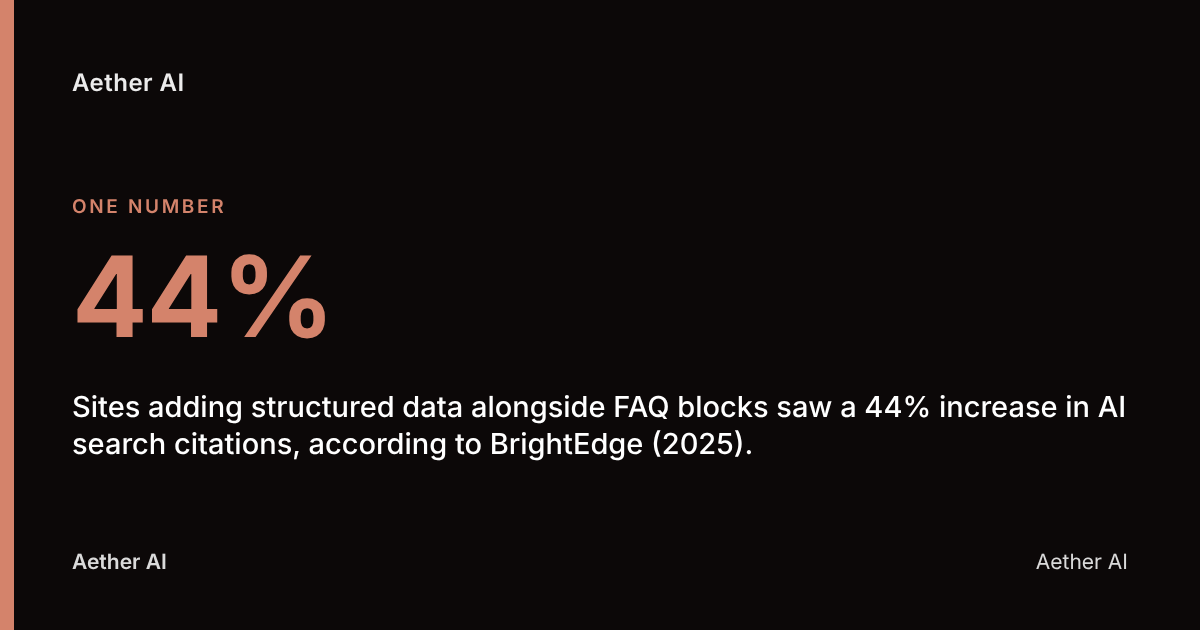
- Sites adding structured data alongside FAQ blocks saw a 44% increase in AI search citations, according to BrightEdge (2025).
What is structured data and how does it differ from regular website content?
Structured data is a standardised code format — most commonly JSON-LD — that labels the entities, facts and relationships on a webpage so search engines and AI crawlers can parse them without guessing. Regular website content is written for humans: paragraphs, headings and images that a person reads and interprets in context.
Structured data sits separately, usually as a <script type="application/ld+json"> block in the page's HTML, and explicitly states things a human infers naturally — that a page is a "Product" priced at £49.99, that an "Organisation" is headquartered in Leeds, or that a block of text answers a specific question under a "FAQPage" type.
The vocabulary comes from Schema.org, a shared standard maintained collaboratively by Google, Microsoft, Yahoo and Yandex. There are over 800 Schema.org structured data types in total, but Google only publishes documentation for around 30 of them, according to Search Engine Journal (2024) — which means most businesses only need a small, well-chosen subset.
Three technical formats exist for writing it: JSON-LD, Microdata, and RDFa (Resource Description Framework in Attributes). JSON-LD is now the format Google recommends because it sits in one block, independent of visible page layout, making it far easier to implement and audit at scale.
Why does structured data matter for AI search tools like Google AI Overviews and ChatGPT?
Structured data matters for AI search because it gives large language models and retrieval systems a shortcut to a page's facts, entities and intent, rather than forcing them to infer meaning from unstructured prose. Google's own AI Overviews — its AI-generated summary box shown above standard search results — appeared for 13.1% of all Google searches as of March 2025, according to tracking data reported on Medium (2025), making AI-generated answers a mainstream part of UK search behaviour, not a niche feature.
The correlation between structured data and AI citation is strong. Pages cited by ChatGPT, Perplexity and Google AI Mode overwhelmingly carry schema markup — 65% of Google AI Mode citations and 71% of ChatGPT citations include it, per SE Ranking (2026). That mirrors long-standing behaviour in traditional search, where Backlinko found 72% of pages on Google's first page use some form of schema (2026).
But Google itself is explicit that structured data is not a ranking or inclusion requirement. Google's own documentation states: "Structured data isn't required for generative AI search, and there's no special schema.org markup you need to add" (Google Search Central). Google Search Advocate John Mueller has made the same point for years about traditional results: "Keep in mind that it's not guaranteed for us to show these rich results just because a page uses the appropriate structured data."
The honest reading for a UK business professional: structured data doesn't buy a citation, but it removes friction for the systems deciding whether to trust and quote a page at all.
Which schema markup types matter most for AI search visibility?
The highest-value schema types for AI search visibility are Organisation, Article, FAQPage, Product and Breadcrumb — each mapping to a distinct way AI systems try to understand a page's identity, content, and credibility. Organisation schema establishes who runs a site (legal name, logo, registered address, social profiles), which feeds entity disambiguation in knowledge graphs used by Google and, increasingly, by Bing-powered Copilot.
Article schema marks up headline, author, publish date and modification date — directly relevant given SEOAuthori's finding that content recency accounts for 11% of the variance in AI citation likelihood. FAQPage schema structures question-and-answer pairs, and BrightEdge's research links FAQ blocks plus structured data to a 44% citation increase.
| Schema type | Primary purpose | Most relevant AI engine behaviour |
|---|---|---|
| Organisation | Establishes brand identity, address, logo | Entity resolution in Google Knowledge Graph |
| Article / NewsArticle | Marks headline, author, dates | Signals recency — an 11% variance driver |
| FAQPage | Structures Q&A pairs | Associated with a 44% citation increase (BrightEdge) |
| Product | Price, availability, reviews | Used heavily in shopping-related AI Overviews |
| BreadcrumbList | Site hierarchy and navigation | Helps crawlers understand page context within a site |
Product schema remains essential for retailers, covering price, stock availability and review ratings — the fields AI shopping assistants pull directly into comparison answers. BreadcrumbList, while less glamorous, helps both Googlebot and AI crawlers like PerplexityBot understand where a page sits within a site's architecture, which supports the broader trust signals that feed citation decisions.
How do I implement structured data: JSON-LD, Microdata or RDFa?
JSON-LD is the implementation format Google recommends and the one used by the vast majority of modern websites, because it's a single, self-contained script block that doesn't require tagging individual HTML elements. Microdata and RDFa (Resource Description Framework in Attributes) both require embedding attributes directly inside visible HTML tags, which is more fragile — a template change or a content editor's accidental edit can silently break the markup.
| Format | How it works | Maintenance burden | Recommended for |
|---|---|---|---|
| JSON-LD | Separate <script> block, independent of HTML layout |
Low — edit one block | Most sites; Google's preferred format |
| Microdata | Attributes added inline to HTML tags | Medium-high — breaks if HTML changes | Legacy CMS templates |
| RDFa | Attributes inline, using RDF vocabulary | High — more complex syntax | Publishing/linked-data specialists |
For most UK businesses, the practical path is: install JSON-LD via a CMS plugin (WordPress's Yoast or RankMath, Shopify's native schema settings) or hand-code it into page templates if using a custom-built site. Each schema type requires specific required and recommended properties — Schema.org's developer documentation lists these per type, and skipping required fields (such as datePublished on Article schema) risks the markup being ignored entirely.
Technical GEO (Generative Engine Optimisation) work increasingly treats this as infrastructure, not decoration — markup that needs to survive CMS migrations, theme updates and content team changes without silently breaking.
Does structured data guarantee inclusion in AI-generated answers?
No. Structured data does not guarantee inclusion in AI-generated answers or featured snippets, and the clearest evidence comes from a controlled experiment rather than observational correlation. When researchers added schema markup to 1,885 pages, the measured effect was statistically insignificant: Google AI Mode citations rose 2.4%, ChatGPT citations rose 2.2%, and AI Overviews citations actually fell 4.6% — all changes SEOAuthori describes as falling within the noise range (2026).
That finding sits alongside a separate regression analysis from the same research team, which found the strongest predictors of AI citation are organic search rankings, domain authority, and content recency — none of which is structured data itself (SEOAuthori, 2026).
John Mueller of Google has said essentially the same thing about traditional search for years: "Independently, you're always welcome to use structured data to provide better machine-readable context for your pages" — framed as a best practice, not a ranking lever. His broader conclusion stands for AI search too: "Google is not killing schema" — it simply isn't a shortcut to citations on its own.
The practical takeaway: structured data is necessary infrastructure that correlates heavily with cited pages, but it works alongside rankings, authority and freshness — not instead of them.
What tools can I use to test and validate my structured data?
The Schema.org Markup Validator is the official successor to Google's old Structured Data Testing Tool and checks JSON-LD, Microdata and RDFa for syntax errors and missing required properties. Google Search Console's "Enhancements" reports flag structured data errors detected during crawling, specifically for the roughly 30 types Google supports with rich result documentation.
Before trusting any markup, check for a mismatch between what the schema states and what's visible on the page — Google explicitly treats mismatched structured data as a guideline violation risk, not just a wasted opportunity. A Product schema claiming "in stock" on a page showing "sold out" is the kind of error that can trigger manual action, not just lost rich results.
A practical first check for any UK business: view a page's source code and search for application/ld+json, or use a free validator to paste in the URL. If nothing returns, structured data likely isn't implemented at all — a surprisingly common finding even on established commercial sites.
Your structured data for AI search checklist
- Confirm whether structured data exists at all by checking page source for
application/ld+jsonscript blocks. - Validate every schema type in use with the Schema.org Markup Validator.
- Prioritise Organisation and Article schema first — they establish entity identity and recency signals.
- Add FAQPage schema to genuine Q&A content, matching visible text exactly.
- Check Google Search Console's Enhancements reports monthly for new errors.
- Ensure structured data never contradicts visible page content (price, stock, dates).
- Review and update
dateModifiedfields whenever substantive content changes. - Treat schema as ongoing technical maintenance, not a one-off project.
FAQ
Does structured data help with AI search visibility and citations?
Structured data correlates strongly with AI citations — 81% of cited pages carry schema markup, per Topic Intelligence (2025) — but a controlled test adding it to 1,885 pages found no statistically significant causal lift, per SEOAuthori (2026). It's a strong signal, not a guarantee.
What's the best format: JSON-LD, Microdata or RDFa?
JSON-LD is the format Google recommends and the easiest to maintain, since it sits in a single script block separate from visible HTML. Microdata and RDFa require inline HTML attributes that are more prone to breaking during template or content changes.
How long does it take to see results in AI search after adding structured data?
There's no fixed timeline, because AI citation depends far more on organic rankings, domain authority and content recency than on structured data alone. Given that rankings explain the largest share of citation variance, expect any schema-driven change to take months and to show up alongside — not ahead of — broader SEO improvements.
Who should be responsible for implementing structured data — developers, SEOs or content teams?
In most UK organisations, this works best as shared ownership: developers handle technical implementation and CMS integration, SEOs or GEO specialists decide which schema types and priorities matter, and content teams ensure markup stays accurate as pages are edited. Without a named owner, mismatches between visible content and markup are the most common failure point.
How does structured data for AI search compare to structured data for traditional Google search?
The underlying markup is identical — the same Schema.org vocabulary powers both. The difference is intent: traditional SEO uses schema chiefly to earn rich results (star ratings, FAQ dropdowns) in standard blue-link search, while AI search uses the same markup as a parsing aid that helps retrieval systems understand and trust a page before it's considered for a generated answer.
What are the most common mistakes businesses make with structured data?
The most common mistakes are: leaving required properties blank, letting visible content drift out of sync with the markup (for example, outdated prices), duplicating conflicting schema types on one page, and never validating after a CMS or theme update. Google treats text-markup mismatches as a guideline risk, not just a missed opportunity.
What ongoing maintenance does structured data require?
Structured data needs periodic validation (ideally monthly via Google Search Console's Enhancements report), updates to dateModified fields when content changes, and re-checks after any CMS, theme or template migration. It's infrastructure, not a one-off task — markup that goes stale can misrepresent a page to both search engines and AI crawlers.
Checking and building your AI search visibility with Aether AI
Most of the businesses Aether AI works with have never checked whether their structured data exists, let alone whether it's accurate — and as this article shows, that's step one before any schema investment makes sense. Aether AI's self-service platform tracks citations across six AI engines — ChatGPT, Perplexity, Google AI Overviews, Claude, Gemini and Microsoft Copilot — so a business can see which pages are actually being cited, not just guess from schema validator reports.
Aether AI's own measured baseline, published at aether-ai.co.uk/insights/ai-visibility-baseline-2026, comes from 700 live AI engine scans of UK brands' target keywords run in July–August 2026: those brands were named in just 3.3% of answers overall, while the longest-established brand (a security services business) appeared in 6.3% of its 270 scans — a reminder that even well-optimised sites start from a low citation base and need measurement before they need more markup.
Start with Aether AI's free AI-visibility audit at /audit to see where your pages currently stand across these engines, then explore the platform's pricing to find the plan that fits your content and tracking needs.