Last updated: 7 November 2026
Good AI visibility means a business is named consistently and accurately when AI engines answer questions relevant to its category — not just once, but across repeated queries and multiple platforms. In practice this is rare: only 36 global brands held top-100 visibility across ChatGPT, Gemini, Google AI Mode and Google AI Overviews every month of a 2026 study, according to the Semrush 2026 AI Visibility Index.
Key Takeaways
- 45% of marketing leaders cannot accurately measure their brand's visibility in AI-generated answers, and only 9% have tools to track all relevant metrics across platforms, according to the Semrush 2026 AI Visibility Index.
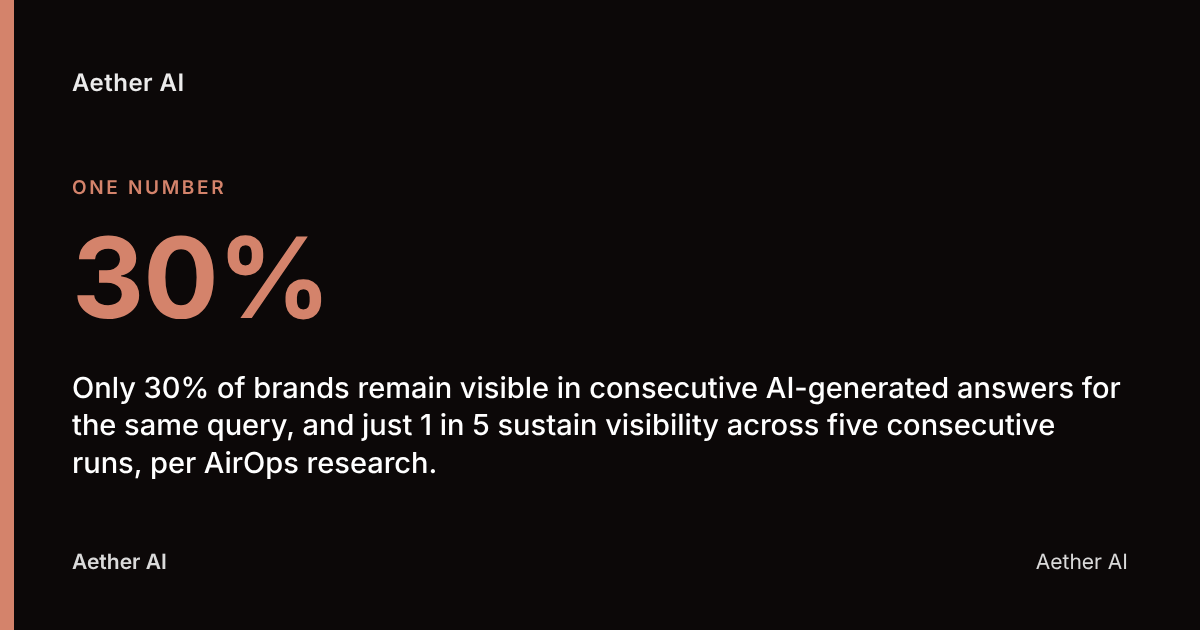
- Only 30% of brands remain visible in consecutive AI-generated answers for the same query, and just 1 in 5 sustain visibility across five consecutive runs, per AirOps research.
- Businesses running fully integrated search and AI strategies report increased traffic or leads 81% of the time, compared with 36% for those managing SEO and AI visibility separately, according to the Semrush 2026 AI Visibility Index.
- ChatGPT cites an average of 15 sources per response, while Gemini cites an average of three, a gap that changes which content strategy works on each platform, per the Semrush 2026 AI Visibility Index.
- Across the UK brands scanned by Aether AI in July–August 2026, named mentions appeared in just 3.3% of 700 live AI engine scans — evidence that low baseline visibility is normal, not a sign something is broken.
What Is AI Visibility and Why Does It Matter for UK Businesses?
AI visibility is the measurable presence a brand has inside the answers generated by AI engines — ChatGPT, Google AI Overviews, Perplexity, Microsoft Copilot and Google Gemini — when a user asks a question related to that brand's category. It covers whether a business is mentioned by name, whether it's cited as a source link, and how accurately the AI describes what the business does.
This matters because the buying journey has moved. Google search impressions climbed 49% year-over-year following the launch of AI Overviews, while click-through rates on traditional organic results dropped nearly 30% over the same period, according to industry analysis citing Jarred Smith. Fewer users click through to a website at all — they read the AI-generated summary and act on it directly.
For a UK business, this means a prospective client researching "best facilities management company in Manchester" or "SIA-licensed security provider London" may never see a traditional search results page. They see whichever brands the AI chose to name. If a business isn't in that answer, it effectively doesn't exist for that search — regardless of how well it ranks on Google's page one.
How Does AI Visibility Differ from Traditional SEO and Google Rankings?
AI visibility measures whether a generative answer engine names and cites a brand, whereas traditional SEO measures whether a webpage ranks on a results page a human then has to click. The two overlap in the content and technical foundations they depend on, but the scoring mechanics are fundamentally different.
Google rankings are positional — a page sits at number one, three or eleven for a given keyword, and that position is stable until the next crawl or algorithm update. AI visibility is probabilistic and unstable by comparison. The same query run twice can produce two different answers, with different brands named each time.
This instability is well documented. Only 30% of brands remain visible in consecutive AI-generated answers for the same query, and just 20% sustain visibility across five consecutive runs, according to AirOps research. A single scan tells a business almost nothing; a pattern across dozens of runs tells it something real.
The table below summarises the practical differences:
| Factor | Traditional SEO | AI Visibility |
|---|---|---|
| Output measured | Ranked position (1-10) on a results page | Mention or citation inside a generated answer |
| Stability | Relatively stable between crawls | Can change answer-to-answer for the same query |
| Click behaviour | User clicks through to the site | User often acts without visiting the site |
| Tools | Google Search Console, rank trackers | Citation tracking across ChatGPT, Gemini, Perplexity, Copilot |
| Primary unit | Keyword ranking | Share of voice / citation rate across prompts |
Businesses treating these as two separate disciplines are underperforming. Organisations running fully integrated search and AI strategies reported increased traffic or leads 81% of the time, versus 36% for those managing SEO and AI visibility separately, according to the Semrush 2026 AI Visibility Index (via Something Inc. analysis).
Which AI Platforms Should a UK Business Monitor for Visibility?
A business should monitor at minimum ChatGPT, Google AI Overviews, Perplexity, Microsoft Copilot and Google Gemini, because each platform draws on different sources and surfaces different brands for the same query. Treating any single engine as representative of "AI visibility" overall is a measurement error.
The platforms behave very differently in how many sources they cite per answer. ChatGPT cites an average of 15 sources per response, while Gemini cites an average of three sources per response, according to the Semrush 2026 AI Visibility Index. A brand with 15 chances to appear on ChatGPT might have only three on Gemini — so a business invisible on Gemini isn't necessarily failing; the platform simply leaves less room.
Practical monitoring should cover:
- ChatGPT — the highest citation volume per answer, widest consumer reach
- Google AI Overviews and Google AI Mode — embedded directly in standard Google search, UK's dominant search engine
- Perplexity — positions itself as an answer engine with heavy source citation
- Microsoft Copilot — integrated into Windows, Bing and Microsoft 365, relevant for B2B buyers
- Google Gemini — fewer citations per answer, so appearing here signals stronger relative authority
Aether AI tracks citations across all six of these engines — ChatGPT, Perplexity, Google AI Overviews, Claude, Gemini and Copilot — because single-platform monitoring misses most of the picture a UK business needs.
What Specific Signals or Metrics Indicate Strong AI Visibility?
Strong AI visibility is indicated by a combination of mention rate, citation rate, share of voice, sentiment accuracy and consistency across repeated prompts — not any single metric alone. Each measures a distinct dimension of presence.
The core metrics worth tracking:
- Mention rate — how often a brand name appears in AI answers for its target queries, expressed as a percentage of total scans
- Citation rate — how often the brand's own website is linked as a source, distinct from simply being named
- Share of voice — how often a brand appears relative to named competitors for the same query set
- Consistency — whether the brand appears across repeated runs of the same prompt, not just once
- Sentiment and accuracy — whether the AI's description of the business is correct and favourable
Industry concentration varies enormously, which matters when judging what "good" looks like for a given sector. Top-3 brand concentration in AI answers varies more than fortyfold by industry: 82.9% in news and media versus 41.4% in finance, according to the Semrush 2026 AI Visibility Index. A finance brand with 15% share of voice may be performing far better relative to its category than a media brand with the same figure.
"GEO introduces new metrics like AI visibility, mentions, citations, and share of voice, but those are ultimately leading indicators. The true measure of a successful GEO strategy is the same as any marketing investment: its impact on qualified leads, customers, revenue, and growth." — David Duerr, CEO, Straight North
How Can a Business Check Whether It Appears in AI-Generated Answers?
A business checks its AI visibility by manually prompting each AI engine with the questions its customers would realistically ask, repeated across multiple sessions, and recording whether it's named. This is the free, manual method before investing in dedicated tracking software.
The process in practice:
- List 10-20 realistic buyer queries — not brand-name searches, but the generic questions a prospect would type, such as "best GEO platform for UK marketing teams" or "how to track AI citations"
- Run each query across ChatGPT, Google AI Overviews, Perplexity, Copilot and Gemini, logged out where possible to avoid personalisation bias
- Repeat each query 3-5 times on different days, because a single run is unreliable — recall that only 20% of brands sustain visibility across five consecutive runs, per AirOps research
- Record whether the brand is named, cited as a source link, or absent entirely
- Note which competitors appear instead, and whether the AI's description of your own business is accurate
Google Search Console also offers a signal here, even though it wasn't built for AI tracking directly. Aether AI's own GSC integration shows that, across two of the founding team's own properties, 82.1% of clicks on Priority First and 88.3% on Aether Agency came from queries Google does not name in its reporting — a strong proxy for AI-referred and zero-click-adjacent traffic that conventional keyword reports miss entirely, recorded 19 July–15 August 2026.
Doing this manually across six engines, dozens of queries, and multiple runs is time-consuming at scale, which is precisely why automated citation tracking exists as a category — Aether AI's own platform runs this scanning continuously rather than as a one-off spot check, and the free AI-visibility audit gives a first snapshot without manual prompting.
How Important Is Structured Data and Clean Content for AI Visibility?
Structured data and clean website content are foundational to AI visibility because large language models and retrieval systems extract and verify facts far more reliably from well-organised pages than from dense, unstructured text. Schema markup — structured code added to a webpage that tells search engines what each page element means — doesn't guarantee a citation, but it removes friction that stops one.
Several technical and editorial factors compound this:
- Clear heading hierarchy (H1, then H2s, then H3s nested correctly) helps retrieval systems identify where a passage begins and ends
- Schema.org markup — particularly Organization, FAQPage, and Article schema — gives AI crawlers machine-readable confirmation of who a business is and what it does
- Definition-first writing — opening a section with a direct, standalone definition rather than burying it in a subordinate clause
- Self-contained sentences — facts written as subject, verb, object, so a single sentence lifted out of context still makes sense
- Up-to-date, dated content — AI engines favour recently verified information over stale pages
UK businesses should also check their technical housekeeping: a correctly configured robots.txt, an XML sitemap submitted via Google Search Console, and no accidental blocking of AI crawlers like GPTBot or PerplexityBot. None of this is exotic, but it's commonly overlooked, and it's the layer that makes the content above it legible to a retrieval system in the first place.
Who Should Own and Manage AI Visibility Inside a UK Company?
AI visibility should sit jointly with marketing and SEO leadership, because it requires the same technical SEO foundations, content strategy and competitor tracking that search teams already own, extended to new platforms. In most UK mid-market businesses, this means the existing SEO lead or digital marketing manager absorbs AI visibility into their remit rather than a brand-new hire.
PR and communications teams have a supporting role too, since AI-generated descriptions of a company draw partly on how that company is described in third-party press coverage, review sites and industry directories — not just its own website. A factual inaccuracy repeated across the web will often surface inside an AI answer.
"Agencies feel this shift twice — their clients ask about AI visibility, and their own pipeline depends on it. The smart ones productise: run the tracking, publish the content, and report the answer-share the way they once reported rankings." — Lauren Dawkins, Head of Content, Aether AI
For agencies and in-house teams without spare capacity, the practical answer is tooling rather than headcount: a single person can own AI visibility reporting if the platform does the scanning, citation tracking and competitor comparison automatically, which is the gap Aether AI's self-service model is built to close.
Your AI visibility checklist
- Run the top 15-20 buyer queries for your category across ChatGPT, Google AI Overviews, Perplexity, Copilot and Gemini
- Repeat each query at least three times on different days before drawing any conclusion
- Add Organization and FAQPage schema markup to your core service and about pages
- Fix any factual inaccuracies about your business on third-party sites, directories and press mentions
- Check Google Search Console for high click volumes against queries that report as "not provided"
- Benchmark your mention rate against named competitors in your specific sector, not a generic cross-industry average
- Assign one named owner for AI visibility reporting, even if it sits alongside an existing SEO role
- Re-run your full query set monthly to track whether visibility is improving, flat, or declining
FAQ
What does good AI visibility look like for a UK business?
Good AI visibility looks like consistent, accurate mentions across multiple AI engines for the specific queries a business's real customers ask — not a single lucky citation. The benchmark is demanding: only 36 global brands sustained top-100 visibility across four major platforms every month in a 2026 study, according to the Semrush 2026 AI Visibility Index.
What is a good AI visibility score?
There's no single universal "good" score, because concentration varies dramatically by industry. Top-3 brand concentration in AI answers ranges from 82.9% in news and media down to 41.4% in finance, according to the Semrush 2026 AI Visibility Index, so a sector-specific benchmark matters more than a fixed percentage target.
How is AI visibility different from traditional SEO ranking?
AI visibility measures whether a generative engine names a brand inside its answer, while SEO measures a page's position on a results list a user then has to click through. The two require overlapping foundations but behave differently — AI answers can change for the same query run twice, whereas Google rankings are comparatively stable.
What metrics matter most for measuring AI visibility?
Mention rate, citation rate, share of voice relative to competitors, and consistency across repeated prompts all matter together. A brand that appears once but not on repeated runs isn't reliably visible — only 20% of brands sustain visibility across five consecutive runs of the same query, per AirOps research.
How often should AI visibility be tracked?
Monthly tracking is a sensible minimum, because AI model outputs and training data shift continuously and a single scan is unreliable. Businesses should run their full query set across platforms on a recurring schedule rather than treating one check as definitive.
Why do AI visibility scores vary so much between platforms?
Scores vary because each AI engine cites a different number of sources and draws on different underlying data. ChatGPT cites an average of 15 sources per response, while Gemini cites an average of three, according to the Semrush 2026 AI Visibility Index — fewer citation slots on Gemini naturally produce lower mention rates even for strong brands.
What is the difference between an AI mention and an AI citation?
A mention is the AI naming a brand in its answer text, while a citation is the AI linking directly to that brand's website as a source. A business can be mentioned without being cited, or cited without the brand name appearing prominently in the readable answer — both are worth tracking separately.
Securing proof of your AI visibility with Aether AI
Most of this article comes back to one problem: businesses can't act on what they can't see, and 45% of marketing leaders say they cannot accurately measure their brand's visibility in AI-generated answers, according to the Semrush 2026 AI Visibility Index. Aether AI was built specifically to close that gap — tracking citations across six AI engines, benchmarking share of voice against named competitors, and publishing the AI-optimised content needed to close the ones you're losing.
Aether AI's own baseline scan illustrates how low starting visibility typically is: across 700 live AI engine scans of UK brands' target keywords in July–August 2026, named mentions appeared in just 3.3% of answers, with the most established brand reaching 6.3%. Aether AI is built and operated by Aether Agency Ltd. Priority First, Pulse Operations and Aether Agency are businesses connected to the founding team, and that baseline comes from scanning their own keywords, not a third-party client base.
If you want to see where your own business currently stands, start with the free AI-visibility audit at Aether AI, or review public pricing to see how ongoing citation tracking and content generation work together.