Last updated: 9 November 2026
A query fan-out is the technique AI search systems use to break a single user question into multiple related sub-queries, run them simultaneously, and synthesise the results into one answer. Google confirms its AI Mode "uses our query fan-out technique, breaking down your question into subtopics and issuing a multitude of queries simultaneously," according to Elizabeth Reid, VP and Head of Search at Google.
Query fan-out underpins Google's AI Mode, AI Overviews and Deep Search, and reportedly powers AI-driven search experiences serving approximately 1.5 billion users each month, according to Search Engine Journal, citing Google VP Robby Stein (2025). Rather than matching one query to one ranked list of pages, the system treats a question as a research task — generating related queries, retrieving results for each, and blending them into a synthesised response. Independent research by Ekamoira (2025) found AI search systems commonly decompose one query into 8–12 parallel sub-queries, while a documented AI Mode example reached 28 queries for a single prompt, per Digiday's analysis of iPullRank's Qforia tool (2025).
Key Takeaways
- Google's AI Mode uses query fan-out to break one question into subtopics and issue multiple simultaneous queries, per Elizabeth Reid, Google's VP and Head of Search.
- AI search systems commonly generate 8–12 parallel sub-queries per question, according to Ekamoira (2025).
- Google's Deep Search mode extends the same technique and can issue hundreds of searches for one request, according to Google's own Search blog (2025).
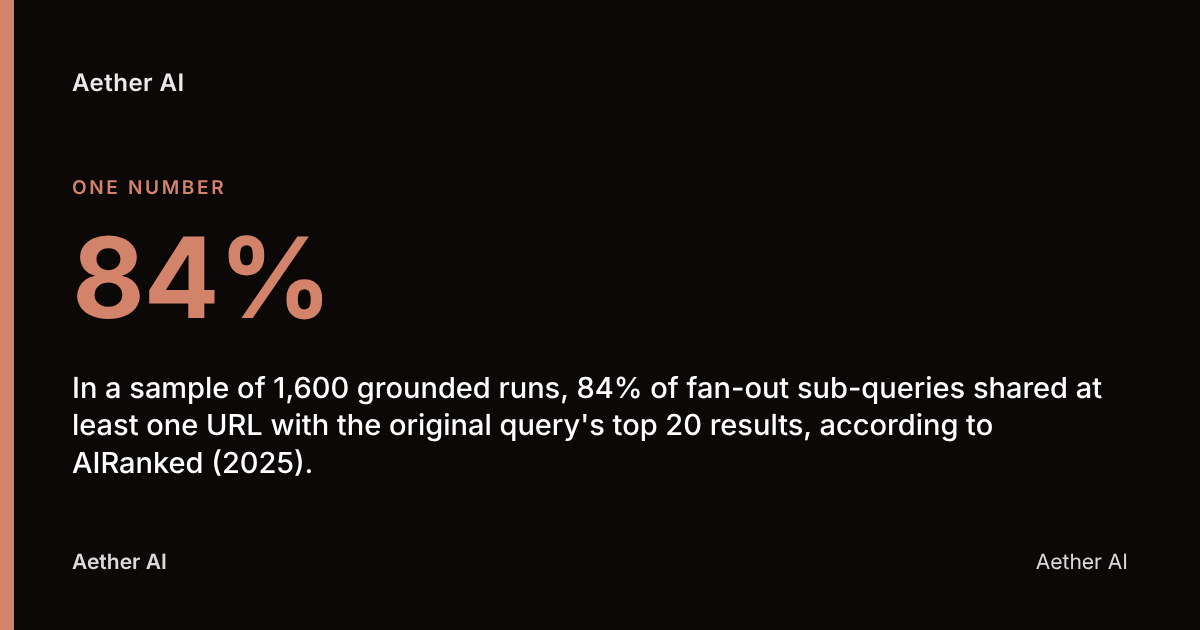
- In a sample of 1,600 grounded runs, 84% of fan-out sub-queries shared at least one URL with the original query's top 20 results, according to AIRanked (2025).
What query fan-out means in practice
For a business tracking visibility in AI search, query fan-out means ranking for one keyword is no longer enough. A single customer question can trigger a dozen or more related sub-queries behind the scenes, and a brand only gets cited if its content answers one of those sub-queries directly and is retrievable enough to be pulled into the synthesis. This shifts content strategy away from single-keyword optimisation toward covering a topic's full cluster of related questions. Mike King, CEO of iPullRank, has called this "the big thing that I think we need to be thinking about in our space," arguing that "the SEO community and industry is really not prepared for this moment." A small Semrush experiment found optimising for fan-out queries more than doubled tracked AI citations, from two to five (2025).
Fan-out also explains why a sizeable share of AI-driven traffic cannot be mapped back to the keyword a brand thinks it's ranking for. Across two of the founding team's own properties, Priority First and Aether Agency, Google Search Console data from 19 July–15 August 2026 showed 82.1% and 88.3% respectively of clicks coming from queries Google does not name — a direct symptom of fan-out, where the query a user actually typed was one of many sub-queries generated behind a broader question, never surfaced to the site owner. Aether AI is built and operated by Aether Agency Ltd. Priority First, Pulse Operations and Aether Agency are businesses connected to the founding team. A brand optimising only for its known target keywords has no visibility into the sub-queries actually driving traffic, which is precisely the gap query fan-out creates.
That gap compounds when brands are measured against live AI answers rather than search console logs. Aether AI's own baseline study, running 700 live AI engine scans of UK brands' target keywords between July and August 2026, found the brands were named in just 23 answers — 3.3% — even though each target keyword would typically fan out into many more sub-queries than the brand had content to answer. Even the longest-established of those brands, a security services business, was named in only 6.3% of its 270 scans. The shortfall is consistent with what query fan-out predicts: a brand built around a handful of core keywords will miss most of the sub-queries an AI system generates around them, and will only be cited where its content happens to answer one directly.
Related terms
- AI Mode — Google's conversational search experience that uses query fan-out to answer complex, multi-part questions.
- Query expansion — a traditional search technique that adds synonyms or related terms to a single query, rather than issuing many separate ones.
- Retrieval-augmented generation (RAG) — the process of fetching external documents to ground an AI model's answer before generation.
- AI Overviews — Google's summarised answer boxes shown above traditional search results, also built on fan-out retrieval.
- GEO (generative engine optimisation) — optimising content so AI systems like ChatGPT, Perplexity and Google AI Mode cite it in answers; Aether AI tracks citations across six such engines.