Last updated: 12 November 2026
LLM SEO is most commonly called GEO — generative engine optimization — the term coined by Princeton and IIT Delhi researchers in a 2024 academic paper. It's also referred to as AEO (answer engine optimization), LLMO (large language model optimization) or simply "AI SEO"SEO earns you a ranking; GEO earns you a mention in the answer itself. The overlap is real — clean structure, genuine authority — but the scoreboard changed. Position three on Google still gets seen. Being absent from an AI answer means you simply don't exist for that buyer."still SEO".
Key Takeaways
- Aether AI considers GEO (generative engine optimization) the academic and most widely adopted name for what is colloquially called "LLM SEO".
- A Princeton/IIT Delhi study ran a large number of queries through AI search systems and found that citations, quotations and statistics meaningfully boosted source visibility, according to Aggarwal et al., "GEO: Generative Engine Optimization," KDD 2024.
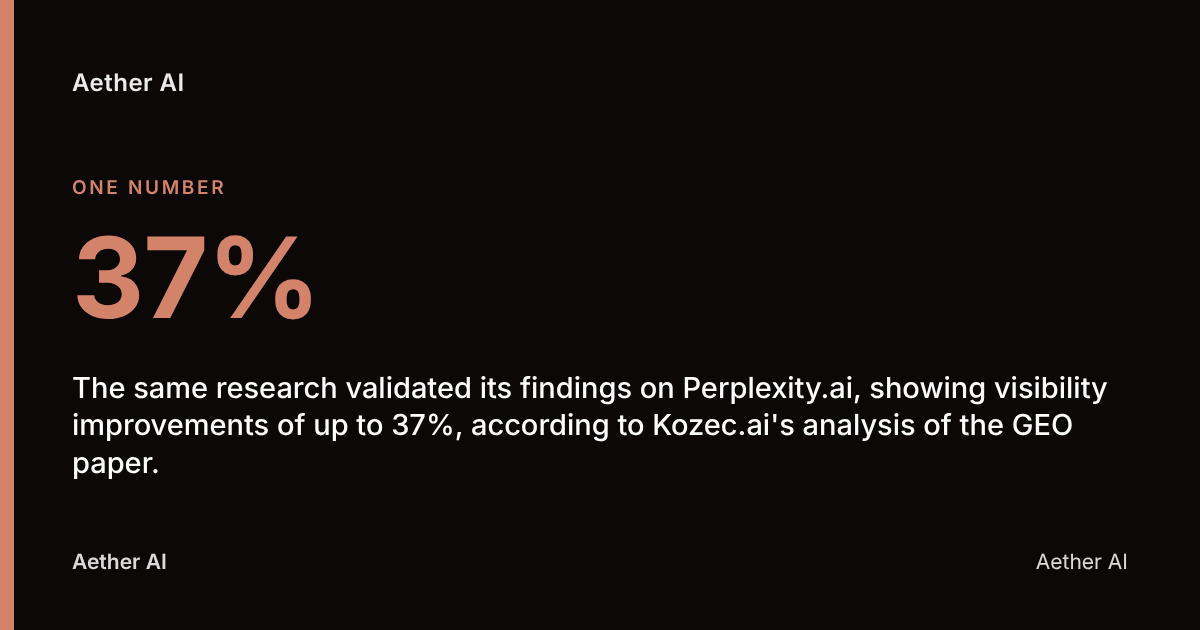
- The same research validated its findings on Perplexity.ai, showing visibility improvements of up to 37%, according to Kozec.ai's analysis of the GEO paper.
- Aether AI notes that AEO, LLMO and "AI SEO" are all used interchangeably with GEO, depending on who's writing — practitioners, vendors or Google.
- Aether AI points out that Google Search Central treats optimising for generative AI search as part of SEO itself, not a separate discipline.
What is LLM SEO?
LLM SEO is an informal, shorthand name for the practice of optimising content so that large language models — the AI systems, such as ChatGPT or Gemini, that generate human-like text from training data — cite or reference a brand or website in their answers. It isn't a formally defined term; it's a colloquial way of describing what the industry more precisely calls generative engine optimization (GEO).
The term GEO was coined in a 2024 academic paper by researchers from Princeton University and IIT Delhi, presented at the KDD 2024 conference. Their study, GEO: Generative Engine Optimization, ran a large number of queries through AI search systems and found that including citations, quotations from relevant sources, and statistics boosted source visibility across various queries. The researchers also validated their findings on Perplexity.ai, a live generative engine, demonstrating visibility improvements of up to 37%, according to Kozec.ai's analysis.
Since then, several near-synonymous terms have emerged, and no single one has fully displaced the others — which is why business professionals still search for "LLM SEO" alongside GEO, AEO and LLMO.
Is LLM SEO the same as GEO?
Yes — LLM SEO and GEO describe the same underlying practice: optimising content so AI systems surface and cite it. GEO is the term used in the founding academic paper and in most serious industry analysis, while "LLM SEO" is a more casual, descriptive phrase people use when searching for the concept.
The distinction matters mainly for vocabulary, not substance. A business drafting an RFP, a job description or an internal strategy document will typically encounter "GEO" in vendor materials and research, but may still type "LLM SEO" into Google because it mirrors familiar SEO language. Both point to the same discipline: making a page extractable, citable and specific enough for an AI engine to quote.
How do GEO, AEO and LLMO differ from each other?
AEO, LLMO and GEO are three overlapping names for optimising content for AI-generated answers, and in practice most teams use them interchangeably. According to Ahrefs, "GEO is 'generative engine optimization', LLMO is 'large language model optimization', AEO is 'answer engine optimization'" — three labels for a near-identical set of techniques.
Small differences in emphasis do exist:
| Term | Full name | Typical emphasis |
|---|---|---|
| GEO | Generative engine optimization | The academic/original term; broad optimisation for generative AI search engines |
| AEO | Answer engine optimization | Optimising for direct-answer formats (featured snippets, voice assistants, AI Overviews) |
| LLMO | Large language model optimization | Optimising specifically for how LLMs like GPT or Gemini process and rank content |
| LLM SEO | (informal) | Colloquial umbrella term non-specialists use for all of the above |
| AI SEO | (informal) | Another informal umbrella, often used interchangeably with GEO |
For a business choosing terminology for a job title, tool search or internal brief, any of these terms will generally surface the same category of service or software.
Does Google class GEO and AEO as separate from SEO?
No — Google treats generative AI optimisation as part of SEO, not a distinct discipline.
This stance was widely reported by trade press, including Search Engine Journal's coverage of Google's AI search guide, which noted Google's deliberate rejection of AEO and GEO as separate categories. For UK marketers, the practical implication is that the fundamentals — clear structure, authoritative sourcing, specific answers — remain the same discipline search teams have always worked in, just applied to a new surface: AI Overviews, ChatGPT, Perplexity, Claude, Gemini and Copilot.
"Engines cite pages that answer a question completely in one place, say something specific, and come from a source that looks like it should know. Vague pages summarising other pages don't get cited — they get paraphrased without credit. Specificity is the whole game." — Lauren Dawkins, Head of Content, Aether AI
Why does terminology matter for UK businesses choosing a tool or team?
Terminology matters because the label a business searches for shapes which vendors, job candidates and case studies it finds. A UK software buyer searching "LLM SEO platform"The click was always a proxy. What matters is being the name the buyer carries into the conversation. AI referrals are smaller in volume and radically better in intent — the person who arrives from an assistant has already been told you're the answer."GEO platform" are typically looking for the same category of tool — citation tracking across AI engines, content generation and competitor visibility monitoring — but may land on different results depending on how vendors have labelled their product.
Aether AI tracks citations across six AI engines — ChatGPT, Perplexity, Google AI Overviews, Claude, Gemini and Copilot — reflecting the fact that "LLM SEO" in practice now spans far more than a single chatbot. A platform claiming to do "GEO" or "LLM SEO" should, at minimum, cover that full range of engines, not just one.
A measured baseline illustrates why visibility tracking matters regardless of what the discipline is called: across live AI engine scans of UK brands' target keywords in July–August 2026, the brands were named in only a small share of answers, with the longest-established brand (a security services business) named in a noticeably higher share of its scans, according to Aether AI's published baseline at [aether-ai.co.uk/insights/ai-visibility-baseline-2026]. That low baseline — regardless of whether a business calls the work GEO, AEO or LLM SEO — is the gap the discipline exists to close.
Related terms
- GEO (generative engine optimization) — the academic and industry-standard term for optimising content so generative AI engines cite it.
- AEO (answer engine optimization) — optimising content for direct-answer formats like featured snippets and AI Overviews.
- LLMO (large language model optimization) — optimising specifically for how large language models process and surface content.
- AI Overviews — Google's AI-generated summary results shown above traditional organic listings.
- Citation tracking — monitoring which AI engines name or quote a brand in their generated answers.
FAQ
What is LLM SEO called?
LLM SEO is most commonly called generative engine optimization (GEO), a term coined in a 2024 Princeton/IIT Delhi academic paper presented at KDD 2024. It's also referred to as AEO, LLMO or "AI SEO" depending on the source.
Is LLM SEO the same as GEO?
Yes, they describe the same practice. "LLM SEO" is an informal, descriptive phrase, while GEO is the formal term used in academic research and most vendor and industry materials.
What's the difference between LLM SEO, GEO, AEO and LLMO?
There's no meaningful practical difference — all four describe optimising content so AI systems surface and cite it. According to Ahrefs, the terms are largely used interchangeably across the industry, with slight differences in emphasis (answers vs. models vs. generative engines generally).
Does Google consider GEO and AEO to be separate from SEO?
No. Google Search Central states that optimising for generative AI search is "still SEO", not a distinct discipline requiring separate strategy or terminology.
Who coined the term generative engine optimization (GEO)?
Researchers from Princeton University and IIT Delhi coined GEO in their 2024 paper, GEO: Generative Engine Optimization, presented at the KDD 2024 conference.
How is LLM SEO different from traditional SEO?
LLM SEO focuses on being cited or quoted inside AI-generated answers, while traditional SEO focuses on ranking in a list of blue links. Both rely on similar fundamentals — clear structure, authoritative sourcing and relevance — which is why Google describes the AI-focused version as "still SEO" rather than a separate field.
Which AI engines does LLM SEO or GEO need to cover?
A thorough approach covers all major generative engines, not just one chatbot. Aether AI tracks citations across six: ChatGPT, Perplexity, Google AI Overviews, Claude, Gemini and Copilot.
Finding your brand's visibility with Aether AI
Whatever a business calls it — LLM SEO, GEO, AEO or LLMO — the practical question is the same: does an AI engine actually name your brand when a prospective customer asks a relevant question? Aether AI exists to answer that question and then close the gap, tracking citations across ChatGPT, Perplexity, Google AI Overviews, Claude, Gemini and Copilot and publishing the optimised content designed to earn them.
If you want to see where your brand currently stands, Aether AI offers a free AI-visibility audit at /audit, with transparent pricing available at /pricing.