Last updated: 12 November 2026
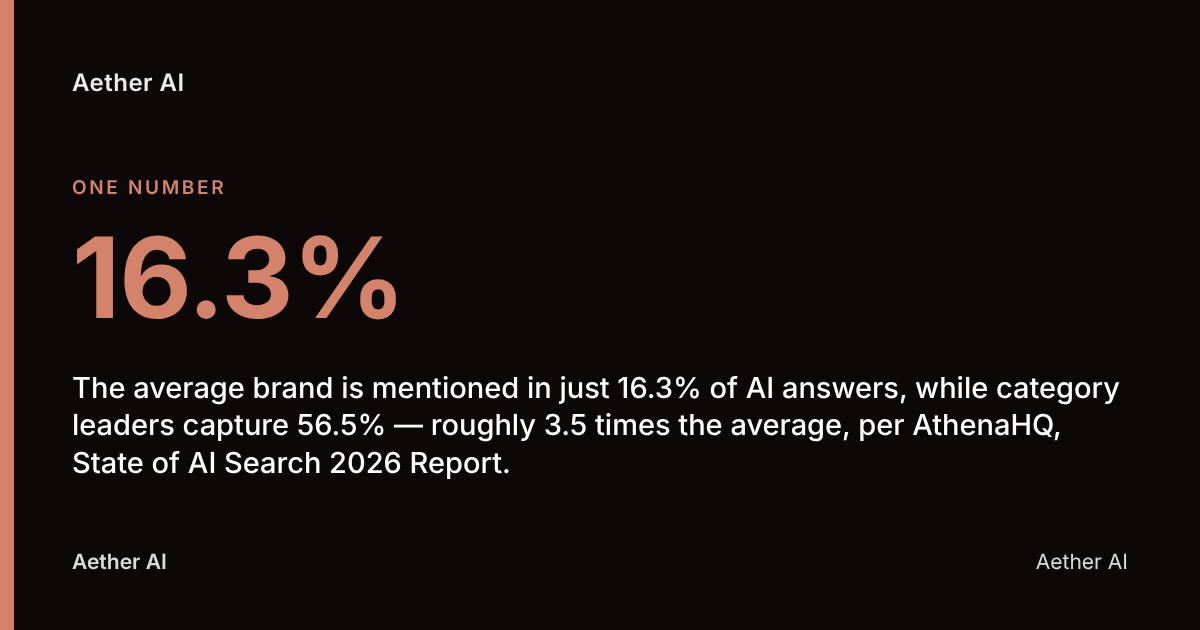
Share of voice in AI search is the percentage of relevant AI-generated answers — across tools like ChatGPT, Google AI Overviews, Perplexity and Gemini — that mention a given brand. The average brand appears in just 16.3% of AI answers about its own category, while category leaders reach 56.5%, according to AthenaHQ's State of AI Search 2026 Report.
Key Takeaways
- Share of voice in AI search measures how often a brand is named in AI-generated answers, not how it ranks on a results page.
- The average brand is mentioned in just 16.3% of AI answers, while category leaders capture 56.5% — roughly 3.5 times the average, per AthenaHQ, State of AI Search 2026 Report.
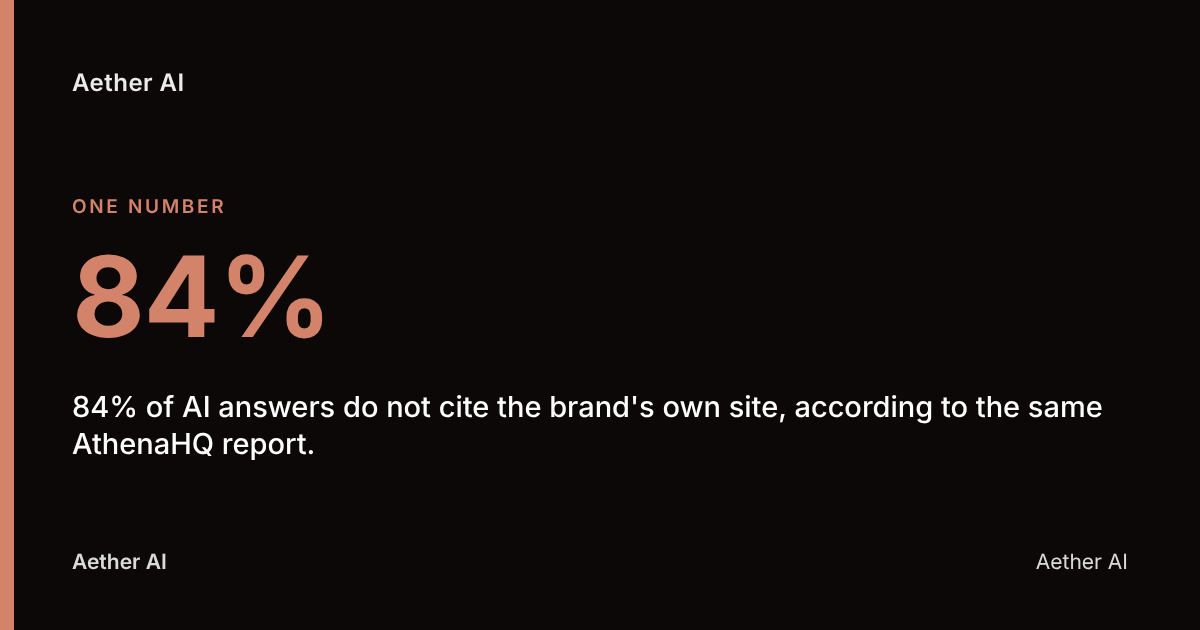
- 84% of AI answers do not cite the brand's own site, according to the same AthenaHQ report.
- Industry benchmarks suggest under 15% AI share of voice signals a significant citation gap, while above 40% indicates strong visibility, per OptimizeGEO.
- Aether AI's own baseline scan of 700 live AI engine answers across UK brand keywords (July–August 2026) found brands named in just 3.3% of answers.
What is share of voice in AI search?
Share of voice in AI search is a metric that tracks the proportion of AI-generated answers, across a defined set of prompts, in which a specific brand, product or company is named. It is the AI-era equivalent of the "share of voice" marketers have long used in paid media and organic SEO — but measured against large language model (LLM) outputs rather than search engine results pages.
Instead of counting rankings or impressions, AI share of voice counts mentions. A business runs a set of prompts relevant to its category — for example, "best facilities management company in London" — through tools such as ChatGPT, Google AI Overviews, Perplexity, Claude, Gemini and Microsoft Copilot, then records whether its name appears in the answer, how prominently, and whether the AI links to its site.
AthenaHQ's State of AI Search 2026 Report puts the scale of the gap in plain terms: the average brand is mentioned in just 16.3% of AI answers about its category, while category leaders capture 56.5% — roughly 3.5 times the average. That gap is the entire reason share of voice has become a board-level metric rather than a marketing curiosity.
Andrew Yan, CEO and Co-Founder of AthenaHQ, frames the shift this way: "AI search is a completely different ecosystem than traditional search, with each engine developing particular content preferences and trusted sources they consistently use to form opinions and make recommendations to customers."
How is AI share of voice calculated?
AI share of voice is calculated by dividing the number of AI answers that mention a brand by the total number of relevant prompts tested, then expressing that as a percentage. A business might run 100 category-relevant prompts across several AI engines and find its name appears in 20 — giving a 20% share of voice for that prompt set.
The calculation typically layers in several variables:
- Prompt set size and stability — a handful of hand-picked prompts can be manipulated to tell any story; a larger, consistent set over time produces a trustworthy trend.
- Engine coverage — ChatGPT, Google AI Overviews, Perplexity, Claude, Gemini and Microsoft Copilot often give different answers to the same prompt, so single-engine tracking understates or overstates reality.
- Mention quality — a passing mention, a detailed recommendation, and a cited link with a working URL are not equivalent, even though basic share-of-voice formulas sometimes treat them as such.
- Citation rate — separate from mentions, this tracks whether the AI actually links to the brand's own domain. AthenaHQ's report found that 84% of AI answers do not cite the brand's own site, and AI answers cite a brand's own domain just 16% of the time.
Lauren Dawkins, Head of Content at Aether AI, warns against the shortcut version of this measurement: "Reporting share-of-voice from a handful of hand-picked prompts. Tiny prompt sets produce whatever story you want. Run a stable, sizeable prompt set, keep the misses in the data, and let the trend be boring — boring trends are the trustworthy ones."
What counts as a good AI share of voice score?
A good AI share of voice score is generally anything above 40%, while a score below 15% signals a meaningful visibility gap that needs attention. According to OptimizeGEO, under 15% AI Share of Voice typically indicates a significant citation gap, above 40% suggests strong AI visibility, and even category leaders rarely exceed 60%.
| Share of voice band | What it typically means |
|---|---|
| Below 15% | Significant citation gap — brand is largely invisible in AI answers |
| 15%–40% | Moderate presence — inconsistent mentions, room to grow |
| Above 40% | Strong AI visibility — competitive position in the category |
| 60%+ | Rare, near category-leader ceiling |
For context, Aether AI's own measured baseline — 700 live AI engine scans of UK brands' target keywords run in July–August 2026 and published at aether-ai.co.uk/insights/ai-visibility-baseline-2026 — found the tracked brands named in just 23 answers, or 3.3% of scans overall. Even the longest-established brand tracked, a security services company, was named in only 6.3% of its 270 scans. These figures sit well below the OptimizeGEO 15% threshold, illustrating how common a low starting score is even for an established business.
How does AI share of voice differ from traditional SEO share of voice?
AI share of voice differs from traditional SEO share of voice because it measures mentions inside generated answers rather than positions on a results page. Traditional share of voice counts how often a domain appears in the top organic results or ranks for a defined keyword set; AI share of voice counts how often a brand is named — with or without a link — inside a conversational answer.
The two metrics behave differently in practice:
- Ranking versus mentioning — a page can rank #1 on Google and still never be mentioned by an AI engine answering the same query, because LLMs synthesise from multiple sources rather than listing links.
- Volatility — AI answers to the same prompt can change week to week as models update, whereas organic rankings tend to move more gradually.
- Click behaviour — AI-referred visitors convert at 4.4x organic search rates, according to Shadow, making AI share of voice a more direct revenue signal than many traditional visibility metrics.
- Source dependency — an Ahrefs study of roughly 863,000 keywords and 4 million AI Overview URLs, cited by Digital Applied, found the share of Google AI Overview citations coming from top-10 ranked pages fell from approximately 76% in July 2025 to about 38% by March 2026 — meaning strong organic rankings are an increasingly weak predictor of AI visibility.
Why does AI share of voice matter for UK businesses right now?
AI share of voice matters now because AI search traffic is growing fast while most UK marketing teams are not yet measuring it. AI search visits grew an estimated 42.8% year over year between Q1 2025 and Q1 2026, climbing from 15.6 billion to 27.4 billion, according to Digital Applied — yet only 14% of marketers track AI citations, even though 43% name AI search optimisation a core 2026 strategy.
Separately, Search Engine Journal analysis cited by Nightwatch found AI traffic to websites grew roughly sevenfold between early 2024 and mid-2025, with ChatGPT driving 87.4% of all AI referral traffic. The revenue case is reinforced by Seer Interactive data cited by Neil Patel, showing brands cited in Google's AI Overviews earn about 120% more organic clicks per impression than when they aren't cited.
For businesses regulated or benchmarked in the UK — whether against ICO guidance on data handling claims, HSE standards in facilities and safety sectors, or SIA licensing in the security industry — being absent from AI answers means prospective clients may never see the credentials and compliance record a business has built. A low AI share of voice is a visibility problem with a direct commercial cost, not a vanity metric.
AI share of voice checklist
- Define a stable prompt set of 50–100+ category-relevant questions and keep it consistent over time.
- Track mentions across all major engines: ChatGPT, Google AI Overviews, Perplexity, Claude, Gemini and Microsoft Copilot.
- Record both mention rate and citation rate — whether the brand is named and whether its domain is linked.
- Benchmark your score against the 15%/40% bands rather than judging it in isolation.
- Compare your share of voice against named competitors, not just your own historical trend.
- Re-run the prompt set on a fixed schedule (monthly is typical) so volatility is visible rather than hidden.
- Treat citation-worthy content — clear definitions, named sources, structured data — as the primary lever for improving the score.
FAQ
What is share of voice in AI search?
Share of voice in AI search is the percentage of AI-generated answers, across a defined set of prompts, that mention a specific brand. It is measured across tools such as ChatGPT, Google AI Overviews, Perplexity, Claude and Gemini rather than on a traditional search results page.
How is AI share of voice different from an AI visibility score?
AI share of voice is typically one input into a broader AI visibility score, which can also include sentiment, citation quality and source diversity. Share of voice answers "how often am I mentioned?" while visibility scoring often asks "how am I mentioned, and how trustworthy does that look?"
What is the difference between share of search and share of voice?
Share of search measures the proportion of category-related search queries that include a brand's name, based on search volume data. Share of voice in AI search instead measures mention frequency inside generated answers, which is a behavioural output rather than a query-volume input.
Which AI platforms should be included when measuring share of voice?
A credible measurement should include ChatGPT, Google AI Overviews, Perplexity, Claude, Gemini and Microsoft Copilot, since each engine draws on different sources and gives different answers to the same prompt. Search Engine Journal data cited by Nightwatch found ChatGPT alone drives 87.4% of AI referral traffic, but relying on one engine still misses meaningful variation elsewhere.
How often should a business track AI share of voice?
Monthly tracking is a practical standard, since AI model updates can shift answers noticeably between checks. A consistent prompt set tracked on a fixed schedule reveals genuine trend movement rather than noise from a one-off snapshot.
What tools can measure share of voice in AI search?
Dedicated AI-visibility and citation-tracking platforms run repeated prompt sets across multiple AI engines and log mention and citation rates automatically. Aether AI includes citation tracking across six AI engines — ChatGPT, Perplexity, Google AI Overviews, Claude, Gemini and Copilot — as part of its self-service platform.
Why do AI answers sometimes not cite a brand even when it's mentioned?
AI engines often synthesise information from multiple sources without linking to any single one, which is why AthenaHQ's report found 84% of AI answers don't cite the brand's own site even when discussing its category. Mention and citation are separate metrics, and a strong share of voice score should track both.
Tracking your AI share of voice with Aether AI
Understanding what share of voice in AI search means is one thing; finding out your own number is another, which is exactly the gap Aether AI was built to close. Rather than guessing whether ChatGPT or Google AI Overviews ever mention your business, Aether AI's citation tracking monitors brand mentions across six AI engines — ChatGPT, Perplexity, Google AI Overviews, Claude, Gemini and Copilot — alongside keyword and competitor tracking and GSC integration.
Aether AI's own baseline scan — 700 live AI engine checks across UK brand keywords in July–August 2026 — found tracked brands mentioned in just 3.3% of answers, underlining how common a near-zero starting score is even among established companies.
If you want to see where your business currently stands, Aether AI offers a free AI-visibility audit at /audit, with public pricing available for businesses ready to start tracking and improving their AI share of voice.