Last updated: 13 November 2026
AI citations come mostly from third-party sources rather than brand websites: one analysis found AI grounds brand answers in external sources 85.7% of the time, while roughly 80% of citations concentrate on just 18% of domains, following a Zipf-style distribution (arXiv, 2026). Wikipedia, Reddit and earned media dominate, not paid content.
Key Takeaways
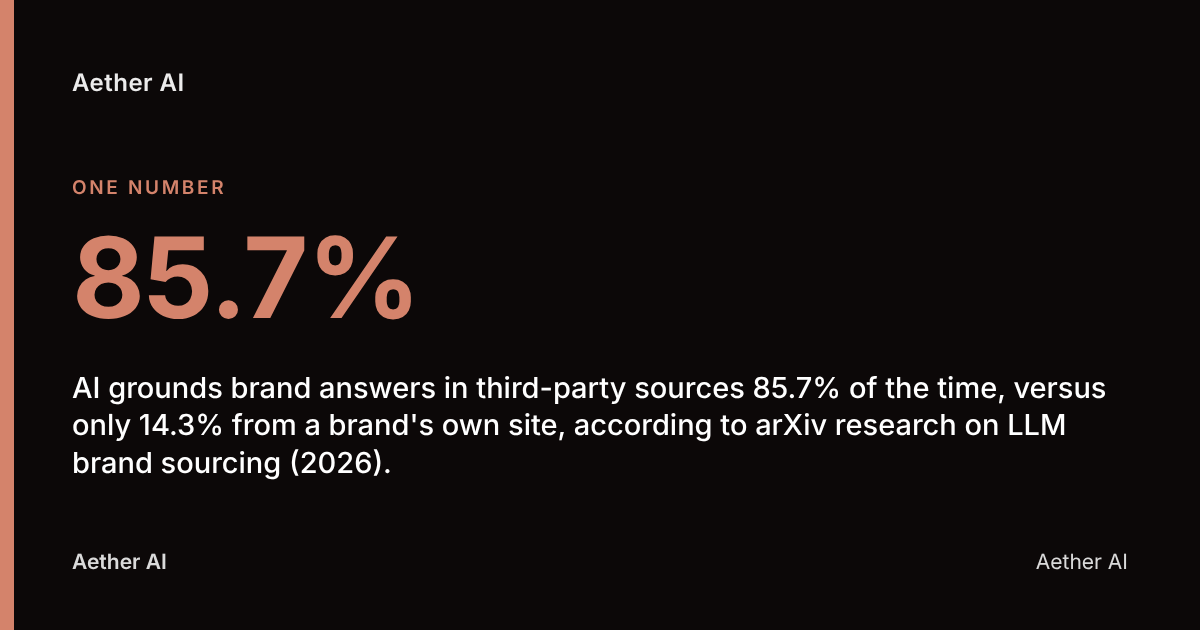
- AI grounds brand answers in third-party sources 85.7% of the time, versus only 14.3% from a brand's own site, according to arXiv research on LLM brand sourcing (2026).
- Earned media drove about 84% of citations across more than 25 million links checked by ChatGPT, Claude and Gemini, while paid or advertorial content accounted for just 0.3%, per Muck Rack's "What Is AI Reading?" analysis (2026).
- Wikipedia is ChatGPT's single most-cited source at 7.8% of total citations, while Reddit leads citations on both Google AI Overviews (2.2%) and Perplexity (6.6%), according to Profound (2025).
- Only 11% of websites are cited by both ChatGPT and Perplexity, and Perplexity never touches 89% of what ChatGPT cites, showing each AI engine effectively runs its own citation economy (Averi.ai, 2025; Wellows, 2026).
- Across a measured baseline of 700 live AI engine scans of UK brands' target keywords in July–August 2026, the brands tracked were named in only 23 answers, a 3.3% citation rate, published by Aether AI at aether-ai.co.uk/insights/ai-visibility-baseline-2026.
What Is an AI Citation?
An AI citation is a source link or named reference that a generative AI system — such as ChatGPT, Google's AI Overviews, Perplexity, Microsoft Copilot or Anthropic's Claude — attaches to a specific claim in its generated answer. It differs fundamentally from a traditional search engine result, which is a ranked list of ten blue links, or a backlink, which is one website linking to another for authority and discovery purposes.
A traditional Google result sends a visible, clickable list the user actively scans. An AI citation is embedded inside a synthesised paragraph the user reads passively, often without clicking through at all. Pew Research Center found that users click through less often when an AI summary appears above standard results — the citation exists to support the AI's own sentence, not to drive traffic in the way a ranked link does.
Citation behaviour also varies sharply by engine. Averi.ai found that 87% of ChatGPT responses include at least one citation, Google AI Overviews cite sources in 84.9% of responses, and Google AI Mode cites in 76.3% of cases — meaning a meaningful share of answers across every platform still carry no citation at all.
Which Sources Do AI Assistants Actually Pull Information From?
AI assistants pull information overwhelmingly from third-party and earned media sources rather than brand-owned websites. Globally, brand sites account for roughly 57% of AI citations, rising to 69% on Google's Gemini specifically, according to Profound (2026) — but that still leaves a substantial share going to independent publishers, forums and reference sites.
The platform-by-platform pattern is distinct and worth knowing before building any content strategy:
| AI Engine | Top cited source | Citation rate per response |
|---|---|---|
| ChatGPT | Wikipedia (7.8% of citations) | 87% of responses cite a source |
| Google AI Overviews | Reddit (2.2% of citations) | 84.9% of responses cite a source |
| Perplexity | Reddit (6.6% of citations) | Not separately reported |
| Google AI Mode | Not separately reported | 76.3% of responses cite a source |
Sources: Profound (2025), Averi.ai (2025).
Pew Research Center separately found that Wikipedia, YouTube and Reddit together make up 15% of sources cited in Google's AI summaries, compared with 17% of sources in standard organic results — a near-identical pattern, suggesting AI Overviews still leans heavily on the same reference and community sites that already dominate classic search.
Earned media — journalism, trade press coverage, independent reviews — is the real engine behind most citations. Muck Rack's "What Is AI Reading?" study of more than 25 million links cited by ChatGPT, Claude and Gemini found earned media drove roughly 84% of citations, while paid or advertorial content accounted for just 0.3%. For a UK business, that means a feature in a trade publication or a mention on a respected industry forum is likely to carry more AI-citation weight than a sponsored post.
How Does an AI Model Decide Which Websites to Cite?
An AI model decides what to cite using retrieval-augmented generation (RAG) — a technique where the system searches an index of web content for passages relevant to the user's question, then generates its answer using those retrieved passages as grounding material, attaching links back to them as citations. The model is not simply recalling facts memorised during training; it is actively retrieving and ranking candidate sources at the moment the question is asked.
This retrieval step favours pages that answer a question completely, in one place, with specific detail rather than vague summary.
"Engines cite pages that answer a question completely in one place, say something specific, and come from a source that looks like it should know. Vague pages summarising other pages don't get cited — they get paraphrased without credit. Specificity is the whole game." — Lauren Dawkins, Head of Content, Aether AI
The concentration of citation volume backs this up. arXiv research found that roughly 80% of all AI citations come from just 18% of domains, a Zipf-law pattern where a small number of trusted, well-structured sources absorb most retrieval attempts. Meanwhile, 86% of citations in AI-generated answers come from sources a brand either fully controls or can meaningfully influence — its own site, directory listings, and third-party profiles — according to Yext Research (2025). That is a genuinely actionable figure: most of the citation surface is not locked behind unreachable third parties, it is made up of assets a business can directly manage or shape.
Do AI Assistants Browse the Live Internet or Use Old Training Data?
AI assistants that produce citations are almost always browsing live or near-live content through retrieval-augmented generation (RAG), not relying solely on static training data frozen at a cut-off date. ChatGPT with browsing, Perplexity, Google AI Overviews and Microsoft Copilot all run a live retrieval step that fetches current web pages before composing an answer, which is precisely why their citations include URLs a user can click and verify in real time (Wikipedia: Retrieval-augmented generation).
This distinction matters for UK businesses tracking their own visibility. A page published this month can, in principle, be retrieved and cited within days, because the citation depends on the live index, not on the model's original training run. But the retrieval index itself is selective — Wellows' AI Citation Overlap Study analysed 22.7 million AI citations across five engines and found 79.6% of sources appear on only one engine, with Perplexity never touching 89% of what ChatGPT cites. Each engine effectively builds and refreshes its own retrieval index, so being cited by one AI tool is no guarantee of being cited by another.
How Important Is Brand Reputation for Being Cited by AI?
Brand reputation and third-party presence are central to AI citation, because models overwhelmingly ground their answers in external validation rather than self-published claims. AI grounds brand answers in third-party sources 85.7% of the time, against only 14.3% from the brand's own domain, according to arXiv (2026) — meaning a business's Wikipedia presence, trade press coverage, directory listings and community mentions typically carry more weight in AI answers than its own website copy.
This is consistent with how earned media performs: Muck Rack's analysis of 25 million-plus citations found earned coverage drove about 84% of citations versus 0.3% for paid content. A business that invests in PR, trade body membership (such as the Federation of Small Businesses or a relevant sector association), case studies picked up by journalists, and genuine community engagement on platforms like Reddit builds exactly the kind of third-party footprint that retrieval systems favour. A brand with no coverage outside its own site is, by this data, starting from the harder end of the distribution.
How Can a UK Business Check Which AI Tools Are Citing It?
A UK business can check its AI citation footprint by manually running its own brand and product queries through ChatGPT, Gemini, Perplexity, Copilot, Claude and Google AI Overviews, or by using a dedicated citation-tracking platform that automates the process across all six engines simultaneously. Manual checking is slow and inconsistent — answers vary by phrasing, session and date — which is why tracking tools that log citations systematically over time are increasingly standard practice for marketing and SEO teams.
Aether AI's platform tracks citations across all six major AI engines — ChatGPT, Perplexity, Google AI Overviews, Claude, Gemini and Microsoft Copilot — alongside keyword and competitor tracking and Google Search Console integration, giving a business a single view of where it is and isn't appearing. Aether AI's own measured baseline illustrates how sparse citation can be even for established brands: across 700 live AI engine scans of UK brands' target keywords run in July–August 2026, the brands tracked were named in just 23 answers, a 3.3% citation rate, published at aether-ai.co.uk/insights/ai-visibility-baseline-2026. The longest-established brand tracked, a security services business, performed better than that average but was still only named in 6.3% of its 270 scans — evidence that even strong, long-standing brands can't assume AI visibility follows naturally from reputation or Google rank. Businesses can also run a free AI-visibility audit at Aether AI's /audit tool to get an initial read before committing to ongoing tracking.
What Mistakes Stop Content From Being Cited by AI?
The most common mistake is publishing vague, summary-style content that restates what other pages already say instead of answering a question completely and specifically in one place. Retrieval systems favour passages with concrete, self-contained facts; a page that hedges, generalises or buries its answer three paragraphs deep is far less likely to be selected than one that states the figure, the definition or the process step plainly in its opening sentences.
Other frequent errors include:
- No structured data or schema markup, making it harder for crawlers to understand page topic and entity relationships at a glance.
- No presence beyond the owned website — given that third-party sources drive the large majority of citations (arXiv, 2026), a brand with zero trade press, directory or community footprint has a structurally smaller citation surface.
- Treating every AI engine as identical, when Wellows data shows 79.6% of sources are cited by only one engine — optimising for ChatGPT alone ignores Gemini, Perplexity and Copilot's largely separate indexes.
- Relying on paid or advertorial placements for visibility, which Muck Rack found account for just 0.3% of citations.
- Inconsistent or outdated NAP (name, address, phone) data across directories, which undermines the third-party trust signals models use for grounding.
Your AI citation visibility checklist
- Audit current AI visibility with a free scan, such as Aether AI's /audit tool
- Write answer-first content that states the definition or figure in the opening sentence of each section
- Add structured data (schema markup) to key pages so crawlers can identify entities and facts clearly
- Build genuine third-party presence through trade press, directory listings and community platforms rather than paid placements
- Track citations separately across ChatGPT, Gemini, Perplexity, Copilot, Claude and Google AI Overviews, since each indexes independently
- Keep business listings and NAP data consistent across every directory and profile
- Monitor Google Search Console for queries driving clicks that Google itself doesn't name, which often signal AI-influenced discovery
- Re-check citation status monthly, since retrieval indexes refresh and competitive positioning shifts
FAQ
Where do AI citations come from?
AI citations come primarily from third-party sources rather than brand websites — roughly 85.7% from external sites and only 14.3% from a brand's own domain, according to arXiv (2026). The biggest contributors are earned media, reference sites like Wikipedia, and community platforms like Reddit.
Do AI chatbots always provide citations?
No. Citation rates vary by platform: Averi.ai data shows ChatGPT cites sources in 87% of responses, Google AI Overviews in 84.9%, and Google AI Mode in 76.3% — meaning a meaningful minority of answers on every platform carry no citation at all.
What's the difference between an AI citation and a backlink?
An AI citation is a source reference embedded inside a generated answer at the moment a question is asked, retrieved live through a process called retrieval-augmented generation (RAG). A backlink is a static link from one website to another, indexed over time to build traditional search authority — the two serve different systems and are measured differently.
Does my Google ranking affect whether AI cites my content?
Google ranking and AI citation are related but distinct processes. AI citation depends on live retrieval relevance and source trustworthiness rather than classic ranking signals alone, which is why Wellows found only limited overlap between what different engines — and by extension, different ranking systems — choose to cite.
Is Wikipedia really the most cited source for AI answers?
Yes, for ChatGPT specifically. Profound found Wikipedia accounts for 7.8% of ChatGPT's total citations, making it the single most-cited source on that platform, while Reddit leads on both Google AI Overviews and Perplexity.
Can a UK business get legal recourse if an AI tool misquotes it?
UK businesses have limited, evolving legal routes here, as AI citation and summarisation sits at the intersection of copyright, data protection and emerging regulation that has not fully caught up with generative AI. Businesses concerned about misrepresentation should document the inaccurate output and consider raising it directly with the AI provider, while monitoring guidance from the ICO and ongoing UK policy work on AI and copyright.
How often should a business check its AI citation performance?
Monthly checks are a reasonable baseline, since retrieval indexes refresh continuously and a business's visibility can shift without any change to its own website. Tools that automate tracking across multiple engines remove the need for manual, ad hoc checking.
Getting Cited: How Aether AI Tracks and Builds AI Visibility
This article has shown that AI citation is driven by live retrieval, third-party trust signals and answer-first content structure — not by traditional SEO alone. That is precisely the gap Aether AI's self-service platform is built to close: automated, AI-optimised article generation paired with citation tracking across ChatGPT, Perplexity, Google AI Overviews, Claude, Gemini and Microsoft Copilot, plus keyword, competitor and Google Search Console data in one place.
Aether AI's own measured baseline — 700 live AI engine scans of UK brands' target keywords in July–August 2026, published at aether-ai.co.uk/insights/ai-visibility-baseline-2026 — found brands named in just 3.3% of scans overall, underlining how much visibility work remains undone even for established names. Aether AI is built and operated by Aether Agency Ltd. Priority First, Pulse Operations and Aether Agency are businesses connected to the founding team, and results referencing them are disclosed as such rather than presented as independent client wins.
If you want to see where your own brand currently stands, start with the free scan at Aether AI's /audit tool, or review public pricing to explore ongoing tracking and content generation built specifically for AI-engine visibility.