Last updated: 15 November 2026
White label AI visibility reporting is a service model where an agency rebrands a third-party platform's data on brand mentions across ChatGPT, Gemini, Perplexity and Google AI Overviews as its own client deliverable. Pricing typically runs from under £100 to several hundred pounds per client per month, depending on the number of prompts, engines and branding depth required.
Key Takeaways
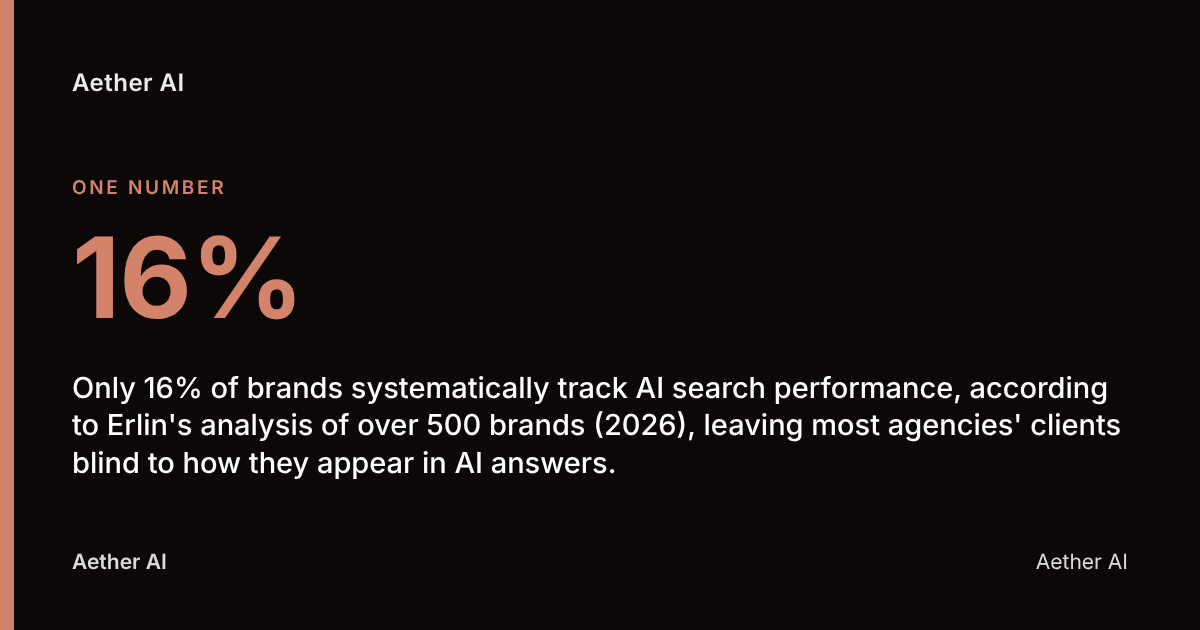
- Only 16% of brands systematically track AI search performance, according to Erlin's analysis of over 500 brands (2026), leaving most agencies' clients blind to how they appear in AI answers.
- Just 22% of marketers currently track AI visibility systematically, while 94% of CMOs plan to increase AEO (answer engine optimisation) spending this year, per the Conductor State of AEO/GEO CMO Investment Report (2026).
- Organisations that run SEO and AI visibility as one workflow see stronger results: 81% report more traffic or leads from AI platforms, against just 36% of those running the two separately, says Semrush via Blazehive (2026).
- Brand visibility across AI sessions is inherently unstable: consistency sits at only 30% across repeated sessions, per AirOps' 2026 State of AI Search, cited by Omnibound (2026) — a fact every white label report should explain, not hide.
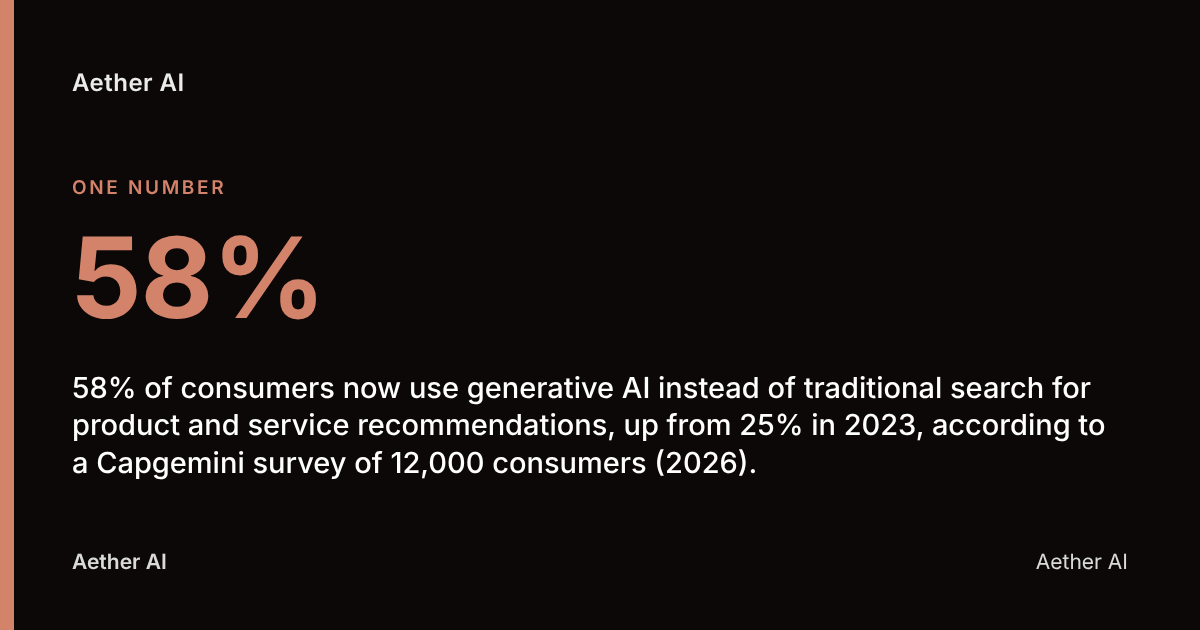
- 58% of consumers now use generative AI instead of traditional search for product and service recommendations, up from 25% in 2023, according to a Capgemini survey of 12,000 consumers (2026).
What is white label AI visibility reporting?
White label AI visibility reporting is a service arrangement in which an agency licenses a third-party platform's AI-engine tracking data — citation frequency, sentiment and competitor comparisons across tools such as ChatGPT, Gemini, Perplexity, Claude and Google AI Overviews — and presents it to clients under the agency's own logo, domain and branding, with no mention of the underlying vendor.
This differs from standard SEO reporting in what it actually measures. Traditional reporting tracks keyword rankings, organic sessions and backlinks inside Google Search Console and Google Analytics. AI visibility reporting instead tracks something Google Search Console cannot see at all: whether a brand gets named in a generative answer, how often, in what context, and against which competitors.
The distinction matters commercially too. Pew Research Center found that Google users clicked a traditional result in just 8% of visits that included an AI summary, compared with 15% of visits without one, according to Pew Research Center via Agency Dashboard (2026). Fewer clicks mean traditional reporting increasingly understates real exposure — a brand can be winning the conversation inside an AI answer while traffic-based reports show nothing happened.
For agencies, white labelling closes that gap without building the tracking infrastructure themselves: scanning six engines, parsing citations, and benchmarking against competitors is a non-trivial engineering task that most agencies would rather buy than build.
How much does white label AI visibility reporting cost per client per month in the UK?
White label AI visibility reporting typically costs UK agencies somewhere between the price of a single self-serve seat and several hundred pounds a month, scaling with the number of tracked prompts, engines covered and clients added to the account. Exact rates vary significantly by vendor, so always check the published pricing rather than a third-party estimate.
Three variables drive the bill in practice:
| Cost driver | Lower-cost setup | Higher-cost setup |
|---|---|---|
| Engines tracked | Single engine (e.g. ChatGPT only) | All six major engines (ChatGPT, Gemini, Perplexity, Claude, Copilot, AI Overviews) |
| Prompts/keywords monitored | A handful of core terms | Full keyword set with competitor benchmarking |
| Branding depth | Logo swap on a shared dashboard | Custom domain, full agency branding, client-facing login |
| Number of client workspaces | Single client | Multi-client agency tier |
A sensible way to budget is to work backwards from the client retainer: if AI visibility reporting sits inside a broader SEO/GEO retainer worth several hundred pounds a month, the reporting layer itself should be a modest fraction of that — not the dominant cost. Given that 94% of CMOs plan to increase AEO spending this year per Conductor via Newengen (2026), agencies that under-price this line item now are likely to renegotiate upward within a year regardless.
Aether AI publishes its own pricing openly at /pricing rather than quoting figures that vary by vendor and package — check there for current rates before comparing against any estimate found elsewhere.
What metrics should an AI visibility report include?
An AI visibility report should include, at minimum, citation frequency (how often a brand is named per 100 scanned prompts), engine-by-engine breakdown, competitor share of voice, and sentiment of the mention — not just a raw "mentioned/not mentioned" count. A report that only states whether a brand appeared, without context, tells a client very little they can act on.
The core data points a credible report covers:
- Citation rate by engine — ChatGPT, Gemini, Perplexity, Claude, Copilot and Google AI Overviews each surface brands differently, so a single blended score hides which engine actually needs work.
- Competitor comparison — share of voice against named rivals in the same prompt set, not just the client's own trend line.
- Source attribution — which web pages or data sources the AI engine appears to be citing when it names the brand, where that can be inferred.
- Session-to-session consistency — because brand visibility consistency across AI sessions sits at only 30%, per AirOps' 2026 State of AI Search via Omnibound (2026), a single snapshot is misleading; reports should show a trend over repeated scans, not one-off results.
- Underlying Google Search Console data where relevant — showing how many search queries never surface a named result at all, which is a useful proxy for how much visibility has shifted away from the organic results the client is used to seeing.
Aether AI's own baseline work illustrates why the trend matters more than any single scan. Across 700 live AI engine scans of UK brands' target keywords run July–August 2026, brands were named in 23 answers — 3.3% of scans — with the longest-established brand in the set (a security services company) named in 6.3% of its 270 scans, as published at aether-ai.co.uk/insights/ai-visibility-baseline-2026. A single-figure headline citation rate would have masked that spread entirely.
Who is responsible for data accuracy when reselling a white label report?
The reselling agency is responsible for how a white label AI visibility report is interpreted and presented to the client, even though the underlying data collection is the vendor's responsibility. This split of responsibility is the single most important thing an agency must understand before putting its name on someone else's numbers.
In practice this means:
- The vendor owns the accuracy of the scan itself — how many prompts were run, which engines were queried, and whether the citation-detection logic correctly identified a genuine brand mention versus a false positive.
- The agency owns the narrative layer — the commentary, the trend explanation, and any claim made to the client about what the numbers mean for their business.
Given that brand visibility consistency across AI sessions is only 30%, per AirOps via Omnibound (2026), an agency that reports a single scan as "the result" without flagging that volatility is misrepresenting the data, regardless of whose logo is on the report.
"Agencies feel this shift twice — their clients ask about AI visibility, and their own pipeline depends on it. The smart ones productise: run the tracking, publish the content, and report the answer-share the way they once reported rankings." — Lauren Dawkins, Head of Content, Aether AI
This is precisely why so few brands are currently tracked well: only 16% of brands systematically track AI search performance at all, per Erlin's 500+ brand analysis (2026). Agencies entering this space now have an opportunity to build genuine authority — provided they treat interpretation as seriously as collection.
What should I check in a vendor's contract before white labelling the tool?
A white label AI visibility reporting contract should state clearly who owns the historical data if the agency switches vendors, what happens to client dashboards if the agency cancels, and whether the vendor's branding can ever leak into a client-facing report. These three points cause the most disputes once an agency has already resold the service to clients.
Specific clauses worth checking before signing:
- Data portability — can historical citation data be exported if the agency leaves, or is it locked inside the vendor's platform permanently?
- White label scope — does "white label" cover the dashboard UI only, or also PDF exports, email alerts and any API responses the client might see?
- Multi-client terms — is pricing per client workspace, per seat, or a flat agency tier, and what happens when client count grows mid-contract?
- SLA on data freshness — how often are engines re-scanned, and is there a guaranteed minimum (daily, weekly) rather than "as available"?
- Liability for misrepresentation — if the agency's own commentary on the data is wrong, is that excluded from any vendor liability, as it should be?
- Exit and notice period — what notice is required to cancel, and is there a minimum term that locks the agency in beyond a client's own contract length?
Given the market is moving fast — the AI visibility agency managed services segment is estimated at $1.2 billion in revenue for 2026, growing approximately 85% year-over-year from 2025, according to GTM 80/20 (2026) — vendor terms, pricing tiers and feature sets are likely to change quickly. A shorter initial commitment with clear exit terms is generally safer than a long lock-in at this stage of the market.
Are there UK GDPR considerations when reselling AI visibility reports?
UK GDPR — the data protection regime enforced by the Information Commissioner's Office (ICO) under the UK General Data Protection Regulation and the Data Protection Act 2018 — applies to AI visibility reporting wherever personal data is involved, even though most of the data itself is about brand mentions rather than individuals.
The practical considerations for agencies:
- Client contact and account data sitting inside the white label dashboard (names, email addresses, login credentials) is personal data under UK GDPR, and the agency acting as data controller needs a lawful basis and an appropriate data processing agreement with the vendor acting as processor.
- Sub-processor disclosure — if the vendor's platform itself calls third-party AI engines (OpenAI, Google, Anthropic, Microsoft) to run scans, those engines may be sub-processors, and the agency's privacy notice to clients should reflect that chain honestly.
- Data residency — agencies working with regulated UK sectors (financial services, healthcare, legal) should check where the vendor stores and processes data, since some clients will ask directly.
- No special category data — AI visibility scans do not typically touch special category data (health, biometric, etc.), which keeps the compliance burden comparatively light compared with, say, a customer-facing chatbot build.
None of this is unique to AI visibility reporting — it is the same due diligence any agency already applies when reselling Google Analytics, HubSpot or Search Console access under its own brand. The ICO's own guidance on data processing agreements at ico.org.uk remains the reference point for agencies unsure where controller and processor responsibilities sit.
How do I explain AI visibility value to clients unfamiliar with AI search?
Explaining AI visibility value to an unfamiliar client works best by anchoring it to a shift they have already noticed in their own search behaviour, then backing that with a concrete figure rather than jargon. Most business owners have personally asked ChatGPT or Gemini a buying question in the last few months — start there.
A simple framing that lands with non-technical clients:
- "Your customers have already changed how they search." A Capgemini survey of 12,000 consumers found that 58% now use generative AI in place of search engines for product and service recommendations, up from 25% in 2023, per Capgemini via Agency Dashboard (2026).
- "Being on page one of Google is no longer the whole picture." When an AI summary appears, Google users click a traditional result in just 8% of those visits versus 15% when no summary appears, per Pew Research Center via Agency Dashboard (2026) — so a brand can rank well and still be invisible in the answer itself.
- "Most competitors aren't measuring this yet, which is an advantage." Only 22% of marketers currently track AI visibility systematically, per Conductor via Newengen (2026), meaning early movers are reporting on something most rivals cannot yet discuss with their own clients.
- "This isn't a replacement for SEO, it's the next layer." Organisations running SEO and AI visibility as a single workflow report stronger results — 81% see more AI-platform traffic or leads, against 36% running the two separately, per Semrush via Blazehive (2026).
Avoiding jargon matters here specifically because only 40.6% of marketers are updating their SEO strategy for AI search at all, and just 23% are measuring it, according to the Nadia Mohamed GEO Statistics compilation (2026) — meaning most clients' internal marketing teams are themselves still catching up, and a report full of acronyms will not land.
Your white label AI visibility reporting checklist
- Confirm which of the six major AI engines (ChatGPT, Gemini, Perplexity, Claude, Copilot, Google AI Overviews) are actually tracked, not just advertised
- Check the vendor's data export and portability terms before signing, not after
- Verify whether branding covers dashboards, PDFs and email alerts, or the dashboard only
- Ask how often citation scans refresh, and get a minimum frequency in writing
- Confirm a UK-appropriate data processing agreement is in place if client contact data is stored
- Build a client-facing explanation that leads with a familiar behaviour change, not a technical metric
- Set internal ownership for interpreting trends, not just forwarding raw numbers
- Review contract exit terms given how fast vendor pricing and features are moving in 2026
FAQ
What is white label AI visibility reporting?
White label AI visibility reporting is a service where an agency rebrands a third-party platform's AI-engine tracking data as its own client deliverable, covering citation rates across tools such as ChatGPT, Gemini and Perplexity. The agency's logo and domain appear throughout, with no reference to the underlying vendor.
How is AI visibility reporting different from standard SEO reporting?
AI visibility reporting measures whether a brand is named inside a generative AI answer, while standard SEO reporting tracks keyword rankings and organic traffic through tools like Google Search Console. The two increasingly diverge because AI summaries reduce clicks to traditional results, according to Pew Research Center via Agency Dashboard (2026).
How much does white label AI visibility reporting cost per client?
Costs vary by vendor based on the number of engines tracked, prompts monitored and branding depth required, ranging from modest single-client setups to higher multi-client agency tiers. Always check a vendor's published pricing directly rather than relying on third-party estimates, since the market is still settling.
Which AI engines should a white label report cover?
A credible report should cover the major generative engines consumers actually use for recommendations — typically ChatGPT, Gemini, Perplexity, Claude, Copilot and Google AI Overviews — rather than a single engine presented as representative. Coverage gaps matter because each engine surfaces brands differently.
Who is liable if a white label AI visibility report is wrong?
The reselling agency carries responsibility for how the data is interpreted and presented to the client, while the vendor is responsible for the accuracy of the underlying scan. This split should be addressed explicitly in the vendor contract before any report reaches a client.
Does GDPR apply to white label AI visibility reporting in the UK?
UK GDPR applies wherever personal data is processed, such as client contact details and login credentials stored in a white label dashboard, requiring the agency to hold an appropriate data processing agreement with its vendor. The AI visibility data itself (brand mentions) is not typically personal data, but account-level data usually is.
How consistent are AI visibility results between scans?
AI visibility results can vary significantly between sessions, with brand visibility consistency across AI sessions measured at only 30%, according to AirOps' 2026 State of AI Search via Omnibound (2026). This is why reports should show trends over multiple scans rather than treating one snapshot as definitive.
Getting your own AI visibility baseline with Aether AI
Everything covered above — citation tracking across engines, competitor comparison, and the volatility of a single scan — is exactly what Aether AI's own platform is built to measure for a brand directly, rather than through a reseller layer. Aether AI tracks citations across six AI engines (ChatGPT, Perplexity, Google AI Overviews, Claude, Gemini and Copilot), alongside keyword and competitor tracking and Google Search Console integration, so a business can see its own answer-share rather than relying on a white label summary of someone else's platform.
Aether AI is built and operated by Aether Agency Ltd. Priority First, Pulse Operations and Aether Agency are businesses connected to the founding team. Aether AI's own published baseline — 700 live AI engine scans of UK brands' target keywords run in July–August 2026 — found the brands named in just 3.3% of scans overall, with the most established brand in the set reaching 6.3%, as set out at aether-ai.co.uk/insights/ai-visibility-baseline-2026.
If you want to see where your own brand currently stands before deciding whether reselling or self-serve tracking is the right route, start with the free AI-visibility audit at aether-ai.co.uk/audit and check current plans at aether-ai.co.uk/pricing.