Last updated: 13 November 2026
Wikipedia and AI brand recognition are tightly linked because large language models were trained on, and still retrieve from, Wikipedia more than almost any other single site. Wikipedia supplies 7.8% of ChatGPT's total citations and 47.9% of its top-10 source citations, according to Profound — making a Wikipedia entry one of the most direct levers a UK brand has over how AI describes it.
Key Takeaways
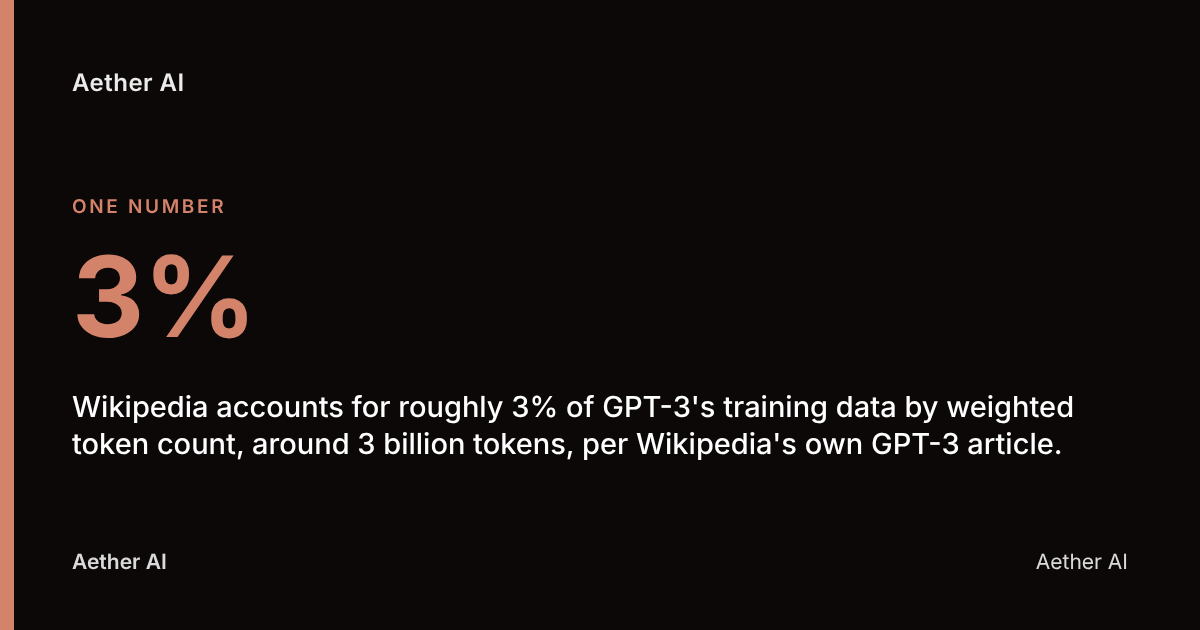
- Wikipedia accounts for roughly 3% of GPT-3's training data by weighted token count, around 3 billion tokens, per Wikipedia's own GPT-3 article.
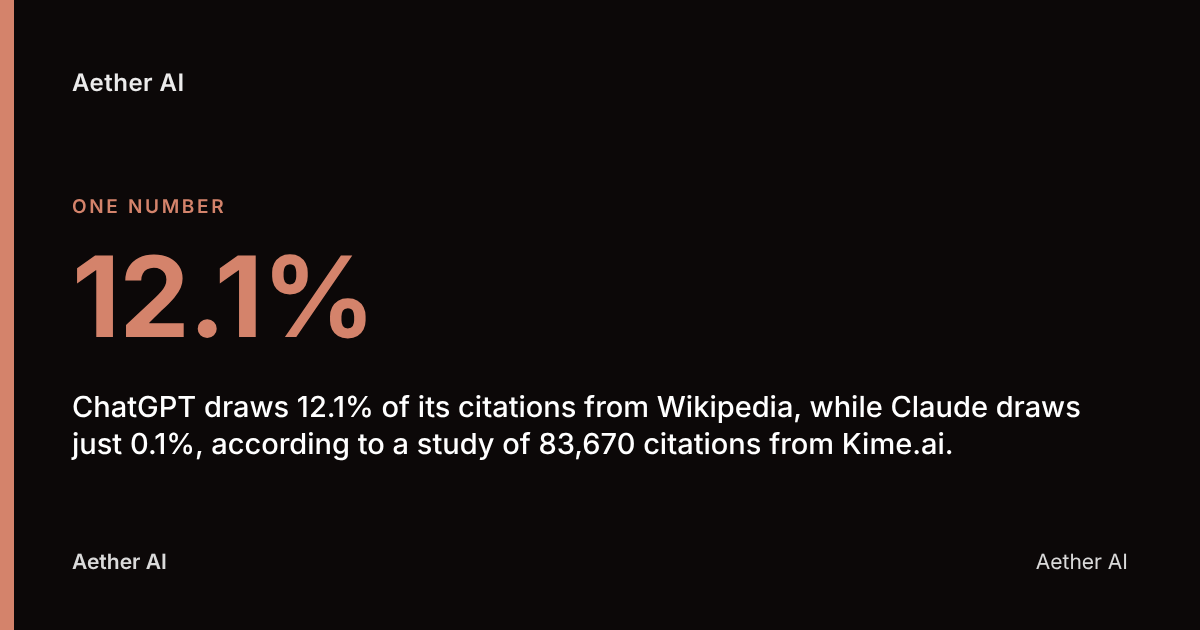
- ChatGPT draws 12.1% of its citations from Wikipedia, while Claude draws just 0.1%, according to a study of 83,670 citations from Kime.ai.
- Perplexity leans on Wikipedia hardest in fact-dense categories, with a 73% Wikipedia citation share for music topics and 80% for sports topics, per arXiv's Answer Bubbles study.
- Small or unestablished brands are named in only 9.9% of ChatGPT answers, 8.9% of Gemini answers, and 6.8% of Perplexity answers on day one of tracking, per arXiv's Generative Engine Optimization at Scale study.
- Aether AI advises that a UK business must meet Wikipedia's notability bar — significant coverage in independent, reliable secondary sources — before any page attempt will survive deletion review.
How Does AI-Generated Content Use Wikipedia as a Source for Brand Information?
AI-generated content uses Wikipedia in two distinct ways: as training data baked into the model's parameters, and as a live retrieval source pulled in at the moment a user asks a question. ChatGPT, Google AI Overviews, Perplexity and Grok all do some version of both, but the balance differs sharply by platform.
On the training side, Wikipedia's structured, citation-heavy prose made it one of the highest-quality text corpora available when models like GPT-3 were built. Wikipedia's own documentation confirms its content made up roughly 3% of GPT-3's weighted training mix — a small percentage of the overall dataset, but a disproportionately influential one, because Wikipedia's uniform structure (infoboxes, categories, consistent prose style) made it easy for models to learn factual patterns from.
On the retrieval side, the gap between platforms is stark. Kime.ai's analysis of 83,670 citations across ChatGPT, Claude and Perplexity between November 2025 and January 2026 found ChatGPT cites Wikipedia for 12.1% of its answers, Claude for just 0.1%, and Perplexity doesn't rely on it the same way at all — Perplexity instead favours real-time web retrieval. Meanwhile, arXiv's ShareChat dataset found Wikipedia is the single most-cited domain for Perplexity in its sample (2,919 citations, ahead of Reddit's 1,642 and NIH's 1,339), and the second most-cited domain for Grok (12,507 references, behind only X at 40,624). The practical upshot: a Wikipedia page is not optional background noise — it is frequently the first and sometimes only secondary source an AI assistant finds when it needs to describe your company.
Why Does Wikipedia Content Carry More Weight Than a Company's Own Website?
Wikipedia content carries more weight in AI training data and search retrieval than a company's own website because it is written by independent editors, cross-checked against secondary sources, and structured in a way models find easy to parse. A company's own "About Us" page is a primary source with an obvious incentive to self-promote — AI systems, like human researchers, treat that as inherently less reliable than independent verification.
Everything-PR's synthesis of more than 680 million citations between August 2024 and April 2026 found Wikipedia alone supplies between 26% and 48% of ChatGPT's top-10 citations, depending on the topic category. That range is wide because Wikipedia's dominance isn't uniform — it peaks in fact-dense, stable-knowledge categories. Arxiv's Answer Bubbles research found Perplexity's citation share for Wikipedia reaches 73% for music topics and 80% for sports topics, where biographical and statistical facts are well-established and rarely disputed.
For a commercial brand, this means Wikipedia functions as a trust signal the model has effectively pre-verified. A company's own site, press releases and LinkedIn page are all useful inputs, but none carry the same "independently checked" weighting that Wikipedia's sourcing requirements impose by design. This is also why Wikipedia's Wikipedia:Conflict of Interest policy exists: the encyclopaedia's value to AI systems (and to human readers) depends entirely on it staying independent of the subjects it covers.
How Can a UK Business Get a Wikipedia Page Created, and What Are the Notability Requirements?
Wikipedia notability is the threshold a subject must clear — significant coverage in multiple reliable, independent secondary sources — before an article about it is allowed to exist and survive deletion. For UK companies, the specific test is Wikipedia:Notability (Organizations and Companies), known as WP:NCORP, which states that "a company, corporation, organization, group, product, or service is presumed notable if it has been the subject of significant coverage in multiple reliable secondary sources that are independent of the subject," according to Wikipedia's own NCORP guideline.
This bar is deliberately high, and most UK small and medium-sized businesses do not clear it. A mention in a local press release, a sponsored listicle, or a trade directory does not count — the source must be independent, meaning it hasn't been paid, commissioned or supplied content by the company itself. National press coverage (the Financial Times, the BBC, the Guardian), substantial trade press features, or academic citation are the kinds of sources that typically pass.
The realistic pathway for most UK brands is:
- Audit existing independent coverage — count genuine third-party articles about the company, not about its products in passing.
- Submit via Articles for Creation (AfC) rather than publishing directly, which routes the draft through experienced reviewers before it goes live.
- Use Talk page edit requests for any changes to an existing article if you have a conflict of interest, rather than editing the article directly.
- Expect rejection on first submission — AfC reviewers decline the majority of company drafts for insufficient sourcing.
A business that doesn't yet qualify should focus on being covered independently — trade press, regional business journalism, sector awards with editorial scrutiny — rather than attempting to force a Wikipedia entry prematurely.
What Risks Do UK Businesses Face When Editing Their Own Wikipedia Page?
Conflict of interest (COI) editing is Wikipedia's term for any edit made by someone with a close personal, financial or professional connection to the subject, and it is heavily restricted by policy. Wikipedia's own guideline is explicit: "Do not edit Wikipedia in your own interests, or in the interests of your external relationships. Paid editing must be disclosed," according to the Wikipedia Conflict of Interest Guideline.
This matters for UK businesses because the consequences of breaching it are public and permanent. Wikipedia maintains a visible record of enforcement action at Conflict-of-interest editing on Wikipedia, documenting cases where companies and PR firms were caught editing undisclosed, sometimes resulting in site-wide bans, article deletion, or public naming in the press — the exact reputational damage the edit was meant to avoid.
Under UK law, undisclosed paid promotion can also intersect with the Consumer Protection from Unfair Trading Regulations 2008, which govern misleading commercial practices, although Wikipedia's own enforcement (bans, reverts, deletion) is typically the first and fastest consequence. The safe routes are:
- Disclose paid editing on your user page, as required by Wikipedia's Terms of Use.
- Use Talk page edit requests instead of direct edits to the article.
- Never create or edit your own company's article without disclosure, even for simple factual corrections like a changed address or CEO name.
How Much Does Hiring a Professional Wikipedia Editor Cost in the UK, and What Common Mistakes Do Brands Make?
A professional Wikipedia page service in the UK typically involves research, drafting, sourcing and submission through Articles for Creation, with costs varying by agency and by how much independent coverage already exists to work from. Because pricing varies so widely by scope and by how contested the notability case is, UK brands should treat any quoted figure as the start of a conversation, not a fixed menu price — Aether AI's own pricing is public for comparison on the GEO/content side of this work.
The most common mistakes UK brands make have less to do with budget and more to do with approach:
| Mistake | Why it backfires |
|---|---|
| Writing in promotional tone | Wikipedia editors and bots flag marketing language for rapid rewrite or deletion |
| Sourcing only from press releases | Fails WP:NCORP's independence test; article gets declined or deleted |
| Editing the live article directly while having a COI | Breaches Wikipedia's Terms of Use; risks a site ban |
| Hiring an undisclosed "Wikipedia expert" | If discovered, both the editor and the brand are publicly listed as sanctioned |
| Treating Wikipedia like a second website | Wikipedia explicitly isn't for SEO manipulation, as set out in Wikipedia:Search Engine Optimization |
| Submitting before notability is actually met | Near-certain rejection, and repeated rejected drafts can draw scrutiny |
Brands that treat Wikipedia as one output of a genuine PR and media relations effort — rather than a shortcut to buy — consistently fare better, both with Wikipedia's reviewers and with the AI systems that later cite the resulting article.
How Can a Business Check What AI Assistants Say About Its Brand, and Compare Wikipedia to SEO and PR?
Checking AI brand recognition means systematically asking the major assistants — ChatGPT, Perplexity, Google AI Overviews, Claude, Gemini and Copilot — the questions a prospective customer would actually ask, and recording whether the brand is named, how it's described, and whether that description is accurate. This is the specific gap Aether AI's free AI-visibility audit is built to close, tracking citations across all six of those engines rather than relying on guesswork or a single spot-check in ChatGPT.
The scale of the problem for smaller brands is significant. arXiv's Generative Engine Optimization at Scale study found that on day-one tracking, small or unestablished brands are named in only 9.9% of relevant ChatGPT answers, 8.9% of Gemini answers, and 6.8% of Perplexity answers — meaning the overwhelming majority of relevant queries return a competitor's name instead of yours. Aether AI's own baseline data, published at aether-ai.co.uk/insights/ai-visibility-baseline-2026, measured 700 live AI engine scans of UK brands' target keywords between July and August 2026 and found those brands were named in just 23 answers — 3.3% — with even the longest-established brand in the sample, a security services company, named in only 6.3% of its 270 scans.
"Start by seeing yourself the way the machines do. Run an audit of the questions that matter in your market and note who gets named instead of you. That gap list is your content strategy — everything else is decoration." — Lauren Dawkins, Head of Content, Aether AI
Wikipedia vs traditional SEO and PR: how they compare for AI recognition
| Channel | What it builds | Speed to impact | Control level |
|---|---|---|---|
| Wikipedia page | Independent, high-trust citation source | Slow (months, if notability is met) | Low — community-edited, no company control |
| Traditional SEO (own site) | Owned content AI can retrieve directly | Medium (weeks to months) | High — full control over content and structure |
| PR / earned media | Independent coverage that can feed Wikipedia and AI citations directly | Medium to slow | Low — editorial decision sits with the publication |
| GEO-structured content | Content engineered for AI retrieval and citation | Fast (days to weeks for new pages to be crawled) | High — full control, platform-agnostic |
None of these replace the others. A strong Wikipedia page is a trust anchor; a well-structured, frequently updated website is what AI engines actually retrieve from for current detail; PR coverage is often the raw material that makes Wikipedia notability possible in the first place. Businesses chasing AI brand recognition need all three working together, not a single silver bullet.
Your wikipedia and AI brand recognition checklist
- Search ChatGPT, Perplexity, Google AI Overviews, Claude, Gemini and Copilot for your brand name and your core unbranded category terms.
- Record every AI answer where a competitor is named instead of you.
- Audit genuine independent press coverage of your company before attempting a Wikipedia submission.
- Never edit your own company's Wikipedia article directly if you have a conflict of interest — use Talk page edit requests instead.
- Disclose any paid Wikipedia editing arrangement on the relevant user page, as Wikipedia's Terms of Use require.
- Publish structured, fact-dense content on your own site that answers the exact questions buyers ask AI assistants.
- Re-run your AI visibility checks monthly, since model retrieval and training snapshots update on different timelines.
FAQ
Does a Wikipedia page actually improve how AI chatbots describe my brand?
Yes, in most cases, because Wikipedia supplies a large share of ChatGPT's top-10 citations in some categories. A Wikipedia page gives AI systems an independent, structured source to draw facts from instead of relying solely on your own website or scattered press mentions.
How much of ChatGPT's training data comes from Wikipedia?
Wikipedia made up approximately 3% of GPT-3's weighted training mix, around 3 billion tokens, according to Wikipedia's own GPT-3 article. Current models like GPT-5 haven't published equivalent breakdowns, but Wikipedia's retrieval-time citation share (12.1% of ChatGPT's citations, per Kime.ai) suggests its influence has continued rather than diminished.
Can a UK business create its own Wikipedia page?
Technically yes, but Wikipedia's Conflict of Interest policy strongly discourages direct self-editing and requires disclosure of any paid involvement, per the Wikipedia Conflict of Interest Guideline. The safer route is submitting a draft through Articles for Creation and disclosing any commercial connection, rather than publishing or editing the live article yourself.
Does Wikipedia matter equally across ChatGPT, Claude, Gemini and Perplexity?
No — the reliance varies enormously by platform. Kime.ai's study found ChatGPT cites Wikipedia for 12.1% of answers versus just 0.1% for Claude, while Perplexity's reliance is highly topic-dependent, reaching 73-80% in fact-dense categories like music and sport according to arXiv's Answer Bubbles study.
What happens to AI brand recognition if a company has no Wikipedia entry?
A company without a Wikipedia entry isn't invisible to AI, but it loses one of the highest-trust citation sources available, and smaller brands already struggle with recognition generally. arXiv's research found small or unestablished brands are named in only 6.8-9.9% of answers across ChatGPT, Gemini and Perplexity on initial tracking — a gap that structured content and PR can help close even without a Wikipedia page.
How long does it take for a Wikipedia edit to show up in AI-generated answers?
This depends entirely on whether the AI platform uses live retrieval or a fixed training snapshot. Platforms with real-time web access, like Perplexity and Copilot, can reflect a Wikipedia change within days; platforms relying more heavily on training data may not reflect it until their next model update, which can take months.
What other sources besides Wikipedia influence how AI models describe a UK brand?
Wikidata, Companies House filings, LinkedIn company pages, and independent press coverage all feed into how AI systems build a picture of a brand, alongside the company's own website. Wikidata in particular feeds structured facts (founding date, headquarters, sector) into knowledge panels and some AI retrieval systems separately from Wikipedia's prose article.
Checking and improving your brand's AI visibility with Aether AI
Getting a Wikipedia page right is one piece of a much bigger puzzle: knowing, with evidence, what ChatGPT, Perplexity, Gemini, Claude, Copilot and Google AI Overviews actually say about your brand today. Aether AI tracks citations across all six of those engines, alongside keyword and competitor tracking and GSC integration, so a Wikipedia submission or PR push can be measured against real before-and-after visibility data rather than guesswork.
Aether AI's own baseline research, published at aether-ai.co.uk/insights/ai-visibility-baseline-2026, found UK brands named in just 3.3% of 700 live AI engine scans run in July–August 2026 — a reminder that most companies, Wikipedia page or not, still have significant ground to make up in how AI assistants describe them.
If you want to see exactly where your brand currently stands, run Aether AI's free AI-visibility audit and compare your citation rate against competitors before deciding whether Wikipedia, structured GEO content, or both should come first. Full pricing for ongoing tracking and content generation is available at aether-ai.co.uk/pricing.