Last updated: 14 November 2026
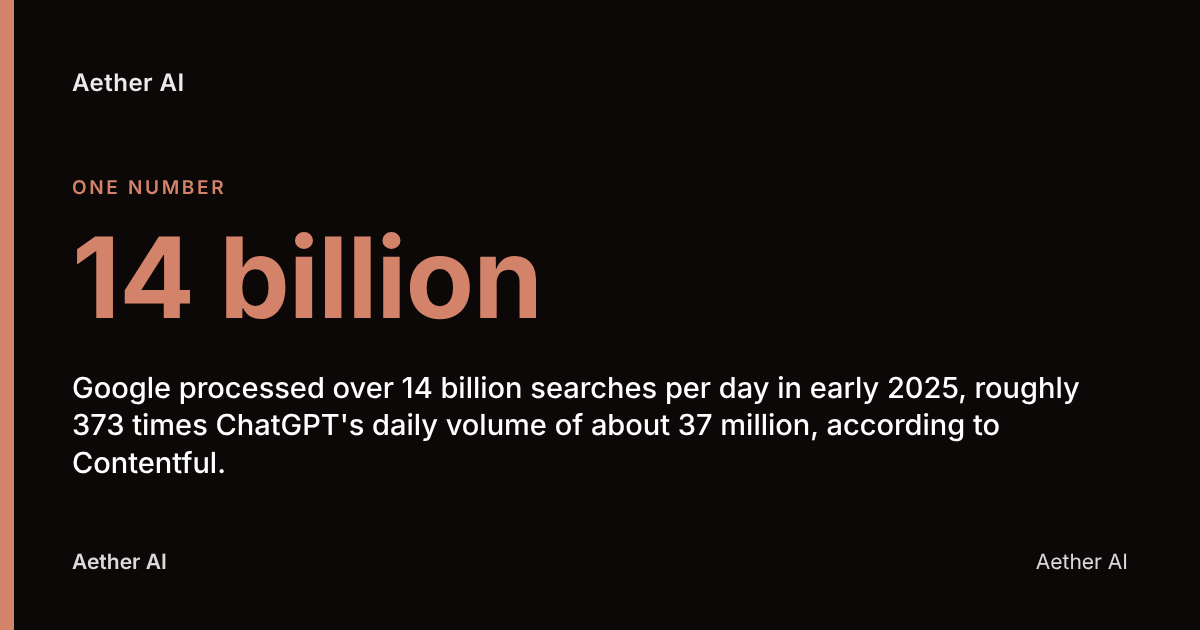
Will GEO replace SEO? No — GEO (generative engine optimisation, the practice of getting content cited inside AI-generated answers) is extending SEO, not retiring it. Google still handled over 14 billion searches a day in early 2025 against ChatGPT's roughly 37 million, per Contentful, but AI Overviews already cut click-through rates by 58% on top-ranking pages, per Ahrefs via Jasper.
Key Takeaways
- Google processed over 14 billion searches per day in early 2025, roughly 373 times ChatGPT's daily volume of about 37 million, according to Contentful.
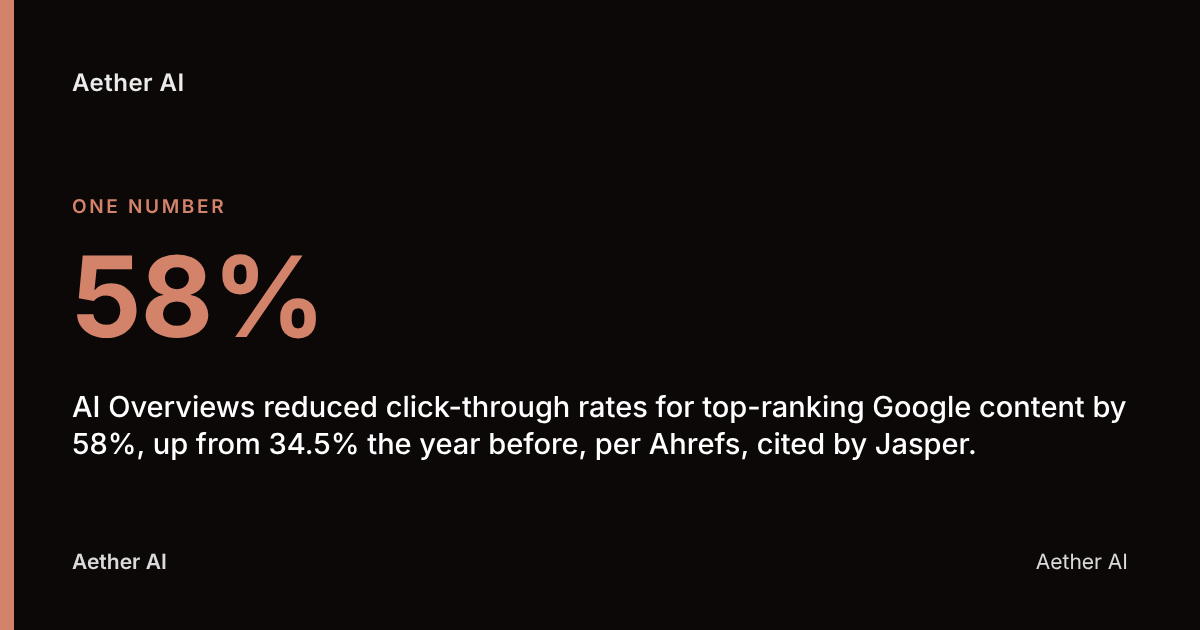
- AI Overviews reduced click-through rates for top-ranking Google content by 58%, up from 34.5% the year before, per Ahrefs, cited by Jasper.
- Including citations, quotations and statistics in content increases visibility in generative engine answers by over 40%, according to Aggarwal et al., Princeton University, KDD 2024.
- Nearly 40% of Google's AI Overviews pull from pages already ranking in the top 10 organic results, per Jasper, meaning traditional SEO ranking signals still feed GEO visibility.
- Aether AI's baseline audit of 700 live AI engine scans across UK brand keywords (July–August 2026) found those brands named in only 3.3% of answers, showing most UK businesses have almost no current AI visibility to lose.
What Is GEO and How Does It Differ From Traditional SEO?
Generative engine optimisation (GEO) is the practice of structuring content so that AI systems like ChatGPT, Google's AI Overviews, Perplexity, Claude, Gemini and Microsoft Copilot select it as a source and cite it directly in their generated answers. SEO (search engine optimisation) is the older, related discipline of ranking a webpage on a traditional results page such as Google's blue-link listings, built on signals like backlinks, keyword relevance and Core Web Services performance.
The term GEO was coined in a 2024 paper by researchers including Pranjal Aggarwal at Princeton University, presented at the ACM SIGKDD conference (KDD 2024). Their research found that content including citations, quotations from relevant sources, and statistics saw visibility increases of over 40% across various queries, according to Aggarwal et al., Princeton University, KDD 2024.
The mechanical difference matters. SEO optimises for a crawler and a ranking algorithm that returns a list of links. GEO optimises for a large language model (LLM) that synthesises an answer and decides, sentence by sentence, which source earns a citation. As Rita Steinberg, Vice President of Media at FUSE Create, put it: "The fight isn't for position one anymore. It's for contextual inclusion inside the model's response." Kaare Wesnaes, Head of Innovation for North America at Ogilvy, frames the stakes bluntly: "If a brand isn't mentioned or cited in that instant, it effectively doesn't exist."
Crucially, GEO doesn't discard SEO foundations — it builds on them. Technical crawlability, structured data (schema.org markup), E-E-A-T signals (experience, expertise, authoritativeness, trustworthiness) and strong editorial writing remain prerequisites for both disciplines.
Why Are UK Businesses Suddenly Asking Whether GEO Will Replace SEO?
UK marketers are asking this question because AI Overviews now appear on a large share of Google searches and visibly cut referral traffic before a user ever clicks through. Ahrefs' data shows AI Overviews pushed click-through rates for top-ranking content down by 58%, a sharp rise from 34.5% the previous year, per Ahrefs, cited by Jasper.
That shift has hit UK sectors reliant on informational search — professional services, software, facilities management, security — particularly hard, because many of their highest-value queries ("how much does X cost", "do I need a licence for Y") are exactly the format AI Overviews answer directly. When Google answers a query on the results page itself, the organic listing below it becomes largely redundant for that user.
Boardroom anxiety has also been fuelled by rapid AI search adoption. In the US, daily AI search users rose from 14% in February 2025 to 29.2% by August 2025, according to HigherVisibility, cited by eMarketer. UK marketing teams are watching that trajectory and asking whether their existing SEO budget still buys the same return it did two years ago.
How Is AI-Driven Search Changing How UK Consumers Find Products and Services?
AI-driven search is changing UK consumer behaviour by collapsing the research phase into a single conversational answer rather than a list of links to evaluate. Tools like ChatGPT, Google's AI Overviews, Perplexity and Microsoft Copilot increasingly return a synthesised recommendation — including named brands, prices and comparisons — before the user ever reaches a traditional search results page.
The scale is already significant. ChatGPT alone processes about 2.5 billion prompts daily, with 65% qualifying as search-style queries, yet these deliver a 96% lower click-through rate than Google, per Jasper. Separately, Contentful reports AI search sends 91% less traffic than traditional search overall, rising to 96% less in some comparisons.
This has a practical consequence for UK businesses: a consumer in Manchester asking an AI assistant "best facilities management company near me" may receive a direct answer with zero attributable website visit. The business either gets named in that answer or it doesn't exist in that moment, regardless of how well its website ranks on Google's tenth results page.
Google's own position, documented in its guide to optimising for generative AI features, confirms AI Overviews draw heavily from pages that already rank well organically — reinforcing that strong SEO foundations remain the entry ticket to GEO visibility.
Does Organic Google Traffic Still Matter If AI Assistants Answer Directly?
Yes — organic Google traffic still matters because Google remains overwhelmingly dominant and most AI Overview citations are pulled from already-ranking pages. Google held 86% of US search market share as of July 2025, according to Search Engine People, and a comparable pattern holds in the UK, where Google remains the default search engine on the vast majority of desktop and mobile devices.
More importantly for strategy, the two systems are entangled rather than separate. Nearly 40% of Google's AI Overviews pull content from pages already ranking in the top 10 organic results, and nearly 70% come from the top 100, according to Jasper. A page with no organic ranking has a dramatically reduced chance of being cited in an AI Overview at all.
| Factor | Traditional SEO | GEO |
|---|---|---|
| Primary goal | Rank in blue-link results | Be cited inside the generated answer |
| Core signals | Backlinks, keywords, page speed | Citations, statistics, clear structure, E-E-A-T |
| Measurement | Rankings, organic clicks, CTR | Citation frequency, share of voice across AI engines |
| Dependency | Mostly independent | Heavily dependent on existing organic ranking |
| Analytics access | Google Search Console, full click data | Limited — few platforms expose referral data |
The practical implication: abandoning SEO to chase GEO is self-defeating, because GEO visibility is substantially built on the organic authority SEO already establishes.
What Evidence Exists That GEO Delivers Measurable Results?
Direct, independently verified UK case studies on GEO's business ROI remain scarce, which is itself a useful signal of how early this discipline is. The strongest controlled evidence available is the original Princeton research, which found specific content techniques — adding citations, quotations and statistics — boosted visibility in generative engine responses by more than 40% across tested queries, per Aggarwal et al., Princeton University, KDD 2024.
Aether AI, built and operated by Aether Agency Ltd, ran its own measured baseline across the brands it writes for. Aether AI's AI-visibility baseline audit scanned 700 live AI engine queries against UK brands' target keywords between July and August 2026, and found those brands were named in only 23 answers — 3.3% of scans. The longest-established brand tracked, a security services business, performed best at 6.3% across its 270 individual scans.
That low baseline across the board is the real headline: most UK businesses currently have almost no measurable presence inside AI-generated answers, which means the opportunity cost of ignoring GEO is rising even as formal case studies catch up. Priority First and Aether Agency — both businesses connected to Aether AI's founding team, a fact Aether AI discloses wherever they're cited — are among the brands tracked in that audit, alongside Pulse Operations.
What Does It Cost to Start Optimising for GEO Versus Ongoing SEO Spend?
GEO does not require a separate budget line built from scratch, because the underlying content, technical foundations and measurement discipline overlap heavily with existing SEO spend. The marginal cost of adding GEO-specific work — citation-dense writing, structured data, multi-engine tracking — is typically incremental rather than a parallel programme.
Where costs diverge is measurement infrastructure. Google Search Console gives UK businesses granular organic click data for free, but no equivalent free, comprehensive dashboard exists across ChatGPT, Perplexity, Claude, Gemini and Copilot simultaneously. That gap is precisely why dedicated citation-tracking tools have emerged — monitoring brand mentions across six engines at once rather than guessing.
A realistic approach for a UK SME marketing team:
- Continue existing SEO retainer or in-house spend largely unchanged
- Add citation-dense, well-structured content (the same 40%+ visibility lever Princeton identified)
- Introduce AI-visibility tracking across multiple engines rather than relying on Google Search Console alone
- Treat GEO content production as an extension of the existing content calendar, not a second one
Who Should Own GEO Strategy Within a UK Marketing Team?
GEO strategy should sit with whoever already owns SEO and content, because the two disciplines share the same technical and editorial foundations — not a newly hired "GEO specialist" working in isolation. In most UK SMEs that means the in-house SEO lead, content manager or marketing director absorbing GEO as an extension of their existing remit.
A dedicated hire or external agency becomes worthwhile once a business needs consistent output across multiple content formats and continuous tracking across six AI engines simultaneously — work that's hard to sustain manually. This is precisely the gap self-service platforms are built to close: automated, AI-optimised article generation paired with citation tracking across ChatGPT, Perplexity, Google AI Overviews, Claude, Gemini and Copilot, plus keyword, competitor and Google Search Console integration in one workflow.
Aether AI is built and operated by Aether Agency Ltd. Priority First, Pulse Operations and Aether Agency are businesses connected to the founding team. Aether AI runs its own content and tracking through the same self-service platform it offers UK buyers, rather than describing a process it hasn't tested on its own properties.
What Practical Steps Should a UK Business Take This Quarter?
A UK business preparing for both SEO and GEO this quarter should start with a visibility audit rather than guessing where it stands across AI engines. Running a free AI-visibility check (available at aether-ai.co.uk/audit) establishes a baseline before committing further spend.
Your GEO readiness checklist
- Run a baseline AI-visibility audit across ChatGPT, Perplexity, Google AI Overviews, Claude, Gemini and Copilot
- Audit existing top-performing SEO pages for citation-readiness: are statistics, sources and clear definitions present?
- Add schema.org structured data (FAQPage, Article) to key pages if not already implemented
- Connect Google Search Console to track the queries still driving organic clicks
- Identify queries where competitors are already being cited by AI engines and you are not
- Rewrite at least one cornerstone page using definition-first structure and named, linked sources
- Set up ongoing multi-engine citation tracking rather than a one-off check
- Report GEO progress alongside — not instead of — existing organic traffic and conversion metrics
How Should Success Be Measured Without Traditional AI Analytics?
Success in GEO should be measured primarily through citation frequency across AI engines, since platforms like ChatGPT and Perplexity don't provide the click-through and keyword-level reporting UK marketers get from Google Search Console. The practical substitute is running repeated, structured prompts against a brand's target queries and logging whether, and how often, the brand is named.
This is exactly the gap Aether AI's AI-visibility baseline exposes: across 700 scans, the measured brands appeared in just 3.3% of answers overall, giving a concrete starting percentage to track upward over time, rather than a vague sense of "better AI presence."
A second, underused signal sits inside Google Search Console itself. Across two properties connected to Aether AI's founding team — Priority First and Aether Agency — between 19 July and 15 August 2026, 82.1% and 88.3% respectively of clicks came from queries Google does not name in its standard reporting. That "not provided"-style gap suggests a large share of real search demand is already harder to attribute than most marketing teams assume, in both traditional and AI-driven search.
Reporting should therefore combine three layers: organic rankings and clicks (via GSC), AI citation share across engines (via dedicated tracking), and the proportion of unnamed or long-tail query traffic that sits underneath both.
FAQ
Will GEO completely replace SEO?
No. GEO depends heavily on existing organic SEO signals — nearly 40% of Google's AI Overviews cite pages already ranking in the top 10 organic results, per Jasper. GEO extends SEO rather than replacing it.
What's the actual difference between GEO and SEO?
SEO optimises content to rank in traditional search results pages, while GEO optimises content to be cited directly inside AI-generated answers from tools like ChatGPT and Google AI Overviews. SEO relies on backlinks and keywords; GEO relies additionally on citations, statistics and clear, quotable structure, per Aggarwal et al., Princeton University, KDD 2024.
Is SEO dead because of AI search?
No — Google still held 86% of US search market share as of July 2025, according to Search Engine People. SEO remains the foundation most AI citations are built on.
How do I measure ROI from GEO versus SEO?
Measure SEO ROI through Google Search Console data — rankings, clicks and conversions. Measure GEO ROI through multi-engine citation tracking, logging how often your brand is named across ChatGPT, Perplexity, Google AI Overviews, Claude, Gemini and Copilot, since these platforms don't provide native analytics comparable to GSC.
Do small UK businesses stand a chance against large competitors for AI citations?
Yes, if content is citation-dense and well-structured. The Princeton research found that adding citations, quotations and statistics boosted visibility by over 40% regardless of domain size, per Aggarwal et al., Princeton University, KDD 2024 — meaning structure and evidence matter more than raw domain authority alone.
How quickly is AI search adoption growing?
Adoption is accelerating. Daily AI search usage in the US rose from 14% in February 2025 to 29.2% by August 2025, according to HigherVisibility, cited by eMarketer.
What should I do first — SEO or GEO?
Neither in isolation. Audit your current AI visibility first, then layer GEO techniques (citations, structured data, clear definitions) onto your existing SEO content, since AI Overviews draw predominantly from already-ranking pages.
Preparing Your Brand for Both SEO and GEO With Aether AI
This article has covered the core tension UK businesses are grappling with: SEO still drives the organic rankings that feed AI citations, yet AI engines increasingly answer queries before a click ever happens. Aether AI was built specifically to close that gap — generating AI-optimised articles automatically while tracking citations across ChatGPT, Perplexity, Google AI Overviews, Claude, Gemini and Copilot in one place, alongside keyword, competitor and Google Search Console data.
The platform's own baseline audit — 700 live AI engine scans of UK brand keywords between July and August 2026 — found the brands tracked were named in just 3.3% of answers, with the best-performing (a security services business) reaching 6.3%. That baseline is the same starting point most UK businesses face today, and it's precisely what the free audit is designed to measure for yours.
If you want to see where your brand currently stands across AI engines before deciding how to split budget between SEO and GEO, run a free AI-visibility audit at aether-ai.co.uk/audit, or check current plans at aether-ai.co.uk/pricing.