Last updated: 11 November 2026
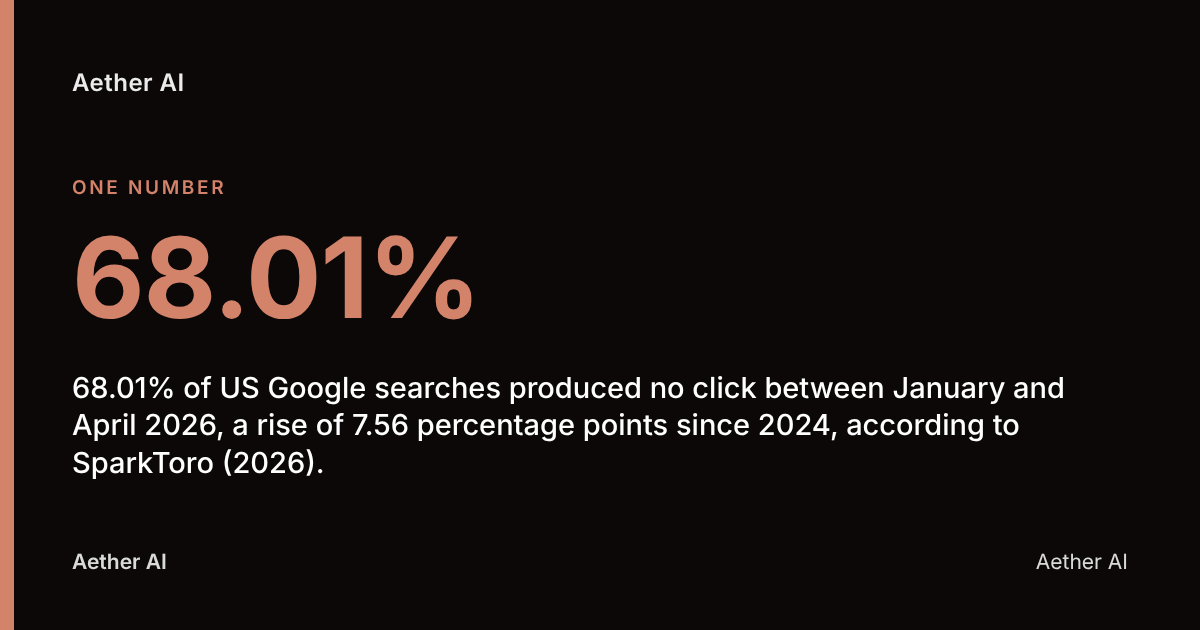
Zero-click search happens when a user gets their answer directly on the search results page or inside an AI chat response and never visits a website. In the US, 68.01% of Google searches ended without a click between January and April 2026, up from 60.45% in 2024, according to SparkToro (2026) — and UK behaviour is following the same trajectory.
Key Takeaways
- 68.01% of US Google searches produced no click between January and April 2026, a rise of 7.56 percentage points since 2024, according to SparkToro (2026).
- Google AI Overviews appeared on roughly 18% of tracked Google searches, and only 8% of searches showing an AI summary led to a click on a traditional result, versus 15% without one, according to Pew Research Center (2025).
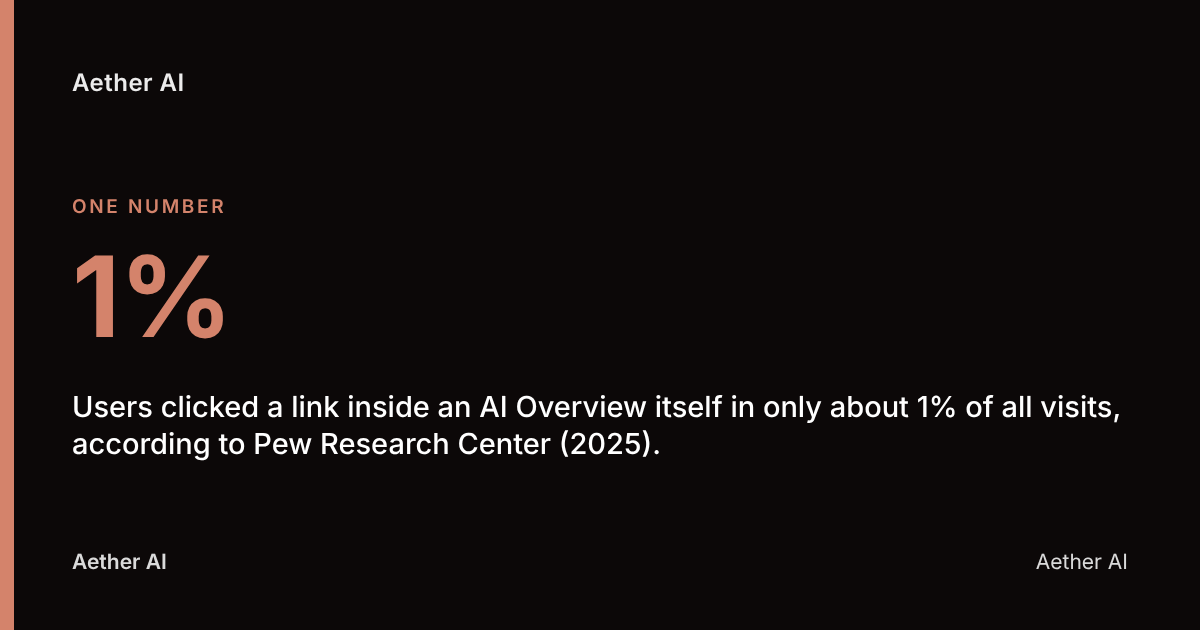
- Users clicked a link inside an AI Overview itself in only about 1% of all visits, according to Pew Research Center (2025).
- Global publisher search referrals fell about 33% in the year to November 2025 (38% in the US), according to Reuters Institute / Press Gazette (2026).
- On two properties connected to Aether AI's founding team, 82.1% and 88.3% of Google Search Console clicks came from queries Google does not name, measured 19 July–15 August 2026 — a pattern consistent with the wider zero-click trend.
What is zero-click search and how common is it in the UK?
Zero-click search is a search interaction in which the user's query is answered directly within the search engine results page — through a featured snippet, knowledge panel, or AI-generated summary — so no visit to a third-party website occurs. The term covers everything from a quick weather lookup to a complex query answered in full by Google's AI Overviews or a chatbot like ChatGPT.
There is no official UK-specific tracking body publishing a national zero-click rate, but the closest available proxy — SparkToro's ongoing US measurement — shows the share of no-click Google searches climbing from 60.45% in 2024 to 68.01% between January and April 2026. UK search behaviour on Google.co.uk, using the same SERP features (AI Overviews, People Also Ask, knowledge panels), tracks this pattern closely because Google deploys these features globally and largely simultaneously.
Separately, Pew Research Center (2025) found AI Overviews appeared on about 18% of tracked Google searches — nearly one in five — confirming this is now a mainstream, not fringe, SERP experience for everyday queries, including informational ones that UK businesses rely on for organic traffic.
How do AI answers decide which sources to cite?
AI answer engines — including Google AI Overviews, ChatGPT, Microsoft Copilot, Perplexity, Claude and Gemini — select sources using a retrieval process that scores content for relevance, structure, and trustworthiness before generating a synthesised response. This is fundamentally different from classic ranking: the system isn't choosing "the best page" to send a user to, it's extracting specific passages to quote or paraphrase.
Several factors consistently improve citation odds:
- Clear, standalone definitions near the top of a page or section, written as a complete statement rather than buried in narrative.
- Structured data and clean heading hierarchy (H1 → H2 → H3), which helps retrieval systems identify where one idea ends and another begins.
- Named, checkable entities — regulators, standards, dates, organisations — that the model can cross-reference against other sources for consistency.
- Recency and freshness signals, particularly for commercial or regulatory topics where guidance changes.
- Authoritativeness, often measured through citations elsewhere on the web, schema markup, and domain-level trust signals.
Google has publicly disputed some of the Pew findings, with a Google spokesperson stating that "people are gravitating to AI-powered experiences, and AI features in Search enable people to ask even more questions, creating new opportunities for people to connect with websites," while also calling Pew's methodology "flawed." That dispute matters for UK marketers: the underlying mechanics of retrieval-and-synthesis are not contested, only how much traffic survives the process.
How is zero-click search different from featured snippets and position zero?
Traditional featured snippets — the boxed answer that sits above organic results, often called "position zero" — extract and display a single passage from one source, with a visible link and attribution directly beneath it. Zero-click AI answers go further: they synthesise information from multiple sources into one generated paragraph, frequently with no visible link at all, or with citations relegated to small, easy-to-miss footnotes.
The practical difference is attribution density. A featured snippet credits one page clearly. An AI Overview or ChatGPT answer might blend three, five, or ten sources into a single response, diluting any individual site's visibility even when it was used. Pew Research Center (2025) found that users clicked a link inside an AI Overview in only about 1% of all visits — far below historical featured-snippet click-through rates, where the single cited source typically still received meaningful traffic.
| Feature | Featured snippet ("position zero") | AI Overview / AI chat answer |
|---|---|---|
| Sources shown | One, with clear link | Multiple, often blended |
| Click-through to source | Moderate (visible, single link) | ~1% of all visits (Pew, 2025) |
| Attribution clarity | High | Low to moderate |
| Session continuation | User often refines search | 26% of sessions end when an AI Overview appears, vs 16% without (Pew, 2025) |
| Measurement method | Rank tracking, CTR | Citation tracking, branded search lift |
What impact does zero-click search have on UK website traffic?
Zero-click search is measurably reducing the volume of traffic that reaches publisher and business websites from search, even as overall search activity grows. Pew Research Center (2025) found that searches showing an AI Overview produced a click on a traditional organic result just 8% of the time, compared with 15% when no AI summary appeared — roughly half the click-through rate.
The downstream effect shows up in publisher-level data. Reuters Institute / Press Gazette (2026) reported that global publisher search referrals fell around 33% in the year to November 2025, with the US decline reaching 38%. Browsing sessions also end sooner: Pew found users stopped searching altogether 26% of the time after seeing an AI Overview, versus 16% when they didn't, according to Pew Research Center (2025).
AI chat assistants are not yet replacing that lost volume. Similarweb data via Press Gazette (2025) showed ChatGPT referral traffic to 14 leading news publishers grew from roughly 435,000 monthly visits in August to 3.5 million by January — an eightfold jump — yet this still represented less than 0.1% of those publishers' total site visits. A separate Search Engine Land analysis of 6.77 million sessions (2026) found ChatGPT commands 92.4% of trackable LLM referral traffic, lands on publisher news pages 54% of the time, but penetrates just 0.11% against over 120 million organic sessions tracked.
"The click was always a proxy. What matters is being the name the buyer carries into the conversation. AI referrals are smaller in volume and radically better in intent — the person who arrives from an assistant has already been told you're the answer." — Lauren Dawkins, Head of Content, Aether AI
How can UK businesses measure ROI when users never click through?
Measuring zero-click impact means replacing click-based KPIs with citation-based and proxy metrics that track presence inside AI answers, not just arrivals on a website. This is a genuine measurement and attribution problem — the GSC dashboard that used to tell the full story now captures only the fraction of demand that survives to a click.
Three proxy metrics are emerging as the practical standard:
- Citation rate — how often a brand, product, or domain is named in AI-generated answers for its target queries, tracked across engines like ChatGPT, Perplexity, Google AI Overviews, Claude, Gemini, and Copilot.
- Branded search lift — whether direct and branded search volume rises after a brand starts appearing in AI answers, used as an indirect signal that the AI mention drove awareness even without a click.
- Share of model (sometimes called share of answer-engine voice) — the proportion of relevant AI answers in which a brand appears versus its competitors. Lyle Stevens of Later has suggested "a healthy share of model is usually north of 30% to start with."
Aether AI's own measured baseline illustrates how thin citation presence typically is even for established brands: across 700 live AI engine scans of UK brands' target keywords run in July–August 2026, the tracked brands were named in just 23 answers — 3.3% of scans — and the longest-established brand, a security services company, was named in only 6.3% of its 270 scans. That baseline is a useful reference point precisely because it shows how low citation rates sit even before an optimisation strategy is applied.
On the GSC side, a separate pattern reinforces the scale of the measurement gap: across two properties connected to Aether AI's founding team (Priority First and Aether Agency), 82.1% and 88.3% of Google Search Console clicks between 19 July and 15 August 2026 came from queries Google does not name — "not provided" style gaps that make last-click attribution increasingly unreliable even for the clicks that do happen.
How should SEO strategy change for zero-click search and AI answers?
SEO strategy for zero-click search must shift from ranking for clicks to structuring content for extraction, because the unit AI engines retrieve is a passage or sentence, not a webpage. Several structural changes matter most:
- Lead every section with a direct, self-contained answer in the first one or two sentences — engines quote openings far more than conclusions.
- Define terms explicitly the first time they appear, rather than assuming context.
- Use clean H2/H3 hierarchy so retrieval systems can identify passage boundaries reliably.
- Add structured data (FAQ schema, Article schema, Organization schema) to make machine-readable signals explicit.
- Name real, checkable entities — regulators, standards, dates — rather than vague generalities, since specificity correlates with citation.
- Maintain traditional technical SEO (crawlability, Core Web Vitals, internal linking) because AI engines still rely heavily on the same indexes Google and Bing use for discovery.
"Vendors will argue AEO versus GEO versus LLM SEO forever because category names are marketing territory. Buyers shouldn't care. The question underneath is identical: when an AI assistant answers a question in your market, are you in the answer, and can you prove it?" — Lauren Dawkins, Head of Content, Aether AI
Your zero-click visibility checklist
- Audit how often your brand is already named in ChatGPT, Perplexity, Google AI Overviews, Claude, Gemini and Copilot for your core commercial queries.
- Rewrite your highest-value pages so every H2 opens with a direct, quotable answer in its first two sentences.
- Add explicit definitions for every technical term or acronym the first time it appears on the page.
- Implement FAQ, Article and Organization schema across priority pages.
- Track branded search volume in Google Search Console alongside citation rate, not instead of it.
- Benchmark your "share of model" against named competitors across all six major AI engines, not just Google.
- Review the "not provided" or unnamed-query share of your GSC clicks to understand how much of your traffic data is already a blind spot.
- Reassess paid search and lead-gen budgets against where buyers now actually form their shortlist — inside AI answers, not just on the SERP.
FAQ
What does zero-click search mean in simple terms?
Zero-click search is when a user's question gets answered directly on the search results page or inside an AI chatbot response, so they never click through to a website. It includes featured snippets, knowledge panels, and AI-generated summaries like Google's AI Overviews.
How common is zero-click search in the UK right now?
There's no official UK-only tracker, but the closest proxy — US data from SparkToro — shows 68.01% of Google searches ended without a click between January and April 2026, up from 60.45% in 2024. UK behaviour tracks closely since Google deploys AI Overviews and other SERP features globally.
Do AI Overviews really reduce clicks to websites?
Yes. Pew Research Center (2025) found only 8% of searches with an AI summary led to a click on a traditional result, compared with 15% without one — roughly half the click-through rate, and link clicks inside the AI Overview itself occurred in only about 1% of visits.
Can ChatGPT and other AI chatbots send meaningful traffic to businesses?
Not yet at scale. ChatGPT referral traffic to 14 leading news publishers grew from about 435,000 to 3.5 million monthly visits between August and January, according to Similarweb via Press Gazette (2025) — but that still represented less than 0.1% of those publishers' total visits.
How do I know if my business is being cited in AI answers?
You need to run structured queries against ChatGPT, Perplexity, Google AI Overviews, Claude, Gemini and Copilot for your target keywords and record whether your brand is named, and how often, compared with competitors. This is what Aether AI's citation tracking is built to do, since manual spot-checking rarely scales beyond a handful of queries.
Are there legal issues around AI tools summarising UK business content without attribution?
UK copyright law (the Copyright, Designs and Patents Act 1988) and ongoing policy debate at the UK Intellectual Property Office continue to grapple with how AI training and summarisation interact with content ownership. There's no settled UK legal requirement forcing AI platforms to attribute or compensate sources for summarised content, which is why many publishers are instead focusing on citation visibility and licensing negotiations rather than litigation.
Should I stop investing in traditional SEO because of zero-click search?
No. Technical SEO fundamentals — crawlability, structured data, site speed, internal linking — remain the foundation AI engines rely on for discovery, even when the end output is a synthesised answer rather than a ranked link. The strategy shift is additive: structure content for extraction on top of existing SEO discipline, not instead of it.
Measuring your AI visibility with Aether AI
The measurement problem this article describes — fewer clicks, more synthesised answers, and attribution models that can no longer account for where demand actually goes — is exactly what Aether AI's platform is built to address. Rather than relying on GSC clicks alone, Aether AI tracks citation presence across six AI engines (ChatGPT, Perplexity, Google AI Overviews, Claude, Gemini and Copilot), alongside keyword and competitor tracking and direct GSC integration, so UK businesses can see share of model rather than guessing at it.
Aether AI's own baseline data shows how low that starting point typically is: across 700 live scans of UK brands' target keywords in July–August 2026, brands were named in just 3.3% of answers overall. Aether AI is built and operated by Aether Agency Ltd. Priority First, Pulse Operations and Aether Agency are businesses connected to the founding team, and the baseline above was measured across properties connected to that team alongside other tracked brands.
If you want to see where your own business currently stands, Aether AI offers a free AI-visibility audit at /audit, with full pricing published openly at /pricing for businesses ready to move from guessing to measuring.