Last updated: 16 November 2026
AI overview citation source analysis is the practice of examining which web pages Google's AI Overviews cite, and why. Research from Position Digital found just 33.2% of cited URLs also ranked in the organic top 10, and Google swapped at least one source for 52% of repeated searches — meaning citation is a separate, less stable game than ranking.
Key Takeaways
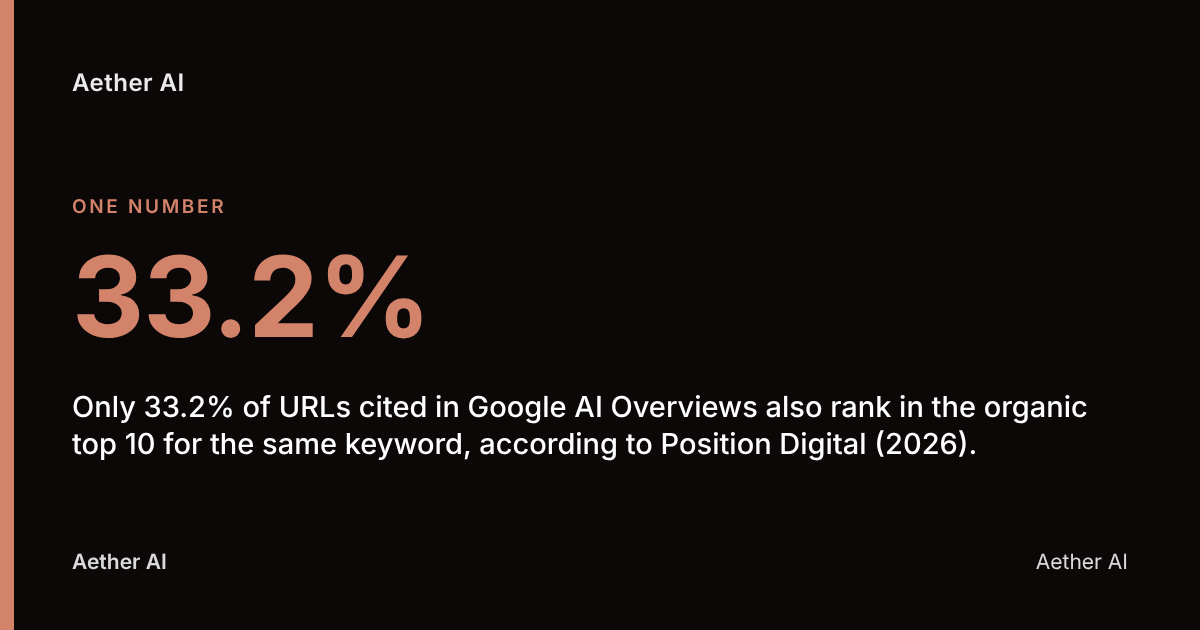
- Only 33.2% of URLs cited in Google AI Overviews also rank in the organic top 10 for the same keyword, according to Position Digital (2026).
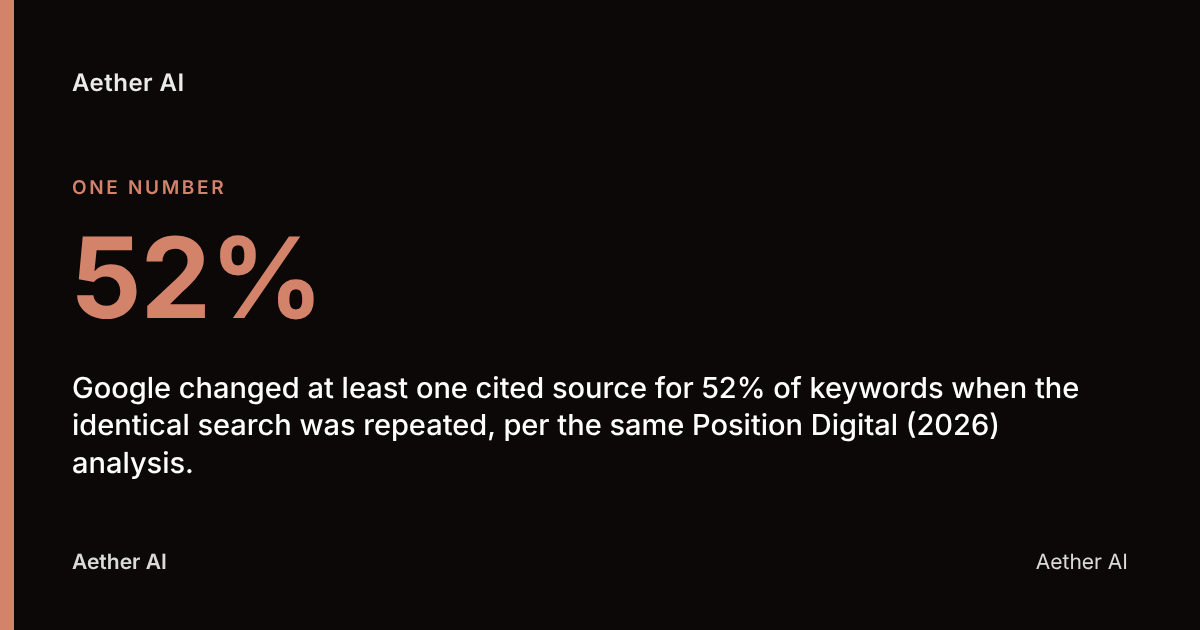
- Google changed at least one cited source for 52% of keywords when the identical search was repeated, per the same Position Digital (2026) analysis.
- YouTube captures a 20.9% citation share across Google AI Overviews, more than any other domain, according to Ahrefs Brand Radar (2026).
- Schema-marked pages are cited markedly more often than pages without structured data, according to Digital Applied's (2026) study.
- Aether AI's measured baseline found UK brands named in only 3.3% of 700 live AI engine scans run in July–August 2026, showing how rare citation still is even for established businesses.
What is an AI Overview and how does citation work?
An AI Overview is a Google Search feature — a generated summary that appears above traditional blue links, synthesising information from multiple web pages into a single answer. Citation, in this context, means Google selects specific URLs as the supporting sources for claims made inside that summary, displaying them as clickable links alongside or beneath the generated text.
Google's own documentation on AI features and your website explains that AI Overviews use a "query fan-out" technique: the system breaks a single search into multiple related sub-queries, retrieves candidate pages for each, and then synthesises an answer while attaching citations to back specific claims. This is fundamentally different from a featured snippet, which pulls one passage from one page.
Citation is not guaranteed to track organic rank. Position Digital's 2026 analysis found that only 33.2% of cited URLs also sat in the organic top 10 for the same keyword — even though higher-ranking pages were still somewhat more likely to be cited than lower-ranking ones. A separate Ahrefs study covering 863,000 keywords and 4 million AI Overview URLs found the overlap had fallen to 38%, down sharply from 76% in an earlier version of the same study — evidence that Google is increasingly drawing on a wider, less rank-dependent pool of sources over time.
Google's own AI Overviews explainer describes an internal "corroboration" process, where claims are checked against multiple sources before a citation is attached — but this process is not infallible, as later sections of this article show.
Which domains and source types get cited most often?
YouTube is the single most-cited domain in Google AI Overviews, holding a 20.9% citation share across more than 3 million US queries analysed by Ahrefs Brand Radar (2026), a share that rose 34% in six months. Video content, in other words, is disproportionately favoured over static text pages for many query types.
Citation share is also highly concentrated. Digital Applied's 2026 study found the top 1% of cited domains — roughly 12 sites, including Wikipedia, Reddit, Forbes, Healthline and Investopedia — captured 47% of all citations between them. For most businesses, that means competing not just against rivals but against a handful of enormous reference and community sites that Google already trusts heavily.
Pew Research Center's 2025 analysis adds useful texture: 88% of AI Overviews cited three or more sources, and only 1% relied on a single source — so breadth of corroboration matters. Wikipedia, YouTube and Reddit together supplied about 15% of all cited sources in that study, while .gov websites made up 6% of AI Overview citations versus just 2% of standard organic results — suggesting government and official sources are weighted more heavily inside AI Overviews than in classic ranking.
For a UK business, this means the realistic competitive set is: large reference sites, video platforms, community forums, government pages (such as GOV.UK or HSE guidance), and a long tail of smaller domains fighting over what's left. Understanding where your sector's citations cluster is the first step in any serious ai overview citation source analysis.
How can a UK business determine whether its website is being cited?
A UK business can determine its AI Overview citation status by manually searching its core commercial keywords in an incognito browser, or by using a dedicated citation-tracking platform that automates the process across many queries and AI engines. Manual spot-checks catch obvious wins and losses but miss volatility, since Position Digital found Google changed at least one cited source for 52% of repeated identical searches — a single snapshot tells you almost nothing about your actual trend.
This is the gap Aether AI was built to close. Aether AI tracks citations across six AI engines — ChatGPT, Perplexity, Google AI Overviews, Claude, Gemini and Microsoft Copilot — alongside keyword and competitor tracking and Google Search Console integration, so a business can see which of its target terms are being cited, by which engine, and whether that status is stable or shifting week to week.
Aether AI's own measured baseline, published at aether-ai.co.uk/insights/ai-visibility-baseline-2026, ran 700 live AI engine scans of UK brands' target keywords between July and August 2026. Across that baseline, the brands were named in only 23 answers — 3.3% of scans — while the longest-established brand, a security services provider, was named in 6.3% of its 270 scans. Those figures are consistent with the wider research showing citation is scarce and concentrated among a small set of trusted domains, not a rebuttal of it.
A free starting point exists for businesses who haven't yet measured their own position: Aether AI's free AI-visibility audit checks current citation status before any tracking subscription is needed.
What on-page and technical factors influence citation likelihood?
Structured data markedly increases citation likelihood. Digital Applied's 2026 study found schema-marked pages were cited markedly more often than pages without it — a clear, actionable signal for any UK content team deciding where to invest technical effort.
Position on the page matters too. CXL's 2026 analysis of 100 citations found 55% of cited passages came from the first 30% of a source page — meaning the answer needs to appear early, not buried under preamble. CXL's broader dataset of 4 million AI Overview URLs found only 37.1% of cited URLs sat in the organic top 10, closely echoing Ahrefs' own 38% figure and reinforcing that strong on-page clarity can outweigh raw ranking position.
Practical on-page levers include:
- Define the core concept in the first sentence of any section addressing a specific question — content written this way gives the retrieval system an unambiguous claim to extract.
- Mark up FAQs, how-tos and articles with Schema.org structured data (FAQPage, HowTo, Article) so Google's systems can parse claims without guesswork.
- Front-load the answer within the first 30% of the page, rather than building up to it through narrative.
- Use clean heading hierarchy (H1, then H2, then H3) so a retrieval system can identify where one passage ends and the next begins.
- Write self-contained sentences that name the subject directly, rather than relying on pronouns a system might misread out of context.
How does AI Overview citation differ from traditional organic ranking?
AI Overview citation and organic ranking are related but distinct systems, measured by different outcomes and rewarding different page qualities. Organic ranking is primarily about relevance and authority signals accumulated over time; citation is about whether a specific passage can be extracted, corroborated against other sources, and attached to a generated claim.
| Factor | Organic ranking | AI Overview citation |
|---|---|---|
| Primary unit | Whole page / URL | Specific passage or claim |
| Correlation with top-10 rank | Direct (rank = position) | Weak — only 33.2%–38% overlap (Position Digital; Ahrefs, 2026) |
| Stability over repeat searches | Relatively stable | Volatile — 52% of keywords saw a source change on repeat search (Position Digital, 2026) |
| Reward for structured data | Minor ranking signal | 2.3x citation multiplier (Digital Applied, 2026) |
| Typical click behaviour | User clicks through to page | Many users read the summary and never click |
This distinction matters because a business can rank well and still never be cited, or be cited occasionally without ever holding a stable top-10 position. The two need separate monitoring, which is precisely why citation tracking has emerged as a discipline distinct from classic rank tracking — and why Aether AI treats them as separate tracked metrics rather than folding one into the other.
How does citation accuracy affect trust, and what's the copyright position?
AI Overview claims are not always accurate, and that matters for any UK business whose content is being summarised or misrepresented without direct control over the wording. A peer-reviewed study by Washington University in St. Louis researchers Xu, Iqbal and Montgomery, examining 98,020 verifiable claims across 61,212 citations, found that 11% of Google AI Overview claims were not supported by their cited source pages. Position Digital's separate 2026 analysis found AI Overviews gave false, contradicted, or unsupported claims 35.3% of the time.
For a UK business, this creates a practical risk: Google may attribute a claim to your page that your page does not actually make, potentially exposing you to reputational harm or customer confusion — for example, a misquoted price, safety claim, or product specification. There is currently no UK-specific statutory mechanism requiring consent before a business's published content is summarised or cited in this way; AI Overviews operate on the same crawlable, publicly indexed web content that underpins standard search, and the UK's Intellectual Property Office and ongoing policy discussions around AI and copyright remain unsettled areas that content owners should watch rather than assume are resolved.
The practical takeaway is governance, not litigation: any business relying on AI Overview visibility should periodically check what is actually being cited and said about them, since an inaccurate citation can sit live in search results for weeks before anyone at the company notices.
Your AI overview citation source analysis checklist
- Search your top 10 commercial keywords in an incognito browser and note whether an AI Overview appears and whether your domain is cited.
- Repeat the same searches a week later to check for the volatility Position Digital measured at 52% of keywords.
- Audit your highest-value pages for Schema.org markup (FAQPage, Article, HowTo) and add it where missing.
- Rewrite opening sentences of key sections as plain definitions — name the subject, state the category, add the distinguishing detail.
- Check citation position: ensure your clearest answer sits within the first 30% of the page, not buried at the end.
- Set up ongoing tracking across multiple AI engines, not just Google, since citation behaviour differs materially between ChatGPT, Perplexity, Gemini and Copilot.
- Review Google Search Console for query data that doesn't map to a named click — a sign AI summaries may be absorbing impressions your reporting doesn't yet capture.
- Assign a named owner inside the marketing or SEO function to review citation status monthly, not quarterly.
FAQ
What is an AI Overview citation?
An AI Overview citation is a link Google attaches to a specific claim inside its generated AI Overview summary, pointing to the web page it drew that information from. Unlike a standard search result, the citation supports a passage of generated text rather than representing the whole page's relevance.
Does ranking in the top 10 guarantee an AI Overview citation?
No. Position Digital's 2026 research found only 33.2% of cited URLs also ranked in the organic top 10, and Ahrefs found the figure at 38% across 4 million URLs — both well below what you'd expect if ranking and citation were the same system.
Which domain types dominate AI Overview citations?
YouTube leads with a 20.9% citation share, according to Ahrefs Brand Radar (2026), while a small group of roughly 12 major reference sites — including Wikipedia, Reddit, Forbes, Healthline and Investopedia — capture 47% of all citations, per Digital Applied (2026).
How often do AI Overview citations change for the same search?
Frequently. Position Digital found Google changed at least one cited source for 52% of keywords when the identical search was repeated — meaning a single check is a snapshot, not a trend.
Can structured data really improve citation chances?
Yes. Digital Applied's study found schema-marked pages were cited markedly more often than pages without structured data, making it one of the few technical levers with a measured effect.
How does AI Overview citation differ from citation in ChatGPT or Perplexity?
Each engine runs its own retrieval and synthesis process, so citation patterns differ by platform, query type, and even by region. A page cited in Google AI Overviews is not automatically cited in ChatGPT or Perplexity, which is why tracking needs to cover multiple engines rather than assuming Google behaviour predicts the rest.
How often should a business review its AI Overview citation performance?
Given that Position Digital measured source changes on 52% of repeated searches, monthly review is a reasonable minimum, with a named owner inside marketing or SEO accountable for tracking trends rather than one-off checks.
Tracking your citations with Aether AI
This article has covered exactly the problem Aether AI's core tracking product exists to solve: knowing whether your business is actually being cited, by which AI engine, for which keywords, and whether that status is holding or slipping. Manual incognito searches catch a moment in time; they cannot catch the volatility this research describes, where Google swapped a cited source for 52% of repeated keywords.
Aether AI's measured baseline — 700 live AI engine scans of UK brands' target keywords run in July–August 2026 — found those brands named in only 3.3% of scans overall, with the most established brand reaching 6.3%. Aether AI is built and operated by Aether Agency Ltd. Priority First, Pulse Operations and Aether Agency are businesses connected to the founding team, and that baseline data comes from brands connected to the platform in exactly that way.
If you want to know where your own business currently stands, Aether AI's free AI-visibility audit checks your citation status across major AI engines before you commit to anything, and full pricing for ongoing tracking across six engines — including Google AI Overviews, ChatGPT, Perplexity, Claude, Gemini and Copilot — is available at /pricing.