Last updated: 17 November 2026
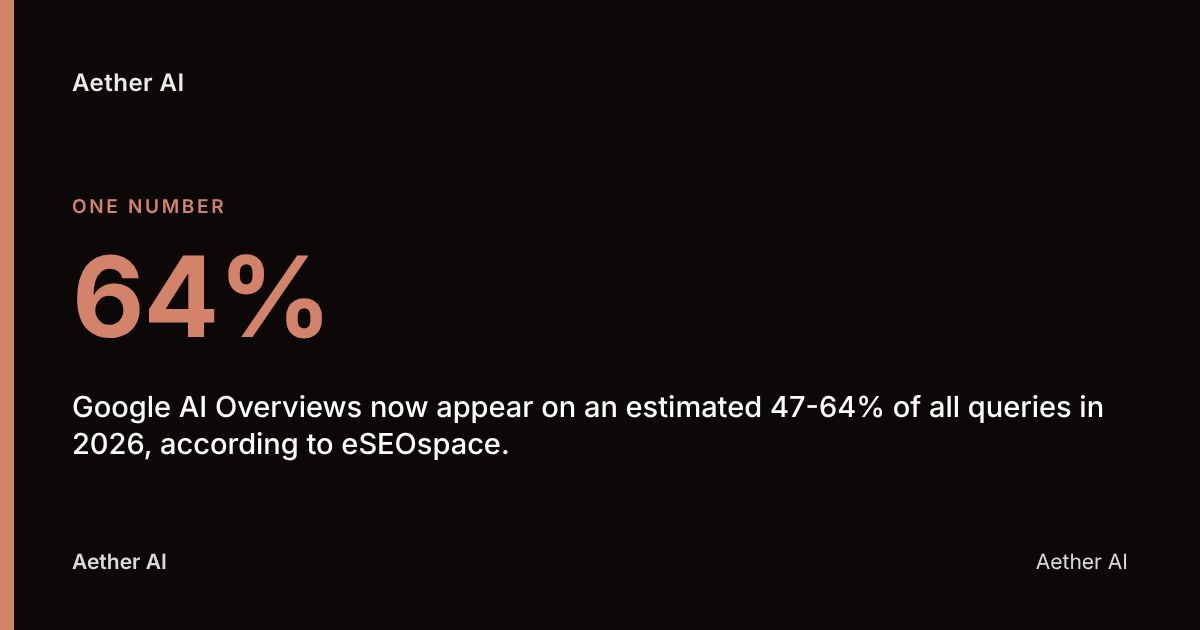
An AI Overviews strategy is the deliberate set of content, technical and measurement decisions a business makes to get cited inside Google's AI-generated search summaries rather than just ranked below them. It matters because AI Overviews now appear on roughly 47-64% of all queries in 2026, up from 25-30% at their 2024 launch, according to eSEOspace.
Key Takeaways
- Google AI Overviews now appear on an estimated 47-64% of all queries in 2026, according to eSEOspace.
- Click-through rate on Google searches with an AI Overview fell to 1.3% in December 2025 before recovering to 2.4% in February 2026, an 85% jump in two months, per the Seer Interactive study via Search Engine Land.
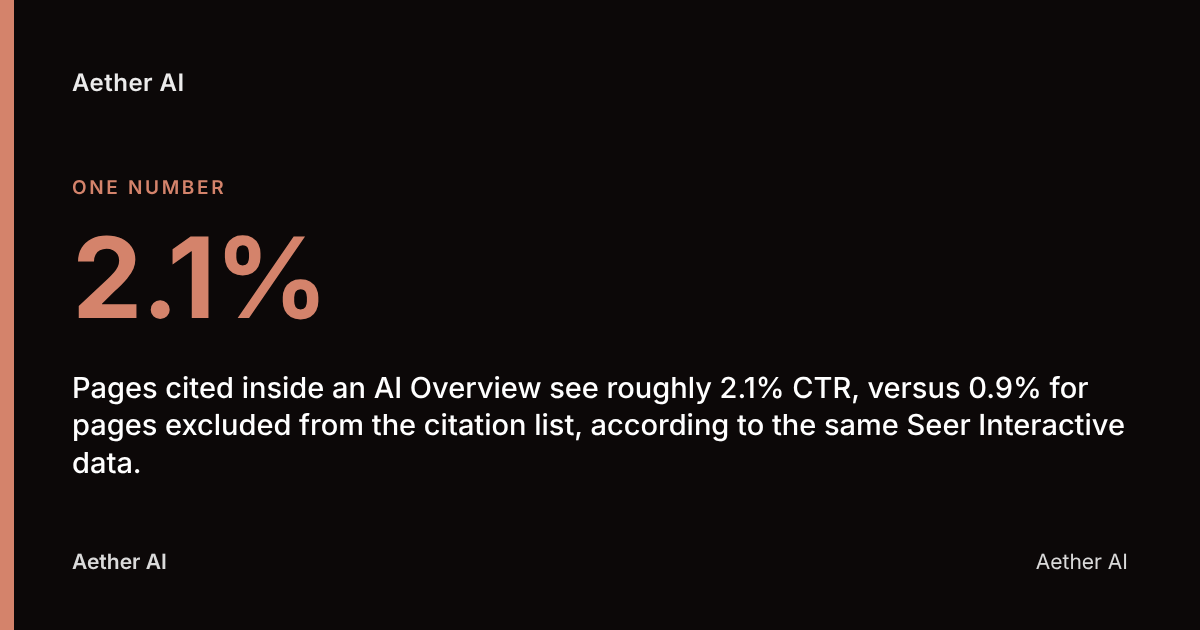
- Pages cited inside an AI Overview see roughly 2.1% CTR, versus 0.9% for pages excluded from the citation list, according to the same Seer Interactive data.
- A 2025 Ahrefs study of 300,000 keywords linked AI Overview presence to a 34.5% drop in click-through rate for top-ranking organic pages, per Ahrefs via Wordstream.
- Adding quotations, statistics and cited sources to a page boosted its visibility in generative engine answers by up to 40% in a KDD 2024 controlled study, per Aggarwal et al., arXiv.
What are Google AI Overviews?
Google AI Overviews are AI-generated summary boxes that appear above traditional blue-link search results, synthesising an answer from multiple web sources rather than showing a single ranked list. They launched in the UK in 2024 as an expansion of the earlier Search Generative Experience and now sit at the top of the results page for a large and growing share of queries.
Unlike a classic featured snippet, which quotes one page verbatim, an AI Overview blends facts from several sources into a single generated paragraph, with a handful of small citation links to the right or beneath the text. Coverage has grown unevenly: SEOProfy tracked UK and global query coverage rising from 6.49% to 24.61% across 2025 before settling around 15-16% as Google tuned which query types trigger the feature.
Google has stated there is no separate "AI ranking index" — the same crawling, indexing and quality systems that power classic Search also feed AI Overviews, according to Google's official optimisation guidance reported by Search Engine Land. That single fact reframes the whole strategy question: a business cannot optimise "for AI Overviews" as a separate channel from SEO — it has to optimise its existing site so the same ranking systems trust it enough to quote it.
How does Google's AI Overviews algorithm select content?
Google's AI Overviews system selects source pages by running a query through its existing Search ranking and quality signals, then asking a language model to synthesise an answer and attach citations to the passages it drew from. A page does not need to rank first to be cited — it needs to contain a clear, extractable answer that the model judges relevant and trustworthy enough to quote.
In practice this means the system favours pages that:
- Answer a specific question in a self-contained passage, rather than burying the answer in a long narrative.
- Carry demonstrable expertise, experience, authoritativeness and trust (E-E-A-T) signals — named authors, dated updates, and verifiable facts.
- Use clean heading structures (H2s and H3s) that let a retrieval system identify where one topic ends and another begins.
- Include original data, quotations or statistics rather than generic restatement of what competitors already say.
That last point has direct experimental backing. In a KDD 2024 controlled study, adding quotations, statistics and cited sources to a page increased its visibility in generative engine responses by up to 40%, according to Aggarwal et al.'s GEO: Generative Engine Optimization paper on arXiv. The same study formalised the term Generative Engine Optimization (GEO) — the practice of shaping content so large language models cite it, as distinct from classic SEO's focus on ranking position.
Google's own guidance, published in 2026, confirms it does not maintain a separate crawl or index for AI features; the same bots and the same content quality bar apply, per Search Engine Journal's coverage of Google Search Advocate John Mueller's guidance. Mueller has also noted a behavioural upside for brands that do get cited: "We've seen that when people click to a website from search results pages with AI Overviews, these clicks are higher quality, where users are more likely to spend more time on the site," according to Google's guidance reported by Search Engine Land.
What on-page changes should a UK business make for AI Overviews?
A UK business improves its AI Overviews eligibility by restructuring existing pages around direct answers rather than by writing entirely new content. The starting point is a definition-first structure: every page introducing a concept, product or regulation should open its first relevant section with a one-sentence, standalone definition a model can lift without extra context.
Practical changes that compound:
- Open each section with the answer. Write the first two sentences of every H2 to stand alone as a complete fact, naming the subject rather than "it" or "this".
- Add original statistics and named sources. Pages with citations and data points were cited up to 40% more often in the KDD 2024 study referenced above — generic restatement rarely gets selected.
- Use clean heading hierarchy. One H1, logically nested H2s and H3s, each describing — not teasing — its content, so a retrieval system can delimit passages correctly.
- Name real entities. Regulators (the Information Commissioner's Office, the Competition and Markets Authority), legislation (the UK GDPR, the Consumer Rights Act 2015) and standards give a model concrete, checkable anchors rather than vague claims.
- Keep content current. Google's crawlers revisit pages regularly; stale statistics and dead links reduce trust signals that feed both classic ranking and AI synthesis.
- Mark up structured data. Schema such as FAQPage, Article and Organization markup helps Google's systems parse entities, authorship and publication dates faster — it does not guarantee citation, but it removes friction.
None of this replaces technical SEO fundamentals — fast load times, mobile usability, a logical site architecture and solid internal linking still underpin whether Google's systems can crawl and trust a page at all. AI Overviews optimisation sits on top of that foundation; it does not substitute for it.
How does AI Overviews visibility affect organic click-through rates?
Appearing in an AI Overview citation list roughly doubles a page's click-through rate compared with being excluded from that list, but both figures sit well below the CTR a page earns with no AI Overview present at all. Seer Interactive's study via Search Engine Land — tracking 53 brands, 5.47 million queries and 2.43 billion impressions — found CTR breaks down as: no AI Overview ~3.3%, AI Overview with citation ~2.1%, AI Overview without citation ~0.9%.
The same study found overall CTR on AI Overview searches bottomed out at 1.3% in December 2025 and climbed to 2.4% by February 2026 — an 85% recovery in two months, as Google iterated on citation placement and users adapted to the format.
Other research paints a starker long-term picture. A 2025 Ahrefs analysis of 300,000 keywords found AI Overview presence strongly associated with a 34.5% decrease in CTR for top-ranking organic pages, according to Ahrefs via Wordstream. Pew Research data reported by Keywords Everywhere found only about 8% of users click any result when an AI Overview is present, versus 15% without one, and roughly 1% click a link inside the Overview itself. A randomised experiment went further still: organic clicks fell 39.8% when an AI Overview was shown, with the probability of no click at all rising from 0.54 to 0.73 and no measurable difference in the quality of clicks that remained, per Agarwal and Sen's working paper via Keywords Everywhere.
The practical read for UK businesses: being cited is now a precondition for getting any meaningful share of remaining clicks, not a bonus on top of normal rankings.
| CTR scenario | Approximate click-through rate | Source |
|---|---|---|
| No AI Overview shown | ~3.3% | Seer Interactive |
| AI Overview shown, page cited | ~2.1% | Seer Interactive |
| AI Overview shown, page not cited | ~0.9% | Seer Interactive |
| User clicks any result with AI Overview present | ~8% | Pew Research via Keywords Everywhere |
| User clicks any result with no AI Overview present | ~15% | Pew Research via Keywords Everywhere |
Who should own AI Overviews strategy inside a UK company?
AI Overviews strategy should sit with whoever already owns organic search performance — typically an in-house SEO lead, head of content or marketing director — because the discipline extends existing SEO and content governance rather than replacing it. Treating it as a brand-new function, separate from SEO, tends to duplicate work and produce content that is optimised for a model but ignored by the people who actually buy.
For most mid-sized UK businesses, the practical ownership model looks like this:
- SEO or digital marketing lead: owns technical foundations, structured data, crawl health and keyword/query mapping.
- Content or communications team: owns definition-first rewrites, original data collection and author attribution (E-E-A-T signals).
- Agency or specialist partner: where in-house capacity is limited, a GEO-literate agency can audit citation gaps and implement schema and structural changes faster than a generalist in-house team learning from scratch.
- Analytics/data function: owns tracking — Google Search Console configuration, citation monitoring tools and reporting back to the board.
The key governance point is that no single hire "does AI Overviews" in isolation; it is a cross-functional discipline layered onto existing SEO ownership, reviewed on the same cadence as classic search performance — typically monthly or quarterly.
What are the most common mistakes UK businesses make with AI Overviews?
The most common mistake is treating AI Overviews optimisation as a bolt-on content project rather than a rebuild of how existing pages answer questions. Businesses write a handful of new "AI-optimised" blog posts while leaving their core product, service and policy pages structured as long, undifferentiated narrative text that no retrieval system can cleanly extract.
Other recurring errors:
- Chasing volume over definition quality. Publishing more pages without opening each section with a clear, standalone answer rarely moves citation rates — Google's own guidance confirms there is no separate AI index to game with sheer output.
- Ignoring E-E-A-T fundamentals. Pages with no named author, no publication date and no verifiable facts struggle to clear the same trust bar AI Overviews inherit from classic Search quality systems.
- Measuring only rankings, not citations. A page can rank well in classic blue links yet never appear in the Overview citation list — and vice versa — so tracking position alone misses the actual KPI.
- Treating all AI engines as one. Optimising solely for Google AI Overviews ignores that ChatGPT, Perplexity, Claude, Gemini and Microsoft Copilot each weight sources differently; a strategy built for one engine alone is incomplete.
- No freshness cadence. Stale statistics, outdated pricing or superseded regulation citations erode the trust signals that keep a page eligible for citation over time.
How can a business measure its visibility across AI Overviews and other AI engines?
A business measures AI Overviews visibility by combining Google Search Console data with dedicated citation-tracking tools, because Search Console alone does not reliably separate AI Overview impressions from classic organic impressions. Google Search Console shows overall impressions, clicks and average position per query, but it does not label which impressions came with an AI Overview shown, nor whether the business's page was actually cited inside it.
To close that gap, UK businesses typically layer in:
- Manual query sampling: running a representative set of target keywords through Google and logging whether an AI Overview appears and whether the brand is cited.
- Dedicated citation-tracking platforms: tools built specifically to scan AI engines — including ChatGPT, Perplexity, Google AI Overviews, Claude, Gemini and Microsoft Copilot — and log where a brand name or URL is mentioned.
- Share-of-voice benchmarking: comparing how often a brand is named in AI answers against its direct competitors for the same query set, not just in isolation.
Aether AI runs this kind of multi-engine citation tracking as a core part of its platform, scanning target keywords across all six major AI engines and reporting back which queries actually named the brand. In the measured baseline — 700 live AI engine scans of UK brands' target keywords run July–August 2026 — the brands tracked were named in 23 answers, a 3.3% citation rate overall, with the longest-established brand (a security services business) named in 6.3% of its 270 individual scans, as published at aether-ai.co.uk/insights/ai-visibility-baseline-2026. That figure illustrates why citation tracking matters as its own metric: a brand can rank comfortably in classic Google results while still being named in only a low single-digit percentage of AI-generated answers for the same topics.
A related, often-overlooked data point sits inside Search Console itself. Across two properties connected to Aether AI's founding team — Priority First and Aether Agency — between 19 July and 15 August 2026, 82.1% and 88.3% of clicks respectively came from queries Google does not name in its reporting (so-called "not provided" or unlabelled query traffic), a reminder that a large share of real search demand is already invisible to standard dashboards before AI Overviews are even factored in.
How does AI Overviews strategy compare with traditional SEO?
AI Overviews strategy is not a replacement for traditional SEO — it is an additional layer of citation-focused optimisation built on the same crawling, indexing and quality systems Google has always used. The two disciplines share roughly 80% of their groundwork: technical health, backlink authority, keyword research and E-E-A-T signals matter identically to both.
| Dimension | Traditional SEO | AI Overviews / GEO strategy |
|---|---|---|
| Primary goal | Rank in top organic positions | Be cited inside the generated answer |
| Core unit of content | Full page / article | Self-contained answer passage |
| Success metric | Position, organic sessions | Citation rate, share of AI answers |
| Measurement tool | Google Search Console, rank trackers | Multi-engine citation trackers (e.g. Aether AI) |
| Content structure | Narrative, keyword-led | Definition-first, question-led |
| Update cadence | Periodic content refresh | Frequent freshness checks for citation eligibility |
The practical implication: a business with weak technical SEO has no realistic path to AI Overviews visibility, because the same crawl and quality signals gate both. Conversely, a business with strong classic SEO but narrative-only content structure will likely rank well while still losing citation share to a smaller competitor whose pages are built to be quoted.
Your AI Overviews strategy checklist
- Audit top pages for a one-sentence, standalone definition in the first relevant section.
- Restructure long narrative sections into clean H2/H3 answer blocks under 300 words each.
- Add at least one original statistic, named source or first-party data point per key page.
- Apply FAQPage, Article and Organization schema markup where it is not already present.
- Name real entities — regulators, legislation, standards — rather than vague generic phrases.
- Set up multi-engine citation tracking rather than relying on Search Console alone.
- Review and refresh statistics, pricing and regulatory references at least quarterly.
- Benchmark citation share against named competitors for the same core query set.
FAQ
What is an AI Overviews strategy?
An AI Overviews strategy is the combination of content structure, technical SEO and citation measurement a business uses to increase its chances of being quoted inside Google's AI-generated search summaries. It builds on existing SEO rather than replacing it, because Google uses the same ranking and quality systems for both.
Do AI Overviews reduce website traffic?
Yes, in most cases. Seer Interactive's study found CTR on AI Overview searches fell to 1.3% in December 2025 before recovering to 2.4% by February 2026, while a 2025 Ahrefs study linked AI Overview presence to a 34.5% CTR drop for top-ranking pages, per Wordstream.
How is optimising for AI Overviews different from Generative Engine Optimization (GEO)?
AI Overviews optimisation is one specific application of the broader discipline called Generative Engine Optimization (GEO) — the practice, formalised in a KDD 2024 academic study, of structuring content so large language models cite it across any generative search engine, not just Google's. GEO also covers ChatGPT, Perplexity, Claude, Gemini and Microsoft Copilot.
Does schema markup help a page appear in AI Overviews?
Structured data such as FAQPage, Article and Organization schema helps Google's systems parse entities, authorship and dates more reliably, which supports the same trust signals AI Overviews draw on. It is not a guaranteed citation trigger on its own, but it removes technical friction that can otherwise hold a page back.
Which queries are most likely to trigger an AI Overview?
Informational, how-to and comparison queries trigger AI Overviews most consistently, since the feature is designed to synthesise an answer from multiple sources rather than send users to a single page. Coverage varies by query type and has fluctuated — from around 6.49% to 24.61% of tracked queries across 2025, settling near 15-16%, according to SEOProfy.
How often should AI-cited content be updated to stay visible?
Content should be reviewed at least quarterly, with pricing, statistics and regulatory references checked more frequently if the sector moves quickly. Stale or dead-linked content erodes the same trust signals that keep a page eligible for citation in classic Search and AI Overviews alike.
Who should manage AI Overviews strategy in a smaller UK business?
In most smaller UK businesses, the existing marketing lead or whoever manages the website should own AI Overviews strategy, supported by a specialist tool or agency for technical implementation and citation tracking. It rarely justifies a standalone hire on its own, but it does require someone accountable for reviewing citation data on a regular cycle.
Turning AI Overviews strategy into measurable visibility with Aether AI
Everything covered above — definition-first structure, schema markup, original data, and tracking citations across engines rather than just rankings — is the exact workflow Aether AI's self-service platform is built to automate for UK brands. Rather than manually auditing every page for AI Overview eligibility, Aether AI generates AI-optimised articles and tracks citations across all six major engines — ChatGPT, Perplexity, Google AI Overviews, Claude, Gemini and Microsoft Copilot — alongside keyword tracking, competitor comparison and Google Search Console integration.
Aether AI applies this process to its own content too: in Aether AI's measured baseline of 700 live AI engine scans run July–August 2026, the brands tracked were named in 23 answers overall, a 3.3% citation rate, with figures published openly at aether-ai.co.uk/insights/ai-visibility-baseline-2026. Aether AI is built and operated by Aether Agency Ltd; Priority First, Pulse Operations and Aether Agency are businesses connected to the founding team, and their results are shown here as connected examples rather than independent client wins.
If your pages rank well but you're not sure whether they're ever being cited by ChatGPT, Gemini or Google's AI Overviews, run a free AI-visibility audit at aether-ai.co.uk/audit to see where the gaps are — and check current plans at the platform's pricing page before deciding how to scale it across your site.