Last updated: 24 November 2026
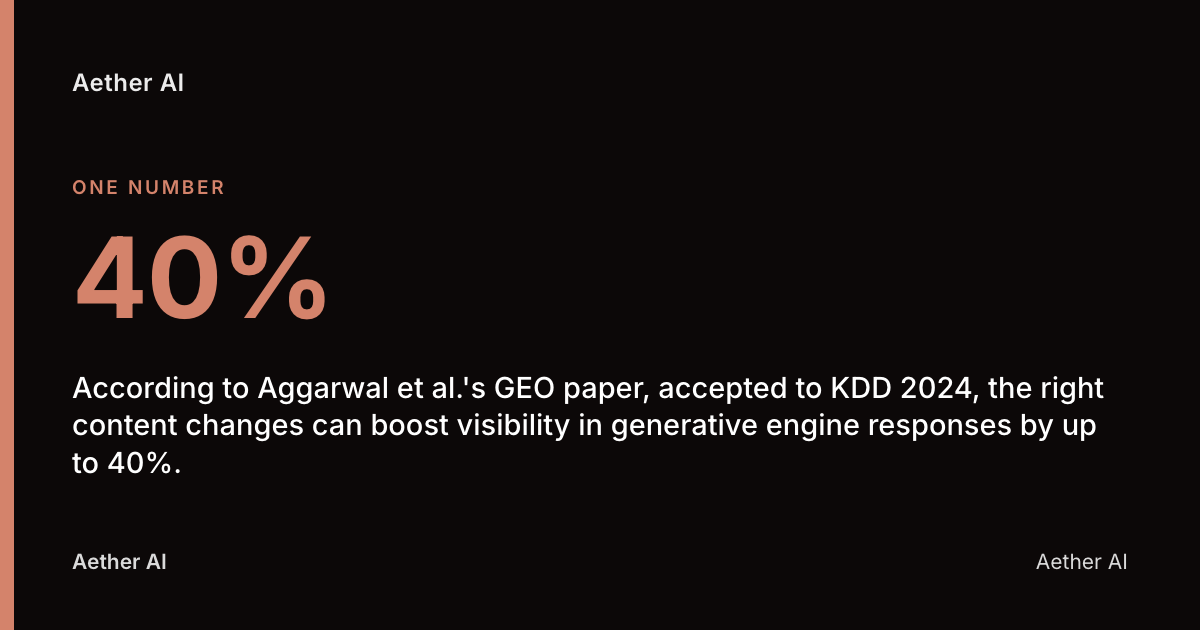
Choosing an expert GEO (generative engine optimisation) provider in the UK means checking three things: technical delivery, content measured against real search demand, and citation tracking across AI tools such as ChatGPT and Perplexity. According to Aggarwal et al.'s GEO paper, accepted to KDD 2024, the right content changes can boost visibility in generative engine responses by up to 40%.
Key Takeaways
- Generative engine optimisation (GEO) is the academic and industry term for optimising content so AI systems cite a brand inside a generated answer, coined by Aggarwal, Murahari, Rajpurohit, Kalyan, Narasimhan and Deshpande in a paper accepted to KDD 2024.
- The same paper found that citing external sources lifted visibility by 115.1% for websites ranked fifth in search results, while the visibility of the top-ranked website fell by 30.3% on average, per Aggarwal et al., KDD 2024.
- ChatGPT sends the largest share of the visits that AI chatbots send to UK websites, according to StatCounter Global Stats; the full figures are below.
- Seer Interactive's September 2025 update found that when a brand was cited inside an AI Overview, it had a 35% higher organic click-through rate than when it was not cited, though Seer notes this may reflect existing brand strength rather than the citation itself.
What is generative engine optimisation (GEO)?
GEO is a content and technical discipline that optimises websites so AI systems such as ChatGPT, Perplexity, Google AI Overviews and Claude cite the brand directly inside a generated answer, rather than ranking the brand on a results page. The term was coined by researchers Aggarwal, Murahari, Rajpurohit, Kalyan, Narasimhan and Deshpande in a paper titled "GEO: Generative Engine Optimization", accepted to the ACM SIGKDD conference (KDD) in 2024.
Classic SEO (search engine optimisation) chases position one on a results page. GEO chases the sentence inside the AI-generated answer itself, whether or not a reader ever clicks through. The researchers built a benchmark called GEO-bench, made up of 10,000 queries drawn from nine different sources, and tested which content changes most reliably made a website's content more visible in the generated answer. Specific, checkable interventions, such as adding statistics and citing named sources, produced measurable gains: GEO can boost visibility by up to 40% in generative engine responses, according to the paper's own results.
One finding matters particularly for smaller or newer websites: in the paper, the Cite Sources method produced a 115.1% increase in visibility for websites ranked fifth in search results, while the visibility of the already top-ranked website fell by 30.3% on average. In the benchmark, lower-ranked pages gained the most. The benchmark used test queries, so it does not predict results for any individual business.
Why does GEO matter for UK businesses right now?
GEO matters because AI chatbots already send a measurable share of UK web traffic, and most of that traffic goes to two platforms rather than being spread evenly. According to StatCounter Global Stats (October 2026, read 24 November 2026), ChatGPT accounts for 44.43% of the AI chatbot visits StatCounter records to UK websites, with Google Gemini at 31.14%, Microsoft Copilot at 10.57%, Perplexity at 9.67% and Claude at 4.19%. A UK business planning where to focus citation-tracking effort should weight that effort accordingly.
AI Overviews also take clicks. Seer Interactive found organic click-through rate for queries showing an AI Overview fell from 1.76% in June 2024 to 0.61% in September 2025. Within that smaller pool, brands cited inside the AI Overview had a 35% higher organic click-through rate (0.70% versus 0.52%) and a 91% higher paid click-through rate than when they were not cited, in Seer's Q3 2025 data. Seer notes this gap may reflect the strength of brands that already tend to get cited, rather than proof that citation alone causes the lift.
Keeping pages up to date also appears to matter. Seer Interactive's 2026 study of content recency looked at 4,124 pages cited by ChatGPT, Gemini and Perplexity where both a publish date and an update date were readable. The study found that 72% of those cited pages had been updated within the past year, but only 42% had originally been published within the past year. Many cited pages were older pages that had been kept up to date, which argues for a refresh schedule on existing content, not only new publishing.
What should you look for in an expert GEO provider?
A capable GEO provider demonstrates technical delivery, not just strategy slides, and can show how content is planned against real search demand rather than guesswork. Vetting one properly means checking the following before signing anything.
Technical delivery capability. A capable provider adds labels in the page code that tell machines what each page is, who wrote it, its questions and answers and where it sits on the site (structured data). It also resolves duplicate copies of the same page, and finds pages that nothing else on the site links to (orphan pages) and links them in or retires them. That foundation helps the software AI companies use to read websites understand a page's content and authorship. Ask for evidence of specific technical fixes carried out on a real site, not just a strategy document.
Content publishing cadence and evidence base. GEO results depend on the volume and quality of content published to answer real queries, ideally derived from Google Search Console demand data (Google's own tool showing which searches already surface a site) rather than generic keyword-volume tools.
Named source citation habit. Following the KDD 2024 finding that citing external sources lifted visibility by 115.1% for websites ranked fifth, a competent provider treats citation-rich, sourced writing as standard practice rather than an afterthought.
Attention to reputation beyond the page itself. A preprint by Chen and Koudas, submitted on 10 October 2026 and not yet peer reviewed, studied 158,099 answers with 468,037 citations and summarised its finding as "Pages are thus cited when searched; brands are also named when remembered." A provider's job includes helping a brand build a reputation elsewhere online that AI models already "remember" when generating an answer, not only optimising a single page.
Cross-platform tracking. The provider should track citations across ChatGPT, Perplexity, Google AI Overviews and Claude individually, since StatCounter's UK data shows these platforms send very different volumes of traffic.
Attribution to commercial outcomes. Ask how enquiries or leads are tied back to specific published content. A provider with no attribution system cannot show whether its work produced any business result. Any enquiry tracking must also follow UK GDPR and the Privacy and Electronic Communications Regulations (PECR), which the Information Commissioner's Office (ICO) enforces, so ask how visitor consent is handled.
Red flags that signal weak GEO expertise
Watch for these warning signs before committing any budget:
- No mention of structured data, duplicate-page cleanup or site readability for AI software in the proposal
- Promises of certain citations on named AI platforms (no provider controls how ChatGPT, Perplexity, Claude or Google AI Overviews choose what to cite)
- No attribution mechanism linking published content to enquiries or leads
- Reporting limited to Google rankings only, with no citation tracking across AI tools
- Case studies whose figures you cannot check
- No discussion of reputation beyond the website itself, given the Chen and Koudas preprint's finding that brands are also named from what the model has learned elsewhere, not only from what it retrieves on the day
How should you compare GEO providers, and what drives the cost?
GEO providers vary mainly on how much technical repair a website needs, how much content must be produced, how many AI platforms are tracked, and how the provider reports results, rather than on a single standard price. There is no fixed market rate for this work. The most reliable way to compare quotes is to get a written scope from each provider stating exactly what is and is not included. Then compare those scopes with each other, not with a headline monthly figure.
Several factors drive cost up or down. A website with a long history of duplicate pages, orphan pages and missing structured data needs more technical work before any content strategy can take effect. A business entering a new market or category needs more new content produced against measured demand than one simply maintaining an existing library. Tracking citations across four AI platforms individually costs more in tool time and reporting than tracking one. Monthly reporting with attribution to specific enquiries takes more work to build and maintain than a simple rankings report.
The table below sets out common provider types and what each tends to suit, without prices, since scope varies too widely between businesses for a single figure to be meaningful.
| Provider type | What it typically includes | Best suited for |
|---|---|---|
| Freelance GEO consultant | Technical audits and specific fixes, limited content production | Small businesses needing narrow, defined technical work |
| Boutique full-service agency | Brand, website and content work combined with GEO strategy | SMEs needing site, brand and content handled together |
| Mid-market specialist agency | Larger content volumes, multi-platform citation tracking | Multi-site or multi-location businesses |
| Enterprise or large agency retainer | Full technical remediation of large legacy content libraries | National brands with complex, long-standing websites |
In-house vs outsourced GEO: the trade-off
Businesses generally face three routes: build an in-house team, hire a freelance consultant, or retain a full-service agency. An in-house team offers control and close brand familiarity, but requires training or hiring specialists in a new discipline. A freelance consultant suits a narrow technical fix but rarely covers brand, website architecture and content publishing together in one engagement. A full-service agency bundles brand identity, website development and GEO content work under one roof. That matters because content worth citing depends on a sound site and a coherent brand voice, not on content alone.
Which UK sectors benefit most from GEO right now?
There is no published evidence ranking which UK sectors gain most from GEO. It is most relevant where buyers compare several firms before getting in touch, such as professional services, security and facilities management, and B2B consulting.
What does an effective GEO engagement look like week to week?
An effective GEO engagement typically follows a repeatable sequence: technical audit and fixes first, then structured data deployment, then content publishing against measured demand, then citation tracking. Ask the provider to describe this sequence for your site.
Early weeks: technical audit and quick fixes. The provider identifies duplicate pages, orphan pages, missing structured data and anything blocking the software AI companies use to read the site, since AI systems cannot cite content they cannot read properly.
Following weeks: structured data deployment. Those labels get added across the site, giving both Google and AI reading software explicit signals about what each page is and who wrote it.
Middle weeks: content publishing against measured demand. Rather than guessing which keywords matter, a stronger approach mines Google Search Console for queries the site is already appearing for but not winning clicks on. Search Console shows the searches real people already made in which the site appeared, so it is a shorter and more honest list than a keyword tool's estimates for the whole market.
Later weeks: citation tracking and attribution. The provider begins scanning ChatGPT, Perplexity, Claude and Google AI Overviews for brand mentions, while enquiry attribution ties leads back to specific published articles. This stage should also include a schedule for revisiting existing content, not only publishing new pages.
Your GEO provider checklist
Use this checklist before commissioning any AI search or GEO optimisation work:
- Confirm the provider audits technical foundations first: duplicate pages, orphan pages, and anything blocking AI reading software
- Check they add structured data across the whole site as a minimum
- Ask whether content is planned against Google Search Console demand data or generic keyword-volume tools
- Require citation tracking across at least ChatGPT, Perplexity, Claude and Google AI Overviews, weighted by how much traffic each one actually sends
- Insist on lead or enquiry attribution tied to individual published articles
- Request a case study whose figures you can check, rather than an unattributed statistic
- Ask for a written scope stating exactly what is and is not included, and compare scopes rather than headline prices
- Ask how the provider has reported a disappointing result in the past, not only a good one
- Confirm there is a plan to refresh older content, not only to publish new pages, given that most cited pages in Seer's recency study had been updated within the past year
FAQ
What is generative engine optimisation (GEO) and how does it differ from SEO?
GEO is the practice of optimising content so AI systems such as ChatGPT and Perplexity cite a brand inside a generated answer, while SEO optimises for position on a traditional search results page. The two disciplines share the same technical foundations, including clean site structure and direct answers to real questions, but GEO's measure of success is the citation itself, according to the paper that coined the term, Aggarwal et al., KDD 2024.
What drives the cost of GEO or AI search optimisation work?
The cost of GEO work is driven mainly by how much technical repair a website needs, how much new content must be produced, how many AI platforms are tracked, and how detailed the reporting and attribution is, rather than by a single standard rate. Because scope varies this widely, the only reliable way to compare providers is to request a written scope listing exactly what is and is not included.
What should businesses look for when choosing a GEO agency or expert?
Businesses should look for demonstrated technical delivery, such as structured data, removing duplicate pages and linking in or retiring orphan pages, content planned against measured search demand, and citation tracking across multiple AI platforms. A provider unable to show case study figures you can check has not shown its method works in practice.
What red flags indicate a GEO agency lacks real AI search expertise?
Red flags include promising certain AI citations, which no provider controls, offering no system linking content to enquiries, and reporting only on Google rankings without tracking mentions across ChatGPT, Perplexity or Claude. Solid GEO expertise includes technical structured-data work, not only content strategy slides.
How is GEO success measured compared to traditional SEO metrics?
GEO success is measured through citation rate across AI platforms and enquiry attribution to specific content, alongside traditional metrics such as organic clicks and keyword rankings. A provider should report both, and say plainly when one of them is not moving.
Which AI platforms should a UK GEO strategy target?
A UK GEO strategy should prioritise ChatGPT and Google Gemini first, since they account for 44.43% and 31.14% of the AI chatbot visits StatCounter records to UK websites as of October 2026, followed by Microsoft Copilot (10.57%), Perplexity (9.67%) and Claude (4.19%), according to StatCounter Global Stats. A strategy that ignores this weighting risks spending equal effort tracking platforms that send far less UK traffic.
Does content need to be new, or can older pages still be cited by AI systems?
Older pages can still be cited by AI systems if they are kept up to date; according to Seer Interactive's 2026 recency study, 72% of pages cited by ChatGPT, Gemini and Perplexity had been updated within the past year, but only 42% had been originally published within that time. So keeping existing pages up to date is worth planning for, alongside publishing new ones.
Checking where your content stands with Aether AI
Choosing a GEO provider comes down to checking whether its technical work, content planning and citation tracking match what the evidence above supports, rather than taking a pitch at face value. Aether AI is AI-visibility software built and operated by Aether Agency Ltd. It asks AI assistants a fixed set of buyer questions about a brand and records whether the brand is named and which pages are cited. A free AI visibility audit shows where a brand is named today, and where it is not, before deciding what to fix first.