Last updated: 18 November 2026
Getting Claude to recommend your brand means earning a mention in its web-search-enabled answers, which draw heavily on Brave Search results and favour pages with clear definitions, checkable facts and structured data. Claude is not paid placement — it's earned visibility, built through credible third-party coverage, crawlable content and consistent factual accuracy rather than traditional link-building or ad spend.
Key Takeaways
- Claude's web search results overlap with Brave Browser's top non-sponsored results by 86.7% (13 of 15 results), according to Profound (2025), meaning ranking well in Brave Search directly affects Claude citations.
- Anthropic's crawler visited roughly 38,066 pages per referred visitor in July 2025, compared with Google's 5.4, according to Peec AI (2026) — Claude reads far more than it sends traffic back.
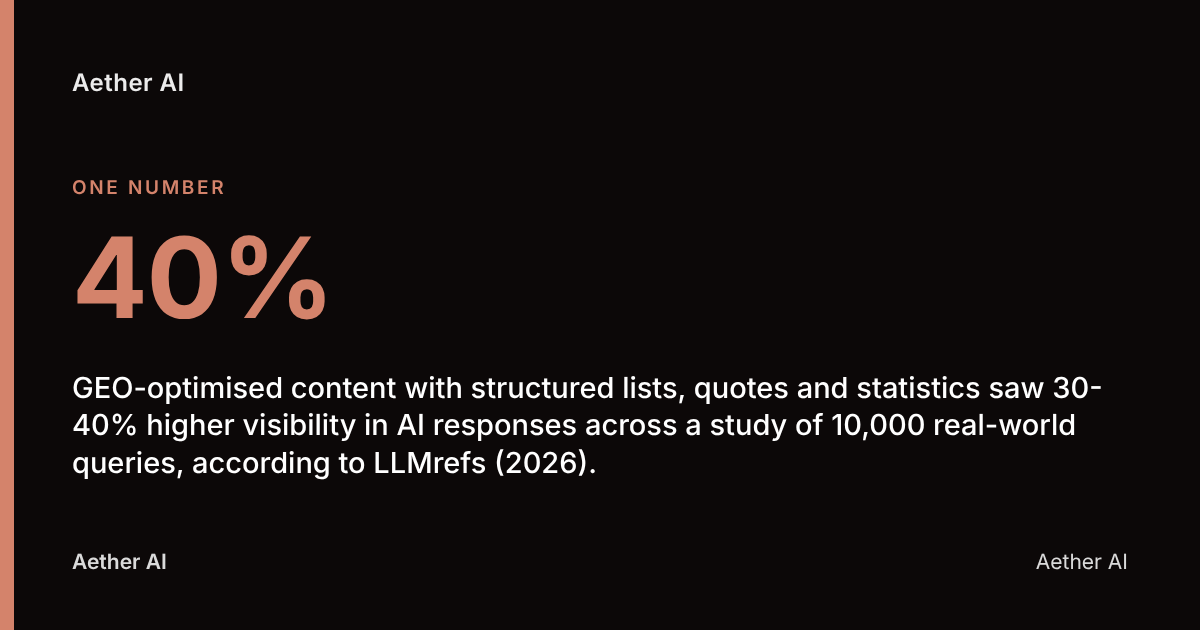
- GEO-optimised content with structured lists, quotes and statistics saw 30-40% higher visibility in AI responses across a study of 10,000 real-world queries, according to LLMrefs (2026).
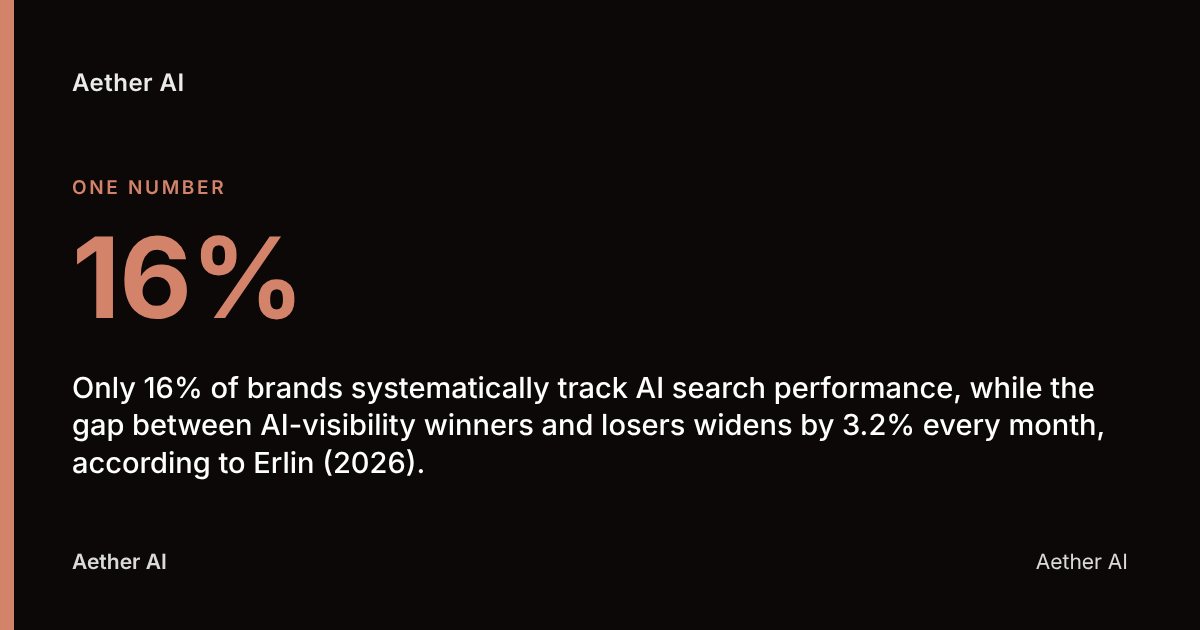
- Only 16% of brands systematically track AI search performance, while the gap between AI-visibility winners and losers widens by 3.2% every month, according to Erlin (2026).
- Aether AI's own baseline scan of 700 live AI engine queries across UK brand keywords (July–August 2026) found brands named in just 3.3% of answers overall, underlining how rare brand mentions still are even for established companies.
What is Claude, and how does it decide which brands to mention?
Claude is a large language model built by Anthropic, a San Francisco-based AI safety company, and it decides which brands to mention by combining two distinct processes: retrieving facts from its static training data, and pulling live results from web search when a query needs current information. When Claude's web search feature activates, it queries a search index and weighs results much like a human researcher would — checking source credibility, specificity and relevance before deciding what to cite.
Anthropic names Brave Search, TurboPuffer and Parallel Web Systems as subprocessors powering its web search function, according to Anthropic's own Trust Center. This matters enormously for brand visibility: if your site doesn't rank in Brave Search's non-sponsored results, it's structurally harder for Claude to surface it in response to live queries.
Three distinct Anthropic crawlers affect this process, as detailed by Search Engine Journal: ClaudeBot gathers training data, Claude-SearchBot indexes pages for search results, and Claude-User fetches pages in real time when a user's prompt triggers a live browse. Anthropic states plainly that "ClaudeBot helps enhance the utility and safety of our generative AI models by collecting web content that could potentially contribute to their training," per its official crawler documentation. Separately, Anthropic confirms "Anthropic's Bots respect 'do not crawl' signals by honoring industry standard directives in robots.txt."
Name bias is also measurable: across 904 brands tested in August 2026, models described positively named companies more favourably, with the newest model showing a name-bias effect roughly four times the smallest, according to Peec AI (2026). Brand naming, tone and framing in your own copy therefore has a quantifiable downstream effect on how Claude characterises you.
What's the difference between optimising for Claude and traditional SEO for Google?
Generative Engine Optimisation (GEO) — the practice of structuring content so AI assistants cite and recommend it — differs from traditional SEO because Claude doesn't rank ten blue links; it synthesises an answer and chooses a handful of sources to credit. Google SEO optimises for position in a results list; GEO optimises for inclusion in a single generated paragraph.
The overlap between top Google links and AI-cited sources has dropped from 70% to below 20%, according to Brandlight research cited by LLMrefs (2026). Ranking page one on Google no longer guarantees a mention in Claude's answer. Consumer behaviour backs this shift: 35% of US consumers now use AI at the product discovery stage compared with 13.6% who use traditional search, according to the Similarweb 2026 Generative AI Brand Visibility Index.
| Factor | Traditional Google SEO | Claude/GEO optimisation |
|---|---|---|
| Unit of success | Ranking position (1-10) | Inclusion in a synthesised answer |
| Primary signal | Backlinks, keywords, domain authority | Factual clarity, structure, third-party corroboration |
| Crawl behaviour | ~5.4 pages per referred visitor (Google) | ~38,066 pages per visitor (Anthropic), per Peec AI (2026) |
| Measurement | Rank tracking, click-through rate | Citation tracking across AI engines |
| Content reward | Keyword density, meta tags | Structured lists, quotes, statistics — 30-40% visibility lift, per LLMrefs (2026) |
"You can't buy your way in, and that's precisely the opportunity. Assistants reward the brand whose content actually answers the question with checkable specifics. Small firms outrank giants in AI answers every day — the shelf space is earned, not rented," says Lauren Dawkins, Head of Content at Aether AI.
What content formats make a brand more likely to be referenced by Claude?
Content structured with clear definitions, bullet lists, direct quotes and verifiable statistics is more likely to be referenced by Claude than unstructured prose. GEO-optimised content using these formats showed 30-40% higher visibility in AI responses, based on a study of 10,000 real-world queries, according to LLMrefs (2026).
Practically, this means every page should open with a direct answer to the question it targets, define jargon on first use, and present comparable data in tables rather than paragraphs. Claude's retrieval process favours content it can extract cleanly — a single self-contained sentence that states a fact, names its subject and source, is far easier to lift into an answer than a sentence buried in a subordinate clause three paragraphs deep.
A few formatting principles consistently help:
- Open each section with a one- or two-sentence direct answer before elaborating.
- Use markdown tables for comparisons (pricing, specifications, feature sets).
- Attribute every statistic to a named, linkable source.
- Define acronyms and technical terms the first time they appear.
- Keep paragraphs to two or three sentences so retrieval systems can isolate discrete facts.
Does Claude use real-time web data, and how does that affect visibility?
Claude uses both static training data and real-time web search, and the choice between them has a major effect on brand visibility. For general knowledge questions, Claude draws on what it learned during training — a snapshot that doesn't update until Anthropic retrains or fine-tunes the model. For queries needing current information, Claude activates web search via Brave Search and related subprocessors.
This dual system creates a visibility gap for newer or smaller brands: if your company launched or rebranded after Claude's last training cutoff, you exist in Claude's world only through live web search — meaning your current website, press mentions and third-party listings are doing all the work. Anthropic's crawler intensity reflects this appetite for fresh web content: Anthropic crawled roughly 38,066 pages per referred visitor in July 2025, versus Google's 5.4, according to Peec AI (2026). Claude is reading vastly more of the web than it's sending visitors back to.
Because Claude's search results overlap with Brave Browser's top non-sponsored results by 86.7% (2025), a brand's visibility in Claude during a live-search query is substantially tied to its performance in Brave's own index — a separate ranking system from Google's, worth checking independently.
How can I check whether Claude currently mentions my brand at all?
You can check Claude's current treatment of your brand by directly prompting it with the questions your customers would ask, such as "best [your category] providers in the UK" or "who offers [specific service] near [city]," and reviewing whether and how it responds. This manual spot-check is the simplest starting point, but it's inherently inconsistent — Claude's web search results can vary between sessions depending on query phrasing and live search results.
For anything beyond occasional spot-checks, systematic tracking matters more than most businesses realise. Only 16% of brands systematically track AI search performance, while the gap between AI-visibility winners and losers is 9x and widening at 3.2% every month, according to Erlin (2026). That compounding gap means brands that start measuring now have a structural advantage over those that wait.
Standard web analytics won't catch most of this traffic either: 70.6% of AI traffic currently arrives without referrer headers and is invisible in default analytics reporting, according to Erlin (2026). This is precisely the blind spot that dedicated citation tracking across engines — including Claude, ChatGPT, Perplexity, Google AI Overviews, Gemini and Copilot — is designed to close. Aether AI's free AI-visibility audit at /audit checks exactly this: whether your brand is currently named, and where it's being missed.
Aether AI's own baseline scan — 700 live AI engine queries against UK brands' target keywords between July and August 2026 — found brands named in just 3.3% of answers overall, with the longest-established brand tested (a security services firm) named in 6.3% of its 270 scans. Even an established company with years of market presence is absent from the overwhelming majority of relevant AI answers, which is the core problem GEO work sets out to fix.
What role do third-party sources play in getting recommended by Claude?
Review sites, trade press, forums and independent directories play an outsized role in Claude's recommendations because Claude treats third-party corroboration as a credibility signal, much as it treats a source's ranking in Brave Search. A brand's own website making a claim about itself carries less evidential weight to a language model than the same claim appearing on Trustpilot, in a trade publication, or discussed on a forum thread.
This is partly structural: Claude's citations draw from the same pool as Brave's non-sponsored search results at an 86.7% overlap rate, according to Profound (2025), and that pool includes review aggregators, news sites and community platforms alongside brand websites. A business with zero coverage outside its own domain is asking Claude to take its word for it — a weaker position than one corroborated by named, external sources.
For UK businesses specifically, this means cultivating a presence across:
- Sector-relevant trade bodies and membership directories (e.g. the SIA register for security firms, or relevant ISO certification bodies)
- Independent review platforms (Trustpilot, Google Business Profile reviews)
- Local and trade press coverage with named dates and specific claims
- Industry forums and Q&A communities where your category is genuinely discussed
How long does it take to see a brand start appearing in Claude's responses?
There's no fixed timeline for a brand to start appearing in Claude's responses, because it depends on whether the change affects Claude's static training data (which updates only when Anthropic retrains the model) or its live web search results (which can reflect new content within days once it's crawled and indexed by Brave Search).
Changes aimed at live search visibility — publishing a well-structured page, securing a piece of trade press coverage, fixing a robots.txt block — can show up in Claude's web-search-enabled answers once Brave and Anthropic's crawlers have indexed the new content, which is typically a matter of days to a few weeks rather than months. Changes that rely on Claude's training data shifting its underlying "knowledge" of your brand are a different matter entirely, since that only moves when Anthropic ships a new model version, which happens on its own schedule, not yours.
Given that the AI-visibility gap between winners and losers widens by roughly 3.2% every month, according to Erlin (2026), the practical lesson is to treat this as an ongoing programme rather than a one-off fix — consistent output and monitoring compound, sporadic effort does not.
Your Claude brand-visibility checklist
- Audit whether Claude currently mentions your brand using direct prompts and a dedicated tracking tool rather than guesswork.
- Confirm your robots.txt allows Anthropic's crawlers (ClaudeBot, Claude-SearchBot, Claude-User) unless you have a specific reason to block them.
- Check your ranking and visibility in Brave Search, not just Google, given the 86.7% overlap with Claude's citations.
- Restructure key pages to open with direct answers, define jargon inline, and use tables for comparisons.
- Pursue genuine third-party coverage — trade press, reviews, directories — rather than relying solely on owned content.
- Attribute every statistic and claim on your site to a named, checkable source.
- Set up citation tracking across Claude, ChatGPT, Perplexity, Google AI Overviews, Gemini and Copilot so you can measure change over time.
- Revisit and republish updated content on a regular cycle rather than treating GEO as a single project.
FAQ
How do I get Claude to recommend my brand?
You get Claude to recommend your brand by combining crawlable, well-structured website content with genuine third-party coverage — reviews, press and directory listings — since Claude's live search results overlap heavily with Brave Search's non-sponsored results. There's no paid placement option; visibility is earned through credibility signals Claude can verify.
Does Claude use Google, Bing or Brave for web search?
Claude's web search function uses Brave Search alongside other subprocessors, TurboPuffer and Parallel Web Systems, as listed on Anthropic's Trust Center — not Google or Bing directly. This means Brave Search ranking factors matter specifically for Claude visibility, separately from Google SEO.
How do I block or allow ClaudeBot in robots.txt?
You control ClaudeBot access by adding directives to your robots.txt file, which Anthropic states it honours as "industry standard directives," according to Anthropic's own crawler documentation. Anthropic operates three distinct bots — ClaudeBot, Claude-SearchBot and Claude-User — each controllable separately, as detailed by Search Engine Journal.
What is the fastest way to get my brand mentioned in Claude?
The fastest realistic route is improving your visibility in Brave Search's non-sponsored results, since these overlap with Claude's citations by 86.7%, according to Profound (2025). Pairing that with a clearly structured page answering the exact question your customers ask gives Claude's live search function the clearest possible signal to cite you.
How do I check if Claude mentions my brand?
You check by prompting Claude directly with realistic customer questions, or by using a dedicated citation-tracking tool that scans multiple AI engines systematically. Manual checks are useful for spot-checking, but only 16% of brands track AI search performance systematically, according to Erlin (2026), which is precisely why most businesses have no real picture of their AI visibility.
What is Generative Engine Optimisation (GEO) and how does it differ from SEO?
Generative Engine Optimisation (GEO) is the practice of structuring content so AI assistants like Claude, ChatGPT and Gemini select and cite it when generating answers, rather than optimising purely for a ranked list of links. GEO rewards structured, fact-dense, source-attributed content; traditional SEO rewards backlinks, keyword targeting and domain authority within a ranked results page.
How does Claude decide which brands to cite or recommend?
Claude decides by weighing a combination of its training data and, for live queries, results pulled via Brave Search and related subprocessors — favouring sources with clear factual claims and credible external corroboration. Positively framed brand names also receive a measurable favourability boost, with the effect roughly four times stronger in newer models, according to Peec AI (2026).
Getting your brand into Claude's answers with Aether AI
This article has covered how Claude's citation behaviour hinges on Brave Search overlap, structured content and third-party corroboration — exactly the gap Aether AI's platform is built to close for UK businesses. Rather than guessing whether Claude mentions your brand, Aether AI tracks citations across Claude alongside ChatGPT, Perplexity, Google AI Overviews, Gemini and Copilot, so you can see precisely where you're named and where competitors are winning the mention instead.
Aether AI's own baseline scan of 700 live AI engine queries against UK brands' target keywords (July–August 2026) found brands named in just 3.3% of answers overall — a figure that shows how much headroom exists even for established companies, and why systematic tracking matters more than sporadic manual checks. Aether AI is built and operated by Aether Agency Ltd; where results are drawn from Priority First, Pulse Operations or Aether Agency, these are businesses connected to the founding team, and this is stated wherever they're cited.
If you want to see exactly where your brand currently stands in Claude's answers, start with Aether AI's free AI-visibility audit at /audit, or review public pricing to explore ongoing citation tracking, keyword and competitor monitoring, and GSC integration built for this exact problem.