Last updated: 20 November 2026
Getting content cited in Google AI Overviews means earning a link inside the AI-generated summary box that now appears above traditional results for many UK search queries. 52% of AI Overview citations come from the top-10 Google organic search results, according to Originality.AI (2025), so ranking well remains the starting point, not the whole answer.
Key Takeaways
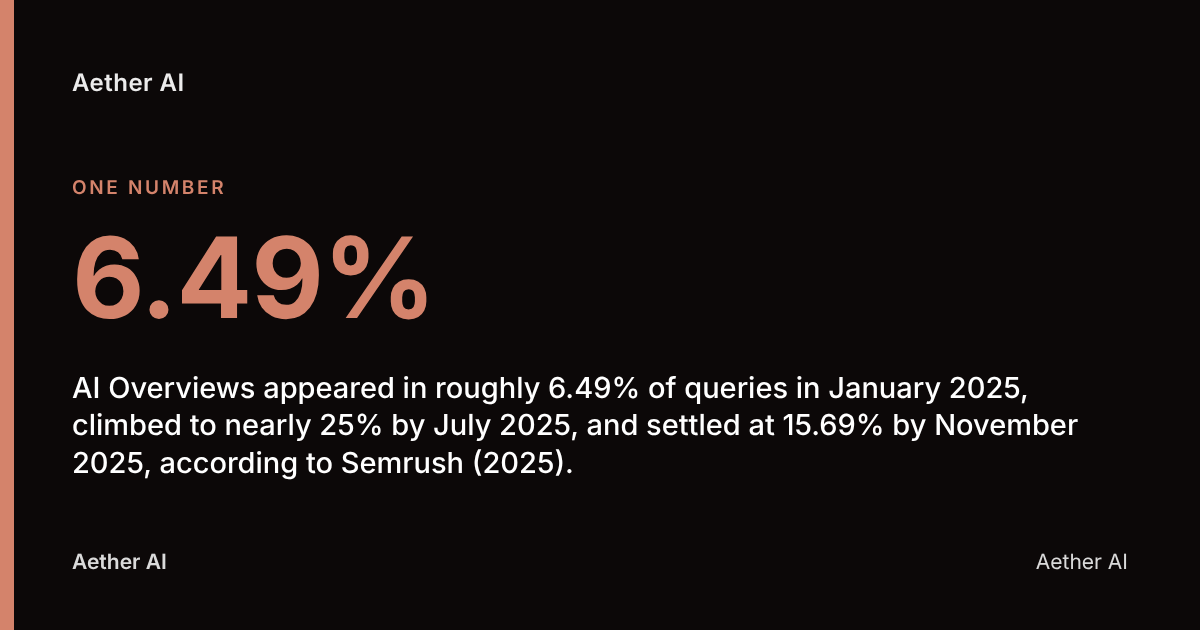
- AI Overviews appeared in roughly 6.49% of queries in **January 2025, climbed to nearly 25% by July 2025, and settled at 15.**69% by November 2025, according to Semrush (2025).
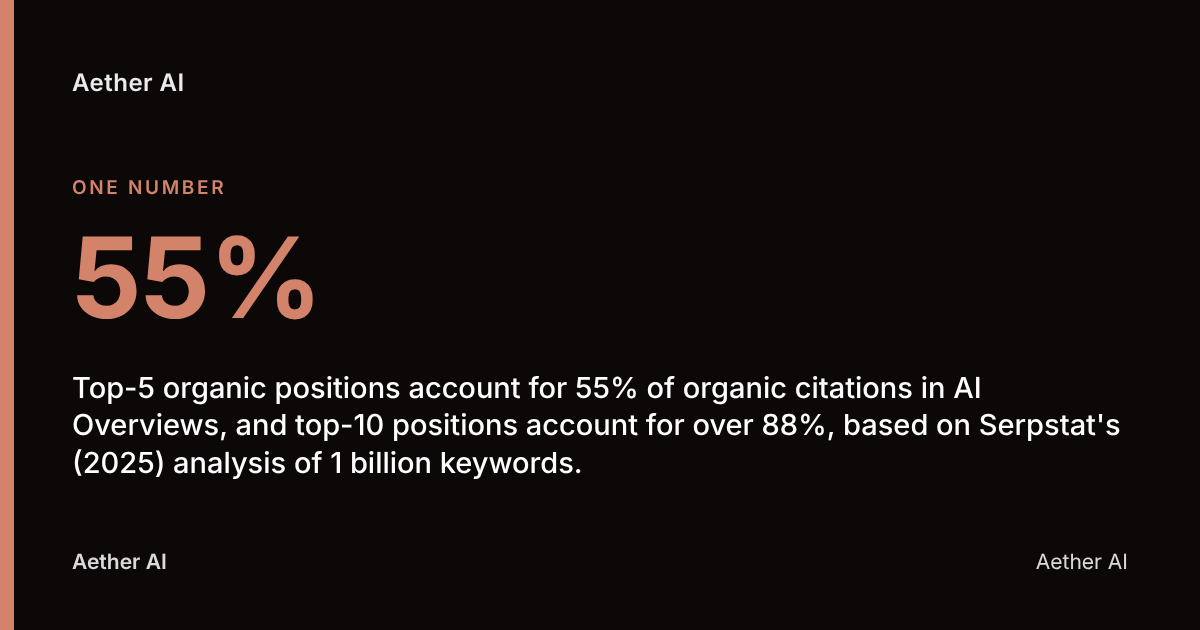
- Top-5 organic positions account for 55% of organic citations in AI Overviews, and top-10 positions account for over 88%, based on Serpstat's (2025) analysis of 1 billion keywords.
- A typical AI Overview runs 157 words and cites around 5 sources per query, per SurferSEO (2025) analysis of over 400,000 overviews.
- Brands cited in an AI Overview saw roughly 35% higher organic click-through rate than uncited results on the same results page, according to Seer Interactive (2025).
- Wikipedia, YouTube, Google's own properties, Reddit and Amazon together account for 38% of all AI Overview citations, per The Digital Bloom (2025).
What are Google AI Overviews?
Google AI Overviews are AI-generated summaries that Google places above standard search results, synthesising information from multiple web pages into a single answer with linked citations. They differ from traditional "ten blue links" results because the system writes a direct answer rather than simply listing matching pages, and they differ from the older featured snippet format because they pull from several sources at once rather than quoting a single page.
An AI Overview typically runs 157 words and cites around five sources per query, according to SurferSEO (2025). That means a search for a single question can surface a compact answer plus a short list of linked sources, all before the reader scrolls to any conventional result.
The feature has grown unevenly since launch. AI Overviews appeared in about 6.49% of **UK and global queries in January 2025, rose to nearly 25% by July 2025, then settled at 15.**69% in November 2025, according to Semrush (2025). That volatility matters for any business professional tracking visibility in London, Manchester or Edinburgh search markets: a query that triggers an overview this month may not next month, and vice versa.
Google's own documentation is explicit that there is no separate submission process. "Structured data isn't required for generative AI search, and there's no special schema.org markup you need to add," according to Google Search Central. Citation in AI Overviews follows from normal search visibility, not a parallel optimisation track.
What factors determine whether a page gets cited?
Ranking position is the strongest single factor behind AI Overview citation, though the strength of that link is shifting. Top-5 organic positions account for 55% of all organic citations in AI Overviews, while top-10 positions account for over 88%, based on Serpstat's (2025) analysis of 1 billion keywords and 35 million AI Overviews.
That overlap is not fixed. Ahrefs found that in July 2025, the large majority of AI Overview citations came from pages already ranking in the organic top 10, but a March 2026 study of 863,000 keywords put that overlap much lower. The gap suggests Google's AI system is increasingly pulling from pages that would not otherwise reach page one, likely because the underlying large language model evaluates relevance and clarity rather than ranking signals alone.
Domain type plays a visible role too. Wikipedia, YouTube, Google's own properties, Reddit and Amazon collectively account for 38% of all AI Overview citations, according to The Digital Bloom (2025), reflecting Google's preference for large, frequently updated, well-structured reference sources. Separately, Ahrefs found YouTube is the single most cited domain, growing 34% in six months, underlining how video content now competes directly with text articles for citation space.
For a UK business, this means a page does not need to be a Wikipedia-scale property to be cited, but it does need clear, direct answers that a generative model can lift cleanly, alongside the conventional signals Google has always rewarded.
How content structure helps increase citation likelihood
Content structured around a clear, direct answer in the opening sentences is far more likely to be lifted into an AI Overview than content that builds an argument gradually. Research across the sector consistently shows that definitional, direct-answer openings are favoured by retrieval systems, because the model can extract a single self-contained sentence without needing to interpret context from surrounding paragraphs.
Practical structural choices that help:
- Open each section with a direct answer in the first one or two sentences, naming the subject rather than using "it" or "this".
- Use a clean H2/H3 hierarchy rather than bold text pretending to be a heading, since retrieval systems use heading structure to decide where a passage begins and ends.
- Answer one distinct question per section, avoiding repetition across the page.
- Use tables for comparisons, lists for sequential steps, and FAQ sections with questions phrased as a searcher would ask them.
- Keep paragraphs short, typically two to three sentences, so a single paragraph can stand alone as a citation.
None of this requires schema markup specific to AI, per Google Search Central, though standard FAQ and HowTo structured data still helps traditional search features and makes the content easier for any crawler to parse.
How much existing SEO performance matters
Existing organic ranking remains the clearest predictor of AI Overview citation, though its influence has weakened over the past year. Top-10 organic results account for 52% of citations, according to Originality.AI (2025), while SurferSEO's (2025) analysis of 405,576 AI Overviews found 52% of cited sources also rank in the top 10, a strikingly consistent figure across two independent studies.
That consistency, paired with the drop recorded over the same period, tells a two-part story. Ranking well still helps enormously, but it is no longer sufficient on its own. A page with moderate backlink authority and weaker domain history can still be cited if its content answers the query more precisely than higher-ranking competitors.
| Factor | Influence on AI Overview citation |
|---|---|
| Top-10 organic ranking | Strongest single factor, though overlap has fallen from 76% to 38% in under a year per Ahrefs data |
| Domain authority / backlinks | Correlates with ranking, so indirectly supports citation likelihood |
| Direct-answer content structure | Increasingly decisive as Google's model favours extractable passages |
| Large reference domains (Wikipedia, YouTube, Reddit) | Account for 38% of citations collectively, per The Digital Bloom |
| Freshness and update frequency | Favoured for time-sensitive or regulatory queries |
For business professionals weighing where to invest, the practical takeaway is that SEO fundamentals (technical health, backlinks, relevant keyword targeting) remain necessary groundwork, but the content itself now carries more weight than it did a year ago.
What role does E-E-A-T play in citation?
E-E-A-T, Google's framework for experience, expertise, authoritativeness and trust, shapes which sources a generative system treats as reliable enough to summarise and cite. Google has applied E-E-A-T to its core search quality rater guidelines for years, and the same signals, author credentials, cited sources, transparent company information, and a track record on the topic, appear to inform which pages the AI Overview system trusts.
A page written by a named author with relevant professional experience, that cites its own sources transparently, and that sits on a domain with a consistent publishing history, aligns with everything the quality rater guidelines ask for. This is particularly visible on YES/YMYL topics (health, finance, legal and safety content), where Google has historically applied the strictest scrutiny, and where regulators such as the Information Commissioner's Office and the Financial Conduct Authority expect accurate, attributable information.
Trust signals that matter in practice include a clear company registration (Companies House details, for a UK business), real author bylines, and citations to primary sources such as gov.uk, the Health and Safety Executive, or sector-specific bodies, instead of circular references to other blogs.
"It's a land grab: venture-funded dashboards, SEO suites bolting on AI modules, and platforms that actually produce and publish content. Judge them by what happens after the report, visibility you can't act on is just a prettier way to worry," said Lauren Dawkins, Head of Content, Aether AI
How to track whether your content is being cited
Measuring AI Overview citation requires different tools than traditional rank tracking, because Google Search Console does not yet separate AI Overview clicks from standard organic clicks in a labelled way. Several third-party platforms, including SEO-focused crawlers and dedicated GEO tools, now scan live AI engines and record whether a brand or URL appears in the answer.
Aether AI tracks citation across six AI engines: ChatGPT, Perplexity, Google AI Overviews, Claude, Gemini and Microsoft Copilot, alongside Google Search Console integration, so a business professional can see whether a page ranking on page one is also being cited inside the AI Overview for the same query. Aether AI has published a measured AI-visibility baseline from 700 live AI engine scans of UK brands' target keywords run in July and August 2026: across that sample, the brands were named in 23 answers, 3.3% of scans, while the longest-established brand, a security services company, was named in 6.3% of its 270 scans. That gap between an established brand and the average illustrates how unevenly citation is currently distributed, even among brands actively competing for the same terms.
Separately, two of the founding team's own properties, Priority First and Aether Agency, recorded that 82.1% and 88.3% respectively of their Google Search Console clicks between 19 July and 15 August 2026 came from queries Google does not name in its Queries report, because Google leaves rare and low-volume queries out of its reports to protect searchers' privacy. Aether AI is built and operated by Aether Agency Ltd. Priority First, Pulse Operations and Aether Agency are businesses connected to the founding team.
AI Overview citation versus ranking in traditional organic search
Being cited in an AI Overview changes the shape of visibility instead of simply adding to it. A cited brand saw roughly 35% higher organic click-through rate than an uncited result on the same search results page, according to Seer Interactive (2025), suggesting the citation itself builds trust that carries through to the organic listing below it.
| Traditional organic ranking | AI Overview citation | |
|---|---|---|
| Visibility surface | Ranked list position | Summarised answer box above results |
| Click behaviour | Direct click to page | Citation link, often secondary to the answer text |
| Typical CTR impact | Varies by position | Cited brands see about 35% higher CTR than uncited peers on the same SERP |
| Dependence on ranking | Primary driver | Correlated but weakening: overlap fell from 76% to 38% within a year |
| Measurement | Google Search Console rank tracking | Requires dedicated AI-engine scanning tools |
The two are not competing goals. A page that ranks well and is structured for direct extraction stands the best chance of achieving both outcomes at once.
Your AI Overview citation checklist
- Confirm the target page already ranks, ideally in the top 10, for its core query.
- Open the page, and each major section, with a direct, self-contained answer in the first two sentences.
- Use a clean H1/H2/H3 hierarchy with no skipped levels and no bold text standing in for headings.
- Name the author and link to genuine credentials or company registration details.
- Cite primary sources (gov.uk, regulators, recognised studies) instead of other blogs.
- Add an FAQ section phrased in the language searchers actually use.
- Track citation across multiple AI engines, not Google alone, since Perplexity, ChatGPT and Gemini surface different sources.
- Revisit and refresh the page regularly, since AI Overview prevalence itself has swung from 6.49% to nearly 25% of queries within a single year.
FAQ
Do you need to rank number one to appear in Google AI Overviews?
No. Top-10 organic positions account for over 88% of organic citations according to Serpstat (2025), but a page ranking lower than first can still be cited if it answers the query more directly than competitors.
Is structured data or schema markup required for AI Overviews?
No. Google states plainly that "structured data isn't required for generative AI search, and there's no special schema.org markup you need to add," according to Google Search Central. Standard FAQ or HowTo schema still supports traditional search features.
Is there a way to submit a page directly to Google AI Overviews?
No. There is no submission form or direct inclusion process. Citation follows from normal crawling, indexing and the same quality signals Google has always used, applied by the generative model at query time.
How does query fan-out affect which pages get cited?
Google's AI system often breaks a single query into several related sub-questions internally, pulling different sources to answer each part before combining them into one summary. A page that answers one sub-question precisely and completely has a better chance of being selected for that specific portion of the overview.
Where Aether AI fits into AI Overview visibility
Chasing an AI Overview citation blind, with no way to see whether a page actually appears in the answer, leaves a business professional guessing at what's working. Aether AI was built to close that gap: it generates AI-optimised articles structured around direct answers and clean heading hierarchy, then tracks whether those pages get cited across ChatGPT, Perplexity, Google AI Overviews, Claude, Gemini and Copilot.
The platform's own measured baseline, 700 live AI engine scans run in July and August 2026, showed UK brands named in just 3.3% of scans overall, evidence that most businesses competing for the same queries are still invisible in these answers. A free AI-visibility audit at /audit shows where a business currently stands before any content work begins, and public pricing at /pricing sets out the plans available. For a business professional wanting to know if their SEO is healthy, and also whether AI engines are actually citing their content, that's the specific question Aether AI is built to answer.