Last updated: 10 November 2026
Quick answer: GEO (Generative Engine Optimisation) is an ongoing process, not a one-off project, because AI platforms re-crawl and re-rank content continuously. Pages not updated quarterly are three times more likely to lose their AI citations entirely, according to Writer's 2026 report, meaning a single GEO fix decays within months.
Key Takeaways
- GEO is an ongoing process: pages not updated quarterly are 3x more likely to lose AI citations entirely, and content refreshed within 30 days earns 3.2x more AI citations than older pages, according to Writer's 2026 analysis citing Kevin Indig's State of AI Search Optimization report.
- A one-off AI citation audit goes stale fast: its findings are outdated within 30 to 90 days, according to Intelligent Resourcing (2026).
- Early GEO signals appear quickly but take time to mature: brand mentions can surface within 2–6 weeks, while comprehensive AI rankings take 3–6 months, according to LinkedIn analysis by Thomas (2025).
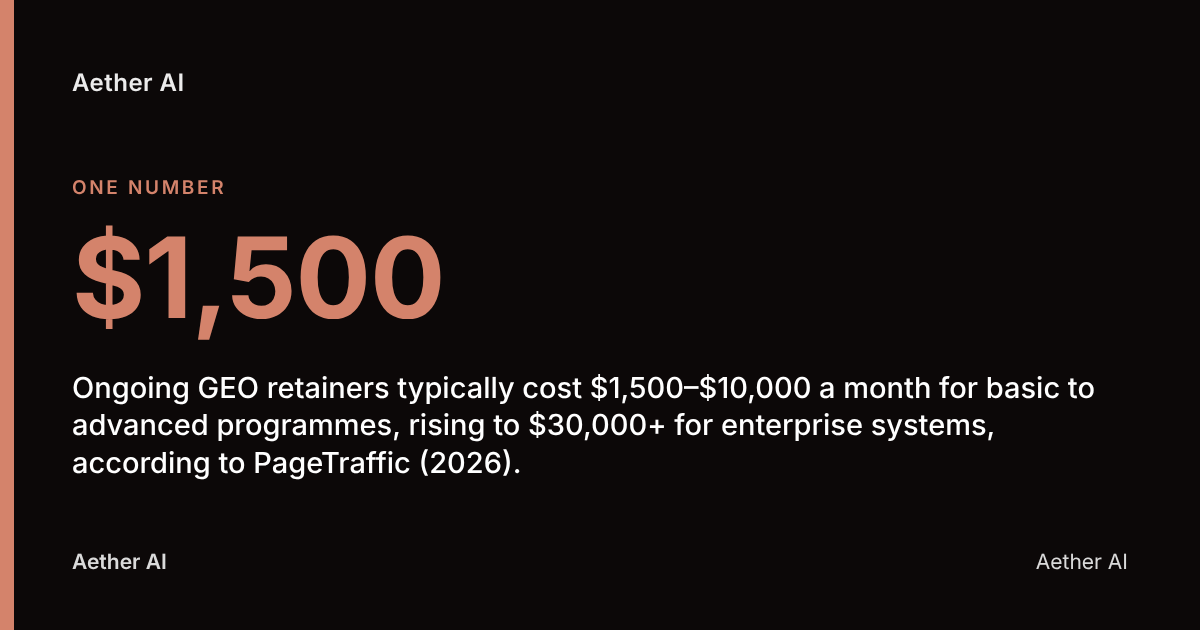
- Ongoing GEO retainers typically cost $1,500–$10,000 a month for basic to advanced programmes, rising to $30,000+ for enterprise systems, according to PageTraffic (2026).
- Aether AI has published 281 articles across the brands it writes for in the last 30 days, reflecting the continuous publishing cadence GEO maintenance demands.
What is GEO (Generative Engine Optimisation)?
GEO (Generative Engine Optimisation) is the practice of structuring, writing and maintaining content so that AI answer engines — ChatGPT, Perplexity, Google AI Overviews, Claude, Gemini and Microsoft Copilot — cite, quote or recommend a brand in their generated responses. Unlike a traditional web page built once and left alone, GEO targets a moving target: large language models that retrain, re-rank sources and change which pages they trust on a rolling basis.
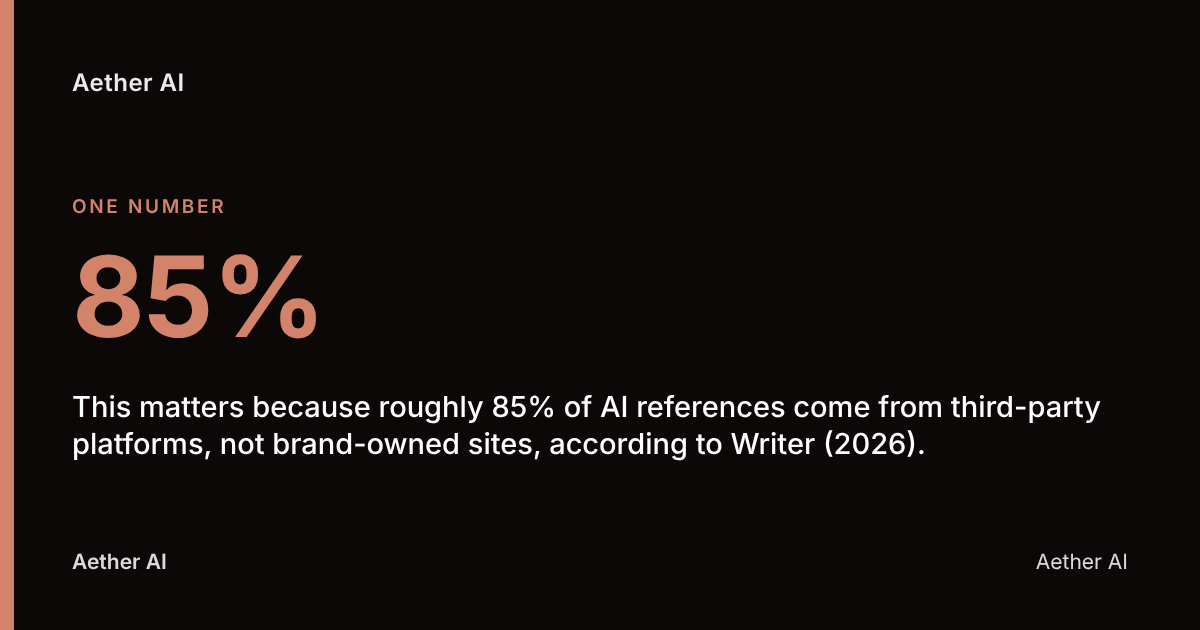
This matters because roughly 85% of AI references come from third-party platforms, not brand-owned sites, according to Writer (2026). A business cannot simply publish a page once and assume an AI model will keep surfacing it; the model is drawing from a wide, shifting pool of sources, and a brand's own site is only one small part of that pool.
GEO overlaps with SEO (search engine optimisation, the discipline of ranking in traditional results such as Google's blue links) but differs in one critical way: it optimises for extraction and citation inside a generated answer, not for a ranked list a user scrolls through. For UK businesses, Companies House-registered or not, this shift matters because click-through rates on the top organic result have dropped by up to 58% for queries triggering Google AI Overviews, according to Xpert.Digital (2026). Visibility inside the AI answer itself is becoming the primary channel, not a bonus.
Why GEO Needs to Be Ongoing, Not a One-Off Task
GEO needs to be ongoing because AI models retrain, re-crawl and reweight sources continuously, which means a page optimised today can lose its citation status within weeks. A one-off AI citation audit's findings go stale in 30 to 90 days, according to Intelligent Resourcing (2026).
The decay mechanics are measurable. Pages not updated quarterly are three times more likely to lose their AI citations entirely, while content refreshed within the last 30 days earns 3.2 times more AI citations than older content, according to Writer's 2026 report citing Kevin Indig's State of AI Search Optimization 2026 study. That is not a marginal difference — it is the gap between appearing in an AI Overview and disappearing from one.
Several industry voices put this plainly. SEOptimer advises agencies to "position GEO as an ongoing service, not a one-time project," adding that "like traditional SEO, GEO requires ongoing optimization." TheBestGEO describes GEO as "a long-term, subscription-based service, similar to SEO." Yellow Circle calls it simply "an ongoing strategic process." Not every commentator agrees — some, like GoDigitN, argue "most of GEO is a one-off fix" — but the weight of evidence and the mechanics of how AI models refresh their training and retrieval data point firmly towards continuous work.
How Often AI Search Engines Change, Forcing GEO Updates
AI search engines update their underlying models, ranking signals and retrieval sources far more frequently than Google's traditional algorithm did during the 2010s, and each change can reshuffle which pages get cited. Google AI Overviews, ChatGPT's browsing and retrieval layer, Perplexity's indexing, Claude's web search feature, Gemini and Microsoft Copilot each run on separate update cycles that are not publicly scheduled in advance.
This creates a compounding problem for any business treating GEO as a single project:
- Model retraining changes which sources an AI engine trusts, without warning.
- Retrieval index refreshes can drop a previously cited page overnight if a competitor's content is judged more current.
- New AI engines (Perplexity's rapid UK growth, Microsoft Copilot's integration into Windows 11) create fresh surfaces a brand must monitor separately.
- Third-party platform changes matter disproportionately, since 85% of AI references come from third-party platforms rather than brand sites, according to Writer (2026) — meaning a Reddit thread, a Wikipedia edit or a review site update can shift citation patterns without the brand touching its own page at all.
Aether AI tracks citation performance across six AI engines — ChatGPT, Perplexity, Google AI Overviews, Claude, Gemini and Copilot — precisely because a change on any one of them can move a brand's visibility independently of the others.
One-Off GEO Project vs Ongoing GEO Retainer: Cost Comparison
A one-off GEO audit and an ongoing GEO retainer solve different problems, and the price difference reflects that. The table below sets out typical ranges reported across the industry.
| Engagement type | Typical monthly cost | What it delivers | Shelf life of results |
|---|---|---|---|
| One-off AI citation audit | Single fixed fee (not a monthly figure) | A snapshot of current AI visibility and gaps | Findings go stale in 30–90 days, according to Intelligent Resourcing (2026) |
| Basic ongoing GEO retainer | $1,500–$10,000/month | Regular content refresh, monitoring, basic reporting | Sustained while retainer is active |
| Advanced/enterprise GEO programme | Up to $30,000+/month | Full content strategy, multi-engine tracking, competitor monitoring | Sustained while programme is active |
| Full agency GEO service range | $1,500–$50,000+/month | Varies by business size, site complexity and scope | Sustained while engaged |
Figures from WebFX (2026) and PageTraffic (2026).
The pattern is consistent across both sources: GEO is priced and sold as a recurring monthly service, not a one-time fee, because the work itself is recurring. A UK business budgeting for GEO should think in terms of a monthly line item — similar to an SEO retainer or a PR retainer — rather than a single capital project cost.
GEO vs SEO: Is One More of a One-Off Than the Other?
GEO and SEO (search engine optimisation) are both continuous disciplines, but GEO's update cadence is arguably faster because AI model behaviour shifts less predictably than Google's documented algorithm updates. SEO practitioners in the UK have worked for over two decades with known patterns — Google Search Console data, documented core updates, the E-E-A-T framework (experience, expertise, authoritativeness, trustworthiness). GEO lacks that maturity; there is no equivalent public changelog for ChatGPT's retrieval weighting or Perplexity's source ranking.
Both disciplines share the same underlying truth: content decays if left untouched. Writer's research shows content updated within 30 days earning 3.2x more AI citations than stale content — a decay curve similar in shape to how Google's algorithm deprioritises outdated pages in organic search. 24Seven Talent summarises the practical implication well: "Success requires ongoing testing and adaptation, not a set-it-and-forget-it approach."
The key difference UK marketers should note: Google AI Overviews are already suppressing organic click-through by up to 58% on affected queries, according to Xpert.Digital (2026), which means SEO and GEO are converging into a single, continuous discipline rather than two separate budgets.
Tasks Involved in Maintaining GEO Performance Month to Month
Maintaining GEO month to month involves a defined set of recurring tasks, not a single implementation phase. A business running an ongoing GEO programme should expect to repeat these actions on a rolling basis:
- Re-run citation tracking across ChatGPT, Perplexity, Google AI Overviews, Claude, Gemini and Copilot to spot gains and losses.
- Refresh existing content at least quarterly — pages left untouched are three times more likely to lose citations, according to Writer (2026).
- Publish new content addressing emerging questions in the brand's sector, since AI engines favour recently updated sources.
- Monitor third-party platforms such as review sites, forums and Wikipedia, given that 85% of AI references originate there rather than on brand-owned domains.
- Check Google Search Console for query-level data, including the growing share of "not provided" queries that Google does not name.
- Review competitor visibility across the same six AI engines to spot where a rival has displaced the brand.
- Update structured data and schema markup to help AI crawlers parse page content accurately.
- Report findings to stakeholders monthly, tracking trend lines rather than single snapshots.
This is the same rhythm Aether AI's platform is built to automate — citation tracking, keyword and competitor tracking, and Google Search Console integration running continuously rather than as a one-time audit.
Who Manages GEO Over Time: In-House Team or Agency?
UK businesses typically assign ongoing GEO responsibility to one of three groups: an in-house marketing or SEO lead, an external GEO/SEO agency, or a self-service platform that automates the recurring work. Each option suits a different stage of business maturity.
In-house teams work well when a business already has a dedicated SEO or content lead with capacity to add AI-visibility monitoring to their remit. The risk is bandwidth — GEO's recurring nature means it competes with other marketing priorities every month.
Agencies suit businesses wanting hands-off management but require ongoing retainer budgets of $1,500–$50,000+ per month depending on scope, according to WebFX (2026). This works well for larger organisations but can be disproportionate for smaller teams.
Self-service platforms like Aether AI sit between the two: founders, in-house marketers and SEO leads can run automated AI-optimised article generation, citation tracking and competitor monitoring themselves, without committing to a full agency retainer or hiring a dedicated specialist. This suits UK SMEs and growing teams who need the ongoing cadence GEO demands without the overhead of either extreme.
How Long GEO Results Take to Appear — and Whether They Last
GEO results typically begin appearing within weeks, but they do not persist without continued work. Initial brand mentions can surface within 2–6 weeks, while comprehensive AI rankings take 3–6 months depending on industry, competition and content quality, according to LinkedIn analysis by Thomas (2025). Separately, WebFX (2026) reports most businesses see early signals, such as increased impressions, within four to eight weeks.
The crucial point is durability. Because pages not updated quarterly are three times more likely to lose citations entirely, according to Writer (2026), early wins are not permanent. A brand that achieves a citation in month two and then stops publishing or refreshing content risks losing that same citation by month five or six as competitors' fresher content displaces it.
Aether AI's own measured baseline illustrates how competitive this landscape is even for established brands: across 700 live AI engine scans of UK brands' target keywords between July and August 2026, the brands were named in 23 answers — 3.3% of scans overall, with the longest-established brand (a security services business) named in 6.3% of its 270 scans. That baseline reflects how much continuous work is needed to move visibility beyond a small single-digit percentage.
Your GEO ongoing-vs-one-off checklist
- Run an initial AI citation audit to establish a baseline across all six major AI engines.
- Set a quarterly content refresh schedule at minimum — Writer's data shows this is the threshold below which citations are three times more likely to be lost.
- Budget for a recurring monthly spend, not a single project fee, using the $1,500–$50,000+ range as a guide depending on scale.
- Track citations across ChatGPT, Perplexity, Google AI Overviews, Claude, Gemini and Copilot every month, not once.
- Monitor third-party platforms given that most AI references come from outside brand-owned sites.
- Review Google Search Console data monthly, including the share of unnamed ("not provided") queries.
- Reassess strategy whenever a new AI model or feature launches, not on a fixed annual cycle.
- Assign clear ownership — in-house, agency or self-service platform — so the recurring tasks do not lapse.
FAQ
Is GEO a one-off project or an ongoing process?
GEO is an ongoing process. Pages not updated quarterly are three times more likely to lose their AI citations entirely, according to Writer's 2026 report, which means a single implementation phase cannot sustain visibility indefinitely.
How much does ongoing GEO support cost per month in the UK?
Ongoing GEO retainers typically cost $1,500–$10,000 a month for basic to advanced programmes, rising to $30,000+ a month for enterprise-level systems, according to PageTraffic (2026). The broader agency market ranges from $1,500 to $50,000+ monthly depending on business size and scope, according to WebFX (2026).
What's the difference between a one-off GEO audit and a GEO retainer?
A one-off GEO audit delivers a single snapshot of AI visibility that becomes outdated within 30 to 90 days, according to Intelligent Resourcing (2026). A GEO retainer delivers continuous monitoring, content refresh and reporting that sustains results over time.
How long does it take to see results from GEO?
Early brand mentions can appear within 2–6 weeks, with comprehensive AI rankings taking 3–6 months, according to LinkedIn analysis by Thomas (2025). Separately, WebFX (2026) notes most businesses see early impression gains within four to eight weeks.
Can a business do a one-off GEO scan instead of a monthly retainer?
A one-off scan provides a useful starting baseline but cannot sustain AI visibility alone. Because AI citation findings go stale within 30 to 90 days, according to Intelligent Resourcing (2026), a scan without follow-up content work will see its findings — and any resulting citations — decay within a single quarter.
Why does GEO performance decline if work is paused?
GEO performance declines because AI models continuously favour fresher, more recently updated content over static pages. Content updated within the last 30 days earns 3.2 times more AI citations than older content, according to Writer's 2026 analysis, so pausing updates hands that advantage to competitors who keep publishing.
Is GEO more expensive than traditional SEO?
GEO and SEO retainer pricing overlap significantly, with GEO agency services ranging from $1,500 to $50,000+ monthly, according to WebFX (2026) — similar ranges to established SEO retainers. The real cost difference is urgency: Google AI Overviews already cut top-result click-through by up to 58% on affected queries, according to Xpert.Digital (2026), making delayed GEO investment costlier in lost organic traffic.
Tracking your ongoing GEO performance with Aether AI
This article has shown why GEO cannot be treated as a one-off audit — citations decay within 30 to 90 days without follow-up, and content left stale for a quarter is three times more likely to disappear from AI answers altogether. Aether AI was built specifically to handle this recurring workload: automated AI-optimised article generation, citation tracking across six AI engines (ChatGPT, Perplexity, Google AI Overviews, Claude, Gemini and Microsoft Copilot), keyword and competitor tracking, and Google Search Console integration, all running continuously rather than as a single project.
Aether AI is built and operated by Aether Agency Ltd. Priority First, Pulse Operations and Aether Agency are businesses connected to the founding team, and the platform's own measured baseline of 700 AI engine scans across UK brands (July–August 2026) is used to demonstrate, transparently, how much ongoing work genuine AI visibility requires. Aether AI has published 281 articles across those brands in the last 30 days alone, reflecting the publishing cadence this article describes as necessary rather than optional.
If your business is weighing up a one-off GEO audit against sustained, ongoing visibility, start with Aether AI's free AI-visibility audit to see where you currently stand, then check public pricing to find a plan that fits an ongoing — not one-off — approach to GEO.