Last updated: 3 November 2026
LLM SEO means optimising a website's content so that large language models — the AI systems behind ChatGPT, Gemini, Claude and Microsoft Copilot — find, understand and cite it when answering user questions. Unlike traditional SEO, it targets AI-generated answers rather than ranked blue links, and UK interest has surged as AI Overviews and chatbots increasingly replace the standard search results page.
Key Takeaways
- Aether AI explains that LLM SEO stands for optimisation of content for large language models, so AI chat tools cite a business rather than just ranking its webpage.
- Branded web mentions correlate with AI visibility roughly three times more strongly than backlinks (0.664 vs 0.218), according to Ahrefs via Piperocket (2025).
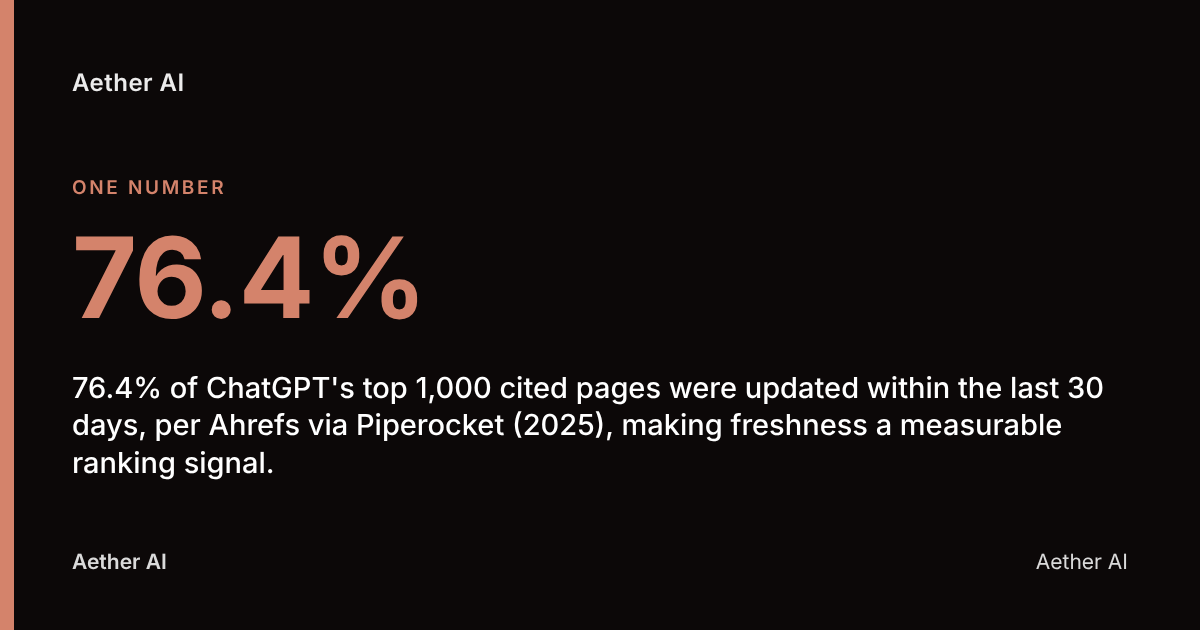
- 76.4% of ChatGPT's top 1,000 cited pages were updated within the last 30 days, per Ahrefs via Piperocket (2025), making freshness a measurable ranking signal.
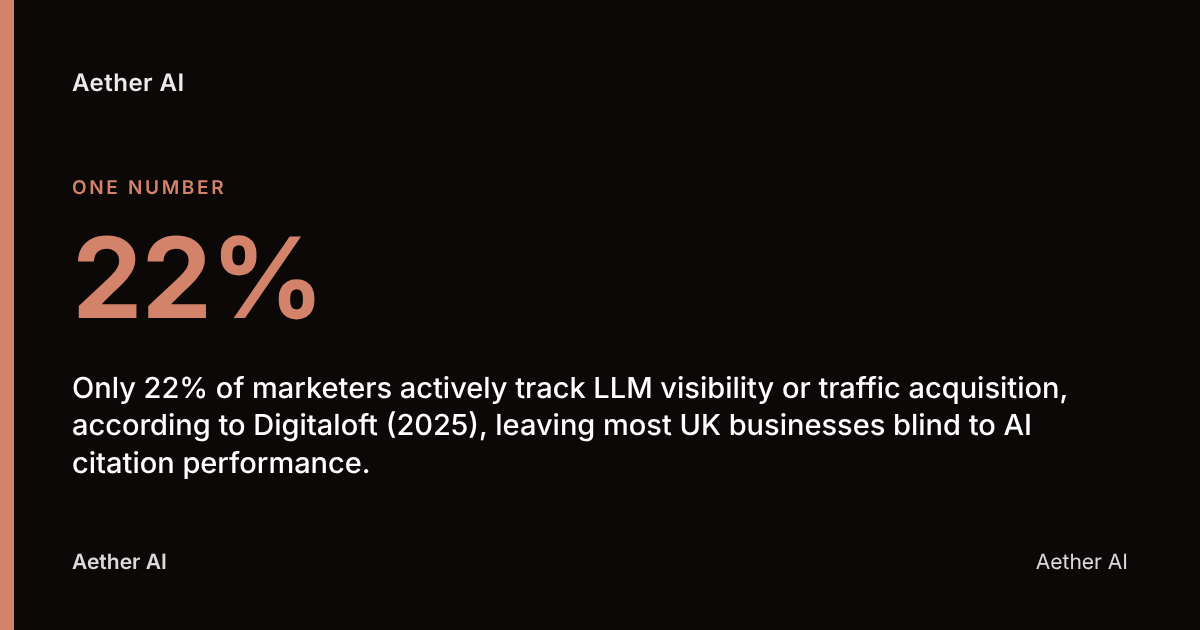
- Only 22% of marketers actively track LLM visibility or traffic acquisition, according to Digitaloft (2025), leaving most UK businesses blind to AI citation performance.
- Generative Engine Optimisation (GEO) methods can lift content visibility in AI answers by up to 40%, per the original Princeton University research (2024).
What does LLM SEO mean?
LLM SEO is the practice of structuring, writing and technically preparing website content so that large language models — AI systems such as OpenAI's ChatGPT, Google's Gemini, Anthropic's Claude and Microsoft's Copilot — can retrieve it, understand it, and cite it as a source in generated answers. It sits alongside closely related terms: GEO (Generative Engine Optimisation, the academic term coined by Princeton researchers), AEO (Answer Engine Optimisation), and LLMO (Large Language Model Optimisation). In practice, most UK marketers use these terms interchangeably, though GEO is the one with peer-reviewed academic grounding.
The defining difference from classic SEO is the outcome being optimised for. Traditional SEO aims for a ranking position on a search engine results page (SERP). LLM SEO aims for inclusion — being one of the sources an AI model pulls from, summarises, and names when it answers a user's question directly, often without the user ever clicking through to a website.
Princeton University's GEO research (Aggarwal et al., presented at ACM SIGKDD 2024) was the first peer-reviewed paper to formally define this discipline, introducing a benchmark called GEO-bench to measure how well content performs inside generative engine responses. Their research found that applying GEO methods can boost content visibility in generative engine responses by up to 40%, according to the Princeton University / GEO: Generative Engine Optimization paper (2024) — the strongest academic evidence currently available that LLM-focused content changes can move the needle.
How is LLM SEO different from traditional SEO?
LLM SEO differs from traditional SEO in what it optimises for, how success is measured, and which content signals matter most. Traditional SEO targets Google's ten blue links and relies heavily on backlinks, keyword density and page authority built over years. LLM SEO targets inclusion inside an AI-generated answer, and the evidence suggests different signals drive that outcome.
Consider the data: branded web mentions — a business being named and discussed across the web, even without a hyperlink — correlate with AI visibility about three times more strongly than backlinks do (0.664 vs 0.218), based on a study of 75,000 brands by Ahrefs via Piperocket (2025). That is a meaningful departure from the backlink-centric model that has governed Google rankings since the PageRank era.
Freshness also behaves differently. 76.4% of ChatGPT's top 1,000 cited pages were updated within the last 30 days, per Ahrefs via Piperocket (2025) — a far shorter content shelf-life than traditional organic rankings typically reward.
| Factor | Traditional SEO | LLM SEO |
|---|---|---|
| Primary goal | Rank on the SERP (positions 1–10) | Be cited inside an AI-generated answer |
| Strongest correlation | Backlinks, domain authority | Branded mentions across the web (0.664 vs 0.218 for backlinks) |
| Content freshness | Helpful but not decisive | 76.4% of top-cited ChatGPT pages updated in the last 30 days |
| Typical sources per answer | One click-through at a time | AI Overviews cite ~7.7 sources; AI Mode cites ~9 |
| Measurement tools | Google Search Console, rank trackers | Citation tracking across multiple AI engines |
AI answer formats also cite more broadly than a single search result. AI Overviews cite an average of 7.7 sources, while AI Mode cites 9, according to Digitaloft (2025) — meaning a business doesn't need to "win" a single top spot; it needs to be one of several credible sources an LLM pulls from.
Why are UK businesses suddenly interested in LLM SEO?
UK businesses are prioritising LLM SEO because AI-generated answers are capturing a growing share of search queries and traffic that once flowed to organic listings. In March 2025, 13% of queries triggered Google's AI Overviews, up from 6.49% in January 2025, with 88.1% of those queries being informational, according to Digitaloft (2025) — a near-doubling in just two months.
Separately, AI search traffic itself has grown sharply. Sessions rose from roughly 17,000 to 107,000 when comparing January–May 2024 with the same period in 2025 — a 527% year-on-year increase — per the Previsible AI Traffic Report via Semrush (2025). For a UK marketing director watching referral logs, that kind of shift is hard to ignore, even from a low base.
Despite this, measurement lags behind interest. Only 22% of marketers actively track LLM visibility or traffic acquisition, according to Digitaloft (2025). Aether AI has measured its own exposure directly: across 700 live AI engine scans of UK brands' target keywords between July and August 2026, the brands were named in 23 answers — 3.3% of scans — with the longest-established brand, a security services business, named in 6.3% of its 270 scans, as published at aether-ai.co.uk/insights/ai-visibility-baseline-2026. That single-figure citation rate is broadly consistent with the wider industry picture of low, unmeasured AI visibility — most UK businesses simply don't yet know how often they're being named.
How do large language models actually find and cite content?
Large language models find and choose content through a retrieval process that blends live web search with learned patterns about which sources tend to be reliable, specific and well-structured. Most consumer-facing LLMs — ChatGPT, Gemini, Copilot and Perplexity — now combine a retrieval step (searching the live web or an indexed corpus) with generation (summarising and synthesising what was retrieved), rather than relying solely on static training data.
Three technical signals matter most, based on available evidence:
- Clear structure and hierarchy. Content with clean H2/H3 headings and a definition-first opening is easier for retrieval systems to chunk and extract — roughly 69% of pages ChatGPT cites follow a clean heading hierarchy, which helps a model identify where one idea ends and another begins.
- Freshness. As noted above, 76.4% of ChatGPT's top-cited pages were updated within the last 30 days, per Ahrefs via Piperocket (2025).
- Brand presence across the web, not just on-site SEO — branded mentions correlate with AI visibility nearly three times more strongly than backlinks, per the same Ahrefs study.
One widely-discussed technical fix — publishing a llms.txt file (a proposed standard for signalling preferred content to AI crawlers) — has not shown measurable benefit. An analysis of 300,000 domains found llms.txt had no measurable effect on how often a domain is cited by LLMs, according to Ahrefs via Piperocket (2025). Businesses are better served investing in content quality, structure and brand mentions than chasing unproven technical markup.
What practical steps can a UK business take to optimise for LLMs?
A UK business can optimise for LLMs by restructuring existing content around clear definitions, keeping it current, and building genuine brand presence across the wider web rather than relying on backlinks alone. The following actions reflect the signals covered above:
- Open every page or section with a direct definition or answer — the "answer-first" pattern mirrors how LLMs extract quotable passages.
- Update cornerstone content at least monthly, given that 76.4% of top-cited ChatGPT pages were refreshed in the prior 30 days.
- Build branded mentions deliberately — PR coverage, industry directories, trade body listings and forum discussions all contribute, since mentions correlate with AI visibility roughly three times more strongly than backlinks.
- Use clean heading hierarchies (H1 → H2 → H3, never skipped) so retrieval systems can isolate passages correctly.
- Publish original, checkable data — Aether AI has published 281 articles across the brands it writes for in the last 30 days, each structured around first-party facts, definitions and named sources rather than generic commentary.
- Monitor Google Search Console for "not provided" style gaps. On two of the founding team's own properties — Priority First and Aether Agency — a striking 82.1% and 88.3% respectively of GSC clicks in the period 19 July–15 August 2026 came from queries Google does not name, a pattern consistent with growing AI-assisted discovery that traditional analytics can't fully attribute.
Aether AI is built and operated by Aether Agency Ltd. Priority First, Pulse Operations and Aether Agency are businesses connected to the founding team.
Does LLM SEO replace traditional Google SEO or work alongside it?
LLM SEO does not replace traditional Google SEO; the two run alongside each other because Google itself still indexes and ranks the same pages that feed its AI Overviews. Google's own public guidance, as tracked in the Wikipedia entry on generative engine optimisation, maintains that strong fundamental SEO — technical performance, helpful content, authoritative sourcing — remains the foundation AI features are built on, rather than a separate discipline requiring a wholly different playbook.
The practical reality for a UK business is additive, not substitutive. A page must still satisfy classic ranking factors — crawlability, page speed, relevant backlinks, E-E-A-T signals — to be indexed and considered at all. On top of that foundation, LLM-specific signals (freshness, structure, brand mentions, direct-answer phrasing) determine whether that same page also gets surfaced inside an AI Overview, a ChatGPT response or a Perplexity citation. Businesses that treat LLM SEO as a bolt-on to a weak SEO base will struggle; those that treat it as the next layer on strong fundamentals tend to see the clearest gains.
Common mistakes UK businesses make with LLM SEO
The most common mistake is chasing unproven technical fixes instead of fundamentals. The llms.txt file is the clearest example: despite considerable industry chatter, it showed no measurable effect on citation rates across 300,000 domains, per Ahrefs via Piperocket (2025).
Other recurring errors include:
- Treating LLM SEO as a one-off project rather than ongoing publishing — freshness is a repeated signal, not a single update.
- Ignoring brand mentions off-site in favour of pure on-page keyword work, despite mentions correlating far more strongly with AI visibility than backlinks.
- Not measuring anything at all. Only 22% of marketers track LLM visibility, per Digitaloft (2025), meaning most businesses have no baseline to improve against.
- Burying the answer. Content that opens with scene-setting rather than a direct answer is harder for an LLM to extract and quote.
- Assuming one AI engine represents them all. ChatGPT, Gemini, Claude, Perplexity, Copilot and Google AI Overviews each retrieve and weight sources differently — citation tracking needs to span all of them, which is why Aether AI tracks citations across six AI engines rather than one.
How do you measure success in LLM SEO?
Success in LLM SEO is measured by citation frequency across AI engines, not by traditional keyword rank position. Because only 22% of marketers currently track this, per Digitaloft (2025), most UK businesses have no visibility into whether ChatGPT, Gemini or Copilot ever mention them at all.
A sound measurement approach includes:
- Citation tracking across multiple engines (ChatGPT, Perplexity, Google AI Overviews, Claude, Gemini, Copilot) for a defined set of target keywords, repeated on a regular cycle.
- Share-of-voice against named competitors within AI answers, not just share of search clicks.
- Google Search Console query analysis, watching for growth in the proportion of "not provided" queries, which can signal AI-assisted discovery paths that bypass traditional attribution.
- A measured baseline before optimising, so improvement can be demonstrated rather than assumed — Aether AI's own baseline recorded a 3.3% citation rate across 700 scans in July–August 2026, giving a concrete starting point rather than a guess.
Aether AI's self-service platform runs this measurement automatically: citation tracking across the six engines listed above, keyword and competitor tracking, and Google Search Console integration, alongside a free AI-visibility audit at /audit for businesses wanting a starting benchmark.
Your LLM SEO starter checklist
- Audit current AI visibility with a baseline scan across ChatGPT, Gemini, Claude, Perplexity, Copilot and Google AI Overviews.
- Rewrite cornerstone pages to open each section with a direct, definition-first answer.
- Set a monthly (or more frequent) content refresh schedule for priority pages.
- Pursue branded mentions through PR, trade bodies and industry directories, not just backlinks.
- Clean up heading hierarchy so every page follows H1 → H2 → H3 without skipping levels.
- Track citation frequency and competitor share-of-voice on an ongoing basis, not as a one-off project.
- Connect Google Search Console and monitor growth in unattributed ("not provided") query traffic.
FAQ
What does LLM SEO mean?
LLM SEO means optimising website content so large language models such as ChatGPT, Gemini and Claude can find, understand and cite it in their generated answers, rather than simply ranking it on a search results page.
Is LLM SEO the same as GEO?
LLM SEO and GEO (Generative Engine Optimisation) are used largely interchangeably in UK marketing, though GEO is the formally defined academic term from the Princeton University research paper presented at ACM SIGKDD 2024.
Does LLM SEO replace traditional SEO?
No — LLM SEO works alongside traditional SEO rather than replacing it, since the same technical and content fundamentals (crawlability, authority, helpful content) remain the foundation AI features are built on.
How long does it take to see results from LLM SEO?
Results depend heavily on content freshness and existing authority, but given that 76.4% of ChatGPT's top-cited pages were updated within the last 30 days, per Ahrefs via Piperocket (2025), consistent monthly publishing tends to show measurable citation movement faster than a one-off overhaul.
Who should own LLM SEO within a business — marketing, IT or an agency?
Ownership typically sits with marketing or the SEO lead, since the core work is content strategy and measurement, though technical elements like site structure may need IT input; many UK businesses use a self-service platform or agency to handle citation tracking across multiple AI engines without needing in-house specialists for each one.
What tools exist to track LLM SEO performance in the UK?
Tools range from manual prompt-testing across individual AI chat interfaces to dedicated platforms that automate citation tracking across several engines at once; Aether AI, for example, tracks citations across six AI engines (ChatGPT, Perplexity, Google AI Overviews, Claude, Gemini and Copilot) alongside keyword, competitor and Google Search Console integration.
Does publishing an llms.txt file help with LLM SEO?
No measurable benefit has been found — an analysis of 300,000 domains showed llms.txt had no measurable effect on citation frequency, according to Ahrefs via Piperocket (2025), so content quality and structure remain better investments.
Measuring your own AI visibility with Aether AI
This article has covered what LLM SEO means and why citation frequency, freshness and brand mentions now matter as much as backlinks — but most UK businesses still have no idea how often they're actually named by ChatGPT, Gemini or Copilot. That's the exact gap Aether AI's platform was built to close: automated, AI-optimised content production paired with ongoing citation tracking, so the question "are we being cited?" has a measured answer instead of a guess.
Aether AI already applies this to its own operations. Its measured baseline — 700 live AI engine scans across UK brands' target keywords in July–August 2026, recording a 3.3% overall citation rate — is published openly at aether-ai.co.uk/insights/ai-visibility-baseline-2026, the same transparency it offers self-serve customers through its platform.
If you want to see where your own business currently stands, Aether AI offers a free AI-visibility audit at /audit, with full pricing available at /pricing for businesses ready to track citations, keywords and competitors across six AI engines on an ongoing basis.