Last updated: 4 November 2026
LLM visibility monitoring is the practice of measuring how often, and how favourably, a brand is mentioned or cited inside AI-generated answers from tools such as ChatGPT, Gemini, Perplexity and Microsoft Copilot. Only 16% of brands currently track this, according to Limelight Digital (2026), leaving most UK businesses blind to a channel increasingly shaping buying decisions.
Key Takeaways
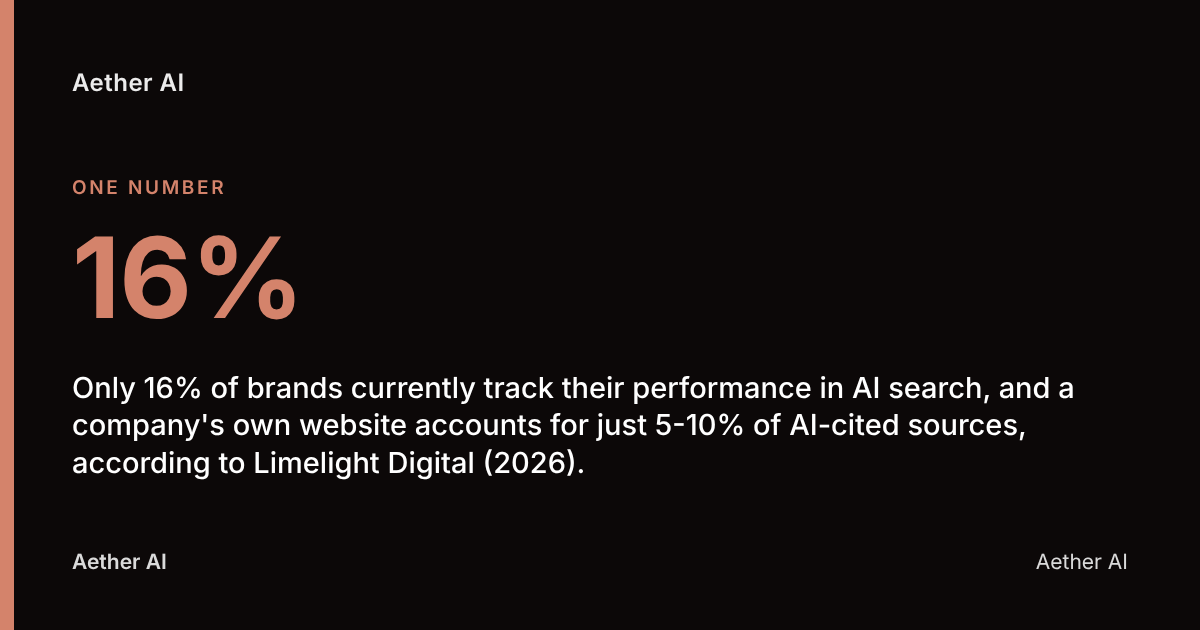
- Only 16% of brands currently track their performance in AI search, and a company's own website accounts for just 5-10% of AI-cited sources, according to Limelight Digital (2026).
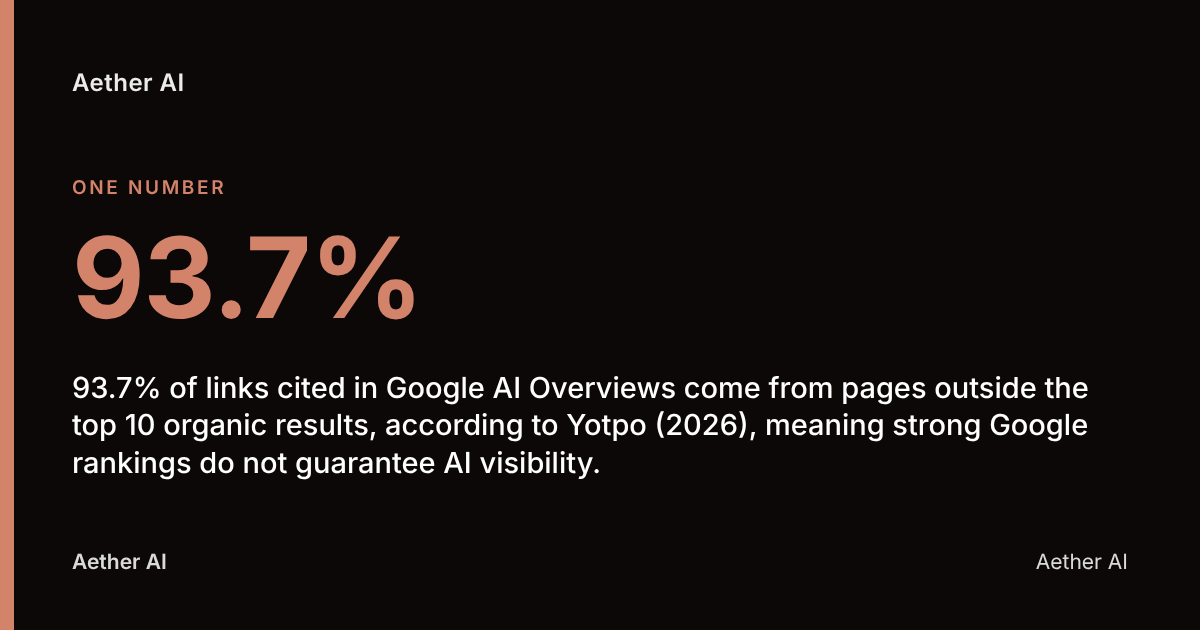
- 93.7% of links cited in Google AI Overviews come from pages outside the top 10 organic results, according to Yotpo (2026), meaning strong Google rankings do not guarantee AI visibility.
- 91% of cited URLs in a 3.7 million-citation analysis appeared in just one LLM, according to Backlinko (2026), so visibility on one AI engine says little about the others.
- 45% of marketing leaders cannot accurately measure their brand's visibility inside AI-generated answers, and only 9% have tools covering every relevant metric across platforms, per Zen Media, citing Semrush's 2026 AI Visibility Index (2026).
- Aether AI's own baseline scan of 700 live AI engine queries across UK brands found their names appeared in just 3.3% of answers (23 of 700), published at aether-ai.co.uk/insights/ai-visibility-baseline-2026.
What Is LLM Visibility Monitoring?
LLM visibility monitoring is the systematic tracking of how a brand, product or domain is mentioned, cited or recommended inside answers generated by large language models (LLMs) — the AI systems, such as GPT-4 and Gemini, that power conversational search tools. It differs from traditional SEO rank tracking because there is no stable "position one" to watch; instead, each AI engine can phrase, source and order an answer differently every time the same question is asked.
Traditional SEO tracking monitors keyword rankings on a results page that, broadly, stays consistent for a given search term. LLM visibility monitoring instead runs repeated prompts against multiple AI engines and records whether, where, and how a brand surfaces inside the generated text.
The gap between the two disciplines is substantial. 93.7% of links cited in Google AI Overviews come from pages outside the top 10 organic results, according to Yotpo (2026) — meaning a page ranking well on Google can still be invisible to Google's own AI answers. This is the core reason GEO (Generative Engine Optimization — the practice of optimising content specifically for citation inside AI-generated answers) has emerged as a discipline separate from classic SEO. Research from Princeton University, IIT Delhi and Georgia Tech, published at ACM SIGKDD KDD 2024, found that GEO techniques can boost content visibility in generative engine responses by up to 40% (arXiv:2311.09735, 2024).
Why Should UK Businesses Monitor Visibility in ChatGPT, Gemini and Copilot?
UK businesses need to monitor visibility in AI assistants such as ChatGPT, Gemini and Microsoft Copilot because customers are already using these tools to research suppliers, compare products and form opinions before a company even knows it's been discussed. The scale of the measurement gap is stark: only 14% of marketers track AI citations, while 89% of brands already appear in AI answers, according to Globe Newswire industry data, cited via DEV Community (2026). That means most brands are being discussed — accurately or not — without anyone in the business watching.
This matters particularly for sectors with long consideration cycles: professional services, B2B software, facilities and security providers, and regulated industries where buyers research extensively before contacting a shortlist. If a competitor is recommended by ChatGPT when a prospect asks "best [category] providers in Manchester" and your business isn't mentioned at all, that's a lost opportunity nobody in marketing, SEO or PR ever sees in a conventional analytics dashboard — because no click occurs to register it.
The problem compounds because AI answers vary wildly between engines and even between repeated runs. SparkToro research, cited via Backlinko (2026), ran nearly 3,000 prompts across multiple AI platforms and found identical brand recommendations occur less than 1 in 100 times, and identical ordering less than 1 in 1,000 times. A single favourable ChatGPT answer is not evidence of reliable visibility — it's a snapshot of one moment on one engine.
Lauren Dawkins, Head of Content at Aether AI, puts the wider market shift this way: "It's a land grab: venture-funded dashboards, SEO suites bolting on AI modules, and platforms that actually produce and publish content. Judge them by what happens after the report — visibility you can't act on is just a prettier way to worry."
Which Tools Track LLM Visibility, and How Do They Compare?
LLM visibility tools track brand mentions and citations by running structured prompts across multiple AI engines on a schedule, then logging where and how a domain appears. The market splits broadly into three categories: dedicated GEO platforms, SEO suites with bolted-on AI modules, and build-your-own prompt-testing scripts.
Picking the right category matters because citation overlap between AI engines on the same prompt runs under 30%, according to cloro.dev (2026). A tool that only checks ChatGPT, or that blends results into a single "average visibility score", can hide poor performance on the one engine your actual buyers use most.
| Tool category | What it typically covers | Best suited to |
|---|---|---|
| Dedicated GEO platforms (e.g. Aether AI) | Multi-engine citation tracking, keyword/competitor tracking, content generation, GSC integration | Businesses wanting monitoring and a route to act on findings |
| SEO suite AI modules | AI visibility bolted onto existing rank-tracking tools | Teams already embedded in one SEO platform |
| DIY prompt scripts | Manual or scripted prompt runs against one or two engines | Technical teams testing a narrow use case |
Aether AI tracks citations across six AI engines — ChatGPT, Perplexity, Google AI Overviews, Claude, Gemini and Copilot — alongside keyword and competitor tracking and Google Search Console integration, which matters given how fragmented citation behaviour is across engines. A free AI-visibility audit is available at /audit for businesses wanting an initial read before committing to ongoing monitoring.
How Much Does LLM Visibility Monitoring Cost?
LLM visibility monitoring cost varies by scope — how many prompts, engines and competitors are tracked, and whether the tool also helps you act on findings. Pricing structures generally fall into tiers based on query volume and engine coverage rather than flat per-brand fees.
Specific current pricing for Aether AI is published at /pricing rather than restated here, since tiers and allowances are subject to change. As a general principle for UK buyers comparing the market: expect entry tiers aimed at small businesses tracking a handful of keywords across two or three engines, mid tiers adding full six-engine coverage and competitor tracking, and higher tiers for agencies or multi-brand portfolios needing white-label reporting.
Build vs buy: the real trade-off
A technical team could, in principle, script API calls to multiple LLMs and log citations manually. In practice this means maintaining prompt libraries, handling rate limits and format changes across six different providers, and building reporting from scratch — work that a dedicated platform has already solved. For most UK marketing and SEO teams, the time cost of building outweighs a subscription, unless query volume is very low and ongoing engineering resource is already available.
What Metrics Should You Track in LLM Visibility Monitoring?
LLM visibility monitoring should track five core metrics: mention rate, mention position, citation rate, share of voice, and sentiment. Each measures a different dimension of how a brand shows up inside AI-generated answers, and conflating them produces a misleadingly simple "visibility score".
- Mention rate: the percentage of tracked prompts where your brand is named at all, regardless of position.
- Mention position: whether the brand appears first, mid-list, or buried — position affects how much weight a reader gives it.
- Citation rate: how often your actual domain is linked or referenced as a source, distinct from a name-drop with no link.
- Share of voice: your mention frequency relative to named competitors across the same prompt set.
- Sentiment: whether the context around the mention is positive, neutral, or negative.
These metrics need to be tracked per engine, not pooled, because 91% of cited URLs in a 3.7 million-citation analysis appeared in just one LLM, according to Backlinko (2026). A pooled "average visibility" figure across six engines can disguise a brand that's strong on Perplexity and entirely absent from Copilot — two very different buyer populations.
Aether AI's own baseline measurement illustrates how low raw mention rates typically run even for established brands: across 700 live AI engine scans of UK brands' target keywords between July and August 2026, the brands were named in just 23 answers — 3.3% — with the longest-established brand, a security services provider, named in 6.3% of its 270 scans (published at aether-ai.co.uk/insights/ai-visibility-baseline-2026). That gap between the group average and the oldest brand's result is itself a reminder to read per-brand and per-engine figures, not a single blended percentage.
How Do You Set Up LLM Visibility Monitoring Step by Step?
Setting up LLM visibility monitoring starts with defining the prompts that matter, then selecting a tool with coverage across the engines your buyers actually use, before building a recurring reporting rhythm. The process typically runs through five stages:
- Define your prompt set. List 20-50 realistic buyer questions ("best [category] in [UK city]", "[Product A] vs [Product B]", "who offers [service] near [location]").
- Select tool coverage. Confirm the platform checks all engines relevant to your sector — ChatGPT, Gemini, Perplexity, Google AI Overviews, Claude and Copilot cover the large majority of UK consumer and B2B usage.
- Add competitor tracking. Monitor named competitors on the same prompt set to establish share of voice, not just raw mention count.
- Connect existing data. Link Google Search Console so AI-driven impressions and clicks can be viewed alongside traditional organic performance.
- Set a reporting cadence. Weekly for fast-moving categories (news, retail, trending topics); monthly for most B2B and professional services.
Who should own this inside a UK business?
Ownership typically sits with whoever already owns organic visibility — usually SEO or marketing — but the data is relevant to PR (sentiment and narrative control) and sales (which competitors are being recommended instead of you). For most UK businesses without a dedicated AI team, the pragmatic answer is: one named owner in marketing or SEO who reports findings to both PR and leadership monthly, rather than a committee that never meets.
Your LLM visibility monitoring checklist
- Define 20-50 realistic buyer prompts covering your core products, services and locations.
- Confirm your monitoring tool covers all six major engines — ChatGPT, Gemini, Perplexity, Google AI Overviews, Claude and Copilot.
- Track mention rate, position, citation rate, share of voice and sentiment separately, per engine.
- Add your top three to five named competitors to the same prompt set.
- Connect Google Search Console to cross-reference AI-driven traffic against organic performance.
- Set a monthly review cadence as a minimum, moving to weekly for fast-changing categories.
- Assign one named owner (marketing or SEO) responsible for reporting to PR and leadership.
- Treat any one engine's result as a snapshot, not a verdict — review the full spread before acting.
FAQ
What is LLM visibility monitoring?
LLM visibility monitoring is the practice of tracking how often, where and how favourably a brand is mentioned or cited inside AI-generated answers from tools like ChatGPT, Gemini and Copilot. It differs from SEO rank tracking because AI answers vary by engine and by run, rather than sitting on a stable results page.
How is LLM visibility different from traditional SEO rank tracking?
Traditional SEO tracks a position on a results page that stays relatively stable for a given keyword. LLM visibility tracks mentions inside generated text that can change between engines and even between identical prompts, which is why 93.7% of links in Google AI Overviews come from outside the top 10 organic results, per Yotpo (2026).
Why does my brand need to track AI visibility if we already track SEO rankings?
Good SEO rankings don't guarantee AI visibility, and the reverse is also true. With only 16% of brands currently tracking AI search performance, according to Limelight Digital (2026), most businesses have no idea whether AI tools are recommending them, ignoring them, or recommending a competitor instead.
How often should visibility reports be reviewed?
Monthly review is a sensible baseline for most B2B and professional services businesses, with weekly checks for fast-moving retail, news or trend-sensitive categories. Given that 45% of marketing leaders can't accurately measure AI visibility, per Zen Media, citing Semrush's 2026 AI Visibility Index (2026), establishing any regular cadence at all puts a business ahead of most competitors.
What's the most common mistake when interpreting LLM visibility data?
The most common mistake is treating a single engine's result, or a blended multi-engine average, as the whole picture. Citation overlap between engines runs under 30%, according to cloro.dev (2026), so a pooled score can hide a complete absence on the one engine that matters most to your category.
Does GDPR apply to LLM visibility monitoring tools?
UK GDPR considerations mainly concern how a monitoring tool handles any personal data within prompts or outputs, and whether a UK-based data processing agreement is in place with the vendor — most prompt-and-response monitoring involves brand and content data rather than personal data, but businesses should still check a vendor's data handling terms before onboarding, as they would for any SaaS tool processing business information.
How does LLM visibility monitoring fit with an existing SEO budget?
LLM visibility monitoring complements rather than replaces SEO spend, since the underlying content still needs to rank and be crawlable for AI engines to cite it. Businesses are increasingly treating it as a line item alongside SEO rather than a replacement, particularly since a company's own website accounts for only 5-10% of AI-cited sources, per Limelight Digital (2026) — meaning third-party citations and mentions need separate attention, not just on-site optimisation.
Monitoring and Acting on AI Visibility with Aether AI
This article has covered why mention rates run low even for established brands, why no single AI engine tells the full story, and why most UK businesses currently have no visibility into any of it. Aether AI was built around that exact gap — tracking citations across six AI engines (ChatGPT, Perplexity, Google AI Overviews, Claude, Gemini and Copilot) alongside keyword and competitor tracking and GSC integration, so a business sees the full spread rather than one engine's snapshot.
Aether AI's own measurement illustrates the scale of the task: across 700 live AI engine scans of UK brands' target keywords in July-August 2026, those brands were named in just 3.3% of answers overall, with the longest-established brand reaching 6.3%. Aether AI is built and operated by Aether Agency Ltd; Priority First, Pulse Operations and Aether Agency are businesses connected to the founding team, and this baseline reflects measurement across those brands.
If your business doesn't yet know how often it's named — or missed — inside ChatGPT, Gemini or Copilot answers, the free AI-visibility audit at /audit is the fastest way to find out, with full pricing and plan details available at /pricing.