Last updated: 20 November 2026
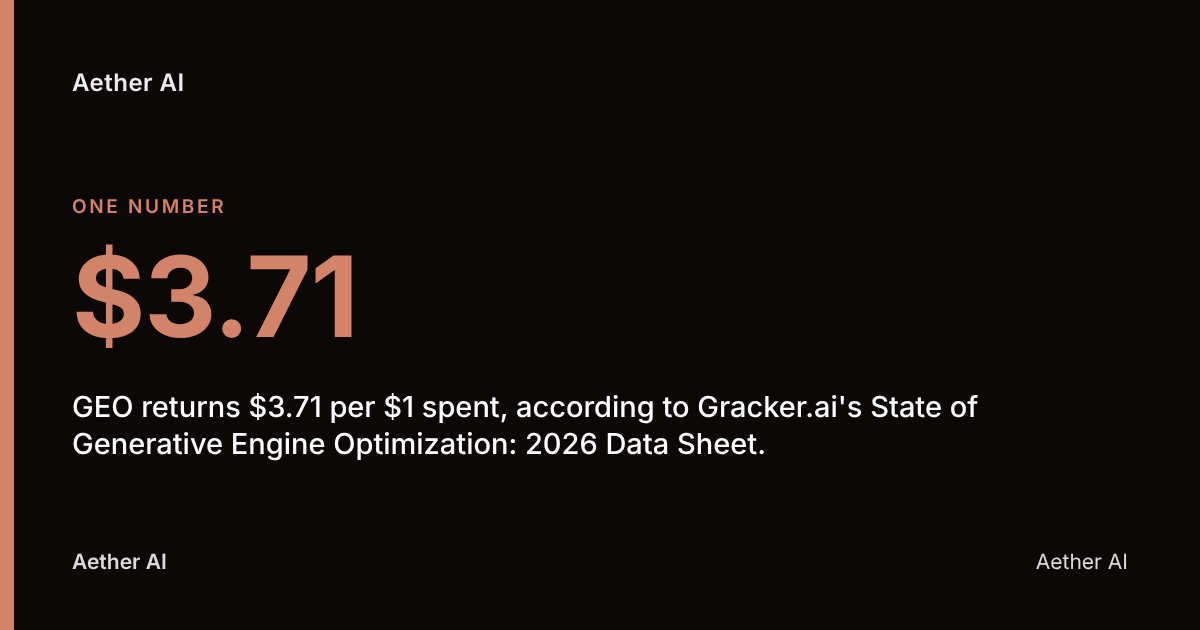
Measuring ROI of generative engine optimization campaigns means tracking AI citation rate, AI-referred traffic and its conversion rate, then weighing that benefit against content and software costs. GEO returns $3.71 per $1 spent, according to Gracker.ai's State of Generative Engine Optimization: 2026 Data Sheet.
Key Takeaways
- Generative engine optimization (GEO) is the discipline of getting a brand cited inside AI-generated answers, distinct from traditional SEO's focus on ranking links.
- Leading indicators such as AI citation rate and share of AI voice typically show meaningful movement within 4 to 12 weeks of implementing prioritised GEO recommendations, according to BrandViz.AI.
- Most GEO ROI reporting fails not from lack of data but from treating AI-referred visits like any other traffic source, ignoring that buyers arrive pre-decided.
What is Generative Engine Optimization (GEO)?
Generative engine optimization (GEO) is the practice of structuring content and technical signals so that AI systems like ChatGPT, Perplexity, Google AI Overviews, Claude, Gemini and Microsoft Copilot cite, quote or recommend a brand inside a generated answer. Traditional search engine optimisation (SEO) aims to rank a web page in a list of blue links; GEO aims to be the sentence an AI model chooses to repeat.
The two disciplines overlap on fundamentals. Both reward clear structure, credible sourcing and fast-loading pages. But GEO adds new requirements: content needs definition-first answers, named entities, and claims an AI model can lift without misreading context. A page can rank on page one of Google and still be invisible inside an AI Overview if it never states its core fact as a standalone sentence.
This distinction matters for budgeting. SEO ROI is usually judged on rankings and organic sessions. GEO ROI has to be judged on something that happens upstream of a click: whether a model mentions the brand at all. Wikipedia's entry on generative engine optimization notes the field is also referred to as AEO (answer engine optimisation), LLMO (large language model optimisation) and AIO, reflecting how new and unsettled the terminology still is.
What KPIs Indicate Success in a GEO Campaign
AI citation rate is the primary GEO metric: how often a brand's name, product or content appears inside an AI-generated answer for its target queries. Share of AI voice, a related metric, measures that citation rate against competitors answering the same prompts.
A useful secondary KPI is AI-referred traffic: sessions in Google Analytics 4 where the referrer is chatgpt.com, perplexity.ai, or a similar AI domain. This traffic converts unusually well. Claude referrals convert at 16.8%, ChatGPT at 14.2% and Perplexity at 12.8%, compared with 2.8% for Google organic search, according to Gracker.ai's 2026 Data Sheet. A separate six-month B2B case study found ChatGPT referral traffic converting at 15.9% against 1.76% for Google organic, with Perplexity at 10.5%, as reported by Seer Interactive.
One limit to keep in mind when reading these KPIs: Google Search Console leaves rare and low-volume queries out of its reports to protect searchers' privacy. On two of the founding team's own properties, Priority First and Aether Agency, 82.1% and 88.3% of Search Console clicks between 19 July and 15 August 2026 came from queries Google did not name. Aether AI is built and operated by Aether Agency Ltd. Priority First, Pulse Operations and Aether Agency are businesses connected to the founding team.
Tracking AI Citations: Tools in the UK Market
Monitoring whether ChatGPT, Perplexity or Google AI Overviews cite a brand requires software that runs repeated, structured prompts across multiple engines and records the answers. Manual spot-checking does not scale because answers change per session and per model update.
Aether AI tracks citations across six AI engines: ChatGPT, Perplexity, Google AI Overviews, Claude, Gemini and Microsoft Copilot. The platform combines this with keyword and competitor tracking and Google Search Console integration, so a marketing lead can see AI citation movement alongside traditional organic performance in one place. Aether AI's free AI-visibility audit at /audit gives a baseline reading before any campaign work begins.
Aether AI ran its own baseline scan across UK brands it publishes for: 700 live AI engine scans of target keywords between July and August 2026 found those brands named in 23 answers, a 3.3% citation rate overall. The longest-established brand in the set, a security services provider, was named in 6.3% of its 270 scans. Tracking this kind of baseline is the first step before judging whether any GEO investment has moved the number.
Calculating the Cost Side of GEO ROI
GEO ROI calculation requires an honest cost base covering three line items: content production, technical optimisation and software subscriptions. Content production includes writing or commissioning articles structured for AI extraction: definition-first openings, named entities, comparison tables and FAQ sections. Technical optimisation covers schema markup, site speed and crawlability for AI bots such as GPTBot and PerplexityBot.
Software subscriptions cover citation-tracking platforms, keyword tools and any analytics add-ons needed to isolate AI-referred sessions in GA4. A realistic cost model adds these three together over a fixed period, typically a quarter, and compares that total against the value of citations, leads or sales attributed to AI channels in the same window.
The formula mirrors any marketing ROI calculation: (value generated minus cost) divided by cost. The complication is valuing a citation that never produces a click. A brand mentioned favourably inside a ChatGPT answer but never visited still shapes a buyer's shortlist, which is why citation rate itself is treated as a leading indicator rather than a vanity metric.
Realistic Timeframe for Measurable GEO Results
Businesses should expect leading indicators before revenue indicators. Leading indicators such as AI citation rate and share of AI voice typically show meaningful movement within 4 to 12 weeks of implementing prioritised GEO recommendations, according to BrandViz.AI.
Lagging indicators such as pipeline influence and closed revenue take longer to surface, partly because of how B2B buying actually works. 95% of B2B purchases come from the vendor already on the buyer's Day One shortlist, formed before any sales contact, according to 6sense's 2025 B2B Buyer Experience Report, based on a survey of 4,510 buyers. That shortlist formation is exactly where AI citations do their work, often weeks or months before a deal appears in a CRM.
| Indicator type | Example metric | Typical timeframe |
|---|---|---|
| Leading | AI citation rate, share of AI voice | 4 to 12 weeks |
| Mid-funnel | AI-referred traffic, conversion rate | 1 to 2 quarters |
| Lagging | Pipeline influence, closed revenue | 2 to 4 quarters |
Because lagging indicators move slowly, GEO ROI reporting should lead with citation rate and AI-referred conversion rate, then layer in revenue attribution as the dataset matures.
Common Mistakes in Measuring GEO ROI
Many businesses apply last-click attribution to AI-influenced deals, ignoring that a buyer may see a brand cited by ChatGPT weeks before any site visit. This undercounts GEO's real contribution, since many B2B purchases are decided on a Day One shortlist (per 6sense) that forms before a trackable session exists.
A second mistake is treating all AI-referred traffic as equivalent to organic search traffic, when conversion rates differ sharply between the two, per Gracker.ai. Lumping the two together hides GEO's actual efficiency.
A third mistake is measuring only after a single prompt test, rather than running repeated scans over weeks. AI answers vary by session, model version and phrasing, so a one-off check cannot establish a reliable baseline. A fourth error is ignoring the cost side entirely and reporting citation gains without ever totting up content, technical and software spend, which makes any ROI figure impossible to defend to a finance team.
FAQ
How is GEO ROI different from traditional SEO or PPC ROI?
SEO ROI is judged on rankings and organic sessions; PPC ROI on cost per click and cost per acquisition. GEO ROI adds a layer neither covers: citation rate inside AI-generated answers, which can influence a buyer before any click occurs.
Who within a UK marketing team should own GEO reporting?
Typically the SEO lead or content lead, since GEO builds directly on existing organic content and keyword tracking. In smaller teams it often sits with whoever already owns Google Search Console and GA4 reporting.
What data privacy considerations apply when tracking AI-driven traffic?
UK GDPR and guidance from the Information Commissioner's Office (ICO) apply to any analytics tracking user behaviour, including AI-referred sessions. Businesses should ensure GA4 configuration, cookie consent and data retention settings comply with existing privacy policies, since AI-referral tracking uses the same underlying analytics infrastructure as any other channel.
Are there established benchmarks for GEO success in the UK market?
No single industry-wide benchmark exists yet; most figures come from vendor or agency research and not a UK regulatory body. Businesses should establish their own baseline citation rate first, then track movement against it over successive quarters.
Where Aether AI Fits in Measuring GEO ROI
Proving GEO ROI depends on having a reliable, repeated baseline to measure against, not a single manual prompt test. Aether AI was built around that requirement: it tracks citation frequency across six AI engines, pairs that with keyword and competitor tracking, and integrates Google Search Console so AI visibility and traditional organic performance sit in one report.
Aether AI applies this to its own content: the platform published 281 articles across the UK brands it writes for in the last 30 days, and ran a baseline audit of those same brands between July and August 2026 to establish starting citation rates before judging any improvement.
A business wanting a starting point before committing budget can run Aether AI's free AI-visibility audit at /audit, or check current plans on the pricing page to see what ongoing citation tracking costs.